The US and Israel are stirring up the oil market, forcing the world to pay the price.
2026-03-26 20:11:50
From imposing massive tariffs to threatening to invade Greenland, its actions have long been controversial. Now, the outbreak of the war with Iran has pushed this chaos into the energy sector, causing severe turmoil in the global oil market.
This geopolitical conflict, led by the United States, has ultimately resulted in an unbalanced situation where "the United States suffers minor losses while the world bears the pressure," once again confirming Trump's image as a bully who "only cares about his own interests and ignores global costs."
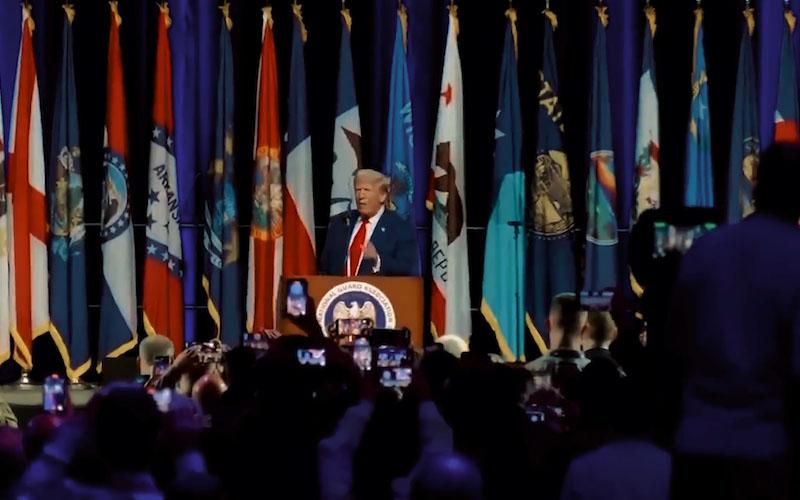
On the military front, the United States holds a clear advantage in its confrontation with Iran, having destroyed Iran's missile launchers, killed its leadership, and seized air superiority at minimal cost.
However, the Trump administration clearly underestimated Iran's determination to retaliate—as widely predicted by global markets, Iran directly closed the Strait of Hormuz, a vital choke point for global energy transport, through which approximately 20%-25% of global oil and liquefied natural gas transport depends.
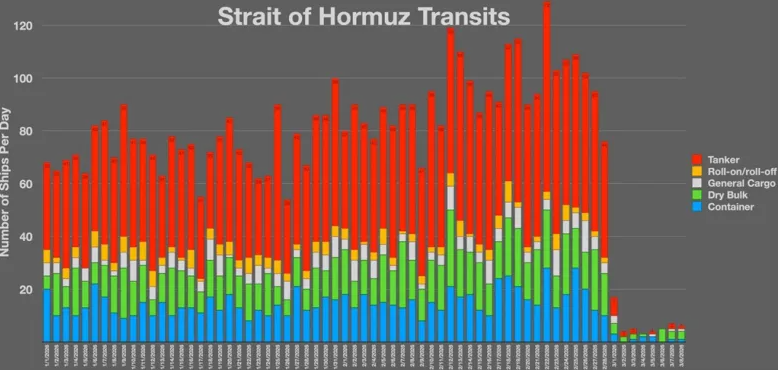
(Map showing passage conditions in the Strait of Hormuz)
The spread of the conflict forced many ships to detour, directly impacting the global energy supply chain. The International Energy Agency (IEA) stated that this constituted "the largest supply shock in the history of the oil market."
The inelastic demand for oil and liquefied natural gas means that a contraction in supply can quickly translate into a geometric surge in prices.
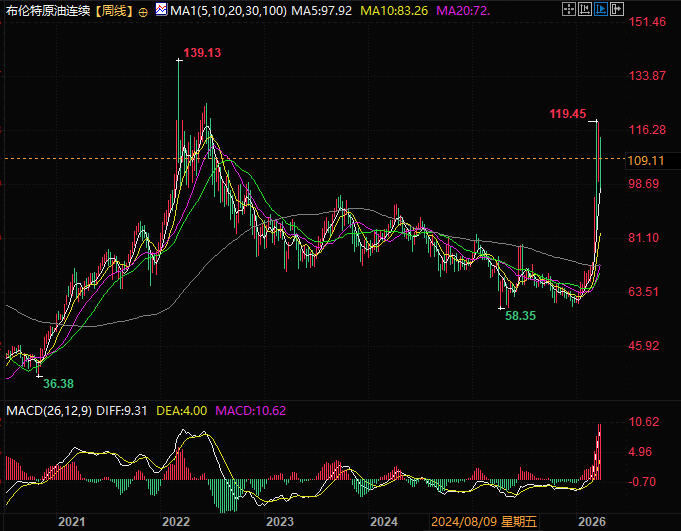
(Brent crude oil futures weekly chart, source: EasyForex)
Data shows that Brent crude oil prices have risen by more than 30% since the end of February, once reaching a high of $114 per barrel, and are currently still around $100 per barrel. The natural gas market has also experienced violent fluctuations, with the European TTF benchmark price surging by 35% at one point, and the Asian JKM spot price hitting a three-year high. The capacity loss caused by the attack on the Qatar LNG hub (accounting for 3% of the global total) may take 3-5 years to recover.
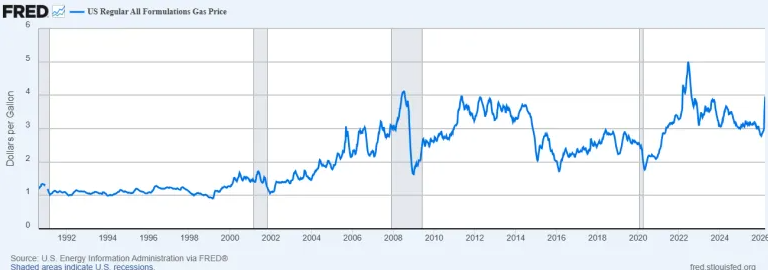
(Natural gas price trend, source: Federal Reserve)
Top investment banks such as Goldman Sachs have warned that if the conflict continues and damages upstream production capacity, oil prices may remain above $100 per barrel for the next two years.
In this energy storm, the United States, with its abundant domestic energy and fertilizer supply, became the least affected major economy.
Although U.S. gasoline prices have rebounded to $4 per gallon (close to the second-highest level since the beginning of the Russia-Ukraine war), putting new upward pressure on domestic inflation, the impact is considered "lightweight" compared to the fuel shortage crisis in other parts of the world.
Americans are only facing rising living costs, while most countries in the world are paying a much heavier price for Trump's decisions.
Asia has become the hardest-hit region in this crisis. As the main destination for energy transport through the Strait of Hormuz, nearly 90% of the strait's oil and gas flows to Asian countries, leading to energy supply shortages in many countries.
In an effort to conserve energy, countries have been forced to take extreme measures: employees working from home, shortening work weeks, declaring national holidays, and closing universities early.
Even with reserves equivalent to three months' worth of imports, my country had to limit fuel price increases to cope with the 20% price hike and prevent further inflation.
India is experiencing widespread fuel shortages and panic, with long queues forming at gas stations; the Philippines has declared a state of emergency and is even considering suspending flights; Australia is considering a nationwide fuel rationing policy, and the energy crisis has already substantially impacted the functioning of society.
Europe and the UK are in equally difficult situations. Research by Kylian and Zhou (2023) has already shown that Europe and the UK are far more sensitive to inflationary shocks from oil prices than the US or Japan.
Due to the impact of the conflict with Iran, European TTF natural gas prices have more than doubled since before the conflict, coupled with the long-term damage to Qatar's LNG production capacity. Goldman Sachs has raised its second-quarter European TTF benchmark forecast to €72/MWh.
For European industrial entities that have not yet fully recovered from the energy shock from Russia and Ukraine, the soaring energy costs are undoubtedly adding insult to injury, further exacerbating the risk of stagflation.
Poor countries like Pakistan and Uganda are facing a crisis of runaway inflation due to the strong correlation between global energy prices and local food prices.
Despite the initial panic in the market, from an economic fundamentals perspective, the direct damage from this energy shock is likely to be relatively limited rather than catastrophic.
Research by economist Lutz Kylian shows that as the global economy’s dependence on oil decreases and policy regulation capabilities improve, the resilience of modern economies to energy shocks has significantly increased.
According to their estimates, a 10% increase in oil prices would only lead to a 0.25 percentage point rise in CPI and a 0.3 percentage point decrease in GDP one year later. Even if oil prices have already surged by 50%, the global inflation rate may rise to around 4% and GDP growth may fall to 1.5% in the coming year. While this is disheartening, it is not unbearable.
What is even more alarming is the long-term and profound impact of the shock. First, the divergence in global inflation will exacerbate economic imbalances. Emerging markets and developing economies, due to their weaker risk resistance, may fall into a predicament of "high inflation and low growth." While the United States itself has suffered only minor damage, the global chaos caused by Trump's policies is weakening the long-term attractiveness of dollar assets and accelerating the global de-dollarization process.
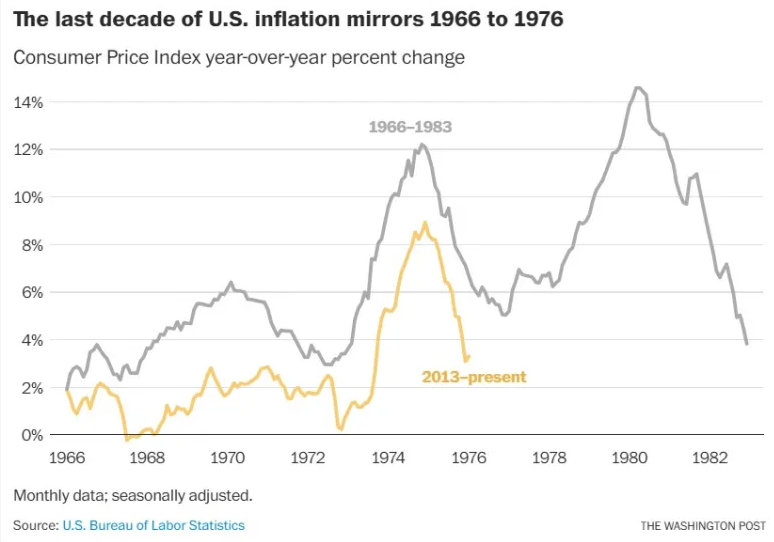
(A preview of US inflation trends)
Secondly, market confidence in U.S. foreign policy continues to decline, and the image of the U.S. as an "out-of-control" power abuser is becoming increasingly entrenched. Even if Trump leaves office, this negative impact will be difficult to eliminate quickly.
For Trump, the conflict has not brought any substantial geostrategic gains—the Iranian regime is not at risk of collapse, its nuclear program has not been destroyed by the airstrikes, and the war is likely to become a protracted stalemate.
Conversely, negative sentiment towards the economy among the American public has reached rock bottom, consumer confidence has plummeted, and approval ratings for Trump's economic policies have fallen sharply due to the Iran war.
The American public is far more sensitive to gasoline prices than to overall inflation, and persistently high oil prices could further worsen public sentiment, constraining consumer spending and economic growth.
The oil market storm triggered by the Trump administration is essentially another blow to the global multilateral order from unilateralism.
The United States’ attempt to gamble with global energy security in exchange for its own geopolitical goals has ultimately led to soaring global energy prices and supply crises in many countries.
Although the short-term economic damage is manageable, in the long run, this conflict has not only exacerbated global economic divergence, but also reshaped countries’ perceptions of energy security—energy systems that rely on a single transportation route and depend on hegemonic powers are no longer sustainable.
Goldman Sachs predicts that traffic in the Strait of Hormuz may gradually recover from mid-April, but the market will not easily forget this largest supply shock in history.
The current situation of over-concentration of supply and damage to spare capacity has substantially increased the long-term "safety premium".
For countries around the world, this crisis is both a warning and an opportunity to restructure energy supply chains and reduce dependence on a single source.
Trump's actions will ultimately only cause the United States to gradually lose its dominance in the restructuring of the global energy landscape, make more countries see the dangers of unilateralism, and accelerate the formation of a multipolar energy order.
This geopolitical conflict, led by the United States, has ultimately resulted in an unbalanced situation where "the United States suffers minor losses while the world bears the pressure," once again confirming Trump's image as a bully who "only cares about his own interests and ignores global costs."
Conflict Escalates: Closure of the Strait of Hormuz Triggers Largest Energy Supply Shock in History
On the military front, the United States holds a clear advantage in its confrontation with Iran, having destroyed Iran's missile launchers, killed its leadership, and seized air superiority at minimal cost.
However, the Trump administration clearly underestimated Iran's determination to retaliate—as widely predicted by global markets, Iran directly closed the Strait of Hormuz, a vital choke point for global energy transport, through which approximately 20%-25% of global oil and liquefied natural gas transport depends.
(Map showing passage conditions in the Strait of Hormuz)
The spread of the conflict forced many ships to detour, directly impacting the global energy supply chain. The International Energy Agency (IEA) stated that this constituted "the largest supply shock in the history of the oil market."
The inelastic demand for oil and liquefied natural gas means that a contraction in supply can quickly translate into a geometric surge in prices.
(Brent crude oil futures weekly chart, source: EasyForex)
Data shows that Brent crude oil prices have risen by more than 30% since the end of February, once reaching a high of $114 per barrel, and are currently still around $100 per barrel. The natural gas market has also experienced violent fluctuations, with the European TTF benchmark price surging by 35% at one point, and the Asian JKM spot price hitting a three-year high. The capacity loss caused by the attack on the Qatar LNG hub (accounting for 3% of the global total) may take 3-5 years to recover.
(Natural gas price trend, source: Federal Reserve)
Top investment banks such as Goldman Sachs have warned that if the conflict continues and damages upstream production capacity, oil prices may remain above $100 per barrel for the next two years.
Global Divergence: The US Easily Extricates Itself, While Many Countries Plunge into Energy Crisis
In this energy storm, the United States, with its abundant domestic energy and fertilizer supply, became the least affected major economy.
Although U.S. gasoline prices have rebounded to $4 per gallon (close to the second-highest level since the beginning of the Russia-Ukraine war), putting new upward pressure on domestic inflation, the impact is considered "lightweight" compared to the fuel shortage crisis in other parts of the world.
Americans are only facing rising living costs, while most countries in the world are paying a much heavier price for Trump's decisions.
Asia has become the hardest-hit region in this crisis. As the main destination for energy transport through the Strait of Hormuz, nearly 90% of the strait's oil and gas flows to Asian countries, leading to energy supply shortages in many countries.
In an effort to conserve energy, countries have been forced to take extreme measures: employees working from home, shortening work weeks, declaring national holidays, and closing universities early.
Even with reserves equivalent to three months' worth of imports, my country had to limit fuel price increases to cope with the 20% price hike and prevent further inflation.
India is experiencing widespread fuel shortages and panic, with long queues forming at gas stations; the Philippines has declared a state of emergency and is even considering suspending flights; Australia is considering a nationwide fuel rationing policy, and the energy crisis has already substantially impacted the functioning of society.
Europe and the UK are in equally difficult situations. Research by Kylian and Zhou (2023) has already shown that Europe and the UK are far more sensitive to inflationary shocks from oil prices than the US or Japan.
Due to the impact of the conflict with Iran, European TTF natural gas prices have more than doubled since before the conflict, coupled with the long-term damage to Qatar's LNG production capacity. Goldman Sachs has raised its second-quarter European TTF benchmark forecast to €72/MWh.
For European industrial entities that have not yet fully recovered from the energy shock from Russia and Ukraine, the soaring energy costs are undoubtedly adding insult to injury, further exacerbating the risk of stagflation.
Poor countries like Pakistan and Uganda are facing a crisis of runaway inflation due to the strong correlation between global energy prices and local food prices.
Economic consequences: manageable but far-reaching, exacerbating global economic divergence.
Despite the initial panic in the market, from an economic fundamentals perspective, the direct damage from this energy shock is likely to be relatively limited rather than catastrophic.
Research by economist Lutz Kylian shows that as the global economy’s dependence on oil decreases and policy regulation capabilities improve, the resilience of modern economies to energy shocks has significantly increased.
According to their estimates, a 10% increase in oil prices would only lead to a 0.25 percentage point rise in CPI and a 0.3 percentage point decrease in GDP one year later. Even if oil prices have already surged by 50%, the global inflation rate may rise to around 4% and GDP growth may fall to 1.5% in the coming year. While this is disheartening, it is not unbearable.
What is even more alarming is the long-term and profound impact of the shock. First, the divergence in global inflation will exacerbate economic imbalances. Emerging markets and developing economies, due to their weaker risk resistance, may fall into a predicament of "high inflation and low growth." While the United States itself has suffered only minor damage, the global chaos caused by Trump's policies is weakening the long-term attractiveness of dollar assets and accelerating the global de-dollarization process.
(A preview of US inflation trends)
Secondly, market confidence in U.S. foreign policy continues to decline, and the image of the U.S. as an "out-of-control" power abuser is becoming increasingly entrenched. Even if Trump leaves office, this negative impact will be difficult to eliminate quickly.
For Trump, the conflict has not brought any substantial geostrategic gains—the Iranian regime is not at risk of collapse, its nuclear program has not been destroyed by the airstrikes, and the war is likely to become a protracted stalemate.
Conversely, negative sentiment towards the economy among the American public has reached rock bottom, consumer confidence has plummeted, and approval ratings for Trump's economic policies have fallen sharply due to the Iran war.
The American public is far more sensitive to gasoline prices than to overall inflation, and persistently high oil prices could further worsen public sentiment, constraining consumer spending and economic growth.
Conclusion: The Restructuring of the Global Energy Landscape Behind the Chaos
The oil market storm triggered by the Trump administration is essentially another blow to the global multilateral order from unilateralism.
The United States’ attempt to gamble with global energy security in exchange for its own geopolitical goals has ultimately led to soaring global energy prices and supply crises in many countries.
Although the short-term economic damage is manageable, in the long run, this conflict has not only exacerbated global economic divergence, but also reshaped countries’ perceptions of energy security—energy systems that rely on a single transportation route and depend on hegemonic powers are no longer sustainable.
Goldman Sachs predicts that traffic in the Strait of Hormuz may gradually recover from mid-April, but the market will not easily forget this largest supply shock in history.
The current situation of over-concentration of supply and damage to spare capacity has substantially increased the long-term "safety premium".
For countries around the world, this crisis is both a warning and an opportunity to restructure energy supply chains and reduce dependence on a single source.
Trump's actions will ultimately only cause the United States to gradually lose its dominance in the restructuring of the global energy landscape, make more countries see the dangers of unilateralism, and accelerate the formation of a multipolar energy order.
- Risk Warning and Disclaimer
- The market involves risk, and trading may not be suitable for all investors. This article is for reference only and does not constitute personal investment advice, nor does it take into account certain users’ specific investment objectives, financial situation, or other needs. Any investment decisions made based on this information are at your own risk.