Why did gold prices plummet? The safe-haven logic has shifted to interest rates and liquidity.
2026-03-27 02:07:23
On Thursday (March 26), during the US trading session, gold and silver prices weakened significantly, experiencing a period of accelerated decline. Spot gold fell back to around $4,400, continuing its pullback from previous highs; silver saw an even more pronounced decline, with significantly increased volatility.

The immediate trigger for this decline was the combined effect of a stronger US dollar and rising US Treasury yields. The yield on 10-year US Treasury bonds remained high at around 4.4%, significantly increasing the cost of holding gold, a non-interest-bearing asset. Simultaneously, the stronger dollar further suppressed the prices of dollar-denominated precious metals, creating systemic pressure.
Overall, this is a typical round of synchronous adjustment driven by macroeconomic variables, rather than a single event shock.
Interest Rate Expectations Reshaping: Inflation Stickiness Changes Market Path
The deeper change comes from the repricing of interest rate expectations.
Recent persistently strong inflation data has led the market to gradually abandon its previous expectations of multiple interest rate cuts this year, and instead accept a new path of "high interest rates being maintained for a longer period." Some Federal Reserve officials have even raised their assessments of the central level of interest rates, reinforcing this trend.
Meanwhile, oil prices remained high, further fueling inflation expectations. Driven by energy price increases, the market began to worry about the risk of a double-dip recession, which directly limited the scope for monetary policy easing.
In this context, the core logic of gold has changed—it is no longer an asset to hedge against inflation, but rather an asset subject to interest rate levels. The higher the interest rate, the less attractive gold becomes.
Liquidity-driven logic: Gold under passive pressure
Despite the continued geopolitical risks, gold has not received sustained support and has instead weakened amid market volatility, primarily due to rising demand for liquidity.
Amid heightened global market volatility, investors tend to hold more liquid assets, particularly US dollar cash, to hedge against potential risks or margin calls. This behavior has led to a sell-off of gold in exchange for liquidity.
At the same time, signs of marginal tightening emerged in the US credit market, with increasing pressure on the corporate bond market, particularly in the investment-grade bond sector. This further reinforced the market's preference for cash.
When liquidity becomes a priority, gold often loses its safe-haven status in the short term and becomes an asset that is sold off.
Geopolitical "counter-effects": Conflict pushes up interest rate expectations
A key characteristic of the current market is that geopolitical factors have not directly benefited gold, but rather exerted downward pressure through indirect means.
The lack of substantial progress in US-Iran negotiations and the risk of a prolonged conflict are keeping oil prices high. Rising oil prices reinforce inflation expectations, which in turn push up interest rate expectations, ultimately putting downward pressure on gold.
In other words, the current transmission chain is: geopolitical conflict → rising oil prices → rising inflation → high interest rates → pressure on gold. Therefore, at the current stage, the core variable determining the direction of gold has shifted from "risk events" to "interest rate expectations".
Technical Analysis
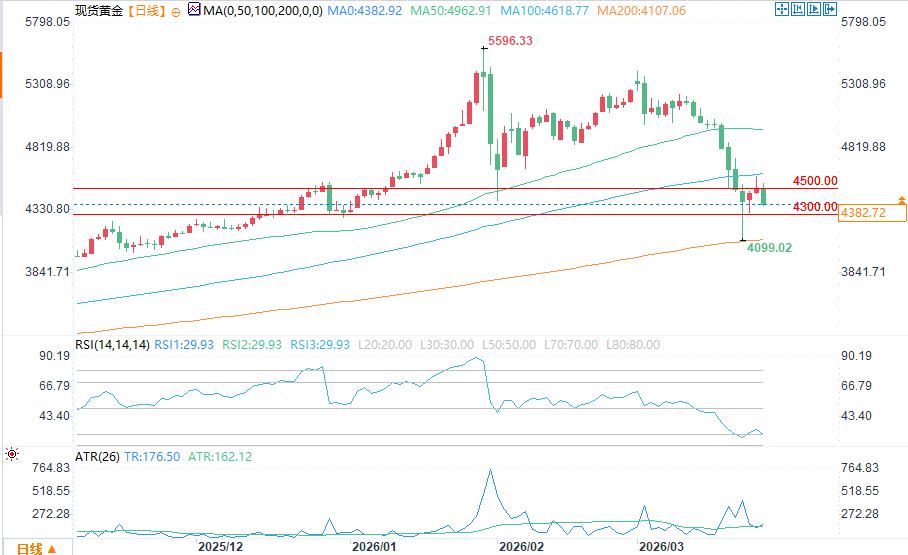
(Spot gold daily chart source: FX678)
Current trend: Short-term bearish (price trading below the 100-day moving average)
Resistance levels: 4500; 4540; further down to the 4620 area.
Support levels: 4350; 4300; key support zone: 4300-4100
Momentum indicators: The RSI is at a low level (around 30), indicating weakness but with signs of short-term stabilization.
Volatility characteristics: A rising ATR indicates that the market has entered a high volatility phase.
Key signal:
If the price returns to and holds above the 100-day moving average (around 4620), the downtrend will be broken.
If the price falls below 4300, it could open up further downside potential.
Summarize:
The recent decline in gold prices is essentially a shift in market logic from "safe-haven" to "interest rate and liquidity." Until the high-interest-rate environment is broken, the upside potential for gold will remain significantly constrained.
The immediate trigger for this decline was the combined effect of a stronger US dollar and rising US Treasury yields. The yield on 10-year US Treasury bonds remained high at around 4.4%, significantly increasing the cost of holding gold, a non-interest-bearing asset. Simultaneously, the stronger dollar further suppressed the prices of dollar-denominated precious metals, creating systemic pressure.
Overall, this is a typical round of synchronous adjustment driven by macroeconomic variables, rather than a single event shock.
Interest Rate Expectations Reshaping: Inflation Stickiness Changes Market Path
The deeper change comes from the repricing of interest rate expectations.
Recent persistently strong inflation data has led the market to gradually abandon its previous expectations of multiple interest rate cuts this year, and instead accept a new path of "high interest rates being maintained for a longer period." Some Federal Reserve officials have even raised their assessments of the central level of interest rates, reinforcing this trend.
Meanwhile, oil prices remained high, further fueling inflation expectations. Driven by energy price increases, the market began to worry about the risk of a double-dip recession, which directly limited the scope for monetary policy easing.
In this context, the core logic of gold has changed—it is no longer an asset to hedge against inflation, but rather an asset subject to interest rate levels. The higher the interest rate, the less attractive gold becomes.
Liquidity-driven logic: Gold under passive pressure
Despite the continued geopolitical risks, gold has not received sustained support and has instead weakened amid market volatility, primarily due to rising demand for liquidity.
Amid heightened global market volatility, investors tend to hold more liquid assets, particularly US dollar cash, to hedge against potential risks or margin calls. This behavior has led to a sell-off of gold in exchange for liquidity.
At the same time, signs of marginal tightening emerged in the US credit market, with increasing pressure on the corporate bond market, particularly in the investment-grade bond sector. This further reinforced the market's preference for cash.
When liquidity becomes a priority, gold often loses its safe-haven status in the short term and becomes an asset that is sold off.
Geopolitical "counter-effects": Conflict pushes up interest rate expectations
A key characteristic of the current market is that geopolitical factors have not directly benefited gold, but rather exerted downward pressure through indirect means.
The lack of substantial progress in US-Iran negotiations and the risk of a prolonged conflict are keeping oil prices high. Rising oil prices reinforce inflation expectations, which in turn push up interest rate expectations, ultimately putting downward pressure on gold.
In other words, the current transmission chain is: geopolitical conflict → rising oil prices → rising inflation → high interest rates → pressure on gold. Therefore, at the current stage, the core variable determining the direction of gold has shifted from "risk events" to "interest rate expectations".
Technical Analysis
(Spot gold daily chart source: FX678)
Current trend: Short-term bearish (price trading below the 100-day moving average)
Resistance levels: 4500; 4540; further down to the 4620 area.
Support levels: 4350; 4300; key support zone: 4300-4100
Momentum indicators: The RSI is at a low level (around 30), indicating weakness but with signs of short-term stabilization.
Volatility characteristics: A rising ATR indicates that the market has entered a high volatility phase.
Key signal:
If the price returns to and holds above the 100-day moving average (around 4620), the downtrend will be broken.
If the price falls below 4300, it could open up further downside potential.
Summarize:
The recent decline in gold prices is essentially a shift in market logic from "safe-haven" to "interest rate and liquidity." Until the high-interest-rate environment is broken, the upside potential for gold will remain significantly constrained.
- Risk Warning and Disclaimer
- The market involves risk, and trading may not be suitable for all investors. This article is for reference only and does not constitute personal investment advice, nor does it take into account certain users’ specific investment objectives, financial situation, or other needs. Any investment decisions made based on this information are at your own risk.