Geopolitical tensions failed to boost safe-haven demand, and a stronger dollar kept gold prices range-bound.
2026-03-27 10:14:44
Amidst ongoing geopolitical volatility, gold prices have not performed as strongly as the market anticipated, instead exhibiting characteristics of consolidation and even periodic pullbacks. This phenomenon has prompted a renewed examination of the effectiveness of gold's safe-haven attributes. Market research indicates that UBS's CIO points out that while gold has long been considered a safe-haven asset, its performance in the initial stages of geopolitical conflicts is not stable, and historical experience shows that its price movements are often dominated by more complex macroeconomic factors.

Historically, gold prices have shown significant variations across different geopolitical conflicts. During the energy shock of the 1970s, gold prices surged due to rapid inflation, while events like the Iraq War did not exhibit a clear upward trend. This suggests that gold price movements are not solely driven by geopolitical risks, but rather depend on the prevailing inflationary environment, monetary policy expectations, and global capital flow patterns. Therefore, simply drawing parallels between the current situation and historical events has considerable limitations.
Returning to the current market environment, gold is facing multiple short-term suppressive factors. First, rising energy prices have led to a rebound in inflation expectations, strengthening market expectations that monetary policy will remain tight, thus putting downward pressure on gold, a non-interest-bearing asset. Second, the strengthening of the US dollar index also has a significant restraining effect on gold, with funds tending to flow into higher-yielding assets. In addition, some investment funds have temporarily flowed out of the precious metals market, further weakening the upward momentum of gold prices.
However, from a longer-term perspective, these suppressive factors may gradually weaken. As high energy prices drag down the economy and expectations of a global growth slowdown intensify, there is room for adjustment in future monetary policy. Once interest rate expectations peak or even reverse, gold's investment value will re-emerge. Against this backdrop, UBS believes the current pullback in gold should be viewed as a temporary correction within a long-term uptrend, rather than a trend reversal.
From a market sentiment perspective, the volatility structure of gold has also diverged. On the one hand, spot price volatility has narrowed, indicating uncertainty about the short-term market direction; on the other hand, the gold volatility index remains relatively high, suggesting that potential risks have not yet been fully released. Investors are becoming less sensitive to geopolitical situations, and the market is gradually shifting from sentiment-driven pricing to fundamental pricing logic.
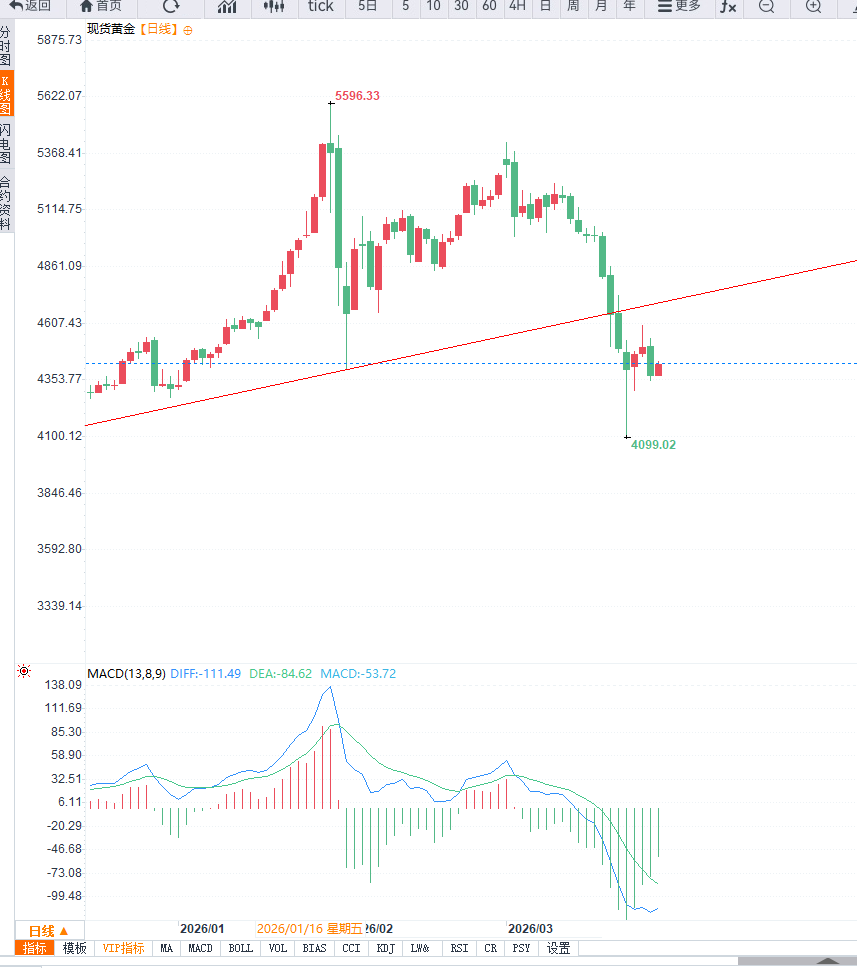
From a technical perspective, the daily chart for gold shows a range-bound trading pattern, with resistance concentrated around $4700 , a level that has been tested multiple times without a decisive breakout, forming a clear resistance level. Support levels are located in the $4400 and $4350 area, forming a medium-term defense line. The moving average system is flattening, indicating that the trend direction is still unclear. Looking at momentum indicators, the MACD is oscillating repeatedly around the zero line, showing a balance between bullish and bearish forces; the RSI remains in the neutral range, suggesting that the market has not yet entered an extreme state.
From a 4-hour chart perspective, gold is exhibiting a converging and oscillating structure, with the short-term trading range gradually narrowing. Short-term resistance is located around $4550 , while support lies near $4400 . A decisive break above the upper limit of this range could open up new upside potential; conversely, a break below the lower support could lead to further testing of medium-term lows. Overall, the current technical structure is primarily in a corrective phase, and a trend-driven opportunity still requires support from fundamental factors.
UBS further points out that gold remains important from an asset allocation perspective. In a multi-asset portfolio, gold not only hedges against inflation risk but also provides stability during periods of heightened market volatility. Therefore, even if prices may decline in the short term, current levels are attractive to long-term investors.
Editor's Summary:
In summary, the current gold market is in a typical phase of "short-term pressure and long-term support." While geopolitical tensions haven't directly driven up gold prices, their indirect impact on the macroeconomic environment is gradually becoming apparent. As the market shifts from being driven by sentiment to pricing in interest rates and economic fundamentals, gold's price movements will become more dependent on actual data changes. In the short term, gold prices are likely to remain range-bound, while in the medium to long term, against the backdrop of a global economic slowdown and shifting policy expectations, gold still has upward potential, and investors need to look for allocation opportunities amidst volatility.
Historically, gold prices have shown significant variations across different geopolitical conflicts. During the energy shock of the 1970s, gold prices surged due to rapid inflation, while events like the Iraq War did not exhibit a clear upward trend. This suggests that gold price movements are not solely driven by geopolitical risks, but rather depend on the prevailing inflationary environment, monetary policy expectations, and global capital flow patterns. Therefore, simply drawing parallels between the current situation and historical events has considerable limitations.
Returning to the current market environment, gold is facing multiple short-term suppressive factors. First, rising energy prices have led to a rebound in inflation expectations, strengthening market expectations that monetary policy will remain tight, thus putting downward pressure on gold, a non-interest-bearing asset. Second, the strengthening of the US dollar index also has a significant restraining effect on gold, with funds tending to flow into higher-yielding assets. In addition, some investment funds have temporarily flowed out of the precious metals market, further weakening the upward momentum of gold prices.
However, from a longer-term perspective, these suppressive factors may gradually weaken. As high energy prices drag down the economy and expectations of a global growth slowdown intensify, there is room for adjustment in future monetary policy. Once interest rate expectations peak or even reverse, gold's investment value will re-emerge. Against this backdrop, UBS believes the current pullback in gold should be viewed as a temporary correction within a long-term uptrend, rather than a trend reversal.
From a market sentiment perspective, the volatility structure of gold has also diverged. On the one hand, spot price volatility has narrowed, indicating uncertainty about the short-term market direction; on the other hand, the gold volatility index remains relatively high, suggesting that potential risks have not yet been fully released. Investors are becoming less sensitive to geopolitical situations, and the market is gradually shifting from sentiment-driven pricing to fundamental pricing logic.
From a technical perspective, the daily chart for gold shows a range-bound trading pattern, with resistance concentrated around $4700 , a level that has been tested multiple times without a decisive breakout, forming a clear resistance level. Support levels are located in the $4400 and $4350 area, forming a medium-term defense line. The moving average system is flattening, indicating that the trend direction is still unclear. Looking at momentum indicators, the MACD is oscillating repeatedly around the zero line, showing a balance between bullish and bearish forces; the RSI remains in the neutral range, suggesting that the market has not yet entered an extreme state.
From a 4-hour chart perspective, gold is exhibiting a converging and oscillating structure, with the short-term trading range gradually narrowing. Short-term resistance is located around $4550 , while support lies near $4400 . A decisive break above the upper limit of this range could open up new upside potential; conversely, a break below the lower support could lead to further testing of medium-term lows. Overall, the current technical structure is primarily in a corrective phase, and a trend-driven opportunity still requires support from fundamental factors.
UBS further points out that gold remains important from an asset allocation perspective. In a multi-asset portfolio, gold not only hedges against inflation risk but also provides stability during periods of heightened market volatility. Therefore, even if prices may decline in the short term, current levels are attractive to long-term investors.
Editor's Summary:
In summary, the current gold market is in a typical phase of "short-term pressure and long-term support." While geopolitical tensions haven't directly driven up gold prices, their indirect impact on the macroeconomic environment is gradually becoming apparent. As the market shifts from being driven by sentiment to pricing in interest rates and economic fundamentals, gold's price movements will become more dependent on actual data changes. In the short term, gold prices are likely to remain range-bound, while in the medium to long term, against the backdrop of a global economic slowdown and shifting policy expectations, gold still has upward potential, and investors need to look for allocation opportunities amidst volatility.
- Risk Warning and Disclaimer
- The market involves risk, and trading may not be suitable for all investors. This article is for reference only and does not constitute personal investment advice, nor does it take into account certain users’ specific investment objectives, financial situation, or other needs. Any investment decisions made based on this information are at your own risk.