The shadow of USD/JPY intervention looms, and energy inflation exacerbates pressure on Japanese debt.
2026-03-27 18:30:29
On Friday (March 27), during the European session, the USD/JPY pair surged from 159.46 to 159.98, maintaining high levels near the close. The pair gained nearly 0.5% for the day, with momentum indicators continuing to strengthen, and the focus now on the 160.00 psychological level. The market is widely watching for a large number of buy stop-loss orders potentially above 160, which, if triggered, could further amplify volatility. Simultaneously, Japanese Finance Minister Katayama stated that there is speculative activity in the foreign exchange market driven by oil prices and emphasized that decisive measures would be taken.

Fundamental Analysis : The current interest rate differential between the US and Japan remains the core factor supporting the US dollar. The Federal Reserve maintained the target range for the federal funds rate at 3.5%-3.75% at its March 18 meeting, while the Bank of Japan also kept its short-term policy rate stable at 0.75% during the same period. The interest rate differential between the two remains above 2.75 percentage points, continuing to attract funds to US dollar assets.
The Bank of Japan recently raised its estimate of the natural interest rate to 0.9% to +0.5%, indicating a slight improvement in its assessment of potential economic growth, but this is unlikely to change its accommodative stance in the short term. Meanwhile, the Federal Reserve, due to the oil price impact from the Middle East conflict, chose to remain on hold, prioritizing observation of the actual evolution of inflation and growth.
Energy-related inflationary pressures have become the biggest variable this week. High oil prices are pushing up Japan's import costs, while the fiscal authorities may further expand the fiscal deficit to alleviate cost of living pressures, creating "double selling pressure." Mainstream institutions point out that the combination of energy inflation, the risk of fiscal stagnation, and a sudden and sharp depreciation of the yen is continuously exacerbating the selling pressure on Japanese government bonds (JGB).
Japanese policymakers have recently repeatedly emphasized close coordination with Washington. If actual intervention occurs, Japan may need to sell up to $100 billion in US Treasury bonds to finance the move, which would directly push up the 10-year Treasury yield—which has already risen by 50 basis points this month.
Geopolitically, oil price volatility triggered by the Middle East conflict remains the dominant factor, indirectly amplifying the safe-haven premium of the US dollar. In terms of trade policy, there are currently no new tariffs or major agreements, but the overall strength of the US dollar has already put pressure on Japanese exports, constituting a hidden negative factor.
Mainstream Viewpoint Interpretation <br/>Reuters market analyst Martin Miller pointed out that Japanese policymakers have hinted that foreign exchange intervention is imminent, and USD/JPY is once again approaching 160.
MUFG's chief foreign exchange analyst, Derek Halpenny, stated bluntly, "Once the dollar breaks through 160, the risk of intervention will increase significantly." He also emphasized that while Finance Minister Katayama has strengthened his rhetoric on intervention, "the words are losing their effectiveness," and the timing of actual action remains uncertain. Halpenny further stated that the possibility of US intervention cannot be ruled out, as Washington is generally uneasy about the excessive appreciation of the dollar.
Analysts such as Chris Turner from ING also cautioned that the 160 level could become a difficult defensive line for Japan, with fundamentals supporting further gains.
Technical Analysis
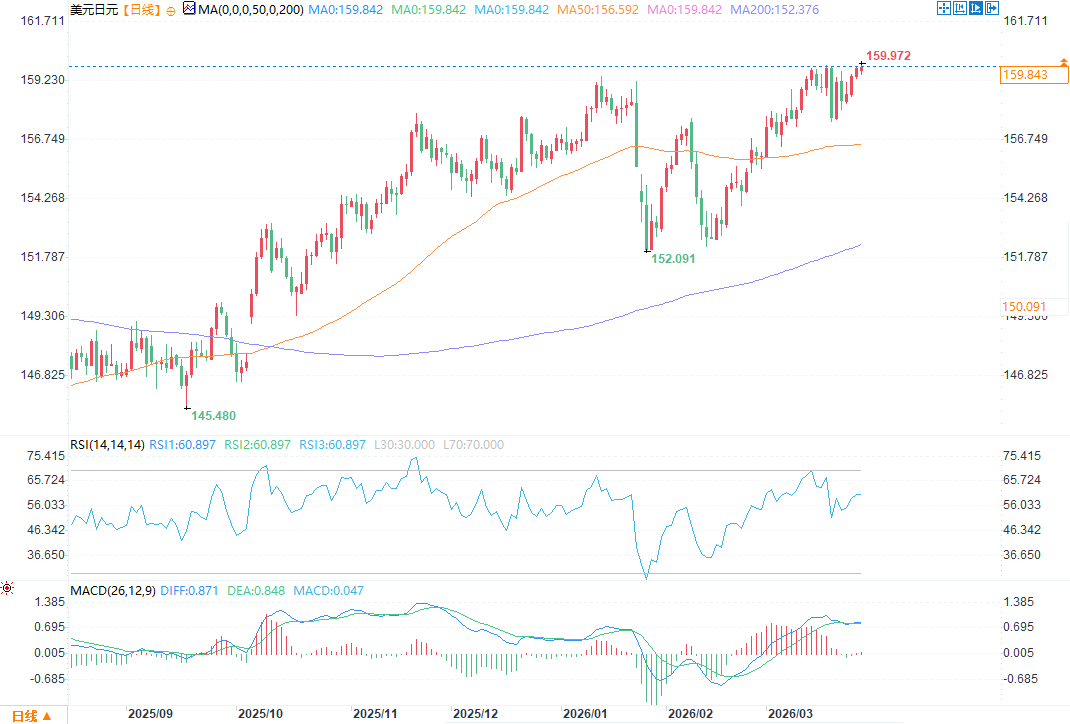
(USD/JPY daily chart source: EasyForex)
From a technical perspective, the USD/JPY momentum indicators remain positive, with a clear cluster of buy stop-loss orders above 160.00. If it stabilizes above the 159.80-160.00 range in the short term, it will open up further upside potential to 161-162; conversely, if it falls back to the 159.00-158.50 range due to intervention expectations, it may enter a consolidation phase.
Key data releases from the US and Japan to watch next week (Beijing time):
March 31 (Tuesday)
07:30 Tokyo CPI (March, including food, energy and core CPI)
22:00 US Consumer Confidence Index (March)
April 1 (Wednesday)
20:15 US ADP Employment Change (March)
20:30 US Retail Sales (February)
22:00 US ISM Manufacturing PMI (March)
April 3 (Friday)
20:30 US Non-Farm Payrolls Report, Unemployment Rate, and Average Hourly Earnings (March)
In addition, the Bank of Japan will release the summary of its March monetary policy meeting on March 30, and the market will focus on its latest statements on the impact on oil prices, exchange rate stability, and easing policies.
In summary, the USD/JPY pair remains supported in the short term by both wide interest rate differentials and energy inflation, but the 160 level has become a battleground for intervention and counter-intervention. Investors need to closely monitor both actual signals from Japan and the trend of US Treasury yields, and be cautious in dealing with potential sudden fluctuations.
Frequently Asked Questions
Fundamental Analysis : The current interest rate differential between the US and Japan remains the core factor supporting the US dollar. The Federal Reserve maintained the target range for the federal funds rate at 3.5%-3.75% at its March 18 meeting, while the Bank of Japan also kept its short-term policy rate stable at 0.75% during the same period. The interest rate differential between the two remains above 2.75 percentage points, continuing to attract funds to US dollar assets.
The Bank of Japan recently raised its estimate of the natural interest rate to 0.9% to +0.5%, indicating a slight improvement in its assessment of potential economic growth, but this is unlikely to change its accommodative stance in the short term. Meanwhile, the Federal Reserve, due to the oil price impact from the Middle East conflict, chose to remain on hold, prioritizing observation of the actual evolution of inflation and growth.
Energy-related inflationary pressures have become the biggest variable this week. High oil prices are pushing up Japan's import costs, while the fiscal authorities may further expand the fiscal deficit to alleviate cost of living pressures, creating "double selling pressure." Mainstream institutions point out that the combination of energy inflation, the risk of fiscal stagnation, and a sudden and sharp depreciation of the yen is continuously exacerbating the selling pressure on Japanese government bonds (JGB).
Japanese policymakers have recently repeatedly emphasized close coordination with Washington. If actual intervention occurs, Japan may need to sell up to $100 billion in US Treasury bonds to finance the move, which would directly push up the 10-year Treasury yield—which has already risen by 50 basis points this month.
Geopolitically, oil price volatility triggered by the Middle East conflict remains the dominant factor, indirectly amplifying the safe-haven premium of the US dollar. In terms of trade policy, there are currently no new tariffs or major agreements, but the overall strength of the US dollar has already put pressure on Japanese exports, constituting a hidden negative factor.
Mainstream Viewpoint Interpretation <br/>Reuters market analyst Martin Miller pointed out that Japanese policymakers have hinted that foreign exchange intervention is imminent, and USD/JPY is once again approaching 160.
MUFG's chief foreign exchange analyst, Derek Halpenny, stated bluntly, "Once the dollar breaks through 160, the risk of intervention will increase significantly." He also emphasized that while Finance Minister Katayama has strengthened his rhetoric on intervention, "the words are losing their effectiveness," and the timing of actual action remains uncertain. Halpenny further stated that the possibility of US intervention cannot be ruled out, as Washington is generally uneasy about the excessive appreciation of the dollar.
Analysts such as Chris Turner from ING also cautioned that the 160 level could become a difficult defensive line for Japan, with fundamentals supporting further gains.
Technical Analysis
(USD/JPY daily chart source: EasyForex)
From a technical perspective, the USD/JPY momentum indicators remain positive, with a clear cluster of buy stop-loss orders above 160.00. If it stabilizes above the 159.80-160.00 range in the short term, it will open up further upside potential to 161-162; conversely, if it falls back to the 159.00-158.50 range due to intervention expectations, it may enter a consolidation phase.
Key data releases from the US and Japan to watch next week (Beijing time):
March 31 (Tuesday)
07:30 Tokyo CPI (March, including food, energy and core CPI)
22:00 US Consumer Confidence Index (March)
April 1 (Wednesday)
20:15 US ADP Employment Change (March)
20:30 US Retail Sales (February)
22:00 US ISM Manufacturing PMI (March)
April 3 (Friday)
20:30 US Non-Farm Payrolls Report, Unemployment Rate, and Average Hourly Earnings (March)
In addition, the Bank of Japan will release the summary of its March monetary policy meeting on March 30, and the market will focus on its latest statements on the impact on oil prices, exchange rate stability, and easing policies.
Summary and Outlook
In summary, the USD/JPY pair remains supported in the short term by both wide interest rate differentials and energy inflation, but the 160 level has become a battleground for intervention and counter-intervention. Investors need to closely monitor both actual signals from Japan and the trend of US Treasury yields, and be cautious in dealing with potential sudden fluctuations.
Frequently Asked Questions
Q1: Why is the USD/JPY exchange rate approaching 160 again?
A: The core driver is that the US-Japan interest rate differential remains above 2.75 percentage points, while the Middle East conflict pushes up oil prices, triggering energy inflation and fiscal spending pressure in Japan, and funds continue to flow into dollar assets.
Q2: What does Japan's Finance Minister's warning about speculative behavior mean?
A: Minister Katayama clearly pointed out that the current upward pressure on the currency comes partly from speculation driven by oil prices, and hinted that the government is prepared to "take decisive action," which was interpreted by the market as a significant increase in intervention signals.
Q3: Why are there so many stop-loss orders above 160?
A: In the past, many interventions have occurred around 160. Institutions and retail investors generally set protective stop-loss orders at this level. Once triggered, this will create a positive feedback loop and amplify the volatility.
Q4: If Japan does intervene, what impact will it have on the US Treasury market?
A: Japan may need to sell hundreds of billions of dollars of US Treasury bonds to obtain dollars, which will directly increase the supply pressure of 10-year US Treasury bonds, causing yields to rise further, having already risen by 50 basis points this month.
Q5: What does the breakdown of the correlation between the US dollar and the Japanese yen and the euro and the Japanese yen mean for ordinary investors?
A: The traditional “yen cross-currency linkage” has failed, which means that the trend of a single currency pair depends more on its own fundamentals. Investors can no longer simply judge the USD/JPY based on the euro’s trend. They need to independently track energy prices, US Treasury yields and Japanese official statements.
- Risk Warning and Disclaimer
- The market involves risk, and trading may not be suitable for all investors. This article is for reference only and does not constitute personal investment advice, nor does it take into account certain users’ specific investment objectives, financial situation, or other needs. Any investment decisions made based on this information are at your own risk.