The Bank of Japan signaled intervention, and uncertainty surrounding the Middle East situation caused the USD/JPY exchange rate to hover around the 160 level.
2026-03-30 09:40:06
The yen strengthened against most major currencies during Monday's Asian trading session, ending a four-day losing streak, with the USD/JPY pair falling back to around 160.00 . The core driver of this yen rebound was the policy signals released by the Bank of Japan, prompting the market to reassess the path of Japan's monetary policy and the possibility of potential currency intervention.

Recent developments indicate that Bank of Japan Governor Kazuo Ueda explicitly stated that exchange rate fluctuations have a "significant impact" on the Japanese economy and prices, and that the central bank will closely monitor changes in the foreign exchange market. This statement has been interpreted by the market as a forward signal of potential intervention, especially given the previous sustained depreciation of the yen, which has significantly reduced policymakers' tolerance for unilateral price movements. Market surveys show that the minutes of the Bank of Japan's March meeting indicated that most members still favored continuing to normalize monetary policy in the future, with some even stating that if the economic environment did not deteriorate significantly, interest rates should be raised "without hesitation." This hawkish stance provided support for the yen.
Market reaction indicates that the Japanese yen performed relatively strongly among major currencies, particularly with a significant rise against the Australian dollar. Funds began to partially withdraw from previous "short yen" trades, shifting towards a more cautious wait-and-see approach. Meanwhile, the US dollar index remained volatile around 100.15 , failing to continue its previous upward trend, which also provided room for a yen rebound. It is worth noting that the US's indication of the possibility of reaching an agreement with Iran has marginally cooled market risk aversion, thereby weakening the short-term attractiveness of the US dollar.
From a global market perspective, the yen's exchange rate fluctuations are causing some disruption to the foreign exchange market structure. For a long time, the yen, as a low-interest-rate currency, has been an important funding currency for carry trades. Once the Bank of Japan signals tightening, it will directly affect the direction of global capital flows. At the same time, the uncertainty surrounding the Middle East situation is also influencing inflation expectations and global risk appetite, thus indirectly impacting the exchange rate market.
From a market sentiment perspective, investors are currently caught in a tug-of-war between policy expectations and geopolitical risks. On the one hand, increased expectations of a possible tightening of policy by the Bank of Japan provide a basis for a yen rebound; on the other hand, uncertainties surrounding the US and Middle East situations may still drive demand for the US dollar as a safe haven in the short term. Therefore, short-term exchange rate movements are characterized by volatility, lacking a clear trend. Market focus is concentrated on the Bank of Japan's subsequent policy statements, the possibility of exchange rate intervention, and the progress of US-Iran negotiations.
From a technical perspective, on the daily chart, USD/JPY previously maintained an upward trend, but showed signs of pullback after reaching the 160 level , indicating some resistance above. Current short-term support is around 158.50 ; a break below this level could lead to a further decline to the 157.00 area. Resistance remains in the 160.50-161.00 range. Momentum indicators suggest weakening upward momentum. On the 4-hour chart, the pair is showing a pullback from its highs, indicating a short-term technical correction. If the rebound is capped at 160.50 , a further decline is possible; if it re-establishes itself above 160.00 , it could retest the previous high. Overall, the short-term trend is slightly weak and volatile, but the medium-term trend still needs to be observed in light of policy changes.
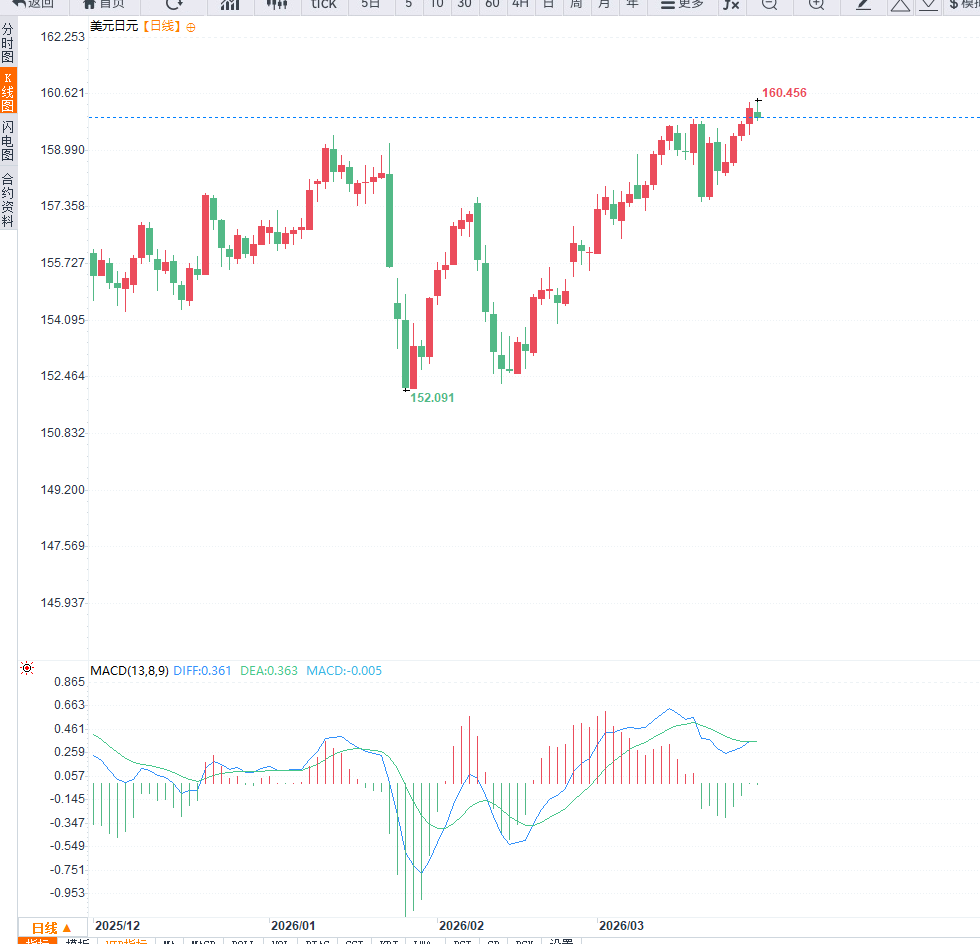
Editor's Summary : The current rebound in the yen is more driven by a correction in policy expectations than a complete reversal in fundamentals. The Bank of Japan's intervention signals and potential interest rate hike path provide temporary support for the yen, but its continued appreciation potential remains limited given the still significant global interest rate differentials. In the short term, the exchange rate will likely fluctuate around the 160 level; the medium-term direction will depend on the pace of Japan's policy tightening and changes in US monetary policy. Investors should be wary of exchange rate volatility risks arising from changes in policy expectations.
Recent developments indicate that Bank of Japan Governor Kazuo Ueda explicitly stated that exchange rate fluctuations have a "significant impact" on the Japanese economy and prices, and that the central bank will closely monitor changes in the foreign exchange market. This statement has been interpreted by the market as a forward signal of potential intervention, especially given the previous sustained depreciation of the yen, which has significantly reduced policymakers' tolerance for unilateral price movements. Market surveys show that the minutes of the Bank of Japan's March meeting indicated that most members still favored continuing to normalize monetary policy in the future, with some even stating that if the economic environment did not deteriorate significantly, interest rates should be raised "without hesitation." This hawkish stance provided support for the yen.
Market reaction indicates that the Japanese yen performed relatively strongly among major currencies, particularly with a significant rise against the Australian dollar. Funds began to partially withdraw from previous "short yen" trades, shifting towards a more cautious wait-and-see approach. Meanwhile, the US dollar index remained volatile around 100.15 , failing to continue its previous upward trend, which also provided room for a yen rebound. It is worth noting that the US's indication of the possibility of reaching an agreement with Iran has marginally cooled market risk aversion, thereby weakening the short-term attractiveness of the US dollar.
From a global market perspective, the yen's exchange rate fluctuations are causing some disruption to the foreign exchange market structure. For a long time, the yen, as a low-interest-rate currency, has been an important funding currency for carry trades. Once the Bank of Japan signals tightening, it will directly affect the direction of global capital flows. At the same time, the uncertainty surrounding the Middle East situation is also influencing inflation expectations and global risk appetite, thus indirectly impacting the exchange rate market.
From a market sentiment perspective, investors are currently caught in a tug-of-war between policy expectations and geopolitical risks. On the one hand, increased expectations of a possible tightening of policy by the Bank of Japan provide a basis for a yen rebound; on the other hand, uncertainties surrounding the US and Middle East situations may still drive demand for the US dollar as a safe haven in the short term. Therefore, short-term exchange rate movements are characterized by volatility, lacking a clear trend. Market focus is concentrated on the Bank of Japan's subsequent policy statements, the possibility of exchange rate intervention, and the progress of US-Iran negotiations.
From a technical perspective, on the daily chart, USD/JPY previously maintained an upward trend, but showed signs of pullback after reaching the 160 level , indicating some resistance above. Current short-term support is around 158.50 ; a break below this level could lead to a further decline to the 157.00 area. Resistance remains in the 160.50-161.00 range. Momentum indicators suggest weakening upward momentum. On the 4-hour chart, the pair is showing a pullback from its highs, indicating a short-term technical correction. If the rebound is capped at 160.50 , a further decline is possible; if it re-establishes itself above 160.00 , it could retest the previous high. Overall, the short-term trend is slightly weak and volatile, but the medium-term trend still needs to be observed in light of policy changes.
Editor's Summary : The current rebound in the yen is more driven by a correction in policy expectations than a complete reversal in fundamentals. The Bank of Japan's intervention signals and potential interest rate hike path provide temporary support for the yen, but its continued appreciation potential remains limited given the still significant global interest rate differentials. In the short term, the exchange rate will likely fluctuate around the 160 level; the medium-term direction will depend on the pace of Japan's policy tightening and changes in US monetary policy. Investors should be wary of exchange rate volatility risks arising from changes in policy expectations.
- Risk Warning and Disclaimer
- The market involves risk, and trading may not be suitable for all investors. This article is for reference only and does not constitute personal investment advice, nor does it take into account certain users’ specific investment objectives, financial situation, or other needs. Any investment decisions made based on this information are at your own risk.