Rising oil prices fueled inflation expectations, suppressing safe-haven demand, and gold remained range-bound.
2026-03-30 10:20:21
Gold prices came under significant pressure during Monday's Asian trading session, with XAU/USD opening down more than 1%, hitting a low near $4445 , continuing its previous correction. In stark contrast to gold, oil prices continued to strengthen, with WTI crude rising about 3% at the open, climbing above $102.50 , indicating that the energy market is re-incorporating supply risks from escalating conflicts in the Middle East. This combination of strong oil and weak gold reflects a shift in market trading logic from simple safe-haven demand to one dominated by inflation and interest rate expectations.

From an event perspective, the situation in the Middle East remains the core driver of the current market. Expectations of further US military action against Iran continue to rise. Market research indicates that the US Department of Defense plans to deploy approximately 10,000 additional troops to the Middle East, a move that significantly exacerbates market concerns about the spillover effects of the conflict. Meanwhile, Iran has released strong statements, further escalating geopolitical risks. However, on another front, the US has also signaled de-escalation. Market research shows that the US President stated that indirect negotiations with Iran are progressing and that an agreement may be reached in the short term. This coexistence of escalating conflict and expectations of negotiations has led to a significant divergence in market sentiment.
From a market perspective, rising oil prices and heightened inflation expectations have become a key factor suppressing gold prices. Theoretically, when inflation expectations rise, major central banks are more inclined to maintain high interest rates or even further tighten monetary policy, thereby increasing the opportunity cost of holding non-interest-bearing assets. As a typical non-yielding asset, gold's attractiveness significantly decreases in a high-interest-rate environment. Therefore, although geopolitical risks are generally favorable for gold, the current market is more focused on the transmission path of "high oil prices → high inflation → high interest rates," leading to a decline in gold prices.
From a global market perspective, rising energy prices are reshaping the macro trading framework. On the one hand, rising inflation expectations may delay the pace of interest rate cuts in major economies, putting pressure on the bond market; on the other hand, the US dollar remains relatively strong, supported by safe-haven demand and interest rate differentials, exerting additional downward pressure on gold. Furthermore, the correlation between commodities is increasing, with rising crude oil prices having a "crowding-out effect" on the metals market, causing more funds to flow into the energy sector rather than precious metals.
From a market sentiment perspective, the current decline in gold prices is not driven by a single factor, but rather by a combination of factors. On one hand, geopolitical risks provide a floor, limiting a deep correction in gold prices; on the other hand, inflation and interest rate expectations dominate the short-term direction, causing the price center of gravity to continue to shift downward. Investors are currently focused on two aspects: whether the situation in the Middle East will escalate further, and whether major central banks will adjust their policy paths due to inflationary pressures.
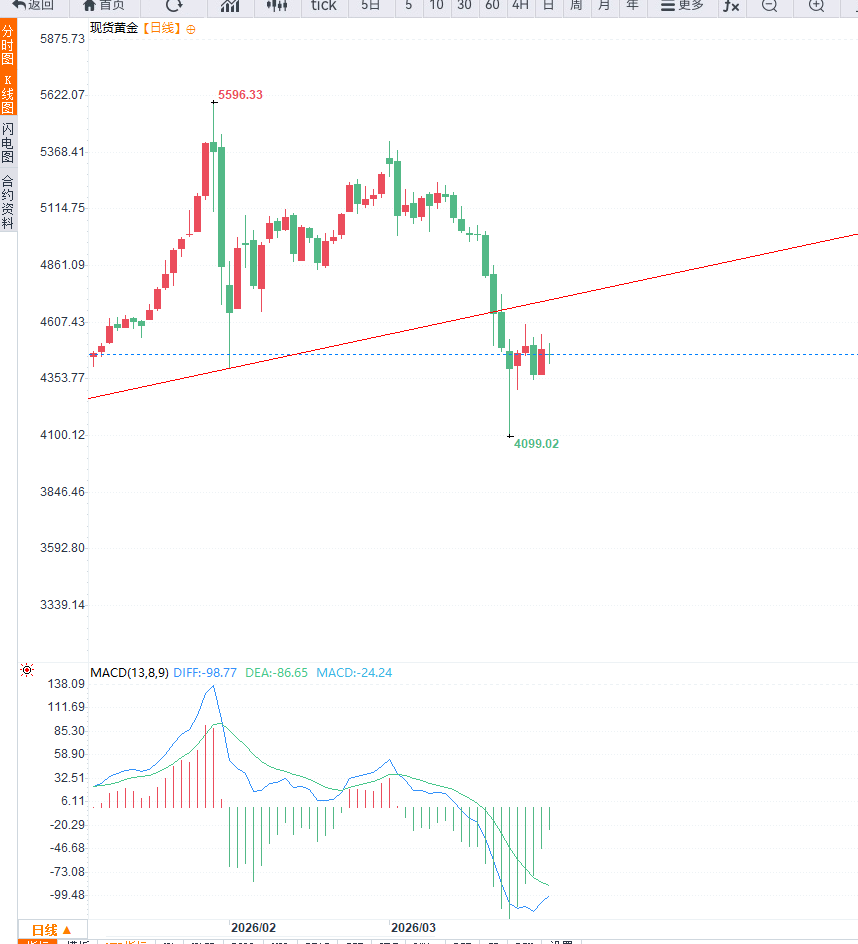
From a technical perspective, on the daily chart, gold prices have broken below a key structural range, forming a clear downward trend. Since the high of $5300 , consecutive closing prices have declined, indicating that bears dominate the market. Currently, the price is trading below the 20-day exponential moving average, which forms dynamic resistance around $4735 . The resistance zone above is concentrated between $4736 and $4915 . Failure to break through this zone will continue to suppress any rebound potential. In terms of momentum indicators, the 14-day Relative Strength Index (RSI) remains in the 20-40 range, indicating that the market is still in a weak zone but has not yet entered an extremely oversold state. On the 4-hour chart, prices are showing a downward trend with limited short-term rebound momentum. If the rebound is capped near $4735 , the downward trend may continue. Initial support is at $4307 , and a break below this level could lead to further declines towards the $4100 area. Overall, until a break above the key resistance zone is achieved, bears will remain in control in the short term.
Editor's Summary : The current gold market is caught in a tug-of-war between "geopolitical support" and "interest rate suppression." While the Middle East conflict has provided some floor support for gold prices, rising oil prices and increased inflation expectations have led the market to re-price the high-interest-rate environment, thus weakening gold's appeal. In the short term, gold is likely to maintain a downward trend unless geopolitical risks escalate unexpectedly or monetary policy expectations shift significantly; otherwise, the upside potential for gold prices is limited. Going forward, key attention should be paid to changes in inflation data and central bank policy signals, as these will determine the medium-term direction of gold's price movement.
From an event perspective, the situation in the Middle East remains the core driver of the current market. Expectations of further US military action against Iran continue to rise. Market research indicates that the US Department of Defense plans to deploy approximately 10,000 additional troops to the Middle East, a move that significantly exacerbates market concerns about the spillover effects of the conflict. Meanwhile, Iran has released strong statements, further escalating geopolitical risks. However, on another front, the US has also signaled de-escalation. Market research shows that the US President stated that indirect negotiations with Iran are progressing and that an agreement may be reached in the short term. This coexistence of escalating conflict and expectations of negotiations has led to a significant divergence in market sentiment.
From a market perspective, rising oil prices and heightened inflation expectations have become a key factor suppressing gold prices. Theoretically, when inflation expectations rise, major central banks are more inclined to maintain high interest rates or even further tighten monetary policy, thereby increasing the opportunity cost of holding non-interest-bearing assets. As a typical non-yielding asset, gold's attractiveness significantly decreases in a high-interest-rate environment. Therefore, although geopolitical risks are generally favorable for gold, the current market is more focused on the transmission path of "high oil prices → high inflation → high interest rates," leading to a decline in gold prices.
From a global market perspective, rising energy prices are reshaping the macro trading framework. On the one hand, rising inflation expectations may delay the pace of interest rate cuts in major economies, putting pressure on the bond market; on the other hand, the US dollar remains relatively strong, supported by safe-haven demand and interest rate differentials, exerting additional downward pressure on gold. Furthermore, the correlation between commodities is increasing, with rising crude oil prices having a "crowding-out effect" on the metals market, causing more funds to flow into the energy sector rather than precious metals.
From a market sentiment perspective, the current decline in gold prices is not driven by a single factor, but rather by a combination of factors. On one hand, geopolitical risks provide a floor, limiting a deep correction in gold prices; on the other hand, inflation and interest rate expectations dominate the short-term direction, causing the price center of gravity to continue to shift downward. Investors are currently focused on two aspects: whether the situation in the Middle East will escalate further, and whether major central banks will adjust their policy paths due to inflationary pressures.
From a technical perspective, on the daily chart, gold prices have broken below a key structural range, forming a clear downward trend. Since the high of $5300 , consecutive closing prices have declined, indicating that bears dominate the market. Currently, the price is trading below the 20-day exponential moving average, which forms dynamic resistance around $4735 . The resistance zone above is concentrated between $4736 and $4915 . Failure to break through this zone will continue to suppress any rebound potential. In terms of momentum indicators, the 14-day Relative Strength Index (RSI) remains in the 20-40 range, indicating that the market is still in a weak zone but has not yet entered an extremely oversold state. On the 4-hour chart, prices are showing a downward trend with limited short-term rebound momentum. If the rebound is capped near $4735 , the downward trend may continue. Initial support is at $4307 , and a break below this level could lead to further declines towards the $4100 area. Overall, until a break above the key resistance zone is achieved, bears will remain in control in the short term.
Editor's Summary : The current gold market is caught in a tug-of-war between "geopolitical support" and "interest rate suppression." While the Middle East conflict has provided some floor support for gold prices, rising oil prices and increased inflation expectations have led the market to re-price the high-interest-rate environment, thus weakening gold's appeal. In the short term, gold is likely to maintain a downward trend unless geopolitical risks escalate unexpectedly or monetary policy expectations shift significantly; otherwise, the upside potential for gold prices is limited. Going forward, key attention should be paid to changes in inflation data and central bank policy signals, as these will determine the medium-term direction of gold's price movement.
- Risk Warning and Disclaimer
- The market involves risk, and trading may not be suitable for all investors. This article is for reference only and does not constitute personal investment advice, nor does it take into account certain users’ specific investment objectives, financial situation, or other needs. Any investment decisions made based on this information are at your own risk.