The US dollar has returned to the 100 mark, and its gains this month may reach a new high for the year.
2026-03-30 20:03:36
On Monday (March 30), during the European session, the US dollar index (DXY) once again stood above the 100 mark amid the complex backdrop of the escalating conflict in the Middle East, reaching a high of 100.3399 during the session, trading in the range of 100.04-100.33, and rising slightly by 0.10% compared to last Friday.
The US dollar has maintained high-level fluctuations for several consecutive days this month, with a cumulative increase of nearly 2.72%, approaching the high point of the past 11 months. Although the daily fluctuation range is limited, buying pressure is exceptionally strong, resulting in four consecutive days of gains. In short, the core reasons for this strong dollar performance are: a surge in safe-haven demand, the traditional positive impact of rising oil prices on the dollar, and the market's rapid shift in expectations from the Federal Reserve's "interest rate cut cycle" to "anti-inflation" measures. These three factors combined have overshadowed the impact of regular macroeconomic data.
Fundamental analysis
The Houthi rebels officially joined the conflict last weekend, and coupled with heightened tensions in Iran, the risk of global supply chain disruptions increased sharply, fueling investor panic. President Trump announced significant progress in negotiations with Iran over the weekend, stating that Iran had met most of the 15 demands made by the US. However, the White House also announced plans for a multi-target ground operation—aimed at seizing Kharg Island, which houses critical oil infrastructure, and seizing approximately 1,000 pounds of uranium from Tehran. These signals kept the market on edge, forcing funds to continue flowing into the most liquid and safest assets: the US dollar. Meanwhile, oil prices surged due to conflict expectations, directly benefiting the US as a net energy exporter, providing additional support for the dollar from the high oil price environment. In the short term, unless Iran releases a clear signal of reconciliation, the dollar's gains this month are unlikely to be quickly reversed.
Market pricing in the Federal Reserve's 2026 monetary policy has shifted dramatically from "multiple rate cuts" to "high probability of no rate cuts, or even a possible rate hike." Before the conflict, the probability of no rate cuts was only 4%, but it has now soared to 92%. Several FOMC officials have publicly stated that they believe inflation risks far outweigh concerns about a cooling labor market, and that high oil prices are rapidly being passed on through energy costs, pushing up overall inflation. This evening Beijing time, Federal Reserve Chairman Jerome Powell will speak at a Harvard University symposium, and the market is highly focused on his latest remarks on inflation, growth, and the policy path—any hawkish signals could further strengthen dollar buying.
The minutes of the Bank of Japan's March 18-19 meeting released a distinctly hawkish tone, repeatedly emphasizing that monetary policy has lagged behind, current interest rates are far below neutral levels, and discussing the magnitude of future rate hikes, even mentioning the possibility of a 50 basis point increase. The Tankan survey report for the first quarter, to be released on Wednesday, will likely strengthen market expectations for a 25 basis point rate hike in April (currently priced in by futures at around 70%). Meanwhile, the Reserve Bank of India has spent approximately $30 billion this month defending the rupee and set a $100 million cap on domestic banks' onshore and offshore foreign exchange holdings, leading to a sharp rebound in the rupee today. Many European and Asian countries continue to intervene in the foreign exchange market, but the pressure on their currencies has not fundamentally eased, indirectly consolidating the strength of the US dollar.
The JOLTS Job Openings and Labor Force Mobility Report, ADP Private Sector Employment Data, and Friday's March Non-Farm Payrolls Report are all expected to be released. The market consensus is for non-farm payrolls to increase by approximately 60,000 jobs and for the unemployment rate to remain at 4.4%. If the data meets or exceeds these expectations, it will further support the logic of the Federal Reserve tightening policy due to the energy shock. If the data is unexpectedly weak, while it may put temporary pressure on the dollar, the impact is expected to be limited under the prevailing geopolitical and inflationary pressures. Furthermore, we continue to monitor dollar cross-currency basis swaps. The euro/dollar basis has widened slightly in the short term; any sharp fluctuations in this area will be accompanied by further dollar strengthening and pressure on risk assets.
mainstream view
FxPro: Safe-haven demand, trade flows, and a shift in Fed policy expectations are all supporting the dollar. Rising oil prices are boosting demand for the dollar, and FOMC officials believe inflation risks are more pressing, with a 92% probability of no rate cuts in 2026.
ING: Houthi involvement exacerbates supply chain concerns; Bank of Japan minutes send clear hawkish signals; Indian rupee rebounds after $30 billion intervention; dollar buying remains strong.
FX Empire: Demand for safe-haven assets + oil prices near $100 + increased probability of Fed rate hikes, DXY tests new high, short-term bullish.
Technical Analysis
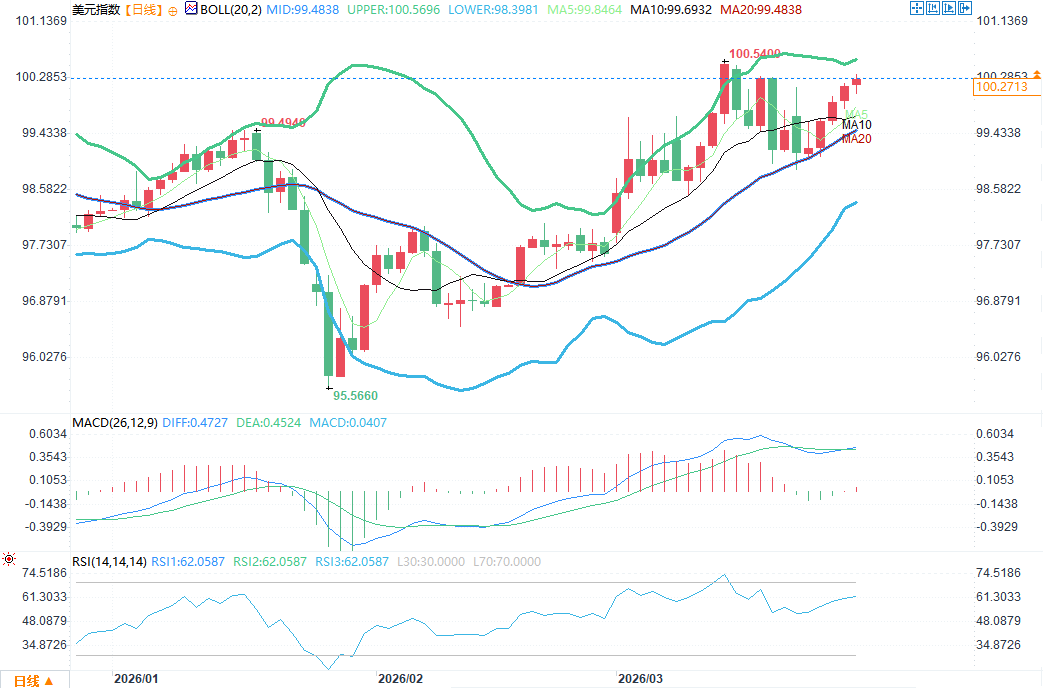
(US Dollar Index Daily Chart Source: FX678)
Daily chart structure and pattern: The DXY has successfully held above the 100 level, nearing the top of its 11-month range, exhibiting a potential five-wave upward pattern. A break above the 100.25-100.50 resistance zone could open up upside potential to 101.00-101.20; key support lies at 99.50-99.80, a break below which would test the 98.80 area.
Moving average system and technical indicators: The price is running above all major moving averages (5/10/20 days), and the Bollinger Bands are narrowing, indicating that short-term volatility has decreased but the bullish trend remains unchanged. The RSI (14) is around 62, which is neutral to bullish and has not entered overbought territory. The MACD histogram remains positive and the golden cross continues.
Financial Calendar Reminder (Eastern Time)
Today (Monday, March 30): Federal Reserve Chairman Jerome Powell holds a seminar at Harvard University, focusing on inflation and policy statements.
Tuesday/Wednesday: JOLTS Job Openings Report, ADP Private Sector Employment Data.
Friday: March non-farm payrolls report (expected increase of 60,000, unemployment rate 4.4%).
Other areas to watch: Japan's Tankan survey, rumors of verbal intervention by the Bank of Japan, the latest developments in the Middle East, and oil price trends.
Frequently Asked Questions
Q1: Why has the Fed's policy expectations shifted from interest rate cuts to a possible interest rate hike?
A: High oil prices are rapidly pushing up inflation through energy and transportation costs, and FOMC officials have clearly stated that inflation risks are more pressing than the cooling labor market. Futures market pricing shows that the probability of the Fed not cutting interest rates in 2026 has surged from 4% before the conflict to 92%. If Powell reiterates the priority of inflation control in his Harvard speech today, it will further confirm this shift, and the market has largely abandoned expectations of interest rate cuts in the short term.
Q2: What are the effects of interventions by countries like India and Japan to devalue their currencies, and what impact do they have on the US dollar?
A: The Reserve Bank of India's spending of approximately $30 billion this month and the setting of limits on banks' foreign exchange holdings have led to a significant rebound in the rupee today; hawkish signals from the Bank of Japan's minutes also pushed the USD/JPY exchange rate down from the 160 level. However, these interventions can only alleviate short-term pressure and are unlikely to reverse the overall strength of the US dollar amid safe-haven demand and policy divergence. Continued pressure on trading partners' currencies has indirectly strengthened the dollar's buying power.
Q3: If this week's non-farm payroll data is unexpectedly weak, will the US dollar experience a significant pullback?
A: While short-term pressure from employment data is possible, given that geopolitical conflicts and inflation have completely dominated the market, the impact of a single employment report is expected to be limited. Unless Iran releases a clear signal of reconciliation, the dollar's gains this month are unlikely to be quickly reversed. Macroeconomic geopolitical risks and the Fed's policy shift are currently far more significant than labor market data.
The US dollar has maintained high-level fluctuations for several consecutive days this month, with a cumulative increase of nearly 2.72%, approaching the high point of the past 11 months. Although the daily fluctuation range is limited, buying pressure is exceptionally strong, resulting in four consecutive days of gains. In short, the core reasons for this strong dollar performance are: a surge in safe-haven demand, the traditional positive impact of rising oil prices on the dollar, and the market's rapid shift in expectations from the Federal Reserve's "interest rate cut cycle" to "anti-inflation" measures. These three factors combined have overshadowed the impact of regular macroeconomic data.
Fundamental analysis
The Houthi rebels officially joined the conflict last weekend, and coupled with heightened tensions in Iran, the risk of global supply chain disruptions increased sharply, fueling investor panic. President Trump announced significant progress in negotiations with Iran over the weekend, stating that Iran had met most of the 15 demands made by the US. However, the White House also announced plans for a multi-target ground operation—aimed at seizing Kharg Island, which houses critical oil infrastructure, and seizing approximately 1,000 pounds of uranium from Tehran. These signals kept the market on edge, forcing funds to continue flowing into the most liquid and safest assets: the US dollar. Meanwhile, oil prices surged due to conflict expectations, directly benefiting the US as a net energy exporter, providing additional support for the dollar from the high oil price environment. In the short term, unless Iran releases a clear signal of reconciliation, the dollar's gains this month are unlikely to be quickly reversed.
Market pricing in the Federal Reserve's 2026 monetary policy has shifted dramatically from "multiple rate cuts" to "high probability of no rate cuts, or even a possible rate hike." Before the conflict, the probability of no rate cuts was only 4%, but it has now soared to 92%. Several FOMC officials have publicly stated that they believe inflation risks far outweigh concerns about a cooling labor market, and that high oil prices are rapidly being passed on through energy costs, pushing up overall inflation. This evening Beijing time, Federal Reserve Chairman Jerome Powell will speak at a Harvard University symposium, and the market is highly focused on his latest remarks on inflation, growth, and the policy path—any hawkish signals could further strengthen dollar buying.
The minutes of the Bank of Japan's March 18-19 meeting released a distinctly hawkish tone, repeatedly emphasizing that monetary policy has lagged behind, current interest rates are far below neutral levels, and discussing the magnitude of future rate hikes, even mentioning the possibility of a 50 basis point increase. The Tankan survey report for the first quarter, to be released on Wednesday, will likely strengthen market expectations for a 25 basis point rate hike in April (currently priced in by futures at around 70%). Meanwhile, the Reserve Bank of India has spent approximately $30 billion this month defending the rupee and set a $100 million cap on domestic banks' onshore and offshore foreign exchange holdings, leading to a sharp rebound in the rupee today. Many European and Asian countries continue to intervene in the foreign exchange market, but the pressure on their currencies has not fundamentally eased, indirectly consolidating the strength of the US dollar.
The JOLTS Job Openings and Labor Force Mobility Report, ADP Private Sector Employment Data, and Friday's March Non-Farm Payrolls Report are all expected to be released. The market consensus is for non-farm payrolls to increase by approximately 60,000 jobs and for the unemployment rate to remain at 4.4%. If the data meets or exceeds these expectations, it will further support the logic of the Federal Reserve tightening policy due to the energy shock. If the data is unexpectedly weak, while it may put temporary pressure on the dollar, the impact is expected to be limited under the prevailing geopolitical and inflationary pressures. Furthermore, we continue to monitor dollar cross-currency basis swaps. The euro/dollar basis has widened slightly in the short term; any sharp fluctuations in this area will be accompanied by further dollar strengthening and pressure on risk assets.
mainstream view
FxPro: Safe-haven demand, trade flows, and a shift in Fed policy expectations are all supporting the dollar. Rising oil prices are boosting demand for the dollar, and FOMC officials believe inflation risks are more pressing, with a 92% probability of no rate cuts in 2026.
ING: Houthi involvement exacerbates supply chain concerns; Bank of Japan minutes send clear hawkish signals; Indian rupee rebounds after $30 billion intervention; dollar buying remains strong.
FX Empire: Demand for safe-haven assets + oil prices near $100 + increased probability of Fed rate hikes, DXY tests new high, short-term bullish.
Technical Analysis
(US Dollar Index Daily Chart Source: FX678)
Daily chart structure and pattern: The DXY has successfully held above the 100 level, nearing the top of its 11-month range, exhibiting a potential five-wave upward pattern. A break above the 100.25-100.50 resistance zone could open up upside potential to 101.00-101.20; key support lies at 99.50-99.80, a break below which would test the 98.80 area.
Moving average system and technical indicators: The price is running above all major moving averages (5/10/20 days), and the Bollinger Bands are narrowing, indicating that short-term volatility has decreased but the bullish trend remains unchanged. The RSI (14) is around 62, which is neutral to bullish and has not entered overbought territory. The MACD histogram remains positive and the golden cross continues.
Financial Calendar Reminder (Eastern Time)
Today (Monday, March 30): Federal Reserve Chairman Jerome Powell holds a seminar at Harvard University, focusing on inflation and policy statements.
Tuesday/Wednesday: JOLTS Job Openings Report, ADP Private Sector Employment Data.
Friday: March non-farm payrolls report (expected increase of 60,000, unemployment rate 4.4%).
Other areas to watch: Japan's Tankan survey, rumors of verbal intervention by the Bank of Japan, the latest developments in the Middle East, and oil price trends.
Frequently Asked Questions
Q1: Why has the Fed's policy expectations shifted from interest rate cuts to a possible interest rate hike?
A: High oil prices are rapidly pushing up inflation through energy and transportation costs, and FOMC officials have clearly stated that inflation risks are more pressing than the cooling labor market. Futures market pricing shows that the probability of the Fed not cutting interest rates in 2026 has surged from 4% before the conflict to 92%. If Powell reiterates the priority of inflation control in his Harvard speech today, it will further confirm this shift, and the market has largely abandoned expectations of interest rate cuts in the short term.
Q2: What are the effects of interventions by countries like India and Japan to devalue their currencies, and what impact do they have on the US dollar?
A: The Reserve Bank of India's spending of approximately $30 billion this month and the setting of limits on banks' foreign exchange holdings have led to a significant rebound in the rupee today; hawkish signals from the Bank of Japan's minutes also pushed the USD/JPY exchange rate down from the 160 level. However, these interventions can only alleviate short-term pressure and are unlikely to reverse the overall strength of the US dollar amid safe-haven demand and policy divergence. Continued pressure on trading partners' currencies has indirectly strengthened the dollar's buying power.
Q3: If this week's non-farm payroll data is unexpectedly weak, will the US dollar experience a significant pullback?
A: While short-term pressure from employment data is possible, given that geopolitical conflicts and inflation have completely dominated the market, the impact of a single employment report is expected to be limited. Unless Iran releases a clear signal of reconciliation, the dollar's gains this month are unlikely to be quickly reversed. Macroeconomic geopolitical risks and the Fed's policy shift are currently far more significant than labor market data.
- Risk Warning and Disclaimer
- The market involves risk, and trading may not be suitable for all investors. This article is for reference only and does not constitute personal investment advice, nor does it take into account certain users’ specific investment objectives, financial situation, or other needs. Any investment decisions made based on this information are at your own risk.