Trump's ultimatum-style pressure caused oil prices to rebound, but gold prices did not fall this time.
2026-03-30 21:05:16
Trump stated clearly on social media that the United States is in serious negotiations with Iran’s “new, more rational regime” to end military operations, and claimed that significant progress has been made. However, he also issued a stern warning: if an agreement cannot be reached in the short term and the Strait of Hormuz is not immediately reopened to navigation, the United States will destroy all of Iran’s power generation facilities, oil wells, Kharg Island, and possibly even desalination facilities—targets that the United States has so far deliberately avoided “touching.”
This move is in retaliation for the killing of U.S. military personnel during the 47-year “reign of terror” by the old Iranian regime.
Meanwhile, Iranian Foreign Ministry spokesman Esmail Bagheei confirmed on Monday that he had received the Trump administration's 15-point negotiating proposal, but emphasized that no direct negotiations have yet taken place with Washington.
Previously, Iranian Parliament Speaker Mohammad Bagher Ghalibaf dismissed the Pakistani negotiations as "an excuse for the US military to expand its regional presence." According to official media reports, he stated that the Iranian military is "awaiting the arrival of US ground forces to deliver a devastating blow and permanently settle accounts with its regional allies."

US Vice President Vance's remarks on Saturday eased market concerns to some extent. He stated that Trump had made it clear he had no intention of staying in Iran for an extended period and would withdraw quickly after achieving his objectives, attempting to calm market fears of a protracted conflict.
On the battlefield, the conflict continues to escalate: Iran launched attacks on energy infrastructure such as Kuwaiti hydroelectric power plants and Israeli oil refineries;
Israel and the United States launched a new round of airstrikes against Iran, including a strike on the Tabriz petrochemical plant in northern Iran;
The death of Iranian Revolutionary Guard Navy Commander Alireza Donsiliri in an Israeli airstrike has impacted its regional operational deployments.
Meanwhile, Iran's continued attacks on Gulf states, Israel's escalating ground invasion in Lebanon, and Spain's closure of its airspace to US aircraft have further exacerbated geopolitical uncertainty.
There are signs of easing in terms of shipping lanes: in addition to Iran actively negotiating passage mechanisms with neighboring countries, Thailand and Iran have reached an agreement that Iran will allow Thai ships to pass safely through the Strait of Hormuz, bringing a limited but crucial positive signal to the strained energy transport route.
On March 30 local time, in response to concerns raised by Europe and other countries about rising fuel prices and increased shipping costs in the Gulf, Iranian Foreign Ministry spokesman Bagaei stated that Iran is not responsible for the current situation and does not want people in other countries to suffer from pressure due to rising fuel or food prices.
Baga'e also stated that, while ensuring security, Iran is managing the passage of vessels that are not hostile. In the past few days, some vessels have passed through the Strait of Hormuz after coordinating with relevant Iranian authorities.
Iran’s continued attacks on regional energy infrastructure, coupled with its control of the Strait of Hormuz—a waterway that carries one-fifth of the world’s oil shipments—have become a key catalyst for rising oil prices.
In early trading, Brent crude oil futures prices touched $109 per barrel, nearly 60% higher than the starting price of the war between the US and Israel on February 28. Geopolitical risk premiums became the core driver of oil prices.
The market's logic for the oil price rebound is based on the following: supply-side shock: If Kharg Island, as the core hub for Iranian oil exports, is captured or destroyed by the US military, it will directly cut off Iranian oil exports, creating a hard gap in global crude oil supply.
Increased shipping risks: The continued risk of blocked navigation in the Strait of Hormuz and the Bab el-Mandeb Strait further restrict global crude oil transport capacity, pushing up transportation costs and risk premiums.
Supply chain disruptions: Iranian strikes against oil refineries, petrochemical plants, and other facilities, as well as Israeli airstrikes on Iranian military infrastructure, have exacerbated global supply shortages of energy and chemicals.
Despite positive signs such as the passage of Thai vessels, market concerns about the deteriorating situation continue to dominate oil price trends. In the short term, oil prices may remain volatile at high levels, with geopolitical risks becoming the core variable in price fluctuations.
It is worth noting that despite the renewed surge in oil prices, US Treasury yields did not follow suit. This market phenomenon sends a key signal: the market has fully priced in the recent rise in inflation, and inflation expectations are no longer the core driver of the bond market.
From a trading logic perspective, this reflects:
Inflation expectations saturated: Oil prices have risen nearly 60% since the end of February, and the market has largely absorbed the transmission effect on inflation. Investors have not further raised their inflation expectations in recent days due to rising oil prices.
Monetary policy expectations remain stable: The market believes that the Federal Reserve will not adjust its existing policy path due to short-term fluctuations in oil prices, and the dampening effect of high oil prices on the economy may instead limit the room for policy tightening.
A mix of safe-haven demand and economic concerns: Some funds flowed into US Treasuries to hedge against uncertainty stemming from geopolitical conflicts, while concerns about a potential economic slowdown due to high oil prices limited the upside potential for yields.
This decoupling indicates that the current market focus has shifted from inflation concerns to the evolution of geopolitical conflicts themselves and their potential impact on global economic growth, creating a favorable environment for safe-haven assets such as gold.
Gold performed strongly, and it's worth noting that today's gold rebound occurred while the US dollar index also strengthened, indicating that even as the price denominated in US dollars continues to rise, market demand for gold is decreasing rather than increasing.
With US Treasury yields decoupling from oil price rebounds and the market fully absorbing inflation expectations, gold has broken free from the dual pressures of inflation and interest rates. Escalating geopolitical conflicts have become the core driving force behind its rise. The logic behind gold's strength can be summarized in three points:
The return of pure safe-haven attributes: As the market fully prices in inflation, gold's inflation-hedging properties have taken a backseat, and geopolitical risks have become the dominant factor driving safe-haven demand.
The Trump administration's "talks while fighting" strategy, threats against key Iranian facilities, and the continued deterioration of the Middle East situation have all driven investors to increase their gold holdings to hedge against uncertainty.
Stable real interest rate expectations: The fact that US Treasury yields have not risen with oil prices indicates that market expectations for real interest rates are stabilizing, reducing the opportunity cost of holding gold as a zero-interest asset and increasing its attractiveness.
Geopolitical risk spillover effects: The Middle East conflict has spread to multiple regions including Lebanon, Iraq, and the Gulf states, increasing global geopolitical uncertainty and further strengthening the safe-haven demand for gold.
From a market perspective, London spot gold prices have risen significantly recently, breaking through the $4,500/ounce mark, with escalating geopolitical conflicts being the core catalyst driving the price increase.
There are several key shifts at present. First, Iran has begun to acknowledge the 15 ceasefire conditions, indicating that the US and Iran were indeed communicating behind the scenes. Second, Iran has explicitly proposed conditional passage through the Strait and provided the Thai case, easing relations with other countries. Finally, the US's pressure tactics have reached their limit, meaning that it is unlikely that US pressure will worsen the situation. In addition, the other two points suggest that the situation will ease over time.
This means that unless the US actually attacks Iran's civilian infrastructure such as power plants, the short-term rise in oil prices may begin to slow, while gold prices will break free from the pressure of rising real interest rates and begin to rebound.
As mentioned in previous articles, spot gold rebounded after holding above 4426, with support around 4500.
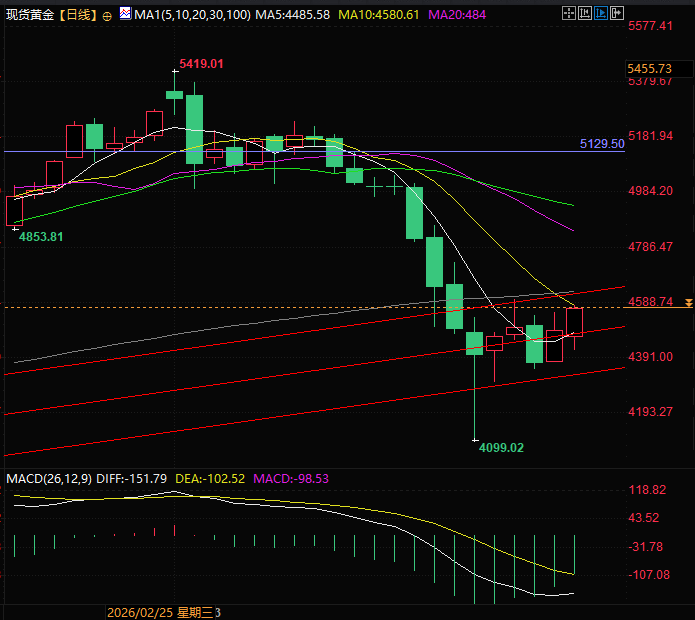
(Spot gold daily chart, source: EasyForex subsidiary)
Although the valuation center of WTI crude oil continues to rise, a dark cloud cover candlestick pattern has appeared, which is worth noting, as it indicates the possibility of a short-term pullback or even a trend reversal.
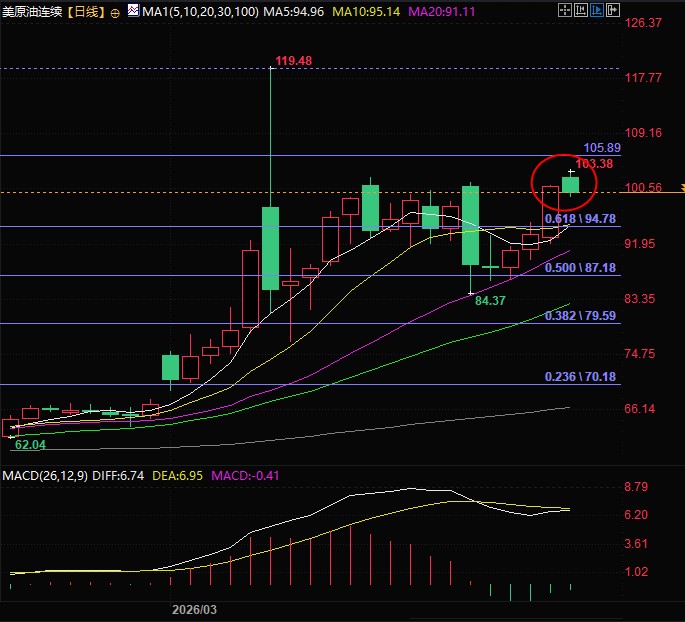
(WTI crude oil futures daily chart, source: FX678's subsidiary EasyForex)
At 21:02 Beijing time, spot gold was trading at $4,576 per ounce, and WTI crude oil futures were trading at $100.04 per barrel.
This move is in retaliation for the killing of U.S. military personnel during the 47-year “reign of terror” by the old Iranian regime.
Meanwhile, Iranian Foreign Ministry spokesman Esmail Bagheei confirmed on Monday that he had received the Trump administration's 15-point negotiating proposal, but emphasized that no direct negotiations have yet taken place with Washington.
Previously, Iranian Parliament Speaker Mohammad Bagher Ghalibaf dismissed the Pakistani negotiations as "an excuse for the US military to expand its regional presence." According to official media reports, he stated that the Iranian military is "awaiting the arrival of US ground forces to deliver a devastating blow and permanently settle accounts with its regional allies."
US Vice President Vance's remarks on Saturday eased market concerns to some extent. He stated that Trump had made it clear he had no intention of staying in Iran for an extended period and would withdraw quickly after achieving his objectives, attempting to calm market fears of a protracted conflict.
On the battlefield, the conflict continues to escalate: Iran launched attacks on energy infrastructure such as Kuwaiti hydroelectric power plants and Israeli oil refineries;
Israel and the United States launched a new round of airstrikes against Iran, including a strike on the Tabriz petrochemical plant in northern Iran;
The death of Iranian Revolutionary Guard Navy Commander Alireza Donsiliri in an Israeli airstrike has impacted its regional operational deployments.
Meanwhile, Iran's continued attacks on Gulf states, Israel's escalating ground invasion in Lebanon, and Spain's closure of its airspace to US aircraft have further exacerbated geopolitical uncertainty.
There are signs of easing in terms of shipping lanes: in addition to Iran actively negotiating passage mechanisms with neighboring countries, Thailand and Iran have reached an agreement that Iran will allow Thai ships to pass safely through the Strait of Hormuz, bringing a limited but crucial positive signal to the strained energy transport route.
On March 30 local time, in response to concerns raised by Europe and other countries about rising fuel prices and increased shipping costs in the Gulf, Iranian Foreign Ministry spokesman Bagaei stated that Iran is not responsible for the current situation and does not want people in other countries to suffer from pressure due to rising fuel or food prices.
Baga'e also stated that, while ensuring security, Iran is managing the passage of vessels that are not hostile. In the past few days, some vessels have passed through the Strait of Hormuz after coordinating with relevant Iranian authorities.
Oil prices: Rebound driven by geopolitical risk premium
Iran’s continued attacks on regional energy infrastructure, coupled with its control of the Strait of Hormuz—a waterway that carries one-fifth of the world’s oil shipments—have become a key catalyst for rising oil prices.
In early trading, Brent crude oil futures prices touched $109 per barrel, nearly 60% higher than the starting price of the war between the US and Israel on February 28. Geopolitical risk premiums became the core driver of oil prices.
The market's logic for the oil price rebound is based on the following: supply-side shock: If Kharg Island, as the core hub for Iranian oil exports, is captured or destroyed by the US military, it will directly cut off Iranian oil exports, creating a hard gap in global crude oil supply.
Increased shipping risks: The continued risk of blocked navigation in the Strait of Hormuz and the Bab el-Mandeb Strait further restrict global crude oil transport capacity, pushing up transportation costs and risk premiums.
Supply chain disruptions: Iranian strikes against oil refineries, petrochemical plants, and other facilities, as well as Israeli airstrikes on Iranian military infrastructure, have exacerbated global supply shortages of energy and chemicals.
Despite positive signs such as the passage of Thai vessels, market concerns about the deteriorating situation continue to dominate oil price trends. In the short term, oil prices may remain volatile at high levels, with geopolitical risks becoming the core variable in price fluctuations.
US Treasury yields: The market has fully priced in inflation, decoupling from the oil price rebound.
It is worth noting that despite the renewed surge in oil prices, US Treasury yields did not follow suit. This market phenomenon sends a key signal: the market has fully priced in the recent rise in inflation, and inflation expectations are no longer the core driver of the bond market.
From a trading logic perspective, this reflects:
Inflation expectations saturated: Oil prices have risen nearly 60% since the end of February, and the market has largely absorbed the transmission effect on inflation. Investors have not further raised their inflation expectations in recent days due to rising oil prices.
Monetary policy expectations remain stable: The market believes that the Federal Reserve will not adjust its existing policy path due to short-term fluctuations in oil prices, and the dampening effect of high oil prices on the economy may instead limit the room for policy tightening.
A mix of safe-haven demand and economic concerns: Some funds flowed into US Treasuries to hedge against uncertainty stemming from geopolitical conflicts, while concerns about a potential economic slowdown due to high oil prices limited the upside potential for yields.
This decoupling indicates that the current market focus has shifted from inflation concerns to the evolution of geopolitical conflicts themselves and their potential impact on global economic growth, creating a favorable environment for safe-haven assets such as gold.
Gold: Escaping inflation concerns, escalating geopolitical conflicts drive gains.
Gold performed strongly, and it's worth noting that today's gold rebound occurred while the US dollar index also strengthened, indicating that even as the price denominated in US dollars continues to rise, market demand for gold is decreasing rather than increasing.
With US Treasury yields decoupling from oil price rebounds and the market fully absorbing inflation expectations, gold has broken free from the dual pressures of inflation and interest rates. Escalating geopolitical conflicts have become the core driving force behind its rise. The logic behind gold's strength can be summarized in three points:
The return of pure safe-haven attributes: As the market fully prices in inflation, gold's inflation-hedging properties have taken a backseat, and geopolitical risks have become the dominant factor driving safe-haven demand.
The Trump administration's "talks while fighting" strategy, threats against key Iranian facilities, and the continued deterioration of the Middle East situation have all driven investors to increase their gold holdings to hedge against uncertainty.
Stable real interest rate expectations: The fact that US Treasury yields have not risen with oil prices indicates that market expectations for real interest rates are stabilizing, reducing the opportunity cost of holding gold as a zero-interest asset and increasing its attractiveness.
Geopolitical risk spillover effects: The Middle East conflict has spread to multiple regions including Lebanon, Iraq, and the Gulf states, increasing global geopolitical uncertainty and further strengthening the safe-haven demand for gold.
From a market perspective, London spot gold prices have risen significantly recently, breaking through the $4,500/ounce mark, with escalating geopolitical conflicts being the core catalyst driving the price increase.
Summary and Technical Analysis:
There are several key shifts at present. First, Iran has begun to acknowledge the 15 ceasefire conditions, indicating that the US and Iran were indeed communicating behind the scenes. Second, Iran has explicitly proposed conditional passage through the Strait and provided the Thai case, easing relations with other countries. Finally, the US's pressure tactics have reached their limit, meaning that it is unlikely that US pressure will worsen the situation. In addition, the other two points suggest that the situation will ease over time.
This means that unless the US actually attacks Iran's civilian infrastructure such as power plants, the short-term rise in oil prices may begin to slow, while gold prices will break free from the pressure of rising real interest rates and begin to rebound.
As mentioned in previous articles, spot gold rebounded after holding above 4426, with support around 4500.
(Spot gold daily chart, source: EasyForex subsidiary)
Although the valuation center of WTI crude oil continues to rise, a dark cloud cover candlestick pattern has appeared, which is worth noting, as it indicates the possibility of a short-term pullback or even a trend reversal.
(WTI crude oil futures daily chart, source: FX678's subsidiary EasyForex)
At 21:02 Beijing time, spot gold was trading at $4,576 per ounce, and WTI crude oil futures were trading at $100.04 per barrel.
- Risk Warning and Disclaimer
- The market involves risk, and trading may not be suitable for all investors. This article is for reference only and does not constitute personal investment advice, nor does it take into account certain users’ specific investment objectives, financial situation, or other needs. Any investment decisions made based on this information are at your own risk.