The new logic behind oil prices: the US, Russia, and Iran tacitly raise prices, and the global supply chain pays the price.
2026-03-31 19:05:13
On Tuesday (March 31), during the Asian and European sessions, international oil prices experienced a volatile trading pattern, rising and falling before rebounding. In the early morning, influenced by Trump's message that he might end military operations, global oil prices plummeted, with intraday declines reaching as high as 4%. WTI crude oil futures fell from 3% to a low of -1.5%. However, due to the possibility that the United States might abandon the struggle for control of the Strait of Hormuz, oil prices rebounded after the initial drop.
Although the United States seems to have gotten bogged down in the Middle East during this war, and the resulting inflation is detrimental to the midterm elections, it also appears to have gained some benefits.
White House Press Secretary Carolyn Levitt said the previous day that the United States is working to restore normal operations in the Strait of Hormuz, but has not included the Strait of Hormuz in its list of key military targets targeting Iran’s military forces, missiles, defense industry and nuclear weapons manufacturing capabilities.
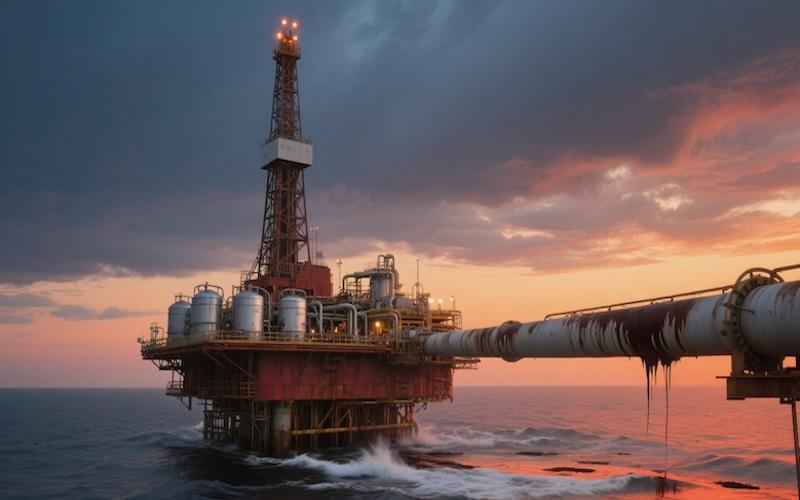
By redefining “victory objectives,” the United States can shift geopolitical burdens to its allies while simultaneously profiting from market mechanisms.
According to The Wall Street Journal, US President Trump has told his staff that even though the Strait of Hormuz remains effectively closed, the US still plans to end its military operations against Iran and leave the issue of reopening the strait to be addressed later.
This move is interpreted as a strategic adjustment by the United States to reap the benefits of geopolitical conflict after achieving its core military objectives.
The Trump administration assessed that forcibly opening the Strait of Hormuz would extend the conflict beyond the initially planned four to six weeks, while the US military had already achieved its main objective of weakening the Iranian navy and missile stockpile. Israeli Prime Minister Netanyahu simultaneously confirmed on March 30 that the joint US-Israeli operation against Iran was "more than halfway complete," with both sides having struck Iranian missile systems, weapons factories, and personnel related to its nuclear program. The current focus is on pushing Iran to remove its enriched uranium stockpile, which may be placed under international supervision, but he did not disclose a specific timeline for the operation's conclusion.
It is worth noting that the US military is reaping double economic benefits as it "withdraws": on the one hand, the traffic volume in the Strait of Hormuz has plummeted by more than 90%, triggering global energy supply panic, and the price of New York crude oil futures once broke through $100 per barrel, with US shale oil producers expecting an additional $63 billion in free cash flow.
On the other hand, the U.S. State Department recently approved a $16.5 billion arms sale to the UAE, Kuwait and other countries, covering equipment such as air defense radar and missiles. This move is an opportunity to expand arms exports by taking advantage of the surge in defense needs of its Middle Eastern allies. Previously, the U.S. and Saudi Arabia had signed the largest arms sale agreement in history, worth $142 billion.
The US will prioritize pressuring Iran through diplomatic channels, demanding that it accept conditions including inspections of its nuclear facilities and the lifting of sanctions in exchange for free trade. If diplomacy fails, the US will push for Europe and its Gulf allies to take the lead in resolving the Taiwan Strait issue.
While the military option has not been completely abandoned, it is no longer a current priority.
Although public opinion is currently putting pressure on the United States, the US has actually cleverly avoided the Strait of Hormuz. It can claim that its military objective is to destroy Iran's nuclear-based military strike capability, and it can say at any time that it has achieved its objective. However, since Europe and Asia, which are the most important countries for passage through the strait, have not cooperated, the strait's openness is irrelevant to the United States.
Meanwhile, oil-related companies in the United States, Iran, and Russia have all benefited from the high oil prices. As a net energy exporter, the United States can transfer the costs of war by earning money from energy and selling arms to the Middle East, and even subsidize its own energy expenditures. At the same time, any Middle Eastern country that supports the United States in increasing military operations is tantamount to breaking ties with Iran and will need more military support from the United States in the future, and will pay more protection money to the United States. Europe, constrained by the tensions in the Taiwan Strait, can only be forced to buy more expensive energy from the United States, which is four times the price in the Middle East.
Previously, in 2023, with China's coordination, Saudi Arabia and Iran had restored diplomatic relations. This was the case with Iran and the UAE. Saudi Arabia, Qatar, and Kuwait were also in good diplomatic relations. This would have reduced the need for military protection from the United States among Middle Eastern countries and decreased the United States' presence in the Middle East. However, this war has indirectly solved this problem for the United States.
If the US delegates the task of "reopening the Straits" to its European and Gulf allies, Iran can exploit these countries' fears about energy supplies, exchanging benefits through bilateral agreements. Domestically and internationally, Tehran can portray the US withdrawal as a "collapse of imperialism." This would help the new leadership (such as Mojtaba Khamenei) consolidate power and attract deeper economic ties with countries unwilling to follow US sanctions (such as some Asian and Southeast Asian nations) during post-war reconstruction.
The US, Russia, and Iran are all major energy producers. Continued instability in the Taiwan Strait is financially beneficial to all three (provided oil price increases exceed the costs of war). The three parties may reach a tacit agreement to maintain a "controllable tension," keeping oil prices above $100 for an extended period.
If the Strait of Hormuz proves unreliable, Russia could aggressively promote its "Arctic shipping route" and the "International North-South Transport Corridor (INSTC)" (connecting the Indian Ocean and Russia via Iran). The development of such infrastructure would allow for a deep economic synergy between Iran and Russia, completely bypassing the Western financial system.
Russia could act as a mediator. Putin could use the promise of persuading Iran to open the floodgates as leverage to secure further concessions from Trump on Ukraine or Eastern European sanctions.
By redefining the "victory objective" and shifting the geopolitical burden to allies, Europe, Middle Eastern oil-producing countries, India, and Japan are likely to be the most affected by this conflict. If the United States, Russia, and other countries want to continue to profit, the Middle East conflict needs to be in a stalemate, and WTI oil prices need to be in a high price range of around $100.
However, oil prices cannot spiral out of control above $110. Too high a price would significantly increase global energy spending, crowding out normal consumption and leading to a global economic recession that would affect total demand for crude oil.
It must be said that, ideally, the United States could achieve a dual loop of security hegemony and energy dividends by maintaining a chaotic situation in the Middle East that is neither truly defeated nor truly peaceful, while the cost would be borne by the mid-to-lower reaches of the global industrial chain.
Technically, WTI crude oil futures contracts showed a bearish but not falling trend. As mentioned in previous articles, oil prices were suppressed after touching 105.89, but are still in an uptrend, with support around 101.
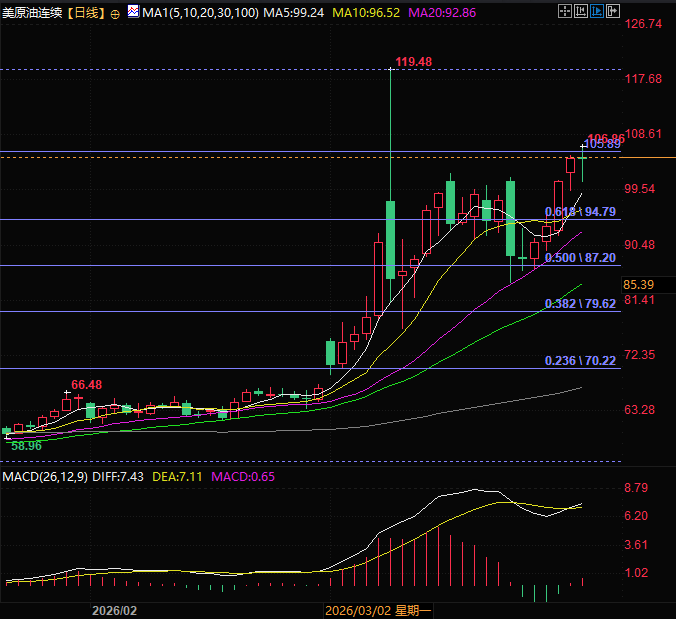
(WTI crude oil futures daily chart, source: EasyForex)
At 19:03 Beijing time, WTI crude oil futures contracts were trading at $104.83 per barrel.
Although the United States seems to have gotten bogged down in the Middle East during this war, and the resulting inflation is detrimental to the midterm elections, it also appears to have gained some benefits.
White House Press Secretary Carolyn Levitt said the previous day that the United States is working to restore normal operations in the Strait of Hormuz, but has not included the Strait of Hormuz in its list of key military targets targeting Iran’s military forces, missiles, defense industry and nuclear weapons manufacturing capabilities.
By redefining “victory objectives,” the United States can shift geopolitical burdens to its allies while simultaneously profiting from market mechanisms.
Trump plans to end military action against Iran while enjoying the spoils of war.
According to The Wall Street Journal, US President Trump has told his staff that even though the Strait of Hormuz remains effectively closed, the US still plans to end its military operations against Iran and leave the issue of reopening the strait to be addressed later.
This move is interpreted as a strategic adjustment by the United States to reap the benefits of geopolitical conflict after achieving its core military objectives.
The Trump administration assessed that forcibly opening the Strait of Hormuz would extend the conflict beyond the initially planned four to six weeks, while the US military had already achieved its main objective of weakening the Iranian navy and missile stockpile. Israeli Prime Minister Netanyahu simultaneously confirmed on March 30 that the joint US-Israeli operation against Iran was "more than halfway complete," with both sides having struck Iranian missile systems, weapons factories, and personnel related to its nuclear program. The current focus is on pushing Iran to remove its enriched uranium stockpile, which may be placed under international supervision, but he did not disclose a specific timeline for the operation's conclusion.
It is worth noting that the US military is reaping double economic benefits as it "withdraws": on the one hand, the traffic volume in the Strait of Hormuz has plummeted by more than 90%, triggering global energy supply panic, and the price of New York crude oil futures once broke through $100 per barrel, with US shale oil producers expecting an additional $63 billion in free cash flow.
On the other hand, the U.S. State Department recently approved a $16.5 billion arms sale to the UAE, Kuwait and other countries, covering equipment such as air defense radar and missiles. This move is an opportunity to expand arms exports by taking advantage of the surge in defense needs of its Middle Eastern allies. Previously, the U.S. and Saudi Arabia had signed the largest arms sale agreement in history, worth $142 billion.
The US will prioritize pressuring Iran through diplomatic channels, demanding that it accept conditions including inspections of its nuclear facilities and the lifting of sanctions in exchange for free trade. If diplomacy fails, the US will push for Europe and its Gulf allies to take the lead in resolving the Taiwan Strait issue.
While the military option has not been completely abandoned, it is no longer a current priority.
The US and Russia may be the winners in this event, but Iran is not the biggest loser.
Although public opinion is currently putting pressure on the United States, the US has actually cleverly avoided the Strait of Hormuz. It can claim that its military objective is to destroy Iran's nuclear-based military strike capability, and it can say at any time that it has achieved its objective. However, since Europe and Asia, which are the most important countries for passage through the strait, have not cooperated, the strait's openness is irrelevant to the United States.
Meanwhile, oil-related companies in the United States, Iran, and Russia have all benefited from the high oil prices. As a net energy exporter, the United States can transfer the costs of war by earning money from energy and selling arms to the Middle East, and even subsidize its own energy expenditures. At the same time, any Middle Eastern country that supports the United States in increasing military operations is tantamount to breaking ties with Iran and will need more military support from the United States in the future, and will pay more protection money to the United States. Europe, constrained by the tensions in the Taiwan Strait, can only be forced to buy more expensive energy from the United States, which is four times the price in the Middle East.
Previously, in 2023, with China's coordination, Saudi Arabia and Iran had restored diplomatic relations. This was the case with Iran and the UAE. Saudi Arabia, Qatar, and Kuwait were also in good diplomatic relations. This would have reduced the need for military protection from the United States among Middle Eastern countries and decreased the United States' presence in the Middle East. However, this war has indirectly solved this problem for the United States.
If the US delegates the task of "reopening the Straits" to its European and Gulf allies, Iran can exploit these countries' fears about energy supplies, exchanging benefits through bilateral agreements. Domestically and internationally, Tehran can portray the US withdrawal as a "collapse of imperialism." This would help the new leadership (such as Mojtaba Khamenei) consolidate power and attract deeper economic ties with countries unwilling to follow US sanctions (such as some Asian and Southeast Asian nations) during post-war reconstruction.
The US, Russia, and Iran are all major energy producers. Continued instability in the Taiwan Strait is financially beneficial to all three (provided oil price increases exceed the costs of war). The three parties may reach a tacit agreement to maintain a "controllable tension," keeping oil prices above $100 for an extended period.
If the Strait of Hormuz proves unreliable, Russia could aggressively promote its "Arctic shipping route" and the "International North-South Transport Corridor (INSTC)" (connecting the Indian Ocean and Russia via Iran). The development of such infrastructure would allow for a deep economic synergy between Iran and Russia, completely bypassing the Western financial system.
Russia could act as a mediator. Putin could use the promise of persuading Iran to open the floodgates as leverage to secure further concessions from Trump on Ukraine or Eastern European sanctions.
Summary and Technical Analysis:
By redefining the "victory objective" and shifting the geopolitical burden to allies, Europe, Middle Eastern oil-producing countries, India, and Japan are likely to be the most affected by this conflict. If the United States, Russia, and other countries want to continue to profit, the Middle East conflict needs to be in a stalemate, and WTI oil prices need to be in a high price range of around $100.
However, oil prices cannot spiral out of control above $110. Too high a price would significantly increase global energy spending, crowding out normal consumption and leading to a global economic recession that would affect total demand for crude oil.
It must be said that, ideally, the United States could achieve a dual loop of security hegemony and energy dividends by maintaining a chaotic situation in the Middle East that is neither truly defeated nor truly peaceful, while the cost would be borne by the mid-to-lower reaches of the global industrial chain.
Technically, WTI crude oil futures contracts showed a bearish but not falling trend. As mentioned in previous articles, oil prices were suppressed after touching 105.89, but are still in an uptrend, with support around 101.
(WTI crude oil futures daily chart, source: EasyForex)
At 19:03 Beijing time, WTI crude oil futures contracts were trading at $104.83 per barrel.
- Risk Warning and Disclaimer
- The market involves risk, and trading may not be suitable for all investors. This article is for reference only and does not constitute personal investment advice, nor does it take into account certain users’ specific investment objectives, financial situation, or other needs. Any investment decisions made based on this information are at your own risk.