How strong is the yen's support amid the shadow of Middle East conflict?
2026-03-31 20:42:18
On Tuesday, March 31, the USD/JPY pair traded around 159.40. International crude oil prices remained high due to the ongoing conflict with Iran pushing up energy costs. The Bank of Japan's mid-March meeting voted 8-1 to keep its short-term policy rate unchanged at 0.75%. Japan's February consumer price index rose 1.3% year-on-year, and March data from the Tokyo area also showed some easing of overall inflationary pressures. Against this backdrop, Commerzbank analysts pointed out that if the protracted conflict with Iran leads to continued increases in energy prices, the Bank of Japan may bring forward its planned June rate hike to the end of April, but this move is expected to have limited support for the yen.
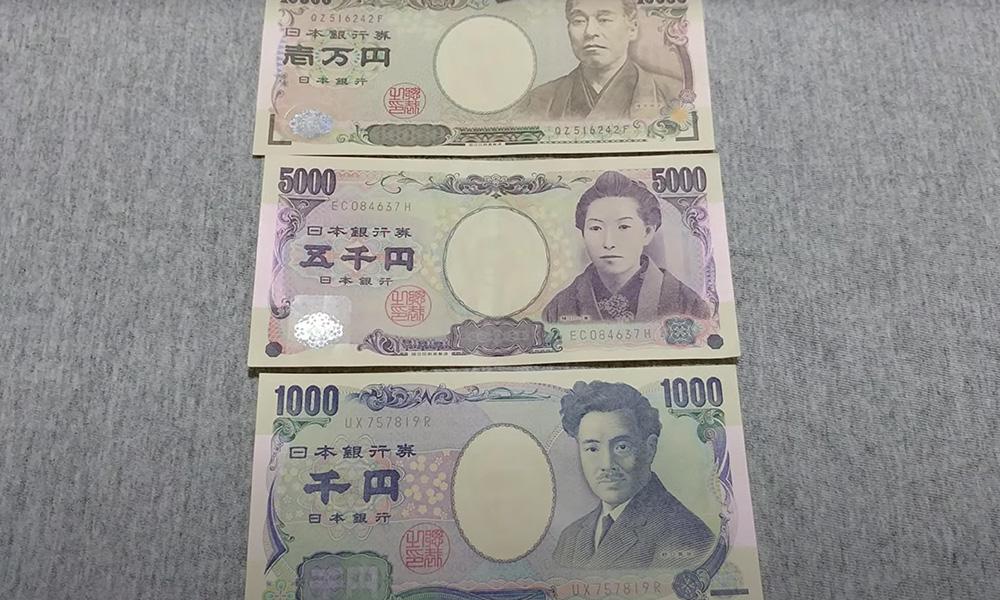
Japan's inflation path exhibits a clear structural divergence. In February 2026, the national consumer price index (CPI) rose 1.3% year-on-year, a decrease of 0.2 percentage points from January's 1.5%, marking the lowest level since March 2022. The core CPI, excluding fresh food, rose 1.6% year-on-year, also below the 2% target range, while the core-core CPI, excluding fresh food and energy, remained high at 2.5%, indicating that domestic underlying inflation remains sticky. Preliminary data for March in the Tokyo area showed an overall CPI increase of 1.4% year-on-year, with the core CPI at 1.7%. While gasoline accounts for only 0.5% of the overall CPI in Tokyo, this weight is higher nationwide, meaning that rising energy prices will have a more significant impact on the overall CPI.
After seasonal adjustment, prices excluding energy and fresh food rose 0.18% month-on-month, remaining within the Bank of Japan's 2% target range. The continued deflationary trend in food prices has masked the upward momentum in energy prices, but if a second round of effects emerges in transportation or food processing, policy maneuvering will significantly narrow. A recent research paper from the Bank of Japan indicates that inflation is slowly stabilizing in the 1.5% to 2% range, ending years of low inflation and even short-term high inflation. Short-term energy price shocks pose a limited direct threat to achieving the target, but long-term conflicts will amplify imported inflationary pressures, testing the central bank's ability to monitor potential wage-price spirals.
The following is a comparison of key recent inflation indicators: index February 2026 January 2026 change Overall Consumer Price Index 1.3% 1.5% Decrease of 0.2 percentage points Core Consumer Price Index 1.6% 2.0% Decreased by 0.4 percentage points Core Consumer Price Index 2.5% 2.6% Decreased by 0.1 percentage points
Data shows that subsidies continue to suppress energy and food prices, but the inflationary path could accelerate once geopolitical factors drive energy costs above current levels.
The conflict in Iran has continued for weeks, with international crude oil prices remaining around $107 per barrel, a significant increase from the initial stages of the conflict. Disruptions to shipping in the Gulf region and damage to export facilities have directly pushed up costs in the global energy supply chain. Japan, as an economy highly dependent on energy imports, is experiencing particularly pronounced imported inflationary pressures. Gasoline prices have a higher weighting in the national consumer price index than in the Tokyo area, and the upward trend in energy prices began to emerge in March. However, the continued decline in food prices has temporarily masked this impact.
If the conflict fails to ease within the next four weeks, the second round of transmission effects from energy prices will gradually appear in transportation, manufacturing, and retail sectors. The Bank of Japan needs to weigh whether rising energy costs will evolve into broad price pressures, thereby affecting corporate pricing behavior and wage negotiations. Commerzbank emphasizes that current inflation trends remain manageable, but the persistence of geopolitical risks will significantly reduce the Bank of Japan's policy space for maintaining current interest rate levels. Every $10 increase in energy prices per barrel could potentially lead to an additional 0.2 to 0.3 percentage points increase in Japan's overall consumer price index; this quantitative impact cannot be ignored given the high import dependence.
The Bank of Japan's March meeting clearly maintained the 0.75% interest rate, indicating that policymakers still prefer to observe data developments before taking action. However, analysts believe that if the conflict with Iran remains unresolved before the end-of-April meeting, the central bank may bring forward its planned June rate hike to April. This assessment is based on the potential disruption of the inflation path caused by energy prices: short-term energy shocks will not pose a fatal threat to the 2% target, but if a second wave of effects spreads to the food and transportation sectors, the room for policy easing will rapidly diminish.
A Bank of Japan research paper further supports the assessment of inflation stabilization, but also cautions against close monitoring of the spillover effects of geopolitical factors on the energy market. Commerzbank points out that "if the conflict continues, the possibility of an earlier rate hike is high." It also warns that the inflationary trend in energy prices was masked by food deflation in March; seasonally adjusted prices excluding energy and fresh food remain within the target range, but if a second round of effects emerges, policy maneuvering will be limited. Overall, the central bank is more inclined to maintain interest rates unchanged at its meeting at the end of April, but geopolitical uncertainty may force policymakers to act sooner to maintain price stability.
While an earlier-than-expected interest rate hike could provide some support for interest rates, the negative spillover effects of the Iranian conflict may offset some of the positive impact, dragging down the yen. The USD/JPY exchange rate is currently fluctuating around 159.40, reflecting a balance between market expectations regarding the Bank of Japan's policy and geopolitical risks.
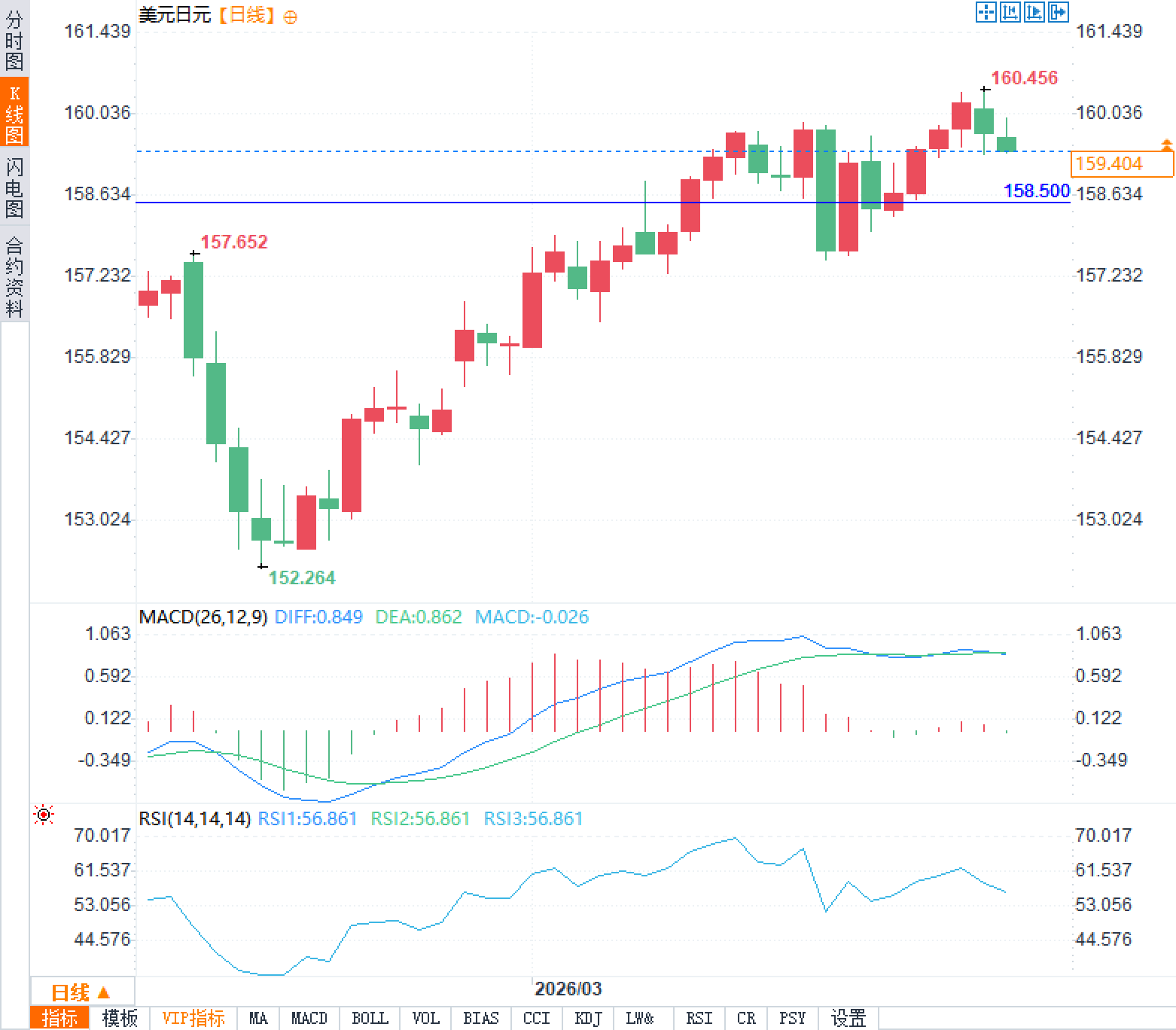
Analysts believe that even if the interest rate hike in April is implemented, its boost to the yen will be limited, as the increased energy costs caused by the conflict will directly worsen Japan's current account and be transmitted to the domestic producer price index through import prices. Traders are focusing on the synchronized evolution of oil prices and inflation data before and after the late April meeting, as well as changes in the Bank of Japan's wording regarding the second-round effect. These factors will dominate the medium-term fluctuation range of the yen exchange rate.
In-depth analysis of Japan's inflation situation
Japan's inflation path exhibits a clear structural divergence. In February 2026, the national consumer price index (CPI) rose 1.3% year-on-year, a decrease of 0.2 percentage points from January's 1.5%, marking the lowest level since March 2022. The core CPI, excluding fresh food, rose 1.6% year-on-year, also below the 2% target range, while the core-core CPI, excluding fresh food and energy, remained high at 2.5%, indicating that domestic underlying inflation remains sticky. Preliminary data for March in the Tokyo area showed an overall CPI increase of 1.4% year-on-year, with the core CPI at 1.7%. While gasoline accounts for only 0.5% of the overall CPI in Tokyo, this weight is higher nationwide, meaning that rising energy prices will have a more significant impact on the overall CPI.
After seasonal adjustment, prices excluding energy and fresh food rose 0.18% month-on-month, remaining within the Bank of Japan's 2% target range. The continued deflationary trend in food prices has masked the upward momentum in energy prices, but if a second round of effects emerges in transportation or food processing, policy maneuvering will significantly narrow. A recent research paper from the Bank of Japan indicates that inflation is slowly stabilizing in the 1.5% to 2% range, ending years of low inflation and even short-term high inflation. Short-term energy price shocks pose a limited direct threat to achieving the target, but long-term conflicts will amplify imported inflationary pressures, testing the central bank's ability to monitor potential wage-price spirals.
The following is a comparison of key recent inflation indicators:
Data shows that subsidies continue to suppress energy and food prices, but the inflationary path could accelerate once geopolitical factors drive energy costs above current levels.
Energy price shocks from the Iranian conflict
The conflict in Iran has continued for weeks, with international crude oil prices remaining around $107 per barrel, a significant increase from the initial stages of the conflict. Disruptions to shipping in the Gulf region and damage to export facilities have directly pushed up costs in the global energy supply chain. Japan, as an economy highly dependent on energy imports, is experiencing particularly pronounced imported inflationary pressures. Gasoline prices have a higher weighting in the national consumer price index than in the Tokyo area, and the upward trend in energy prices began to emerge in March. However, the continued decline in food prices has temporarily masked this impact.
If the conflict fails to ease within the next four weeks, the second round of transmission effects from energy prices will gradually appear in transportation, manufacturing, and retail sectors. The Bank of Japan needs to weigh whether rising energy costs will evolve into broad price pressures, thereby affecting corporate pricing behavior and wage negotiations. Commerzbank emphasizes that current inflation trends remain manageable, but the persistence of geopolitical risks will significantly reduce the Bank of Japan's policy space for maintaining current interest rate levels. Every $10 increase in energy prices per barrel could potentially lead to an additional 0.2 to 0.3 percentage points increase in Japan's overall consumer price index; this quantitative impact cannot be ignored given the high import dependence.
Policy considerations regarding the timing of interest rate hikes by the Bank of Japan
The Bank of Japan's March meeting clearly maintained the 0.75% interest rate, indicating that policymakers still prefer to observe data developments before taking action. However, analysts believe that if the conflict with Iran remains unresolved before the end-of-April meeting, the central bank may bring forward its planned June rate hike to April. This assessment is based on the potential disruption of the inflation path caused by energy prices: short-term energy shocks will not pose a fatal threat to the 2% target, but if a second wave of effects spreads to the food and transportation sectors, the room for policy easing will rapidly diminish.
A Bank of Japan research paper further supports the assessment of inflation stabilization, but also cautions against close monitoring of the spillover effects of geopolitical factors on the energy market. Commerzbank points out that "if the conflict continues, the possibility of an earlier rate hike is high." It also warns that the inflationary trend in energy prices was masked by food deflation in March; seasonally adjusted prices excluding energy and fresh food remain within the target range, but if a second round of effects emerges, policy maneuvering will be limited. Overall, the central bank is more inclined to maintain interest rates unchanged at its meeting at the end of April, but geopolitical uncertainty may force policymakers to act sooner to maintain price stability.
Complex dynamic assessment of the Japanese yen exchange rate
While an earlier-than-expected interest rate hike could provide some support for interest rates, the negative spillover effects of the Iranian conflict may offset some of the positive impact, dragging down the yen. The USD/JPY exchange rate is currently fluctuating around 159.40, reflecting a balance between market expectations regarding the Bank of Japan's policy and geopolitical risks.
Analysts believe that even if the interest rate hike in April is implemented, its boost to the yen will be limited, as the increased energy costs caused by the conflict will directly worsen Japan's current account and be transmitted to the domestic producer price index through import prices. Traders are focusing on the synchronized evolution of oil prices and inflation data before and after the late April meeting, as well as changes in the Bank of Japan's wording regarding the second-round effect. These factors will dominate the medium-term fluctuation range of the yen exchange rate.
- Risk Warning and Disclaimer
- The market involves risk, and trading may not be suitable for all investors. This article is for reference only and does not constitute personal investment advice, nor does it take into account certain users’ specific investment objectives, financial situation, or other needs. Any investment decisions made based on this information are at your own risk.