Oil prices rebounded strongly as Trump's speech fell short of expectations; pricing adjustments under slow-paced conflict.
2026-04-02 18:45:14
On Thursday (April 2), during the European trading session, international oil prices reacted directly and sharply to the policy signals from the previous evening.
Following U.S. President Trump's national address on the evening of April 1, Brent crude oil futures rose by more than 7% at one point, reaching a high of $108.93 per barrel, and fluctuated between $107.6 and $108.8 per barrel during the session; WTI crude oil rose between 6.4% and 7.1%, with the intraday high approaching $107.2 per barrel, and traded around $106.3 to $107 per barrel during the session.
This rebound in oil prices stands in stark contrast to the trends of the previous two trading days. Previously, oil prices had briefly fallen below $100 per barrel due to rising expectations of a ceasefire, and today's price recovery is essentially a rapid correction of the previous excessive optimism.
While Trump mentioned in his speech that the US's "core objectives" on Iran were "close to completion," he did not specify a withdrawal path or timetable. Instead, he emphasized that more severe strikes might be taken in the next two to three weeks. At the same time, he called on countries that rely on the Strait of Hormuz for energy transport to "take responsibility" in restoring normal navigation through the strait.
For markets that had previously bet on a rapid de-escalation of geopolitical tensions, such a statement lacked both specificity and moderation. Market risks not only failed to subside but were, to some extent, reaffirmed. This rise in oil prices is more of a repricing of risk premiums than the start of a new upward trend.
Many institutions see this as a realistic correction to the "ceasefire narrative," and some analysts point out that the market's previous pricing of a "rapid de-escalation" was inherently aggressive, and this rebound is simply pulling oil prices back to a more reasonable range that matches the current pace of the conflict.
The logic behind oil price movements: It's not a repeat of the 2022 Russia-Ukraine conflict.
To understand the logic behind current oil price movements, a comparative analysis can be conducted by referring to the market performance during the 2022 Russia-Ukraine conflict.
The Russia-Ukraine conflict erupted on February 24, 2022, exhibiting typical characteristics of a "sudden shock." As a key global energy supplier, Russia faced the risk of sanctions on its crude oil exports in the short term. With little room for maneuver, the market urgently repriced the energy supply chain. Brent crude oil prices surged from around $90 per barrel to nearly $139 per barrel within approximately 12 trading days. The core of that price movement was the "instantaneous imbalance" in the supply chain.
In contrast, this round of geopolitical conflict surrounding Iran exhibits a more "progressive evolution" characteristic. Over the past five weeks or so, tensions have shifted repeatedly between military operations, diplomatic contacts, and ceasefire rumors. While the Strait of Hormuz has been disturbed, it has not yet entered a state of complete and long-term closure.
This difference in pace is crucial to market pricing logic—the current market is not undergoing a one-time reassessment of risk, but rather a gradual pricing process through continuous revisions of expectations. Therefore, oil prices exhibit a pattern of "upward momentum with downward support," rather than a one-sided, out-of-control trend. This recent oil price increase is more of a release of short-term sentiment than a signal of the start of a trend-driven rise.
Why is it difficult to see a one-sided trend after a rebound?
Despite the significant intraday increase in oil prices, a market structure suggests that future oil prices are more likely to maintain a range-bound trading pattern, exhibiting clear characteristics: a gradually rising bottom, but with clearly limited upside potential. This assessment has become a consensus among a growing number of domestic sell-side institutions.
First, the prolonged conflict is gradually diminishing the impact of the geopolitical shock. Currently, the market is experiencing a dense flow of information, but lacks decisive influencing variables. While the market can react quickly to policy signals, it is difficult to form a sustained one-sided trend. Even after Trump released hawkish signals, oil prices failed to effectively break through the upper limit of the $110-$112/barrel range, indicating that the marginal impact is weakening.
Meanwhile, support around $100/barrel has continued to strengthen. Oil prices have rebounded quickly after repeatedly testing this range, reflecting market acceptance of this price level and indicating that the market is gradually adapting to an environment of "normalized conflict."
Secondly, the buffering effect on the supply side is gradually becoming apparent. Despite the uncertainty surrounding navigation in the Strait of Hormuz, the global energy supply system has not lost its resilience. US shale oil production capacity, global crude oil inventories, and alternative transportation routes are all continuously mitigating geopolitical risks.
The latest data from the U.S. Energy Information Administration (EIA) shows that global commercial crude oil inventories are increasing, and high oil prices are beginning to suppress energy demand, particularly in industrial production and transportation in Europe and Asia. Many analysts emphasize that a consensus within the industry has re-emerged: as long as there is no substantial disruption to energy supply, the higher the oil price, the more pronounced its constraining effect. Today's market performance also confirms this – after a rapid rise in oil prices, profit-taking emerged, and the upward momentum subsequently slowed.
Third, the current information structure itself does not support a one-sided trend. The market is simultaneously facing two contradictory signals: on the one hand, positive signals of ceasefire expectations, diplomatic contacts, and the restoration of air traffic; on the other hand, negative signals of the risk of military escalation and tough policy statements.
Fourth, this market environment of "coexistence of positive and negative signals" makes it difficult for funds to form a consensus, and they are more inclined to trade repeatedly within the range. The final pattern is that oil prices have support below and resistance above, and the price is locked in a continuously verified range of fluctuation.
Technical Analysis and Positioning: The Market is "Adapting" Rather Than "Crowding"
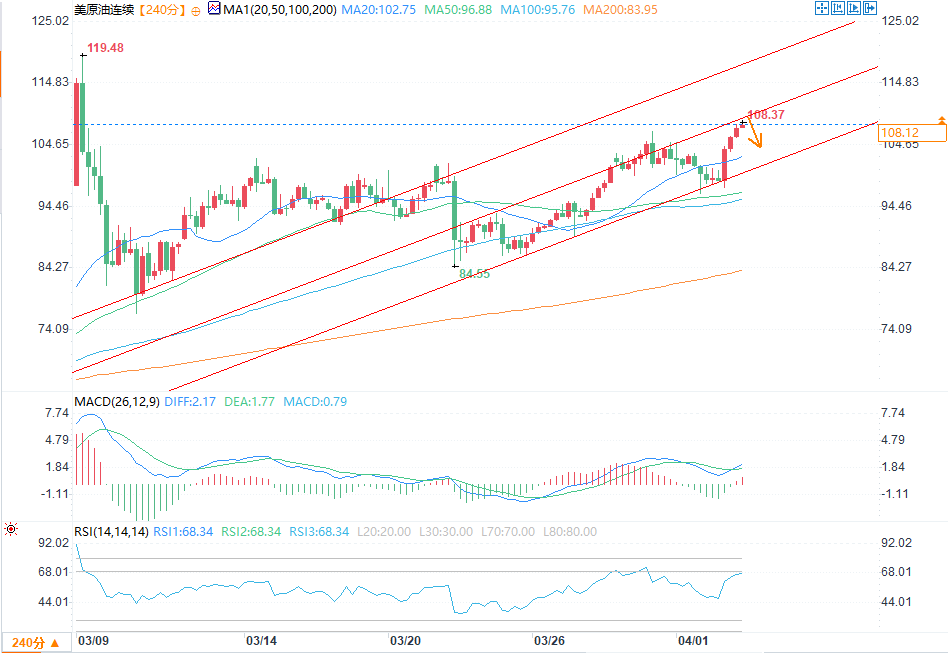
(WTI crude oil 4-hour chart source: FX678)
From a technical perspective, Brent crude oil's support level around $100/barrel remains solid. Although short-term moving averages have recovered somewhat, overall momentum has not entered an acceleration phase, and the Relative Strength Index (RSI) remains at a neutral to high level.
As seen on the 240-minute chart, WTI crude oil is currently trading within a medium-to-long-term upward channel, with lower support around $100 (combined with the MA50 and MA100 support zone), and upper resistance at $108.37. Today, WTI rebounded rapidly to around $107, briefly surpassing the MA20 (approximately $102.75) and MA50, but is currently facing resistance from the channel's middle line. The current bottom is significantly higher than at the beginning of the conflict, but the overall trend remains one of high-level range-bound trading. Short-term upside potential is limited by the upper channel line, while the $100 psychological level provides strong support. Overall, the channel and moving averages point to a "rising bottom and continued range-bound trading," making a sustained breakout of the $108-$110 resistance zone unlikely unless there is an extreme escalation of geopolitical events.
Meanwhile, while speculative long positions have rebounded, they are far from reaching the crowded levels of early 2022. A noteworthy change is the market's decreasing sensitivity to extreme scenarios: in the early stages of a conflict, oil prices above $120 per barrel were a hot topic; currently, even with relatively hawkish policy statements, oil prices have only recovered to around $108 per barrel. This phenomenon indicates that geopolitical risk premiums are gradually being absorbed by the market, and "normalization of conflict" has become an important premise for pricing.
Following U.S. President Trump's national address on the evening of April 1, Brent crude oil futures rose by more than 7% at one point, reaching a high of $108.93 per barrel, and fluctuated between $107.6 and $108.8 per barrel during the session; WTI crude oil rose between 6.4% and 7.1%, with the intraday high approaching $107.2 per barrel, and traded around $106.3 to $107 per barrel during the session.
This rebound in oil prices stands in stark contrast to the trends of the previous two trading days. Previously, oil prices had briefly fallen below $100 per barrel due to rising expectations of a ceasefire, and today's price recovery is essentially a rapid correction of the previous excessive optimism.
While Trump mentioned in his speech that the US's "core objectives" on Iran were "close to completion," he did not specify a withdrawal path or timetable. Instead, he emphasized that more severe strikes might be taken in the next two to three weeks. At the same time, he called on countries that rely on the Strait of Hormuz for energy transport to "take responsibility" in restoring normal navigation through the strait.
For markets that had previously bet on a rapid de-escalation of geopolitical tensions, such a statement lacked both specificity and moderation. Market risks not only failed to subside but were, to some extent, reaffirmed. This rise in oil prices is more of a repricing of risk premiums than the start of a new upward trend.
Many institutions see this as a realistic correction to the "ceasefire narrative," and some analysts point out that the market's previous pricing of a "rapid de-escalation" was inherently aggressive, and this rebound is simply pulling oil prices back to a more reasonable range that matches the current pace of the conflict.
The logic behind oil price movements: It's not a repeat of the 2022 Russia-Ukraine conflict.
To understand the logic behind current oil price movements, a comparative analysis can be conducted by referring to the market performance during the 2022 Russia-Ukraine conflict.
The Russia-Ukraine conflict erupted on February 24, 2022, exhibiting typical characteristics of a "sudden shock." As a key global energy supplier, Russia faced the risk of sanctions on its crude oil exports in the short term. With little room for maneuver, the market urgently repriced the energy supply chain. Brent crude oil prices surged from around $90 per barrel to nearly $139 per barrel within approximately 12 trading days. The core of that price movement was the "instantaneous imbalance" in the supply chain.
In contrast, this round of geopolitical conflict surrounding Iran exhibits a more "progressive evolution" characteristic. Over the past five weeks or so, tensions have shifted repeatedly between military operations, diplomatic contacts, and ceasefire rumors. While the Strait of Hormuz has been disturbed, it has not yet entered a state of complete and long-term closure.
This difference in pace is crucial to market pricing logic—the current market is not undergoing a one-time reassessment of risk, but rather a gradual pricing process through continuous revisions of expectations. Therefore, oil prices exhibit a pattern of "upward momentum with downward support," rather than a one-sided, out-of-control trend. This recent oil price increase is more of a release of short-term sentiment than a signal of the start of a trend-driven rise.
Why is it difficult to see a one-sided trend after a rebound?
Despite the significant intraday increase in oil prices, a market structure suggests that future oil prices are more likely to maintain a range-bound trading pattern, exhibiting clear characteristics: a gradually rising bottom, but with clearly limited upside potential. This assessment has become a consensus among a growing number of domestic sell-side institutions.
First, the prolonged conflict is gradually diminishing the impact of the geopolitical shock. Currently, the market is experiencing a dense flow of information, but lacks decisive influencing variables. While the market can react quickly to policy signals, it is difficult to form a sustained one-sided trend. Even after Trump released hawkish signals, oil prices failed to effectively break through the upper limit of the $110-$112/barrel range, indicating that the marginal impact is weakening.
Meanwhile, support around $100/barrel has continued to strengthen. Oil prices have rebounded quickly after repeatedly testing this range, reflecting market acceptance of this price level and indicating that the market is gradually adapting to an environment of "normalized conflict."
Secondly, the buffering effect on the supply side is gradually becoming apparent. Despite the uncertainty surrounding navigation in the Strait of Hormuz, the global energy supply system has not lost its resilience. US shale oil production capacity, global crude oil inventories, and alternative transportation routes are all continuously mitigating geopolitical risks.
The latest data from the U.S. Energy Information Administration (EIA) shows that global commercial crude oil inventories are increasing, and high oil prices are beginning to suppress energy demand, particularly in industrial production and transportation in Europe and Asia. Many analysts emphasize that a consensus within the industry has re-emerged: as long as there is no substantial disruption to energy supply, the higher the oil price, the more pronounced its constraining effect. Today's market performance also confirms this – after a rapid rise in oil prices, profit-taking emerged, and the upward momentum subsequently slowed.
Third, the current information structure itself does not support a one-sided trend. The market is simultaneously facing two contradictory signals: on the one hand, positive signals of ceasefire expectations, diplomatic contacts, and the restoration of air traffic; on the other hand, negative signals of the risk of military escalation and tough policy statements.
Fourth, this market environment of "coexistence of positive and negative signals" makes it difficult for funds to form a consensus, and they are more inclined to trade repeatedly within the range. The final pattern is that oil prices have support below and resistance above, and the price is locked in a continuously verified range of fluctuation.
Technical Analysis and Positioning: The Market is "Adapting" Rather Than "Crowding"
(WTI crude oil 4-hour chart source: FX678)
From a technical perspective, Brent crude oil's support level around $100/barrel remains solid. Although short-term moving averages have recovered somewhat, overall momentum has not entered an acceleration phase, and the Relative Strength Index (RSI) remains at a neutral to high level.
As seen on the 240-minute chart, WTI crude oil is currently trading within a medium-to-long-term upward channel, with lower support around $100 (combined with the MA50 and MA100 support zone), and upper resistance at $108.37. Today, WTI rebounded rapidly to around $107, briefly surpassing the MA20 (approximately $102.75) and MA50, but is currently facing resistance from the channel's middle line. The current bottom is significantly higher than at the beginning of the conflict, but the overall trend remains one of high-level range-bound trading. Short-term upside potential is limited by the upper channel line, while the $100 psychological level provides strong support. Overall, the channel and moving averages point to a "rising bottom and continued range-bound trading," making a sustained breakout of the $108-$110 resistance zone unlikely unless there is an extreme escalation of geopolitical events.
Meanwhile, while speculative long positions have rebounded, they are far from reaching the crowded levels of early 2022. A noteworthy change is the market's decreasing sensitivity to extreme scenarios: in the early stages of a conflict, oil prices above $120 per barrel were a hot topic; currently, even with relatively hawkish policy statements, oil prices have only recovered to around $108 per barrel. This phenomenon indicates that geopolitical risk premiums are gradually being absorbed by the market, and "normalization of conflict" has become an important premise for pricing.
- Risk Warning and Disclaimer
- The market involves risk, and trading may not be suitable for all investors. This article is for reference only and does not constitute personal investment advice, nor does it take into account certain users’ specific investment objectives, financial situation, or other needs. Any investment decisions made based on this information are at your own risk.