Is silver poised for a violent rebound after a 5% retracement?
2026-04-02 19:48:37
On Thursday, April 2nd, spot silver prices saw a significant pullback, with the latest price around $71 per ounce, a single-day drop of over 5%. This change occurred amidst a period of rising energy prices due to geopolitical factors, with a reassessment of inflationary pressures dominating trading sentiment. While geopolitical tensions are typically seen as a traditional positive for precious metals, in the current environment, rising oil and gas prices are driving major central bank policy expectations towards a more cautious direction, and adjustments to interest rate paths are directly weakening the attractiveness of holding precious metals.
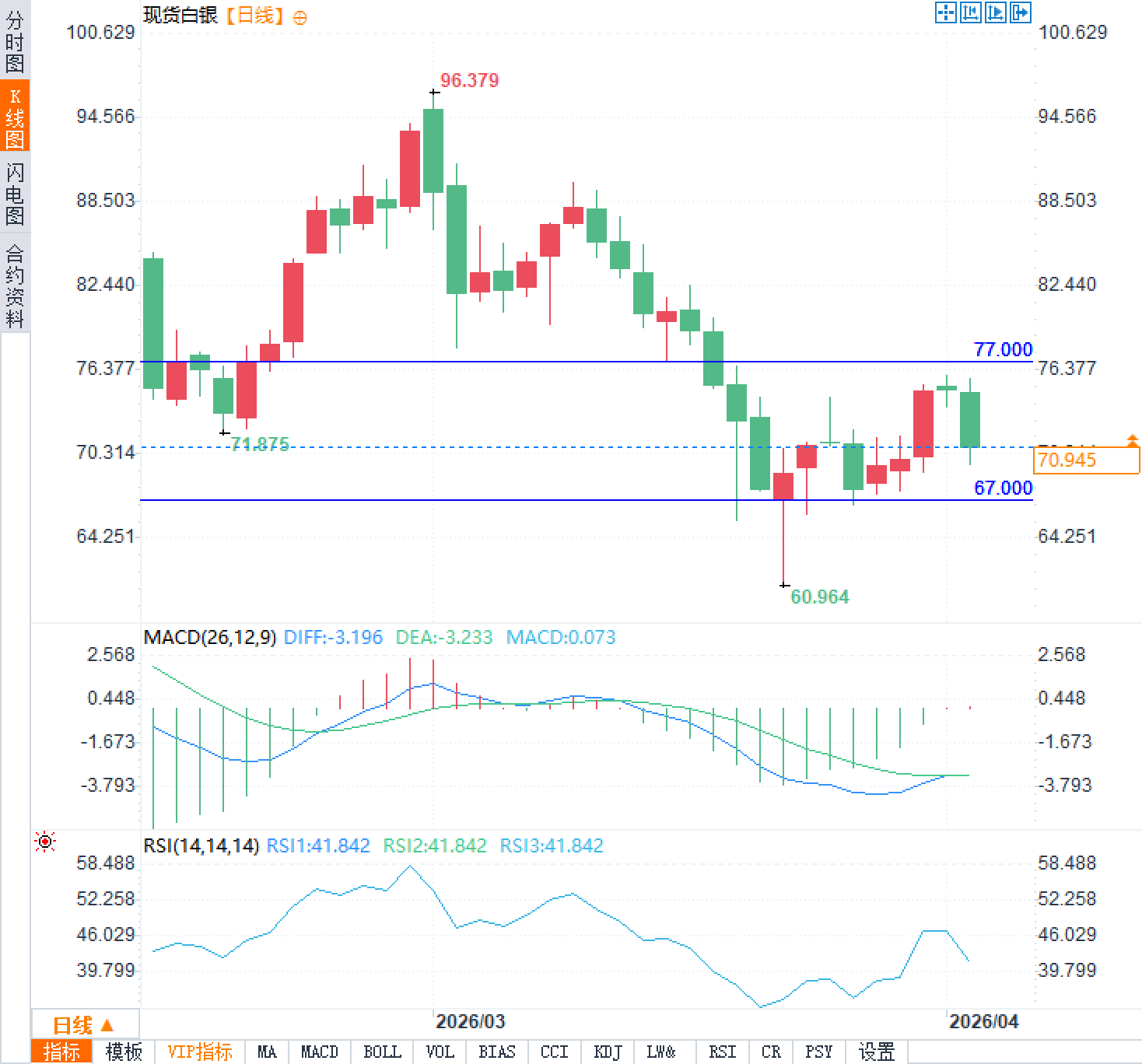
Meanwhile, technical charts show that selling pressure continues to exert force at key levels, and any short-term rebound faces rapid suppression. Overall, although spot silver has fallen by about 41% from its January high, it still records a cumulative increase of over 123% compared to the same period last year, indicating that the long-term supply and demand structure remains resilient.
The technical pattern for spot silver clearly shows that sellers have firmly held key areas recently. Prices have repeatedly tested above $75/oz before quickly retreating. The Relative Strength Index (RSI) is currently hovering around 40, far from overbought territory but not yet clearly oversold, suggesting that sellers still have room to maintain control in the short term. The current price has fallen 41% from the January peak of $121.64/oz, but its year-to-date performance remains positive, providing a technical basis for a potential bottom. Traders are watching whether the $68-70/oz support zone can hold; a break below this level could lead to further testing of lower ranges.
Geopolitical factors should have provided safe-haven support for spot silver, but this time the opposite has occurred. Rising energy prices have directly pushed up global inflation expectations, prompting major central banks to adjust their monetary policy paths, postponing previously anticipated easing and instead emphasizing maintaining interest rates at restrained levels to address price pressures. This shift stripped away the tailwinds of the low-interest-rate environment that precious metals had relied on for the past two years. Rising oil and gas costs not only increased inflation on the production side but also transmitted to the consumption side through the supply chain, forcing policymakers to prioritize price control over stimulating growth. Market pricing has already reflected a significant reduction in expectations for rate cuts by institutions such as the Federal Reserve and the European Central Bank in 2026, with even discussions about the probability of rate hikes at some points. This fundamental reassessment has directly led to a decrease in the attractiveness of precious metals; even with continued short-term geopolitical uncertainty, funds are prioritizing higher-yielding assets. Historically, similar scenarios show that when inflation expectations dominate rather than pure safe-haven demand, precious metals often experience a period of adjustment until central banks take clear action or energy pressures ease.
Over the past eight months, a surge of traders into the precious metals market has led to a sharp expansion of leveraged positions and excessive concentration of consensus trading. Entering 2026, some large institutions were forced to liquidate positions due to volatility in other assets, with precious metals being the primary source of liquidity. The forced correction at the end of January already revealed this vulnerability, and this current pullback further confirms the leverage-driven volatility. Market sentiment has shifted from optimism to caution, and fund flows show that selling pressure mainly comes from hedge funds and speculative accounts, rather than changes in real demand. The simultaneous deterioration of technical indicators and positioning data suggests that the current downtrend is not an isolated event, but a necessary step in the deleveraging process. Once this wave of liquidations ends and the broader market environment stabilizes, precious metals are expected to return to structural buying, provided that inflationary pressures are effectively managed.
Despite short-term pressures, the supply and demand fundamentals for spot silver remain in a sixth-annual deficit, projected to remain around 67 million ounces globally in 2026. Industrial demand accounts for over 60%, encompassing solar energy, electric vehicles, and electronics, with the structural growth trend unchanged. Limited growth in mineral supply, coupled with continued inventory reduction, further amplifies price elasticity. Analysts generally expect the average price to reach $81/ounce in 2026, a significant increase from 2025. This long-term support suggests that the current pullback is more of a cyclical adjustment than a trend reversal. When inflation concerns subside and central bank policies return to neutral, buying is expected to return to the market, driving prices to recover some of the losses from previous highs.
Meanwhile, technical charts show that selling pressure continues to exert force at key levels, and any short-term rebound faces rapid suppression. Overall, although spot silver has fallen by about 41% from its January high, it still records a cumulative increase of over 123% compared to the same period last year, indicating that the long-term supply and demand structure remains resilient.
Sellers continue to suppress upward momentum
The technical pattern for spot silver clearly shows that sellers have firmly held key areas recently. Prices have repeatedly tested above $75/oz before quickly retreating. The Relative Strength Index (RSI) is currently hovering around 40, far from overbought territory but not yet clearly oversold, suggesting that sellers still have room to maintain control in the short term. The current price has fallen 41% from the January peak of $121.64/oz, but its year-to-date performance remains positive, providing a technical basis for a potential bottom. Traders are watching whether the $68-70/oz support zone can hold; a break below this level could lead to further testing of lower ranges.
Fundamental Game Theory: Inflation Shocks Amid Geopolitical Tensions
Geopolitical factors should have provided safe-haven support for spot silver, but this time the opposite has occurred. Rising energy prices have directly pushed up global inflation expectations, prompting major central banks to adjust their monetary policy paths, postponing previously anticipated easing and instead emphasizing maintaining interest rates at restrained levels to address price pressures. This shift stripped away the tailwinds of the low-interest-rate environment that precious metals had relied on for the past two years. Rising oil and gas costs not only increased inflation on the production side but also transmitted to the consumption side through the supply chain, forcing policymakers to prioritize price control over stimulating growth. Market pricing has already reflected a significant reduction in expectations for rate cuts by institutions such as the Federal Reserve and the European Central Bank in 2026, with even discussions about the probability of rate hikes at some points. This fundamental reassessment has directly led to a decrease in the attractiveness of precious metals; even with continued short-term geopolitical uncertainty, funds are prioritizing higher-yielding assets. Historically, similar scenarios show that when inflation expectations dominate rather than pure safe-haven demand, precious metals often experience a period of adjustment until central banks take clear action or energy pressures ease.
Leverage position adjustments and changes in market sentiment
Over the past eight months, a surge of traders into the precious metals market has led to a sharp expansion of leveraged positions and excessive concentration of consensus trading. Entering 2026, some large institutions were forced to liquidate positions due to volatility in other assets, with precious metals being the primary source of liquidity. The forced correction at the end of January already revealed this vulnerability, and this current pullback further confirms the leverage-driven volatility. Market sentiment has shifted from optimism to caution, and fund flows show that selling pressure mainly comes from hedge funds and speculative accounts, rather than changes in real demand. The simultaneous deterioration of technical indicators and positioning data suggests that the current downtrend is not an isolated event, but a necessary step in the deleveraging process. Once this wave of liquidations ends and the broader market environment stabilizes, precious metals are expected to return to structural buying, provided that inflationary pressures are effectively managed.
Supply and Demand Outlook: Structural Gap Provides Long-Term Support
Despite short-term pressures, the supply and demand fundamentals for spot silver remain in a sixth-annual deficit, projected to remain around 67 million ounces globally in 2026. Industrial demand accounts for over 60%, encompassing solar energy, electric vehicles, and electronics, with the structural growth trend unchanged. Limited growth in mineral supply, coupled with continued inventory reduction, further amplifies price elasticity. Analysts generally expect the average price to reach $81/ounce in 2026, a significant increase from 2025. This long-term support suggests that the current pullback is more of a cyclical adjustment than a trend reversal. When inflation concerns subside and central bank policies return to neutral, buying is expected to return to the market, driving prices to recover some of the losses from previous highs.
Question 1: Why have geopolitical tensions failed to boost spot silver prices as they have in the past?
A: The recent geopolitical factors, coupled with a sharp rise in energy prices, directly triggered a surge in inflation expectations. This led major central banks to tighten policy, and adjustments to interest rate paths weakened the holding advantage of precious metals. Concentrated liquidation of leveraged positions further amplified selling pressure, causing the inflation logic to override the safe-haven logic.
Question 2: What impact will the current pullback have on the long-term trend of spot silver?
A: Although it has fallen 41% from its January high, it still maintains a positive return year-to-date, and the structural supply-demand gap persists. The pullback is mainly due to deleveraging and a shift in policy expectations, not a deterioration in fundamentals. Once energy pressures ease, prices are expected to return to an upward trend.
- Risk Warning and Disclaimer
- The market involves risk, and trading may not be suitable for all investors. This article is for reference only and does not constitute personal investment advice, nor does it take into account certain users’ specific investment objectives, financial situation, or other needs. Any investment decisions made based on this information are at your own risk.