Risk aversion recedes? Behind the euro's brief rally
2026-04-06 20:17:20
On Monday, April 6th, major financial markets were partially closed for the Easter holiday, and the euro saw a modest rebound against the US dollar. The exchange rate recovered from its intraday low of 1.1505 and is currently trading around 1.1550, but failed to hold above the intraday high of 1.1570, remaining firmly within last week's trading range. This movement was mainly driven by news of a potential ceasefire in Iran, which boosted market risk sentiment; however, traders remained cautious, as geopolitical risk premiums have not yet fully subsided.

The United States and Iran are discussing a 45-day ceasefire agreement, which, if implemented, would immediately end hostilities and reopen the Strait of Hormuz. This news injected some optimism into the market, pushing the euro to rebound from its lows against the US dollar. As a crucial passage for approximately 20% of global oil transportation, the stability of the Strait of Hormuz directly impacts energy price fluctuations and global supply chain expectations. If the ceasefire proceeds, the geopolitical premium in risk asset pricing is expected to decline, thus benefiting high-beta currencies such as the euro.
However, the market has not fully unleashed its potential. US President Trump recently reiterated that if Iran fails to reopen the Straits of Hormuz, he will take severe measures against Iranian civilian and energy infrastructure. This tough stance has cast doubt on the prospects for the agreement's implementation among traders, while the safe-haven appeal of the US dollar remains partially supported. Traders are closely monitoring changes in the correlation between energy futures volatility and the euro/dollar exchange rate; currently, oil price sensitivity remains high, and any adjustments to the negotiation details could trigger a rapid repricing of the exchange rate.
The U.S. nonfarm payrolls report released last Friday showed a net increase of 178,000 jobs in March, higher than the market expectation of 60,000. The previous figure was revised from a decrease of 92,000 to a decrease of 133,000, and the unemployment rate fell slightly to 4.3%. This data exceeded expectations, indicating that the labor market remains resilient, despite geopolitical factors causing disturbances to the overall economy.
Following the data release, the US dollar index initially found support, but the euro/dollar exchange rate did not fall significantly, indicating that easing geopolitical tensions dominated exchange rate pricing logic in the short term. Strong employment data may delay expectations of a Fed rate cut; however, in the current environment of global uncertainty, traders are more focused on the data's implications for long-term growth paths than on single-month fluctuations.
This week's focus shifts to the US March services Purchasing Managers' Index (PMI). The market widely expects the index to see a modest decline from February's robust 56.1, but still remain above 50, indicating healthy expansion. As the service sector is a major driver of the US economy, if the data meets expectations, it will further confirm the possibility of a soft landing and provide more insights into the Federal Reserve's policy.
A slowdown in the service sector, if accompanied by a decline in price indices, would alleviate inflationary pressures; conversely, a stronger-than-expected dollar could reinforce neutral-to-strong dollar expectations. In the Eurozone, the European Central Bank's recent policy signals have been cautious, diverging somewhat from the Federal Reserve's stance, providing additional support for the euro against the dollar.
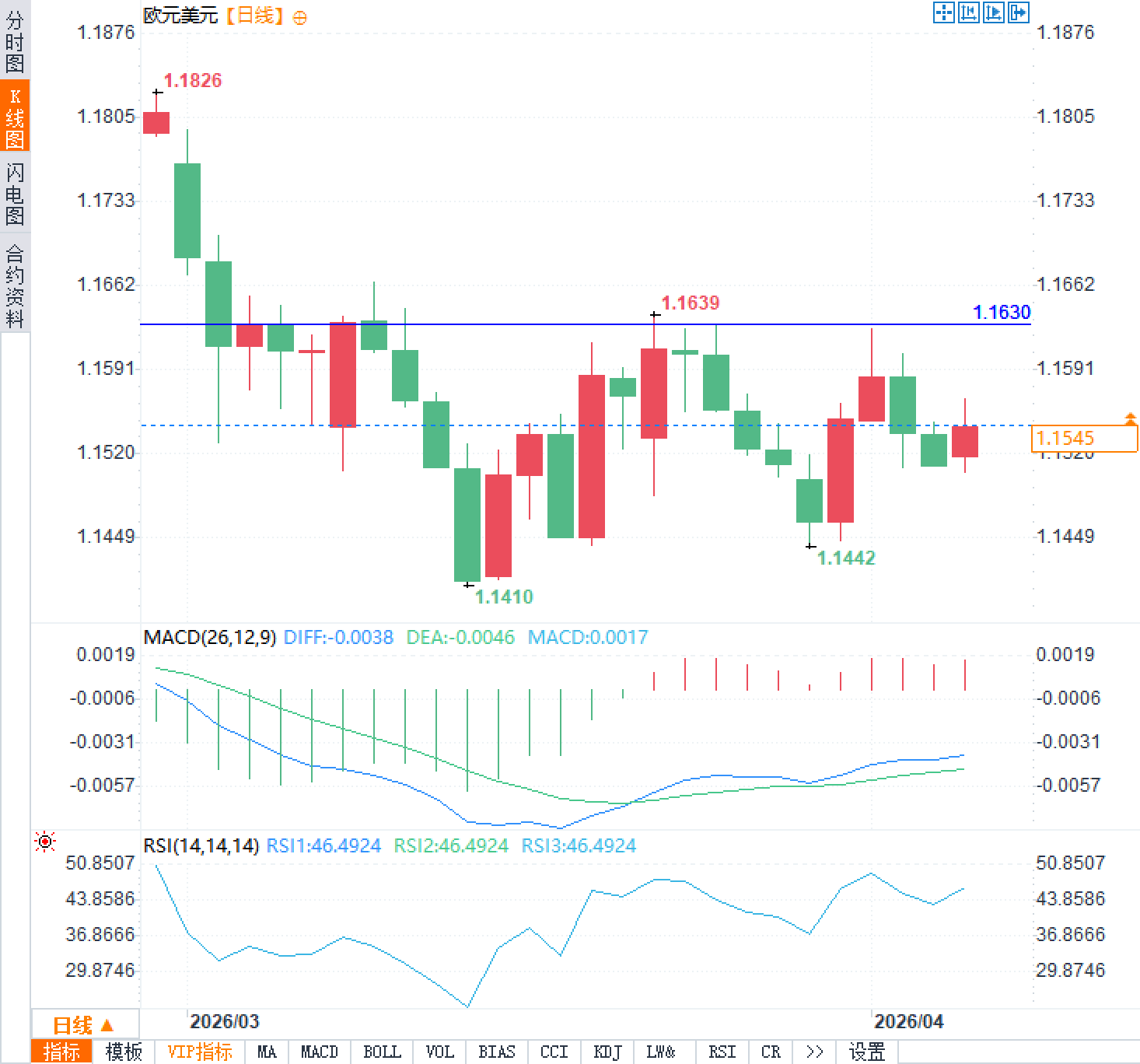
The euro/dollar pair remains trapped in a narrow range of 1.1505 to 1.1570, with narrowing Bollinger Bands indicating low volatility. The RSI indicator hovers in neutral territory, lacking clear overbought or oversold signals. While the MACD histogram is slightly positive, the momentum is insufficient to drive a breakout. If ceasefire negotiations make substantial progress, the upper limit of this range at 1.1570 could become a short-term test target; conversely, if Trump's statements further escalate tensions, the 1.1505 support level will be tested again. Overall, the technical picture lacks a clear trend signal, with range-bound trading dominating until a clear catalyst emerges from geopolitical or macroeconomic data.
Geopolitical easing boosts short-term sentiment for the euro against the dollar.
The United States and Iran are discussing a 45-day ceasefire agreement, which, if implemented, would immediately end hostilities and reopen the Strait of Hormuz. This news injected some optimism into the market, pushing the euro to rebound from its lows against the US dollar. As a crucial passage for approximately 20% of global oil transportation, the stability of the Strait of Hormuz directly impacts energy price fluctuations and global supply chain expectations. If the ceasefire proceeds, the geopolitical premium in risk asset pricing is expected to decline, thus benefiting high-beta currencies such as the euro.
However, the market has not fully unleashed its potential. US President Trump recently reiterated that if Iran fails to reopen the Straits of Hormuz, he will take severe measures against Iranian civilian and energy infrastructure. This tough stance has cast doubt on the prospects for the agreement's implementation among traders, while the safe-haven appeal of the US dollar remains partially supported. Traders are closely monitoring changes in the correlation between energy futures volatility and the euro/dollar exchange rate; currently, oil price sensitivity remains high, and any adjustments to the negotiation details could trigger a rapid repricing of the exchange rate.
Better-than-expected March non-farm payroll data bolstered the dollar's resilience.
The U.S. nonfarm payrolls report released last Friday showed a net increase of 178,000 jobs in March, higher than the market expectation of 60,000. The previous figure was revised from a decrease of 92,000 to a decrease of 133,000, and the unemployment rate fell slightly to 4.3%. This data exceeded expectations, indicating that the labor market remains resilient, despite geopolitical factors causing disturbances to the overall economy.
Following the data release, the US dollar index initially found support, but the euro/dollar exchange rate did not fall significantly, indicating that easing geopolitical tensions dominated exchange rate pricing logic in the short term. Strong employment data may delay expectations of a Fed rate cut; however, in the current environment of global uncertainty, traders are more focused on the data's implications for long-term growth paths than on single-month fluctuations.
Services PMI Outlook: Moderate Slowdown, Still in Expansion Range
This week's focus shifts to the US March services Purchasing Managers' Index (PMI). The market widely expects the index to see a modest decline from February's robust 56.1, but still remain above 50, indicating healthy expansion. As the service sector is a major driver of the US economy, if the data meets expectations, it will further confirm the possibility of a soft landing and provide more insights into the Federal Reserve's policy.
A slowdown in the service sector, if accompanied by a decline in price indices, would alleviate inflationary pressures; conversely, a stronger-than-expected dollar could reinforce neutral-to-strong dollar expectations. In the Eurozone, the European Central Bank's recent policy signals have been cautious, diverging somewhat from the Federal Reserve's stance, providing additional support for the euro against the dollar.
The technical range-bound trading pattern may continue in the short term.
The euro/dollar pair remains trapped in a narrow range of 1.1505 to 1.1570, with narrowing Bollinger Bands indicating low volatility. The RSI indicator hovers in neutral territory, lacking clear overbought or oversold signals. While the MACD histogram is slightly positive, the momentum is insufficient to drive a breakout. If ceasefire negotiations make substantial progress, the upper limit of this range at 1.1570 could become a short-term test target; conversely, if Trump's statements further escalate tensions, the 1.1505 support level will be tested again. Overall, the technical picture lacks a clear trend signal, with range-bound trading dominating until a clear catalyst emerges from geopolitical or macroeconomic data.
Frequently Asked Questions
Question 1: Why did the rumors of a ceasefire in Iran cause the euro to rebound against the US dollar?
A: If the ceasefire agreement is implemented, it will directly reduce the risk of energy price volatility and weaken the safe-haven premium of the US dollar. The expectation of the reopening of the Strait of Hormuz has eased pressure on global supply chains, and market risk sentiment has moderately improved, thus benefiting risk-sensitive currencies such as the euro. However, Trump's tough stance has limited the rebound, indicating that geopolitical uncertainty has not been completely eliminated, and exchange rates reflect short-term sentiment more than a fundamental trend change.
Question 2: Will the expected moderate slowdown in the US services PMI change the range-bound trading pattern of the euro against the US dollar?
A: If the March services PMI meets expectations of a moderate slowdown but still expansion, it will confirm the soft landing path of the US economy and provide contrasting support for policy divergence within the Eurozone. It's unlikely to break out of the 1.1505-1.1570 range in the short term, but if the data deviates significantly from expectations, it could trigger increased volatility and test the range's boundaries. The key lies in whether this data can resonate with geopolitical developments, jointly determining the direction of the exchange rate breakout.
- Risk Warning and Disclaimer
- The market involves risk, and trading may not be suitable for all investors. This article is for reference only and does not constitute personal investment advice, nor does it take into account certain users’ specific investment objectives, financial situation, or other needs. Any investment decisions made based on this information are at your own risk.