The war spread to Iran's railways, raising concerns about gold prices and inflation, but the central bank suddenly increased its stimulus measures.
2026-04-07 18:29:57
On Tuesday (April 7), during the Asian and European sessions, the market is currently betting slightly on Trump continuing TACO, the US dollar is slightly weaker, and gold prices are rising slightly by 0.5% to trade around $4,672 per ounce. The deadline for Trump's agreement with Iran (8 a.m. on Wednesday) is approaching, but aside from Trump's wavering statements, the geopolitical situation in the Middle East is itself evolving in a more dangerous direction.
According to Fars News Agency, the Mashhad Railway in Iran has suspended operations after Israel warned the country of its railway system, indicating that the scope of the conflict is expanding from military targets to critical civilian infrastructure.
Italian Defense Minister Croceto stated bluntly that the conflict with Iran has jeopardized the United States' global leadership and expressed strong concern about the risk of nuclear escalation spiraling out of control.
The Russian Foreign Ministry issued a stern warning that further attacks on Iran's Bushehr nuclear power plant could trigger a catastrophic radiation crisis far exceeding that of Chernobyl, with irreparable ecological and security consequences for the Gulf and surrounding regions.
The escalating geopolitical uncertainty has not significantly boosted gold buying; instead, it has strengthened the US dollar's global safe-haven and reserve currency attributes. Coupled with rising market expectations that global central banks will maintain hawkish policies, the attractiveness of non-interest-bearing gold has continued to weaken.
With the deadline set by Trump approaching, both the overall technical outlook and fund flows for gold are bearish.
Spot gold (XAU/USD) has maintained a weak trend for three consecutive trading days. No trend-driven selling pressure emerged in the early European session on Tuesday, and the overall price remained within the wide trading range of the previous day.
Expectations of a last-minute deal between the US and Iran continued to cool, and the strong dollar further suppressed gold prices. At the same time, market bets on major central banks maintaining high interest rates for longer continued to reinforce the downward logic for gold prices.
The market generally believes that geopolitical conflicts driving up energy prices will reignite inflationary pressures, forcing central banks such as the Federal Reserve to adopt a more hawkish policy path.
Trump's escalation of his hardline stance against Iran and threats to destroy civilian infrastructure directly pushed crude oil prices to a four-week high, while Iran responded strongly, further increasing the risk of escalation in the Middle East conflict.
The US March ISM Services PMI fell short of expectations, indicating a marginal slowdown in economic momentum. However, the price paid index rebounded sharply, raising inflationary pressures again. Coupled with the resilience of the job market shown in last Friday's non-farm payroll data, market bets on a "higher and longer" interest rate path by the Federal Reserve have intensified across the board. Dollar bulls have benefited, and the short-term downward trend of gold prices has become clearer. Traders are waiting for subsequent US macroeconomic data to guide new trading directions.
Although short-term geopolitical and interest rate expectations are suppressing gold prices, the global wave of central bank gold purchases has provided a solid floor for gold prices.
ING analysts point out that global central banks have resumed large-scale gold purchases, with Poland leading the way in net gold purchases in February, followed by continued increases from central banks in China, the Czech Republic, and other countries.
Even with a slowdown in investment inflows, official gold purchases, geopolitical risks, and the need for diversification of foreign exchange reserves will still effectively support gold prices and limit downside potential.
Data from the World Gold Council shows that after a brief slowdown in gold purchases in January, global central banks accelerated significantly in February, with many central banks maintaining a stable trend of stockpiling gold, which has become an important support for gold prices during periods of market volatility.
The People's Bank of China's continued increase in gold reserves has become a highlight of the market. Data shows that at the end of March, China's gold reserves were 74.38 million ounces (about 2,313.48 tons), an increase of 160,000 ounces (about 4.98 tons) month-on-month, marking the 17th consecutive month of increases. Moreover, the increase this month was significantly higher than the average monthly increase of less than 100,000 ounces over the previous year, indicating that the current price level has become a comfortable range for the central bank to invest.
From a trading perspective, the impact of sudden events such as war on asset prices usually does not exceed three months, and this geopolitical shock may be even shorter.
After a period of adjustment driven by rising energy inflation and interest rate expectations, gold prices will gradually return to the core logic of central bank gold purchases, the Fed's interest rate cut cycle, and the weakening of the US dollar globally. Among these, continued gold purchases by global central banks will be the core driving force supporting gold prices in the medium to long term.
From a technical perspective, spot gold continues to be suppressed by the upper rail of the upward channel. Currently, support is around 4600, while resistance is at the upper rail of the channel, around 4700.
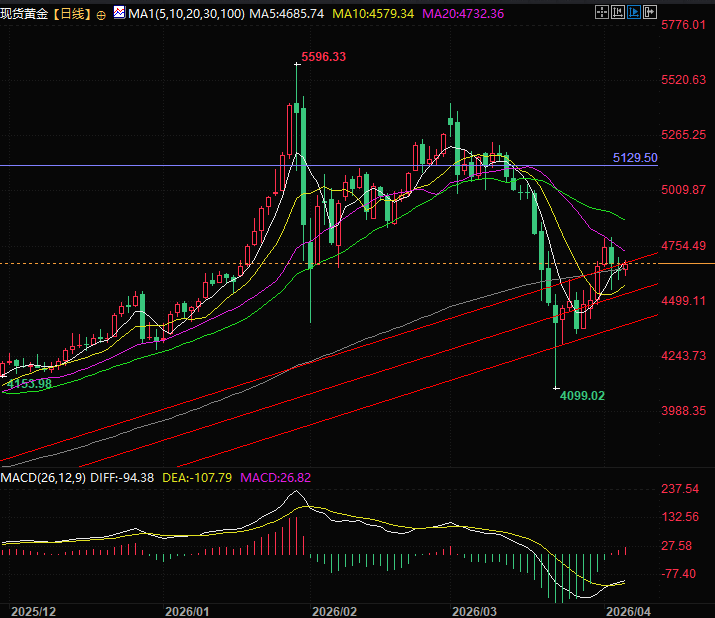
(Spot gold daily chart, source: EasyForex subsidiary)
At 18:28 Beijing time, spot gold was trading at $4,663 per ounce.
According to Fars News Agency, the Mashhad Railway in Iran has suspended operations after Israel warned the country of its railway system, indicating that the scope of the conflict is expanding from military targets to critical civilian infrastructure.
Italian Defense Minister Croceto stated bluntly that the conflict with Iran has jeopardized the United States' global leadership and expressed strong concern about the risk of nuclear escalation spiraling out of control.
The Russian Foreign Ministry issued a stern warning that further attacks on Iran's Bushehr nuclear power plant could trigger a catastrophic radiation crisis far exceeding that of Chernobyl, with irreparable ecological and security consequences for the Gulf and surrounding regions.
A stronger dollar coupled with hawkish expectations will likely keep gold prices weak in the short term.
The escalating geopolitical uncertainty has not significantly boosted gold buying; instead, it has strengthened the US dollar's global safe-haven and reserve currency attributes. Coupled with rising market expectations that global central banks will maintain hawkish policies, the attractiveness of non-interest-bearing gold has continued to weaken.
With the deadline set by Trump approaching, both the overall technical outlook and fund flows for gold are bearish.
Spot gold (XAU/USD) has maintained a weak trend for three consecutive trading days. No trend-driven selling pressure emerged in the early European session on Tuesday, and the overall price remained within the wide trading range of the previous day.
Expectations of a last-minute deal between the US and Iran continued to cool, and the strong dollar further suppressed gold prices. At the same time, market bets on major central banks maintaining high interest rates for longer continued to reinforce the downward logic for gold prices.
The market generally believes that geopolitical conflicts driving up energy prices will reignite inflationary pressures, forcing central banks such as the Federal Reserve to adopt a more hawkish policy path.
Trump's escalation of his hardline stance against Iran and threats to destroy civilian infrastructure directly pushed crude oil prices to a four-week high, while Iran responded strongly, further increasing the risk of escalation in the Middle East conflict.
The US March ISM Services PMI fell short of expectations, indicating a marginal slowdown in economic momentum. However, the price paid index rebounded sharply, raising inflationary pressures again. Coupled with the resilience of the job market shown in last Friday's non-farm payroll data, market bets on a "higher and longer" interest rate path by the Federal Reserve have intensified across the board. Dollar bulls have benefited, and the short-term downward trend of gold prices has become clearer. Traders are waiting for subsequent US macroeconomic data to guide new trading directions.
Global central banks are launching a gold-buying spree, with the People's Bank of China increasing its holdings for 17 consecutive months.
Although short-term geopolitical and interest rate expectations are suppressing gold prices, the global wave of central bank gold purchases has provided a solid floor for gold prices.
ING analysts point out that global central banks have resumed large-scale gold purchases, with Poland leading the way in net gold purchases in February, followed by continued increases from central banks in China, the Czech Republic, and other countries.
Even with a slowdown in investment inflows, official gold purchases, geopolitical risks, and the need for diversification of foreign exchange reserves will still effectively support gold prices and limit downside potential.
Data from the World Gold Council shows that after a brief slowdown in gold purchases in January, global central banks accelerated significantly in February, with many central banks maintaining a stable trend of stockpiling gold, which has become an important support for gold prices during periods of market volatility.
The People's Bank of China's continued increase in gold reserves has become a highlight of the market. Data shows that at the end of March, China's gold reserves were 74.38 million ounces (about 2,313.48 tons), an increase of 160,000 ounces (about 4.98 tons) month-on-month, marking the 17th consecutive month of increases. Moreover, the increase this month was significantly higher than the average monthly increase of less than 100,000 ounces over the previous year, indicating that the current price level has become a comfortable range for the central bank to invest.
Summary and Technical Analysis:
From a trading perspective, the impact of sudden events such as war on asset prices usually does not exceed three months, and this geopolitical shock may be even shorter.
After a period of adjustment driven by rising energy inflation and interest rate expectations, gold prices will gradually return to the core logic of central bank gold purchases, the Fed's interest rate cut cycle, and the weakening of the US dollar globally. Among these, continued gold purchases by global central banks will be the core driving force supporting gold prices in the medium to long term.
From a technical perspective, spot gold continues to be suppressed by the upper rail of the upward channel. Currently, support is around 4600, while resistance is at the upper rail of the channel, around 4700.
(Spot gold daily chart, source: EasyForex subsidiary)
At 18:28 Beijing time, spot gold was trading at $4,663 per ounce.
- Risk Warning and Disclaimer
- The market involves risk, and trading may not be suitable for all investors. This article is for reference only and does not constitute personal investment advice, nor does it take into account certain users’ specific investment objectives, financial situation, or other needs. Any investment decisions made based on this information are at your own risk.