With secret talks in Islamabad imminent, can silver regain its upward momentum?
2026-04-09 20:17:44
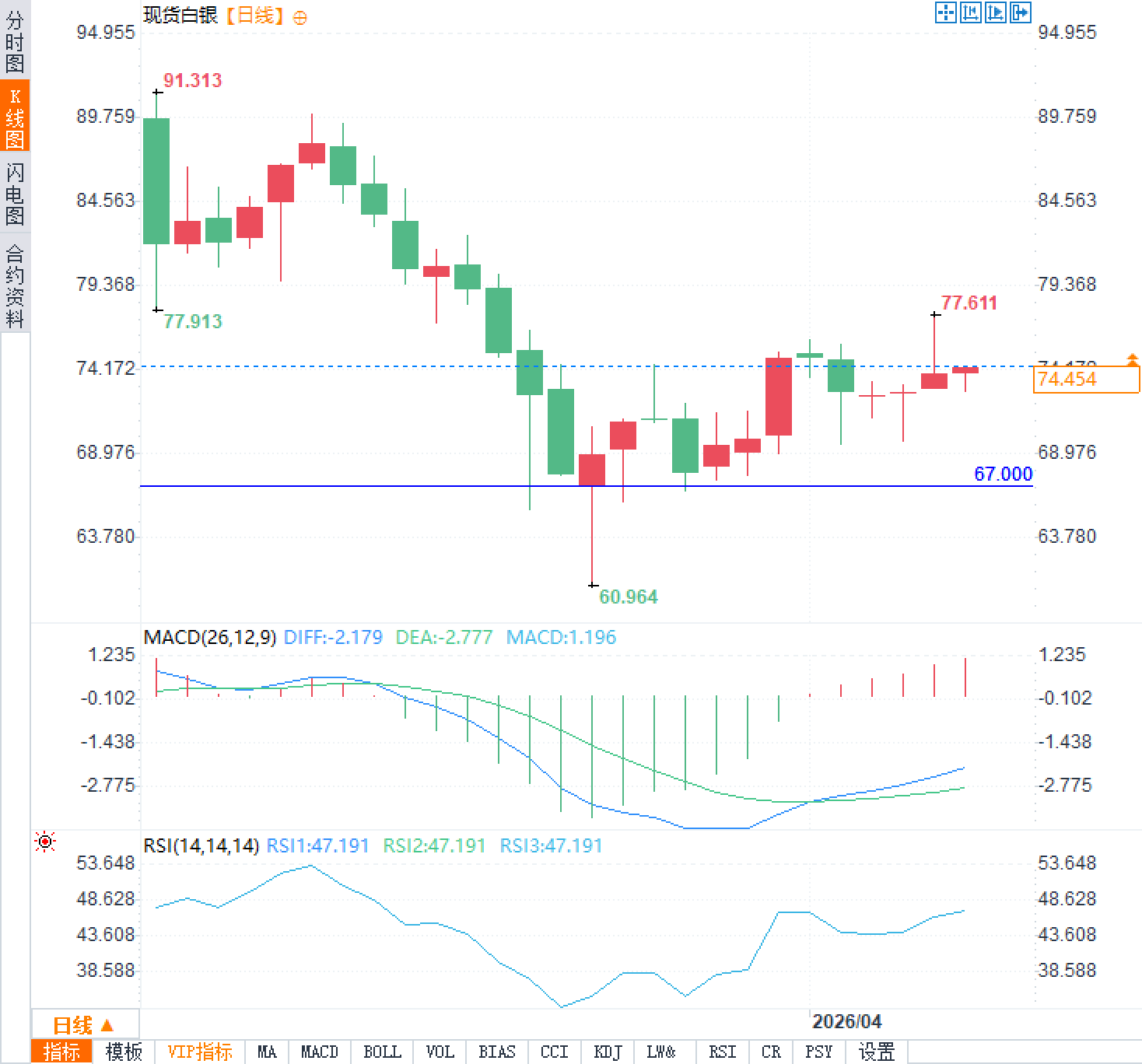
Yesterday, after the US and Iran announced a two-week ceasefire agreement, spot silver prices surged to above $77 per ounce. However, Israel's subsequent strikes against Lebanon triggered strong Iranian resentment, causing silver prices to quickly give back their gains. As of Thursday, April 9th, spot silver is trading around $74.50 per ounce, down from yesterday's high. While the ceasefire agreement is temporarily in effect, the market is highly sensitive to the formal US-Iran talks scheduled for April 11th in Islamabad. Any developments or surprises could reshape risk premiums. Traders are closely monitoring this development, as geopolitical factors combined with a tight fundamental balance are driving silver prices to switch dramatically between safe-haven and industrial attributes.
Silver prices rose after the ceasefire agreement was announced; however, Israel's strikes on Lebanon disrupted this balance, with Iran insisting that Lebanon should be included in the ceasefire, leading to uncertainty regarding its implementation. In the short term, silver prices have erased their gains, but traders have already repriced hawkish expectations, and the overall bias remains bullish.
The global silver market is projected to enter its sixth consecutive year of supply shortage in 2026, with a structural gap estimated at 67 million ounces. While mine production has reached a ten-year high, it still falls short of strong demand. Total supply is estimated at approximately 1.05 billion ounces, with mine production accounting for 820 million ounces and recycled silver contributing the remainder.
While industrial demand has slightly declined due to silver-saving technologies in photovoltaics, the expansion of electric vehicles, AI data centers, and 5G infrastructure continues to provide strong support. Investment demand has shown resilience amid risk events, with both physical ETF holdings and leveraged positions being replenished. This tight supply-demand balance provides a solid foundation for silver prices, making it difficult for prices to break down significantly even with short-term geopolitical pressures. Traders have observed that London lease rates remain high, reflecting the tightness of the physical market; this indicator often leads price rebounds.
The Federal Reserve's policy path, the dollar's trajectory, and crude oil prices are the three major macroeconomic variables influencing silver prices. In the current environment, a slight decline in real interest rates supports the overall valuation of precious metals, while oil prices have corrected due to the temporary opening of the Strait of Hormuz, further easing inflationary pressures. Although silver prices have a high correlation with gold, their volatility is greater, with a beta coefficient typically between 1.5 and 2.0. This means that silver prices often outperform gold during periods of macroeconomic improvement.
Traders should be wary of the risk of a dollar rebound; a strengthening dollar in the short term would limit the upside potential of silver prices. Historical data shows that during similar geopolitical event windows, silver prices can fluctuate by 3% to 5% daily, far exceeding normal levels. Current positioning indicates that speculative long positions have been partially reduced, but physical buying continues to accumulate at low levels, providing ammunition for a potential rebound.
Silver prices rose after the ceasefire agreement was announced; however, Israel's strikes on Lebanon disrupted this balance, with Iran insisting that Lebanon should be included in the ceasefire, leading to uncertainty regarding its implementation. In the short term, silver prices have erased their gains, but traders have already repriced hawkish expectations, and the overall bias remains bullish.
Tight supply and demand balance continues, with fundamentals providing a price floor.
The global silver market is projected to enter its sixth consecutive year of supply shortage in 2026, with a structural gap estimated at 67 million ounces. While mine production has reached a ten-year high, it still falls short of strong demand. Total supply is estimated at approximately 1.05 billion ounces, with mine production accounting for 820 million ounces and recycled silver contributing the remainder.
| project | 2026 forecast (million ounces) |
|---|---|
| mine output | 820 |
| Total supply | 1050 |
| Industrial demand | Approximately 650 |
| Investment and physical demand | Approximately 400 |
| Market gap | 67 |
Macroeconomic variables intertwine, amplifying silver price volatility.
The Federal Reserve's policy path, the dollar's trajectory, and crude oil prices are the three major macroeconomic variables influencing silver prices. In the current environment, a slight decline in real interest rates supports the overall valuation of precious metals, while oil prices have corrected due to the temporary opening of the Strait of Hormuz, further easing inflationary pressures. Although silver prices have a high correlation with gold, their volatility is greater, with a beta coefficient typically between 1.5 and 2.0. This means that silver prices often outperform gold during periods of macroeconomic improvement.
Traders should be wary of the risk of a dollar rebound; a strengthening dollar in the short term would limit the upside potential of silver prices. Historical data shows that during similar geopolitical event windows, silver prices can fluctuate by 3% to 5% daily, far exceeding normal levels. Current positioning indicates that speculative long positions have been partially reduced, but physical buying continues to accumulate at low levels, providing ammunition for a potential rebound.
Frequently Asked Questions
Question: What support will the silver market's sixth consecutive year of shortages in 2026 provide for the price center?
A: The supply gap is 67 million ounces. Although mine production has increased to 820 million ounces, it is still insufficient. Total supply cannot meet the 650 million ounces of industrial demand plus the 400 million ounces of investment demand. Solar energy savings only partially offset the increased demand from electric vehicles and data centers. The tight physical balance pushes up leasing rates, providing a long-term floor for silver prices. Even with geopolitical disturbances, fundamentals limit the downside.
- Risk Warning and Disclaimer
- The market involves risk, and trading may not be suitable for all investors. This article is for reference only and does not constitute personal investment advice, nor does it take into account certain users’ specific investment objectives, financial situation, or other needs. Any investment decisions made based on this information are at your own risk.