Crude oil trading alert: US-Iran talks fail, oil prices rise again?
2026-04-13 09:12:19
On Monday during Asian trading hours, the international crude oil market experienced significant volatility, with prices rebounding rapidly after a week of correction. The main driving factor was renewed tensions in the Middle East, particularly the escalating conflict between the US and Iran, which caused market risk sentiment to quickly shift towards safe-haven demand and supply concerns.
Latest developments indicate that the negotiations, which lasted approximately 21 hours over the weekend, failed to yield any substantial results, and the situation has clearly deteriorated. US President Trump subsequently stated that he would impose blockade measures on Iranian ports and related shipping lanes. The US Central Command further confirmed that it would formally launch a blockade of all maritime traffic entering and leaving Iranian ports on Monday. This move quickly triggered heightened market concerns about the stability of the crude oil supply chain.
Meanwhile, market research indicates that the US government is assessing the possibility of further escalation, including resuming limited military strikes. This potential risk has further exacerbated market uncertainty, significantly amplifying volatility in the energy market.
From a market perspective, WTI crude oil opened significantly higher at the beginning of the week, with an increase of approximately 8% , quickly approaching the key psychological level of $105 per barrel . Brent crude oil also strengthened, resulting in a general rise in global energy prices. It is worth noting that the Strait of Hormuz, as one of the world's most critical energy transportation routes, handles approximately 20% of global seaborne crude oil shipments ; any blockade or disruption could rapidly alter the supply and demand balance.
At the global market level, rising oil prices directly boost inflation expectations and have a potential impact on the monetary policy paths of major economies. The US dollar index remained relatively strong driven by safe-haven demand, while gold prices also received some support, demonstrating a typical risk-hedging pattern. Meanwhile, stock market performance diverged, with the energy sector benefiting significantly, while energy-intensive industries faced pressure.
In terms of market sentiment, investors are rapidly shifting from previous "expectations of easing tensions" to "pricing in escalation," with risk premiums rising significantly. Especially after the breakdown of ceasefire negotiations, the market's lack of clear expectations regarding future developments has led short-term trading to favor price fluctuations driven by geopolitical risks.
Key variables that investors are currently focusing on include: the actual effectiveness of the blockade measures, whether there is a substantial disruption in the Strait of Hormuz, and whether the United States will take further military action. These factors will directly determine whether oil prices will break through $112 and remain at high levels.
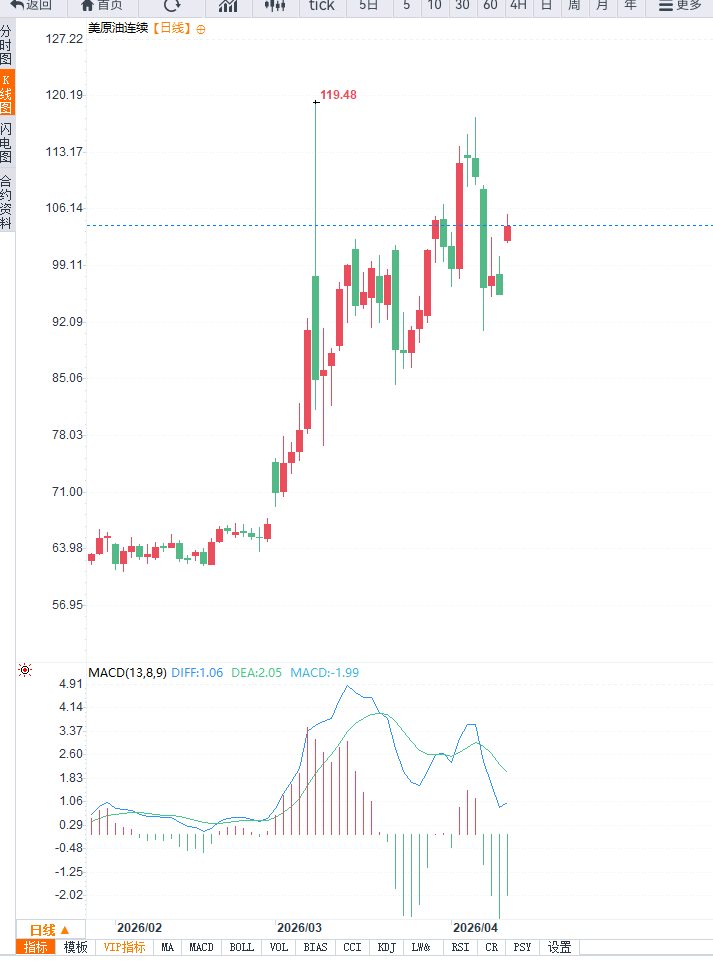
From a technical perspective, the daily chart shows that WTI crude oil has re-entered a strong upward channel. The low point formed by the previous pullback is a key short-term support level, currently around $95 . Resistance is concentrated at the $112 psychological level and the previous high area. In terms of momentum indicators, the MACD has formed a golden cross again, and the RSI has quickly rebounded to high levels, indicating a significant increase in bullish momentum, but also suggesting a certain risk of overbought conditions in the short term.
From a 4-hour chart perspective, oil prices gapped up and then maintained a high-level consolidation structure, indicating a slightly bullish short-term trend. If the price effectively breaks through and holds above $112 , it may open up further upside potential, testing the $119 area; conversely, if it rises and then falls back below $95 , it may enter a technical correction phase, filling part of the gap. Overall, short-term price movements remain highly dependent on changes in the geopolitical situation.
Editor's Summary : Overall, the core driver of this round of oil price increases stems from the escalation of geopolitical conflicts and the rapid strengthening of supply disruption expectations. The potential risk of a blockade of the Strait of Hormuz has led the market to reprice global energy supply security, a key factor pushing oil prices above $100 again. Looking ahead, if the conflict continues to escalate or even results in actual supply disruptions, oil prices may rise further and break through key resistance levels; however, if the situation shows signs of easing, market risk premiums will quickly decline, and oil prices may experience a sharp correction. On the risk side, caution is needed regarding technical corrections after short-term excessive gains and price volatility caused by policy intervention; on the opportunity side, the energy sector and related assets may still benefit from a highly volatile environment.
Latest developments indicate that the negotiations, which lasted approximately 21 hours over the weekend, failed to yield any substantial results, and the situation has clearly deteriorated. US President Trump subsequently stated that he would impose blockade measures on Iranian ports and related shipping lanes. The US Central Command further confirmed that it would formally launch a blockade of all maritime traffic entering and leaving Iranian ports on Monday. This move quickly triggered heightened market concerns about the stability of the crude oil supply chain.
Meanwhile, market research indicates that the US government is assessing the possibility of further escalation, including resuming limited military strikes. This potential risk has further exacerbated market uncertainty, significantly amplifying volatility in the energy market.
From a market perspective, WTI crude oil opened significantly higher at the beginning of the week, with an increase of approximately 8% , quickly approaching the key psychological level of $105 per barrel . Brent crude oil also strengthened, resulting in a general rise in global energy prices. It is worth noting that the Strait of Hormuz, as one of the world's most critical energy transportation routes, handles approximately 20% of global seaborne crude oil shipments ; any blockade or disruption could rapidly alter the supply and demand balance.
At the global market level, rising oil prices directly boost inflation expectations and have a potential impact on the monetary policy paths of major economies. The US dollar index remained relatively strong driven by safe-haven demand, while gold prices also received some support, demonstrating a typical risk-hedging pattern. Meanwhile, stock market performance diverged, with the energy sector benefiting significantly, while energy-intensive industries faced pressure.
In terms of market sentiment, investors are rapidly shifting from previous "expectations of easing tensions" to "pricing in escalation," with risk premiums rising significantly. Especially after the breakdown of ceasefire negotiations, the market's lack of clear expectations regarding future developments has led short-term trading to favor price fluctuations driven by geopolitical risks.
Key variables that investors are currently focusing on include: the actual effectiveness of the blockade measures, whether there is a substantial disruption in the Strait of Hormuz, and whether the United States will take further military action. These factors will directly determine whether oil prices will break through $112 and remain at high levels.
From a technical perspective, the daily chart shows that WTI crude oil has re-entered a strong upward channel. The low point formed by the previous pullback is a key short-term support level, currently around $95 . Resistance is concentrated at the $112 psychological level and the previous high area. In terms of momentum indicators, the MACD has formed a golden cross again, and the RSI has quickly rebounded to high levels, indicating a significant increase in bullish momentum, but also suggesting a certain risk of overbought conditions in the short term.
From a 4-hour chart perspective, oil prices gapped up and then maintained a high-level consolidation structure, indicating a slightly bullish short-term trend. If the price effectively breaks through and holds above $112 , it may open up further upside potential, testing the $119 area; conversely, if it rises and then falls back below $95 , it may enter a technical correction phase, filling part of the gap. Overall, short-term price movements remain highly dependent on changes in the geopolitical situation.
Editor's Summary : Overall, the core driver of this round of oil price increases stems from the escalation of geopolitical conflicts and the rapid strengthening of supply disruption expectations. The potential risk of a blockade of the Strait of Hormuz has led the market to reprice global energy supply security, a key factor pushing oil prices above $100 again. Looking ahead, if the conflict continues to escalate or even results in actual supply disruptions, oil prices may rise further and break through key resistance levels; however, if the situation shows signs of easing, market risk premiums will quickly decline, and oil prices may experience a sharp correction. On the risk side, caution is needed regarding technical corrections after short-term excessive gains and price volatility caused by policy intervention; on the opportunity side, the energy sector and related assets may still benefit from a highly volatile environment.
- Risk Warning and Disclaimer
- The market involves risk, and trading may not be suitable for all investors. This article is for reference only and does not constitute personal investment advice, nor does it take into account certain users’ specific investment objectives, financial situation, or other needs. Any investment decisions made based on this information are at your own risk.