The USD/JPY exchange rate is approaching 160! Japanese bond yields are soaring towards 1997 highs, but the Bank of Japan is hesitant to act?
2026-04-13 18:29:45
On Monday (April 13), the foreign exchange market witnessed significant volatility in yen assets amid a complex macroeconomic environment. The USD/JPY exchange rate briefly approached the 160.00 mark, as escalating international geopolitical tensions and soaring oil prices significantly heightened market concerns about inflation. The Japanese government bond (JGB) market experienced selling pressure, with the benchmark 10-year JGB yield jumping to 2.49% , its highest level since 1997. Meanwhile, due to increased external uncertainty, market expectations for a rate hike by the Bank of Japan (BoJ) at its April 28 policy meeting cooled, with the probability plummeting from 56.5% at the end of last week to below 40% .

At the crossroads of fundamentals and policy maneuvering, the yen exchange rate is not only driven by interest rate differentials but has also been pushed to the forefront of a steepening Japanese bond yield curve and potential currency intervention . As prices have rebounded to the upper limit of their high-level trading range, Japanese regulators' sensitivity to exchange rate fluctuations has reached a critical point, and market sentiment is oscillating wildly between "inflationary pressures" and "policy restraint."
From a macroeconomic perspective, the core driver of today's yen's movement stems from the sudden disruption in global energy costs. Rhetoric surrounding potential blockades of key shipping routes has fueled a surge in oil prices, directly pushing up expectations of imported inflation. This presents a double squeeze on the Japanese economy: on the one hand, Economy, Trade and Industry Minister Ryosuke Akazawa recently pointed out that boosting the yen through policy is an option to curb inflation; on the other hand, due to the complexity of the situation in the Middle East, the Bank of Japan is becoming increasingly cautious in its decision-making. In reading Governor Kazuo Ueda's remarks today, Bank of Japan Deputy Governor Ryozo Himino mentioned that although the economy is performing as expected, the transmission effects of external conflicts on prices must be closely monitored. This "wait and see" stance has weakened market pricing in a short-term interest rate hike, putting pressure on the yen.
On the fiscal policy front, the multi-year budget framework proposed today by the Council for Economic and Fiscal Policy (CEFP) is noteworthy. Private lawmakers have proposed shifting the fiscal management objective from a single-year basic fiscal balance to a sustained decline in the long-term debt-to-GDP ratio . This shift from "accommodative discipline" to "strategic proactive fiscal policy" suggests a change in the future supply structure of Japanese government bonds. Against the backdrop of tomorrow's 20-year Japanese government bond auction , the rise in long-term yields has significantly steepened the yield curve, with the 30-year yield rising by 8 basis points today. The sharp rise in bond yields should theoretically support the yen, but due to uncertainty surrounding interest rate hike expectations, this support has been offset by a stronger dollar.
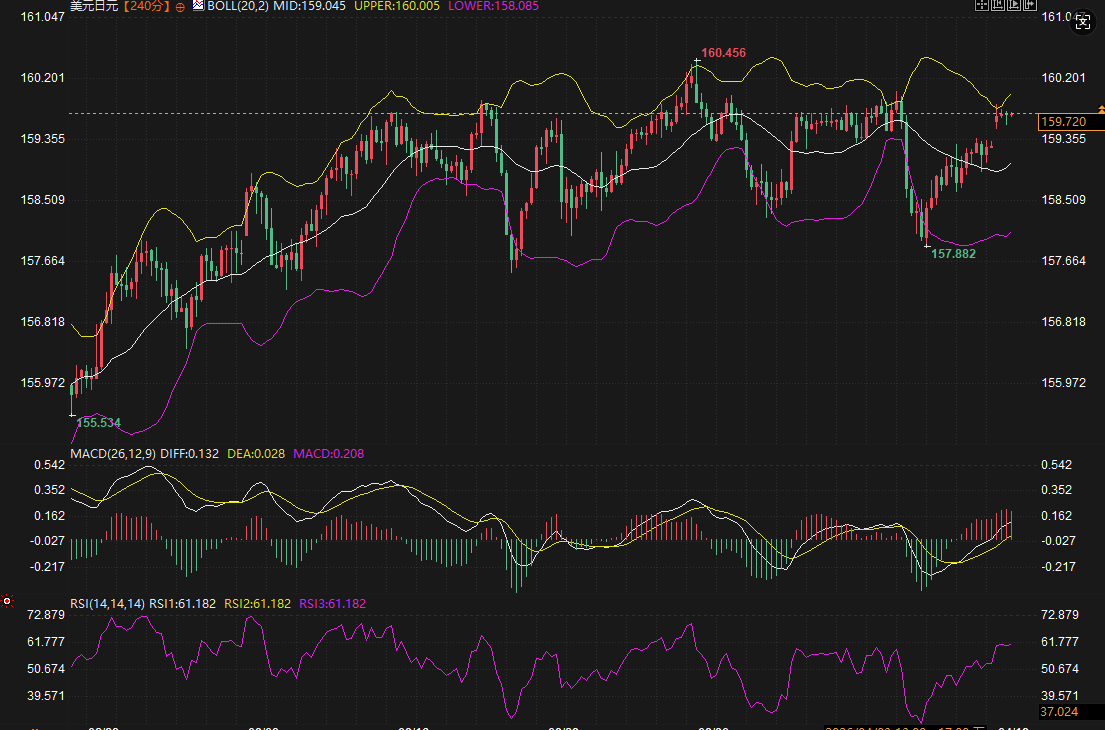
Turning to technical analysis, the USD/JPY pair shows a clear rebound from its highs on the 240-minute (4-hour) chart. After a deep pullback to 157.882 in early April, the current exchange rate has successfully recovered the Bollinger Band middle line ( 159.045 ) and is approaching the upper line.
Analysis of key technical indicators:
Bollinger Bands (BOLL): The price is currently trading between the middle and upper bands ( 160.005 ). The Bollinger Band width is showing signs of expansion, suggesting that short-term bullish momentum is building.
MACD: The DIF ( 0.132 ) and DEA ( 0.028 ) have formed a golden cross above the zero line, and the red bars continue to expand. This indicates that the medium-term rebound momentum since the pullback in early April is still strong, and there are no obvious signs of top divergence.
RSI: The current reading is approximately 61.18 , which is in the strong zone but has not yet entered the overbought zone above 70 , meaning there is still room for upward movement before touching key psychological levels.
Support and resistance range prediction:
Reference contract: USD/JPY spot.
Resistance range: 159.70 - 160.50 . Rationale: 160.00 is a crucial psychological level and a high point in sentiment influenced by tariff rhetoric, while 160.456 , the previous high from late March, is the ultimate target for the bulls.
Support range: 158.80 - 159.10 . Rationale: The Bollinger Band middle line at 159.045 is the first line of defense; if it breaks down, the next target will be the densely traded area of the previous wide-range fluctuations.
Key points to watch during trading: Be wary of potential verbal intervention or even substantive foreign exchange market operations by Japanese authorities if the exchange rate rises above 160.00 .
Looking ahead, the yen remains caught between a "policy lull" and "cost-driven inflation." With the 10-year Japanese government bond yield reaching a historic high, the logic behind the shifts in the Japan-US interest rate differential is becoming increasingly complex. In the short term, if energy prices continue to remain high, the yen may continue to face depreciation pressure.
However, with the exchange rate approaching last year's intervention warning level, volatility around 160.00 is expected to increase significantly. Traders should closely monitor demand at tomorrow's 20-year Japanese government bond auction . A dismal auction result leading to a runaway rise in long-term yields could force the Bank of Japan to adjust its remaining yield curve control (YCC) strategy or signal a clearer interest rate hike. Overall, USD/JPY has the momentum to challenge previous highs in the short term, but the difficulty of breaking through upwards increases exponentially with the risk of regulatory intervention.
1. Why did the yen not strengthen despite the 10-year Japanese government bond yield hitting a new high since 1997?
While a surge in JGB yields typically benefits the Japanese currency, the current rise is primarily driven by inflation fears triggered by soaring energy prices and the correlation with US Treasury yields. Simultaneously, uncertainty in the Middle East has shaken market confidence in a potential Bank of Japan rate hike on April 28th , reducing the probability of such a hike in interest rate swap pricing. When the yen's safe-haven status is overshadowed by negative expectations of imported inflation, the exchange rate tends to rise more in line with interest rate differentials rather than simply yield figures.
2. Has there been any substantial change in the Japanese regulators' attitude towards exchange rates?
According to Cabinet Secretary Akazawa Ryomasa, the authorities have clearly identified "yen appreciation" as one of the means to "curb inflation," reflecting a shift in policy focus from solely economic growth to balancing price stability. Although no substantial intervention has been observed so far, the longer the exchange rate stays around 160.00 , the higher the probability that Japan will resort to unconventional measures (such as instructing the Bank of Japan to buy yen).
3. What potential impact will tomorrow's 20-year Japanese bond auction have on the foreign exchange market?
Auctions of ultra-long-term bonds (20-year/30-year) serve as a barometer for market expectations regarding Japan's fiscal health and future inflation pricing. Weak demand (low oversubscription rates) will further push up long-term yields, leading to a steeper yield curve. This volatility can affect the yen through cross-market capital flows, and if a significant drop in Japanese bond prices triggers concerns about financial stability, it could force the Bank of Japan to make a more difficult choice between maintaining low interest rates and a stable exchange rate.
4. What signals are the MACD and RSI indicators currently sending?
On the 240-minute chart , the MACD golden cross and expanding red bars indicate that the rebound momentum has not yet exhausted, while the RSI near 61 suggests that the market is not yet overbought. Technically, there is room for further testing of the previous high of 160.456 . However, it should be noted that technical indicators cannot predict sudden "verbal interventions," and the effectiveness of technical signals often weakens when the exchange rate enters a high-risk zone.
5. What is a multi-year budget framework, and what is its significance for the long-term trend of the Japanese yen?
The multi-year budget aims to break Japan's traditional annual budget constraints and establish long-term fiscal support for core industries such as semiconductors. For the foreign exchange market, this suggests that Japan may maintain high levels of government debt spending in the future, shifting the performance indicator to the "debt-to-GDP ratio." This requires Japan to maintain a certain level of inflation and nominal growth, which could lead to persistent pressure on the yen's depreciation in the long run, unless the Bank of Japan simultaneously enters a substantial interest rate hike cycle.
At the crossroads of fundamentals and policy maneuvering, the yen exchange rate is not only driven by interest rate differentials but has also been pushed to the forefront of a steepening Japanese bond yield curve and potential currency intervention . As prices have rebounded to the upper limit of their high-level trading range, Japanese regulators' sensitivity to exchange rate fluctuations has reached a critical point, and market sentiment is oscillating wildly between "inflationary pressures" and "policy restraint."
Fundamental analysis and technical logic analysis
From a macroeconomic perspective, the core driver of today's yen's movement stems from the sudden disruption in global energy costs. Rhetoric surrounding potential blockades of key shipping routes has fueled a surge in oil prices, directly pushing up expectations of imported inflation. This presents a double squeeze on the Japanese economy: on the one hand, Economy, Trade and Industry Minister Ryosuke Akazawa recently pointed out that boosting the yen through policy is an option to curb inflation; on the other hand, due to the complexity of the situation in the Middle East, the Bank of Japan is becoming increasingly cautious in its decision-making. In reading Governor Kazuo Ueda's remarks today, Bank of Japan Deputy Governor Ryozo Himino mentioned that although the economy is performing as expected, the transmission effects of external conflicts on prices must be closely monitored. This "wait and see" stance has weakened market pricing in a short-term interest rate hike, putting pressure on the yen.
On the fiscal policy front, the multi-year budget framework proposed today by the Council for Economic and Fiscal Policy (CEFP) is noteworthy. Private lawmakers have proposed shifting the fiscal management objective from a single-year basic fiscal balance to a sustained decline in the long-term debt-to-GDP ratio . This shift from "accommodative discipline" to "strategic proactive fiscal policy" suggests a change in the future supply structure of Japanese government bonds. Against the backdrop of tomorrow's 20-year Japanese government bond auction , the rise in long-term yields has significantly steepened the yield curve, with the 30-year yield rising by 8 basis points today. The sharp rise in bond yields should theoretically support the yen, but due to uncertainty surrounding interest rate hike expectations, this support has been offset by a stronger dollar.
Turning to technical analysis, the USD/JPY pair shows a clear rebound from its highs on the 240-minute (4-hour) chart. After a deep pullback to 157.882 in early April, the current exchange rate has successfully recovered the Bollinger Band middle line ( 159.045 ) and is approaching the upper line.
Analysis of key technical indicators:
Bollinger Bands (BOLL): The price is currently trading between the middle and upper bands ( 160.005 ). The Bollinger Band width is showing signs of expansion, suggesting that short-term bullish momentum is building.
MACD: The DIF ( 0.132 ) and DEA ( 0.028 ) have formed a golden cross above the zero line, and the red bars continue to expand. This indicates that the medium-term rebound momentum since the pullback in early April is still strong, and there are no obvious signs of top divergence.
RSI: The current reading is approximately 61.18 , which is in the strong zone but has not yet entered the overbought zone above 70 , meaning there is still room for upward movement before touching key psychological levels.
Support and resistance range prediction:
Reference contract: USD/JPY spot.
Resistance range: 159.70 - 160.50 . Rationale: 160.00 is a crucial psychological level and a high point in sentiment influenced by tariff rhetoric, while 160.456 , the previous high from late March, is the ultimate target for the bulls.
Support range: 158.80 - 159.10 . Rationale: The Bollinger Band middle line at 159.045 is the first line of defense; if it breaks down, the next target will be the densely traded area of the previous wide-range fluctuations.
Key points to watch during trading: Be wary of potential verbal intervention or even substantive foreign exchange market operations by Japanese authorities if the exchange rate rises above 160.00 .
Future Trend Outlook
Looking ahead, the yen remains caught between a "policy lull" and "cost-driven inflation." With the 10-year Japanese government bond yield reaching a historic high, the logic behind the shifts in the Japan-US interest rate differential is becoming increasingly complex. In the short term, if energy prices continue to remain high, the yen may continue to face depreciation pressure.
However, with the exchange rate approaching last year's intervention warning level, volatility around 160.00 is expected to increase significantly. Traders should closely monitor demand at tomorrow's 20-year Japanese government bond auction . A dismal auction result leading to a runaway rise in long-term yields could force the Bank of Japan to adjust its remaining yield curve control (YCC) strategy or signal a clearer interest rate hike. Overall, USD/JPY has the momentum to challenge previous highs in the short term, but the difficulty of breaking through upwards increases exponentially with the risk of regulatory intervention.
Frequently Asked Questions
1. Why did the yen not strengthen despite the 10-year Japanese government bond yield hitting a new high since 1997?
While a surge in JGB yields typically benefits the Japanese currency, the current rise is primarily driven by inflation fears triggered by soaring energy prices and the correlation with US Treasury yields. Simultaneously, uncertainty in the Middle East has shaken market confidence in a potential Bank of Japan rate hike on April 28th , reducing the probability of such a hike in interest rate swap pricing. When the yen's safe-haven status is overshadowed by negative expectations of imported inflation, the exchange rate tends to rise more in line with interest rate differentials rather than simply yield figures.
2. Has there been any substantial change in the Japanese regulators' attitude towards exchange rates?
According to Cabinet Secretary Akazawa Ryomasa, the authorities have clearly identified "yen appreciation" as one of the means to "curb inflation," reflecting a shift in policy focus from solely economic growth to balancing price stability. Although no substantial intervention has been observed so far, the longer the exchange rate stays around 160.00 , the higher the probability that Japan will resort to unconventional measures (such as instructing the Bank of Japan to buy yen).
3. What potential impact will tomorrow's 20-year Japanese bond auction have on the foreign exchange market?
Auctions of ultra-long-term bonds (20-year/30-year) serve as a barometer for market expectations regarding Japan's fiscal health and future inflation pricing. Weak demand (low oversubscription rates) will further push up long-term yields, leading to a steeper yield curve. This volatility can affect the yen through cross-market capital flows, and if a significant drop in Japanese bond prices triggers concerns about financial stability, it could force the Bank of Japan to make a more difficult choice between maintaining low interest rates and a stable exchange rate.
4. What signals are the MACD and RSI indicators currently sending?
On the 240-minute chart , the MACD golden cross and expanding red bars indicate that the rebound momentum has not yet exhausted, while the RSI near 61 suggests that the market is not yet overbought. Technically, there is room for further testing of the previous high of 160.456 . However, it should be noted that technical indicators cannot predict sudden "verbal interventions," and the effectiveness of technical signals often weakens when the exchange rate enters a high-risk zone.
5. What is a multi-year budget framework, and what is its significance for the long-term trend of the Japanese yen?
The multi-year budget aims to break Japan's traditional annual budget constraints and establish long-term fiscal support for core industries such as semiconductors. For the foreign exchange market, this suggests that Japan may maintain high levels of government debt spending in the future, shifting the performance indicator to the "debt-to-GDP ratio." This requires Japan to maintain a certain level of inflation and nominal growth, which could lead to persistent pressure on the yen's depreciation in the long run, unless the Bank of Japan simultaneously enters a substantial interest rate hike cycle.
- Risk Warning and Disclaimer
- The market involves risk, and trading may not be suitable for all investors. This article is for reference only and does not constitute personal investment advice, nor does it take into account certain users’ specific investment objectives, financial situation, or other needs. Any investment decisions made based on this information are at your own risk.