Australian business and consumer confidence has plummeted, leaving the Reserve Bank of Australia facing a difficult policy decision and potentially prompting a pause in interest rate hikes.
2026-04-14 15:32:07
According to APP, HSBC Chief Economist Paul Brocksham stated that the current situation is quite challenging for Reserve Bank of Australia (RBA) officials, as the ongoing Middle East wars and rising interest rates are causing declining confidence among Australian businesses and consumers. The RBA may continue to focus on excessive inflation in the short term. However, once economic activity indicators show a sufficiently significant decline, suggesting a faster cooling in the job market, the market should expect the RBA to confidently predict a return to its 2.5% core inflation target, eliminating the need for further policy tightening.

Paul Blocksham recently further elaborated on this topic, stating, "The double whammy of rising interest rates and soaring oil prices is significantly weakening consumer spending, and we believe there is a greater than 50% chance that Australia's GDP will experience negative growth in the June quarter. If the war drags on, Australia will face the risk of a technical recession." This assessment is highly consistent with the current environment of high oil prices, highlighting that external geopolitical factors are being directly transmitted to households and businesses through fuel costs.
Latest market data shows that as of April 14, 2026, Brent crude oil spot prices remained in the $98-99/barrel range, still about 50% higher than pre-conflict levels, directly pushing up domestic fuel prices in Australia and exacerbating imported inflationary pressures. Meanwhile, the Westpac Consumer Confidence Index plummeted 12.5% to 80.1 points in April, the largest monthly drop since the pandemic began; business confidence indicators also fell to recent lows, with the NAB Business Confidence Index recently recording a negative value.
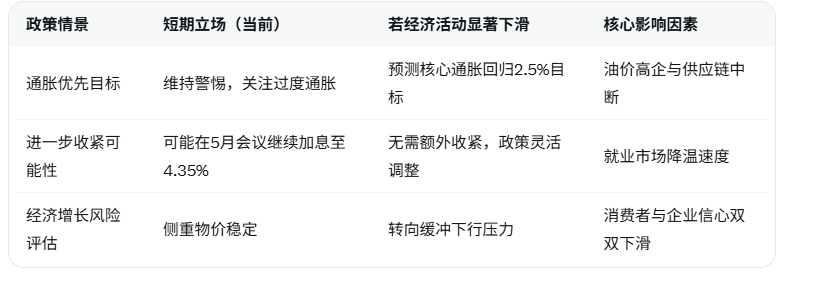
The Reserve Bank of Australia's current cash rate is 4.10%, having been raised by 25 basis points at its March meeting. In the short term, monitoring upside risks to inflation will remain a priority. However, Paul Brocksham 's analysis suggests that if subsequent employment and demand data remain weak, the central bank will have sufficient room to shift to a neutral stance to avoid excessive tightening and potential secondary damage to the real economy.
The following table compares the evolution of the Reserve Bank of Australia's policy stance under different scenarios:
This policy dilemma reflects Australia's reality as a resource exporter, yet highly susceptible to global energy price fluctuations. While high oil prices may benefit the resource sector in the short term, they erode the profits of small and medium-sized enterprises and household disposable income through fuel and logistics costs, leading to a slowdown in both consumption and investment. Coupled with the lagged effects of previous interest rate hike cycles, the risk of economic downturn is shifting from "controllable" to "intractable." If the conflict does not see substantial relief, supply chain disruptions will further amplify this transmission chain, creating compound pressure on the manufacturing and service sectors.
From a broader perspective, the current situation highlights the amplifying effect of geopolitical events on import-dependent consumer economies. Investors need to closely monitor the Reserve Bank of Australia's May meeting, employment data, and oil price trends, dynamically assessing the volatility potential of the stock market, bond market, and Australian dollar exchange rate. Overall, the rapid deterioration of confidence indicators has become a key leading signal for judging a turning point in monetary policy.
Editor's Summary : The ongoing Middle East wars and interest rate pressures have amplified the external vulnerabilities of the Australian economy. Paul Blocksham 's warnings highlight that declining confidence is becoming a key variable constraining growth. The Reserve Bank of Australia 's prudent and balanced strategy will depend on subsequent economic data. Market participants should rely on the latest indicators to flexibly manage their exposure to both inflation and recession risks.
Paul Blocksham recently further elaborated on this topic, stating, "The double whammy of rising interest rates and soaring oil prices is significantly weakening consumer spending, and we believe there is a greater than 50% chance that Australia's GDP will experience negative growth in the June quarter. If the war drags on, Australia will face the risk of a technical recession." This assessment is highly consistent with the current environment of high oil prices, highlighting that external geopolitical factors are being directly transmitted to households and businesses through fuel costs.
Latest market data shows that as of April 14, 2026, Brent crude oil spot prices remained in the $98-99/barrel range, still about 50% higher than pre-conflict levels, directly pushing up domestic fuel prices in Australia and exacerbating imported inflationary pressures. Meanwhile, the Westpac Consumer Confidence Index plummeted 12.5% to 80.1 points in April, the largest monthly drop since the pandemic began; business confidence indicators also fell to recent lows, with the NAB Business Confidence Index recently recording a negative value.
The Reserve Bank of Australia's current cash rate is 4.10%, having been raised by 25 basis points at its March meeting. In the short term, monitoring upside risks to inflation will remain a priority. However, Paul Brocksham 's analysis suggests that if subsequent employment and demand data remain weak, the central bank will have sufficient room to shift to a neutral stance to avoid excessive tightening and potential secondary damage to the real economy.
The following table compares the evolution of the Reserve Bank of Australia's policy stance under different scenarios:
This policy dilemma reflects Australia's reality as a resource exporter, yet highly susceptible to global energy price fluctuations. While high oil prices may benefit the resource sector in the short term, they erode the profits of small and medium-sized enterprises and household disposable income through fuel and logistics costs, leading to a slowdown in both consumption and investment. Coupled with the lagged effects of previous interest rate hike cycles, the risk of economic downturn is shifting from "controllable" to "intractable." If the conflict does not see substantial relief, supply chain disruptions will further amplify this transmission chain, creating compound pressure on the manufacturing and service sectors.
From a broader perspective, the current situation highlights the amplifying effect of geopolitical events on import-dependent consumer economies. Investors need to closely monitor the Reserve Bank of Australia's May meeting, employment data, and oil price trends, dynamically assessing the volatility potential of the stock market, bond market, and Australian dollar exchange rate. Overall, the rapid deterioration of confidence indicators has become a key leading signal for judging a turning point in monetary policy.
Editor's Summary : The ongoing Middle East wars and interest rate pressures have amplified the external vulnerabilities of the Australian economy. Paul Blocksham 's warnings highlight that declining confidence is becoming a key variable constraining growth. The Reserve Bank of Australia 's prudent and balanced strategy will depend on subsequent economic data. Market participants should rely on the latest indicators to flexibly manage their exposure to both inflation and recession risks.
- Risk Warning and Disclaimer
- The market involves risk, and trading may not be suitable for all investors. This article is for reference only and does not constitute personal investment advice, nor does it take into account certain users’ specific investment objectives, financial situation, or other needs. Any investment decisions made based on this information are at your own risk.