Market optimism prevails, but crude oil's resilience against the downward trend may signal the start of a rebound.
2026-04-16 16:12:46
On Thursday (April 16), international crude oil prices rebounded slightly during the Asian and European sessions. Brent crude oil futures contracts for June traded at 95.49, up 0.6%. The Strait of Hormuz remained closed. In the capital markets, the US Nasdaq index achieved a strong 11-day winning streak. The comprehensive rebound in the equity market means that the market is already fully reflecting the optimistic expectations for US-Iran peace talks.
Iranian Foreign Ministry spokesman Bagaei told RIA Novosti that the US blockade of the Strait of Hormuz is a blatant provocation that could directly lead to the collapse of the US-Iran ceasefire agreement, and that the Iranian armed forces are prepared to take necessary actions.
However, sources close to the Tehran authorities revealed that, within the framework of the relevant agreement reached between the US and Iran, Iran will most likely agree to allow ships to pass smoothly on the Omani side of the Strait of Hormuz without interfering with or attacking them, thus leaving room for easing geopolitical tensions.
The same applies to oil prices, which have recently experienced a continuous correction. Even if the US-Iran negotiations are quite optimistic, oil prices may not be able to fall further, and the upward trend in oil prices may be maintained for a long time.

According to official EIA data released on April 15, 2026, U.S. crude oil inventories unexpectedly decreased by approximately 913,000 barrels in the week ending April 10. This was the first decline in U.S. crude oil inventories in eight weeks. The adjusted total commercial crude oil inventories reached 463.8 million barrels, which is still 1% higher than the five-year average for the same period in previous years.
However, data released by the API the day before showed that crude oil inventories increased by 6.1 million barrels in the same statistical period. Such data discrepancies are quite common in the crude oil market.
The core difference between the two stems from the different nature of data collection: API is an industry association, and the data relies on members' voluntary reporting, resulting in gaps in coverage;
As a government agency, EIA enforces mandatory reporting. Failure to report or making false reports will result in legal penalties, ensuring the data's authority and completeness.
In addition, differences in statistical cycle adjustments, different calibers for strategic petroleum reserve transfers, fluctuations in crude oil imports and exports and refinery operating rates, coupled with the EIA's unique adjustment mechanism, have further widened the data discrepancies.
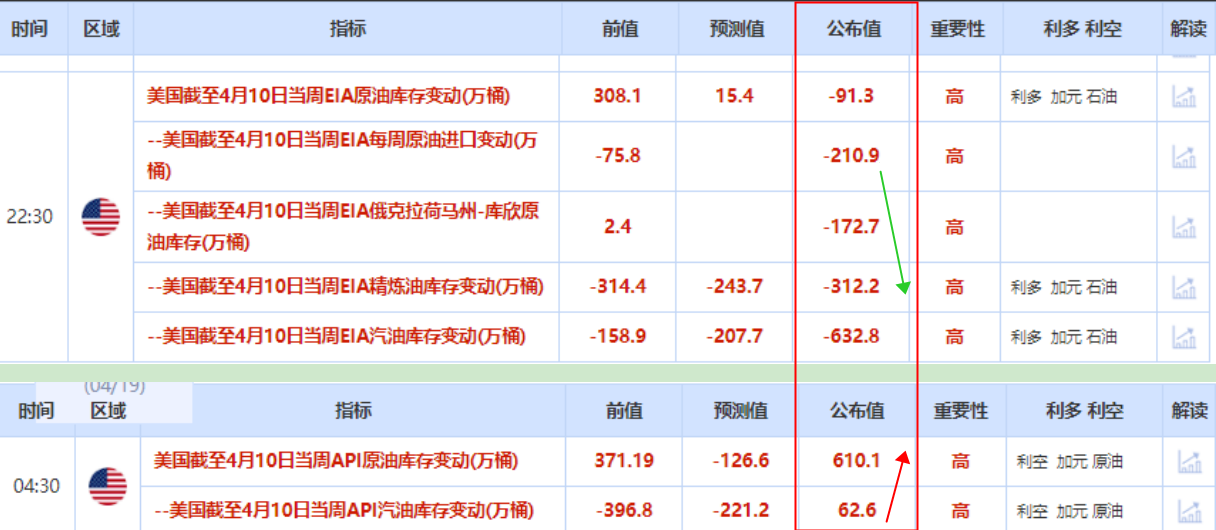
(Comparison of EIA and API data, source: EasyForex)
The current tight supply of US crude oil exports is evident. EIA data shows that US crude oil exports rebounded sharply this week, while imports decreased by about 1 million barrels per day. The API's preliminary statistics failed to capture the sudden acceleration in port exports.
Domestic oil product inventories tightened simultaneously, with gasoline inventories decreasing by 6.3 million barrels, following a 1.6 million barrel decrease the previous week, and daily gasoline production rising to 9.8 million barrels; middle distillate inventories decreased by 3.1 million barrels, and daily production fell back to 4.9 million barrels, with distillate inventories 6% lower than the five-year average.
Demand was strong, with total daily supply of refined petroleum products reaching 20.6 million barrels over the past four weeks, up 5.6% year-on-year. Daily demand for gasoline and distillate fuels both maintained steady growth, further highlighting the tight supply and demand situation for crude oil in the United States.
Even though the market is extremely optimistic about the US-Iran peace talks, the global crude oil supply gap continues to widen. Coupled with the fundamental support of declining US domestic inventories and tight exports, even if oil prices do fall back, the downside is very limited.
For crude oil traders, API data is only a leading indicator, and when the two diverge, the official EIA data should be used as the standard. Such data discrepancies often trigger short covering, which in turn leads to a more dramatic rebound in oil prices.
From a technical perspective, the price-volume relationship of the Brent crude oil June contract shows a clear bullish defensive zone. Currently, the oil price is near the neckline of a double top, and as long as it does not fall below 94, the oil price is expected to continue to rebound.
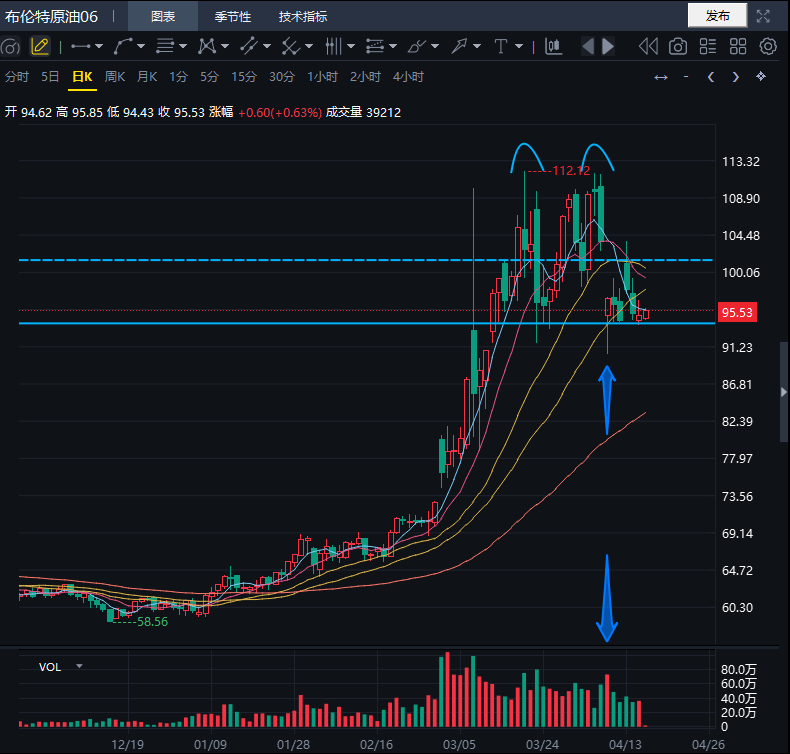
(Brent crude oil June futures contract daily chart, source: EasyForex)
At 16:08 Beijing time, Brent crude oil futures for June delivery were trading at $96.06 per barrel.
Iranian Foreign Ministry spokesman Bagaei told RIA Novosti that the US blockade of the Strait of Hormuz is a blatant provocation that could directly lead to the collapse of the US-Iran ceasefire agreement, and that the Iranian armed forces are prepared to take necessary actions.
However, sources close to the Tehran authorities revealed that, within the framework of the relevant agreement reached between the US and Iran, Iran will most likely agree to allow ships to pass smoothly on the Omani side of the Strait of Hormuz without interfering with or attacking them, thus leaving room for easing geopolitical tensions.
The same applies to oil prices, which have recently experienced a continuous correction. Even if the US-Iran negotiations are quite optimistic, oil prices may not be able to fall further, and the upward trend in oil prices may be maintained for a long time.
The data significantly deviates from the API and EIA inventory data, creating a discrepancy.
According to official EIA data released on April 15, 2026, U.S. crude oil inventories unexpectedly decreased by approximately 913,000 barrels in the week ending April 10. This was the first decline in U.S. crude oil inventories in eight weeks. The adjusted total commercial crude oil inventories reached 463.8 million barrels, which is still 1% higher than the five-year average for the same period in previous years.
However, data released by the API the day before showed that crude oil inventories increased by 6.1 million barrels in the same statistical period. Such data discrepancies are quite common in the crude oil market.
The core difference between the two stems from the different nature of data collection: API is an industry association, and the data relies on members' voluntary reporting, resulting in gaps in coverage;
As a government agency, EIA enforces mandatory reporting. Failure to report or making false reports will result in legal penalties, ensuring the data's authority and completeness.
In addition, differences in statistical cycle adjustments, different calibers for strategic petroleum reserve transfers, fluctuations in crude oil imports and exports and refinery operating rates, coupled with the EIA's unique adjustment mechanism, have further widened the data discrepancies.
(Comparison of EIA and API data, source: EasyForex)
The US supply and demand dynamics are characterized by tight crude oil exports and a broad-based tightening of oil product inventories.
The current tight supply of US crude oil exports is evident. EIA data shows that US crude oil exports rebounded sharply this week, while imports decreased by about 1 million barrels per day. The API's preliminary statistics failed to capture the sudden acceleration in port exports.
Domestic oil product inventories tightened simultaneously, with gasoline inventories decreasing by 6.3 million barrels, following a 1.6 million barrel decrease the previous week, and daily gasoline production rising to 9.8 million barrels; middle distillate inventories decreased by 3.1 million barrels, and daily production fell back to 4.9 million barrels, with distillate inventories 6% lower than the five-year average.
Demand was strong, with total daily supply of refined petroleum products reaching 20.6 million barrels over the past four weeks, up 5.6% year-on-year. Daily demand for gasoline and distillate fuels both maintained steady growth, further highlighting the tight supply and demand situation for crude oil in the United States.
Summary and Technical Analysis:
Even though the market is extremely optimistic about the US-Iran peace talks, the global crude oil supply gap continues to widen. Coupled with the fundamental support of declining US domestic inventories and tight exports, even if oil prices do fall back, the downside is very limited.
For crude oil traders, API data is only a leading indicator, and when the two diverge, the official EIA data should be used as the standard. Such data discrepancies often trigger short covering, which in turn leads to a more dramatic rebound in oil prices.
From a technical perspective, the price-volume relationship of the Brent crude oil June contract shows a clear bullish defensive zone. Currently, the oil price is near the neckline of a double top, and as long as it does not fall below 94, the oil price is expected to continue to rebound.
(Brent crude oil June futures contract daily chart, source: EasyForex)
At 16:08 Beijing time, Brent crude oil futures for June delivery were trading at $96.06 per barrel.
- Risk Warning and Disclaimer
- The market involves risk, and trading may not be suitable for all investors. This article is for reference only and does not constitute personal investment advice, nor does it take into account certain users’ specific investment objectives, financial situation, or other needs. Any investment decisions made based on this information are at your own risk.