Gold Trading Alert: Gold Prices Surge to $4,841! US-Iran Talks Resume Within Two Days, Trump Declares "The War is Over," Is the Gold Bull Market About to Erupt?
2026-04-15 07:37:15
The global gold market saw a dramatic rebound on Tuesday (April 14), with spot gold prices surging 2% to close at $4,841.56 per ounce, the highest closing price in nearly a month. US gold futures also rose 1.7% to $4,850.10. This surge, against the backdrop of the ongoing conflict with Iran, ignited strong investor expectations for gold's return as a safe-haven asset. The core driving force behind this rally was the seventh consecutive day of decline in the US dollar index, coupled with the positive news that US-Iran peace talks might resume in Pakistan. Market sentiment quickly shifted from initial panic selling to optimistic expectations of a de-escalation of the conflict, providing double support for gold prices. Analysts point out that this trend is not merely a short-term rebound, but also reflects the subtle interplay between global geopolitics, economic policies, and commodity markets. On Wednesday (April 15) in early Asian trading, spot gold traded in a narrow range at high levels, currently hovering around $4,835 per ounce.
US President Donald Trump stated in a media interview on Tuesday that negotiations aimed at ending the war with Iran could resume in Pakistan within the next two days. While talks in Islamabad over the weekend broke down, leading to Washington's blockade of Iranian ports, the latest diplomatic signals indicate that the two sides are bridging their differences through informal channels, particularly making progress on key issues such as the suspension of Iran's nuclear activities and the removal of enriched nuclear materials. A source involved in the negotiations revealed that the two sides are close to reaching an agreement that could be presented in the next round of talks, giving the fragile ceasefire a much-needed respite.
Bob Haberkorn, senior market strategist at RJO Futures, stated that the future direction of the gold market will directly depend on the progress of negotiations with Pakistan. If positive news emerges before the weekend, gold prices are expected to continue rising. Trump even declared in a Fox News interview that "the war with Iran is over," and although the ceasefire agreement remains fragile and the full interview will air on the evening of the 15th Beijing time, this statement itself has greatly alleviated market concerns about energy supply disruptions and a prolonged conflict. Shipping data from the Strait of Hormuz shows that although some ships turned back at the beginning of the blockade, actual traffic was almost unaffected on Tuesday, further confirming that diplomatic contacts are stabilizing the situation. As a traditional safe-haven asset, gold often receives support when geopolitical conflict expectations cool down due to a decline in "risk premium," and this time is no exception.
In line with easing geopolitical tensions, the US dollar index fell 0.3% to 98.10 on Tuesday, its lowest level since the start of the Iran-Iraq war, and is on track for its seventh consecutive day of decline, with a cumulative drop exceeding 2%. The weaker dollar directly increased the attractiveness of dollar-denominated gold to holders of other currencies, becoming a major driver of gold price increases. Meanwhile, international oil prices also experienced a sharp correction: US crude oil plunged 7.11% to $92.04 per barrel, and Brent crude fell to around $95 per barrel, a single-day drop of 4.39%, successfully breaking below the psychological barrier of $100.
The decline in oil prices is attributed to the easing of market panic regarding potential energy supply disruptions due to expectations of peace negotiations. Previously, in the early stages of the war, investors cashed out large amounts of gold due to concerns about energy security; this pressure has now been quickly released. Haberkorn further analyzes that the current weakening dollar and falling oil prices are jointly providing strong support for gold. On Tuesday, the International Monetary Fund (IMF) simultaneously lowered its global economic growth forecast and warned that if oil prices remain above $100 per barrel until 2027, the global economy will teeter on the brink of recession. This expectation further strengthens investor demand for gold, as gold often plays the role of a "safe haven" in an environment of uncertainty.
The U.S. Labor Department reported that the Producer Price Index (PPI) rose 0.5% month-over-month in March, far below the market expectation of 1.1%, and the 12-month year-over-year increase was 4.0%, also lower than previous forecasts. While the Iran war, which has pushed up energy prices, continues to exacerbate some inflationary pressures, positive signals of flat service sector costs made the overall data appear relatively mild. This directly contributed to the continued decline of the dollar and also subtly shifted market expectations regarding the Federal Reserve's policy.
Traders currently expect a 33% probability of only one Federal Reserve rate cut this year, a significant decrease from the two pre-war expectations. Chicago Fed President Goolsby stated that the timing of a rate cut could be delayed until 2027, depending on how long oil prices remain high. However, in the bond market, the 10-year Treasury yield fell 4.3 basis points to 4.254%, and the 30-year yield fell 3.3 basis points, flattening the yield curve. This reflects that investor optimism about a de-escalation of the conflict has outweighed inflation concerns. Gold is typically more attractive in low-interest-rate environments, and although expectations for a rate cut have weakened, the rapid decline in geopolitical risk premiums has still provided upward momentum for gold prices.
The rise in gold prices is not an isolated phenomenon. U.S. stocks rose across the board on Tuesday, with the S&P 500 climbing 1.18% to 6967.38, nearing its all-time high; the Nasdaq surged 1.96%, marking its tenth consecutive day of gains; and the Dow Jones Industrial Average also recorded its highest closing level since early March. While the energy sector led the decline due to falling oil prices, overall market sentiment has recovered from the panic of "uncertainty reaching its peak." Investors began buying on dips, with bank stocks such as BlackRock rising on strong earnings reports, and rumors of a merger between United Airlines and American Airlines also boosting their share prices.
The bond market was equally positive, with US Treasury prices rising as investors consolidated their positions while awaiting further clarity on the situation. Jim Barnes, head of fixed income at Bryn Mawr Trust, stated that the market was indeed slightly optimistic, as both the US and Iran wanted a swift resolution, reducing uncertainty. However, some analysts, such as David Rolley of Loomis Sayles, remained cautious, believing the conflict could last longer than expected, with the risk of a prolonged conflict similar to the Russia-Ukraine conflict remaining. Overall, however, the rebound in both the stock and bond markets further validated the broad positive fundamentals behind this round of gold price increases.
In summary, the recent 2% surge in gold prices is a result of the combined effects of a weaker dollar, a sharp drop in oil prices, easing geopolitical tensions, and moderate inflation data. The Trump administration's clear signal of an "exit strategy" has fueled market expectations for a symbolic agreement between the US and Iran to reopen the Strait of Hormuz, allowing gold to recover from the initial selling pressure of the war and enter a rebound phase. However, the specific dates for negotiations are still uncertain, and core disagreements such as the Iranian nuclear issue and the lifting of sanctions remain complex. Any setbacks in the diplomatic process could lead to significant fluctuations in gold prices.
From a medium- to long-term perspective, the IMF's downward revision of global economic growth and the International Energy Agency's pessimistic forecasts for oil supply and demand both suggest that macroeconomic uncertainties persist. While the Federal Reserve's policy has become more cautious due to oil price factors, the long-term support for gold from the low-interest-rate environment has not disappeared. Investors need to closely monitor the progress of the new round of negotiations with Pakistan, oil price trends, and subsequent statements from the Federal Reserve. Catalyzed by Trump's declaration that "the war is over," the gold market is at a critical turning point: if peace truly materializes, gold prices may face profit-taking pressure; however, if geopolitical risks resurface slightly, the $4840 level may only be the starting point of a new bull market. In any case, this gold price surge ignited by diplomatic glimmers has become one of the most noteworthy focuses in the global financial markets in 2026.
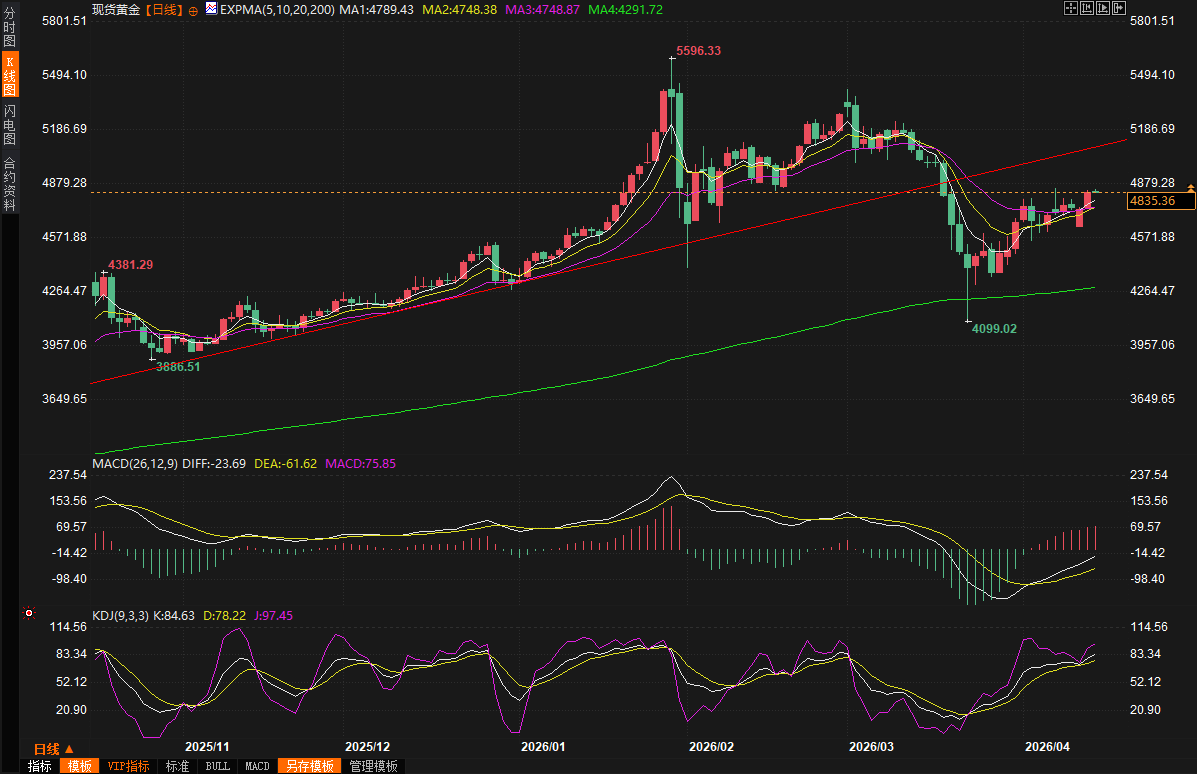
(Spot gold daily chart, source: FX678)
At 07:33 Beijing time, spot gold was trading at $4,835.52 per ounce.
Geopolitical easing: Trump announces resumption of negotiations, signaling the "end" of the Iran war.
US President Donald Trump stated in a media interview on Tuesday that negotiations aimed at ending the war with Iran could resume in Pakistan within the next two days. While talks in Islamabad over the weekend broke down, leading to Washington's blockade of Iranian ports, the latest diplomatic signals indicate that the two sides are bridging their differences through informal channels, particularly making progress on key issues such as the suspension of Iran's nuclear activities and the removal of enriched nuclear materials. A source involved in the negotiations revealed that the two sides are close to reaching an agreement that could be presented in the next round of talks, giving the fragile ceasefire a much-needed respite.
Bob Haberkorn, senior market strategist at RJO Futures, stated that the future direction of the gold market will directly depend on the progress of negotiations with Pakistan. If positive news emerges before the weekend, gold prices are expected to continue rising. Trump even declared in a Fox News interview that "the war with Iran is over," and although the ceasefire agreement remains fragile and the full interview will air on the evening of the 15th Beijing time, this statement itself has greatly alleviated market concerns about energy supply disruptions and a prolonged conflict. Shipping data from the Strait of Hormuz shows that although some ships turned back at the beginning of the blockade, actual traffic was almost unaffected on Tuesday, further confirming that diplomatic contacts are stabilizing the situation. As a traditional safe-haven asset, gold often receives support when geopolitical conflict expectations cool down due to a decline in "risk premium," and this time is no exception.
A weakening dollar and plunging oil prices: the twin engines that boost gold's value.
In line with easing geopolitical tensions, the US dollar index fell 0.3% to 98.10 on Tuesday, its lowest level since the start of the Iran-Iraq war, and is on track for its seventh consecutive day of decline, with a cumulative drop exceeding 2%. The weaker dollar directly increased the attractiveness of dollar-denominated gold to holders of other currencies, becoming a major driver of gold price increases. Meanwhile, international oil prices also experienced a sharp correction: US crude oil plunged 7.11% to $92.04 per barrel, and Brent crude fell to around $95 per barrel, a single-day drop of 4.39%, successfully breaking below the psychological barrier of $100.
The decline in oil prices is attributed to the easing of market panic regarding potential energy supply disruptions due to expectations of peace negotiations. Previously, in the early stages of the war, investors cashed out large amounts of gold due to concerns about energy security; this pressure has now been quickly released. Haberkorn further analyzes that the current weakening dollar and falling oil prices are jointly providing strong support for gold. On Tuesday, the International Monetary Fund (IMF) simultaneously lowered its global economic growth forecast and warned that if oil prices remain above $100 per barrel until 2027, the global economy will teeter on the brink of recession. This expectation further strengthens investor demand for gold, as gold often plays the role of a "safe haven" in an environment of uncertainty.
Unexpectedly mild inflation data: Fed rate cut expectations slightly adjusted, but gold still benefits.
The U.S. Labor Department reported that the Producer Price Index (PPI) rose 0.5% month-over-month in March, far below the market expectation of 1.1%, and the 12-month year-over-year increase was 4.0%, also lower than previous forecasts. While the Iran war, which has pushed up energy prices, continues to exacerbate some inflationary pressures, positive signals of flat service sector costs made the overall data appear relatively mild. This directly contributed to the continued decline of the dollar and also subtly shifted market expectations regarding the Federal Reserve's policy.
Traders currently expect a 33% probability of only one Federal Reserve rate cut this year, a significant decrease from the two pre-war expectations. Chicago Fed President Goolsby stated that the timing of a rate cut could be delayed until 2027, depending on how long oil prices remain high. However, in the bond market, the 10-year Treasury yield fell 4.3 basis points to 4.254%, and the 30-year yield fell 3.3 basis points, flattening the yield curve. This reflects that investor optimism about a de-escalation of the conflict has outweighed inflation concerns. Gold is typically more attractive in low-interest-rate environments, and although expectations for a rate cut have weakened, the rapid decline in geopolitical risk premiums has still provided upward momentum for gold prices.
Stock and bond markets rebounded in tandem: the market is gradually recovering from the worst-case scenario.
The rise in gold prices is not an isolated phenomenon. U.S. stocks rose across the board on Tuesday, with the S&P 500 climbing 1.18% to 6967.38, nearing its all-time high; the Nasdaq surged 1.96%, marking its tenth consecutive day of gains; and the Dow Jones Industrial Average also recorded its highest closing level since early March. While the energy sector led the decline due to falling oil prices, overall market sentiment has recovered from the panic of "uncertainty reaching its peak." Investors began buying on dips, with bank stocks such as BlackRock rising on strong earnings reports, and rumors of a merger between United Airlines and American Airlines also boosting their share prices.
The bond market was equally positive, with US Treasury prices rising as investors consolidated their positions while awaiting further clarity on the situation. Jim Barnes, head of fixed income at Bryn Mawr Trust, stated that the market was indeed slightly optimistic, as both the US and Iran wanted a swift resolution, reducing uncertainty. However, some analysts, such as David Rolley of Loomis Sayles, remained cautious, believing the conflict could last longer than expected, with the risk of a prolonged conflict similar to the Russia-Ukraine conflict remaining. Overall, however, the rebound in both the stock and bond markets further validated the broad positive fundamentals behind this round of gold price increases.
Gold Market Outlook: Can the Bull Market Continue Amidst the Dawn of Peace? Risks and Opportunities Coexist.
In summary, the recent 2% surge in gold prices is a result of the combined effects of a weaker dollar, a sharp drop in oil prices, easing geopolitical tensions, and moderate inflation data. The Trump administration's clear signal of an "exit strategy" has fueled market expectations for a symbolic agreement between the US and Iran to reopen the Strait of Hormuz, allowing gold to recover from the initial selling pressure of the war and enter a rebound phase. However, the specific dates for negotiations are still uncertain, and core disagreements such as the Iranian nuclear issue and the lifting of sanctions remain complex. Any setbacks in the diplomatic process could lead to significant fluctuations in gold prices.
From a medium- to long-term perspective, the IMF's downward revision of global economic growth and the International Energy Agency's pessimistic forecasts for oil supply and demand both suggest that macroeconomic uncertainties persist. While the Federal Reserve's policy has become more cautious due to oil price factors, the long-term support for gold from the low-interest-rate environment has not disappeared. Investors need to closely monitor the progress of the new round of negotiations with Pakistan, oil price trends, and subsequent statements from the Federal Reserve. Catalyzed by Trump's declaration that "the war is over," the gold market is at a critical turning point: if peace truly materializes, gold prices may face profit-taking pressure; however, if geopolitical risks resurface slightly, the $4840 level may only be the starting point of a new bull market. In any case, this gold price surge ignited by diplomatic glimmers has become one of the most noteworthy focuses in the global financial markets in 2026.
(Spot gold daily chart, source: FX678)
At 07:33 Beijing time, spot gold was trading at $4,835.52 per ounce.
- Risk Warning and Disclaimer
- The market involves risk, and trading may not be suitable for all investors. This article is for reference only and does not constitute personal investment advice, nor does it take into account certain users’ specific investment objectives, financial situation, or other needs. Any investment decisions made based on this information are at your own risk.