Easing geopolitical tensions boosted risk appetite, while the US dollar index continued its correction.
2026-04-16 14:14:14
The US dollar index continued its downward pressure during Thursday's Asian trading session, hovering around 97.90 , extending its decline since April 6. The current overall weakness of the dollar is mainly due to the combined effects of improved market risk sentiment and changes in macroeconomic interest rate expectations.
Geopolitical tensions between the United States and Iran have shown signs of easing, with markets anticipating a gradual de-escalation of the conflict and even the possibility of a ceasefire extension of about two weeks to facilitate long-term negotiations. Despite remaining uncertainties, overall risk premiums have declined significantly, driving capital outflows from safe-haven assets such as the US dollar.
Meanwhile, although the Strait of Hormuz remains effectively restricted, the restoration of some passage mechanisms after negotiations are reached would help further stabilize energy supply expectations. This shift in expectations is suppressing oil risk premiums, thus indirectly impacting the US dollar.
The decline in oil prices has become one of the key factors currently suppressing the US dollar. Lower energy prices have eased global inflationary pressures, significantly cooling market expectations for further interest rate hikes by the Federal Reserve. Currently, the market widely expects the Fed to keep interest rates unchanged this month and likely maintain high interest rates throughout the year, meaning the dollar's interest rate advantage is gradually narrowing.
From the perspective of inflation transmission mechanisms, energy prices remain a key variable. Federal Reserve official Beth Hammark pointed out that the current focus should be on the magnitude and duration of energy price increases, while Musshalam emphasized that the oil price shock triggered by the Middle East situation could push core inflation to around 3% . This means that although short-term inflationary pressures have eased somewhat, structural pressures still exist.
Against this backdrop, the US dollar is caught in a game of "declining inflation expectations vs. persistent structural inflation," but the market is currently pricing in the former, thus driving the dollar index to continue to weaken.
From the perspective of the overall market structure, the US dollar index has broken through the short-term consolidation platform and entered a bearish phase, but it has not yet formed an accelerated downward trend. Instead, it is more inclined to a pattern of "slow decline + downward fluctuation".
From a technical perspective, on the daily chart, the US dollar index has formed a continuous bearish candlestick pattern after falling from its highs, with the price trading below short-term moving averages, indicating that the downtrend is dominant. The key resistance level is currently around 98.50 , which is a previous rebound high and a cluster of moving averages; further resistance lies at 99.20 . A retest and hold above this level could potentially reverse the short-term weakness.
On the downside, initial support is located in the 97.50 area, a recent area of concentrated lows; further support lies at 96.80 . A break below this area could open up further downside potential. Looking at momentum indicators, the RSI continues to run below 50, indicating that bearish momentum dominates, but it has not yet entered an extremely oversold state, meaning that the downward trend may continue, but the pace could be erratic.
The short-term 4-hour chart shows that the US dollar index maintains its downward channel structure, with rebounds consistently limited, indicating strong bearish control. The MACD indicator continues to operate below the zero line without significant correction, suggesting that downward momentum still dominates. However, there is a short-term technical rebound potential; if the rebound is capped at the 98.30 area, it may continue to fall back to test lower support levels.
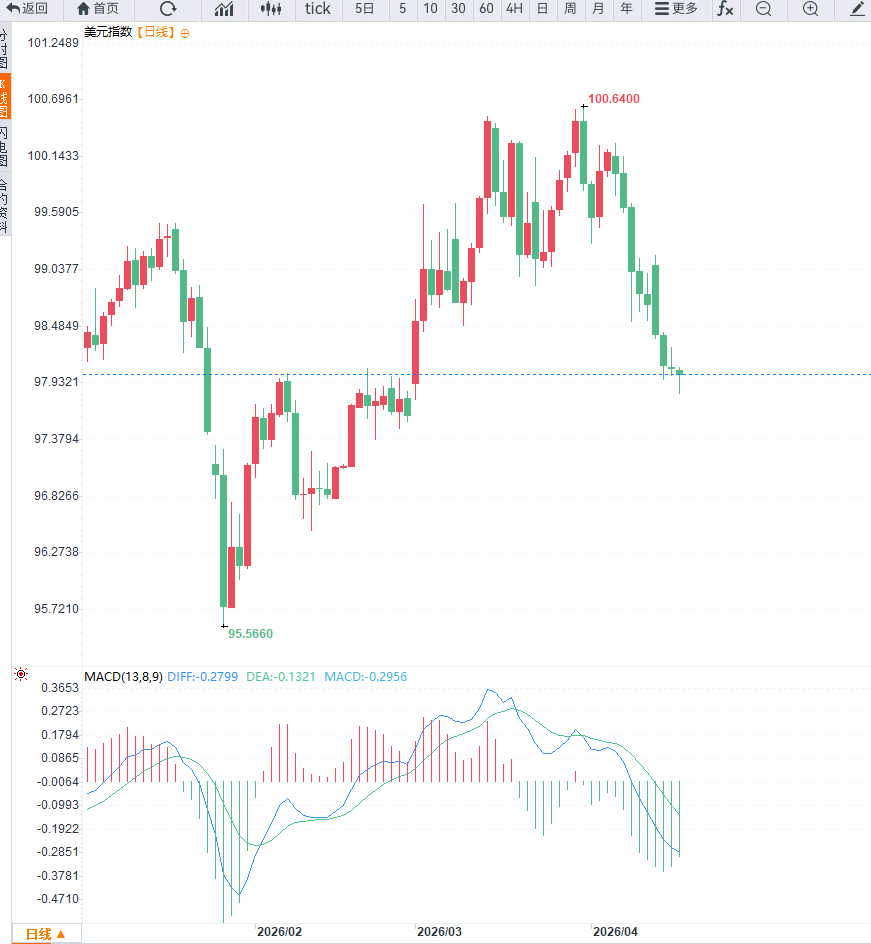
Overall, the US dollar index is currently in a "weak downward cycle driven by risk sentiment," but because the inflation structure is not yet fully stable, the market has not formed a one-sided accelerated decline.
Editor's Summary : Overall, the decline in the US dollar index was mainly driven by improved risk sentiment and falling energy prices. These two factors together weakened the dollar's safe-haven appeal and interest rate expectations. However, structurally, inflation remains sticky, and the Federal Reserve has not entered a clear easing cycle, thus the dollar still possesses some resilience. Its future trajectory hinges on three key factors: whether the situation in the Middle East continues to ease, whether oil prices fall further, and whether inflation data rebounds. Against this backdrop, the US dollar index is likely to maintain a weak and volatile downward trend in the short term, but the risk of a technical rebound should still be monitored.
Geopolitical tensions between the United States and Iran have shown signs of easing, with markets anticipating a gradual de-escalation of the conflict and even the possibility of a ceasefire extension of about two weeks to facilitate long-term negotiations. Despite remaining uncertainties, overall risk premiums have declined significantly, driving capital outflows from safe-haven assets such as the US dollar.
Meanwhile, although the Strait of Hormuz remains effectively restricted, the restoration of some passage mechanisms after negotiations are reached would help further stabilize energy supply expectations. This shift in expectations is suppressing oil risk premiums, thus indirectly impacting the US dollar.
The decline in oil prices has become one of the key factors currently suppressing the US dollar. Lower energy prices have eased global inflationary pressures, significantly cooling market expectations for further interest rate hikes by the Federal Reserve. Currently, the market widely expects the Fed to keep interest rates unchanged this month and likely maintain high interest rates throughout the year, meaning the dollar's interest rate advantage is gradually narrowing.
From the perspective of inflation transmission mechanisms, energy prices remain a key variable. Federal Reserve official Beth Hammark pointed out that the current focus should be on the magnitude and duration of energy price increases, while Musshalam emphasized that the oil price shock triggered by the Middle East situation could push core inflation to around 3% . This means that although short-term inflationary pressures have eased somewhat, structural pressures still exist.
Against this backdrop, the US dollar is caught in a game of "declining inflation expectations vs. persistent structural inflation," but the market is currently pricing in the former, thus driving the dollar index to continue to weaken.
From the perspective of the overall market structure, the US dollar index has broken through the short-term consolidation platform and entered a bearish phase, but it has not yet formed an accelerated downward trend. Instead, it is more inclined to a pattern of "slow decline + downward fluctuation".
From a technical perspective, on the daily chart, the US dollar index has formed a continuous bearish candlestick pattern after falling from its highs, with the price trading below short-term moving averages, indicating that the downtrend is dominant. The key resistance level is currently around 98.50 , which is a previous rebound high and a cluster of moving averages; further resistance lies at 99.20 . A retest and hold above this level could potentially reverse the short-term weakness.
On the downside, initial support is located in the 97.50 area, a recent area of concentrated lows; further support lies at 96.80 . A break below this area could open up further downside potential. Looking at momentum indicators, the RSI continues to run below 50, indicating that bearish momentum dominates, but it has not yet entered an extremely oversold state, meaning that the downward trend may continue, but the pace could be erratic.
The short-term 4-hour chart shows that the US dollar index maintains its downward channel structure, with rebounds consistently limited, indicating strong bearish control. The MACD indicator continues to operate below the zero line without significant correction, suggesting that downward momentum still dominates. However, there is a short-term technical rebound potential; if the rebound is capped at the 98.30 area, it may continue to fall back to test lower support levels.
Overall, the US dollar index is currently in a "weak downward cycle driven by risk sentiment," but because the inflation structure is not yet fully stable, the market has not formed a one-sided accelerated decline.
Editor's Summary : Overall, the decline in the US dollar index was mainly driven by improved risk sentiment and falling energy prices. These two factors together weakened the dollar's safe-haven appeal and interest rate expectations. However, structurally, inflation remains sticky, and the Federal Reserve has not entered a clear easing cycle, thus the dollar still possesses some resilience. Its future trajectory hinges on three key factors: whether the situation in the Middle East continues to ease, whether oil prices fall further, and whether inflation data rebounds. Against this backdrop, the US dollar index is likely to maintain a weak and volatile downward trend in the short term, but the risk of a technical rebound should still be monitored.
- Risk Warning and Disclaimer
- The market involves risk, and trading may not be suitable for all investors. This article is for reference only and does not constitute personal investment advice, nor does it take into account certain users’ specific investment objectives, financial situation, or other needs. Any investment decisions made based on this information are at your own risk.