Why did crude oil prices surge again? Investors struggle to trade amidst headlines.
2026-04-17 02:36:46
On Thursday (April 16), international crude oil futures rebounded sharply during the US trading session. Brent crude rose by more than 4% at one point, while WTI crude rose by more than 3%, and some physical crude oil prices in the spot market continued to remain high. This "re-emergence surge" did not stem from a new round of escalation of conflict, but rather from the market's complex interpretation of the latest geopolitical signals: the news of a short-term ceasefire provided a respite, but the reality that "a truly comprehensive agreement may take six months" reminded investors that risk premiums had risen again. Investors traded with difficulty amidst extreme volatility driven by "headlines," and while short-term anxiety seemed to have eased, long-term uncertainty continued to support oil prices.
Key positive news tonight: Trump announces a 10-day ceasefire between Israel and Lebanon, potentially restarting Iran negotiations.
Trump announced a 10-day ceasefire agreement between Israel and Lebanon on TruthSocial tonight, calling it his "tenth war resolved." This marks another significant development in Middle East diplomacy in recent weeks. Under US pressure, Israel has agreed to direct dialogue with the Lebanese president for the first time in 34 years.
Meanwhile, Trump has repeatedly stated publicly that US-Iran negotiations are "very likely to resume in the coming days," possibly in Pakistan or Europe. Sources familiar with the matter revealed that Iran has accepted previously unacceptable proposals, and the US is open to a second round of talks. Although the first round of talks in Islamabad over the weekend failed to achieve a breakthrough, both sides made progress on "thorny issues." The White House confirmed that it is discussing extending the current two-week ceasefire to allow more time for negotiations.
These news items directly alleviated market panic regarding a prolonged blockade of the Strait of Hormuz. The strait's disruption has already hampered approximately 20% of global oil and gas transport, causing physical crude oil prices to surge to nearly $150 per barrel. The combination of a ceasefire and the resumption of negotiations is seen as a key signal of a "short-term resolution of anxieties"—even though full peace may take time, the immediate military risk has significantly decreased.
A stark reminder: Officials say a "real ceasefire may take six months," meaning short-term gains do not equate to a long-term solution.
Alongside the optimism comes a more pragmatic assessment. Reports indicate that US officials have explicitly stated that finalizing a comprehensive agreement on Iran "may take six months." This echoes the reality that while the Gaza ceasefire has been in place for six months, reconstruction remains fraught with difficulties. The market interprets this as meaning that the current two-week ceasefire and 10-day ceasefire in Lebanon are merely "buying time," with core issues such as the complete lifting of sanctions, reopening of the Straits, and disarmament of militias still requiring lengthy negotiations.
This is why oil prices did not collapse due to the ceasefire news; instead, they rebounded under the dual logic of "short-term anxiety easing + long-term risks remaining." Analysts point out that this "fragile ceasefire" is a typical characteristic of the current market: Israeli officials privately admitted that the ceasefire in Lebanon was "forced" to be accepted, and the conflict within Lebanon could spill over at any time; Iran also continues to threaten Red Sea shipping as leverage.
Market characteristics: Trading is "too difficult," and volatility is the headline.
Several energy traders admitted, "Trading in this market is too difficult." In recent weeks, oil prices have fluctuated by 5-10% daily, completely dominated by headlines such as Trump's tweets, Iranian statements, and Israeli actions. Fundamental analysis has given way to "fear and headlines." Even with relatively ample US inventories and the potential release of strategic petroleum reserves, geopolitical risk premiums have firmly locked oil prices above the $90-$100 range.
Analysts from Bloomberg, Reuters, and other institutions agree that oil prices will remain volatile at high levels in the short term. As long as actual traffic in the Strait of Hormuz does not significantly recover (a large number of oil tankers remain stranded), any delays in negotiations or unforeseen events could push prices higher. Some institutions have even warned that if there is no substantial progress in negotiations next week, oil prices could return to $110.
The supply chain shock is still unfolding. (Review)
Over the past six weeks: Following the US-Israeli military action against Iran at the end of February, the Strait of Hormuz was effectively closed, forcing several countries (Iraq, Saudi Arabia, and the UAE) to reduce production or declare force majeure. The Brent-WTI price spread widened to $25 per barrel at one point, with European and Asian refineries paying record premiums to compete for non-Middle Eastern crude oil. Even with a ceasefire, infrastructure repairs and the reopening of the tanker will take several weeks.
The good news is that Trump's statement that "the end of the war is in sight" has spurred the stock market to record highs, reflecting market hopes for long-term peace. However, the energy market is more cautious—the logic of "buy the rumor, sell the fact" remains.
Summary and Outlook
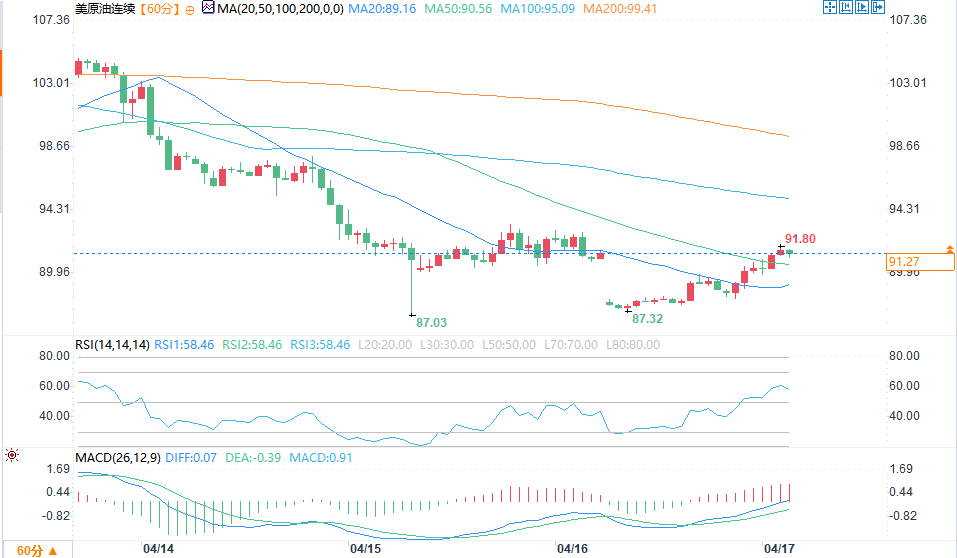
(WTI crude oil daily chart source: FX678)
Tonight's surge in crude oil prices is a result of both short-term geopolitical gains (a ceasefire in Lebanon and the resumption of negotiations with Iran) and long-term realities (a six-month timetable for an agreement). It reflects the market's pricing in a "fragile peace": short-term anxieties have been partially resolved, but the risk premium has not completely subsided. Investors need to be highly vigilant for any leaks of negotiation details or unexpected events—this is the harsh reality of the current "headline market."
The second round of US-Iran talks next week will be the focus. If the ceasefire can be extended and a preliminary consensus can be reached on reopening the Strait of Hormuz, oil prices may face downward pressure; otherwise, prices are more likely to rise than fall. In any case, traders' most realistic feeling remains the old adage: "In this market, survival is victory." Crude oil price movements will continue to be dominated by every piece of news from the Middle East.
At 02:31 Beijing time, WTI crude oil was trading at $91.31 per barrel, up 3.61%. Brent crude oil was trading at $99.47 per barrel, up 4.59%.
Key positive news tonight: Trump announces a 10-day ceasefire between Israel and Lebanon, potentially restarting Iran negotiations.
Trump announced a 10-day ceasefire agreement between Israel and Lebanon on TruthSocial tonight, calling it his "tenth war resolved." This marks another significant development in Middle East diplomacy in recent weeks. Under US pressure, Israel has agreed to direct dialogue with the Lebanese president for the first time in 34 years.
Meanwhile, Trump has repeatedly stated publicly that US-Iran negotiations are "very likely to resume in the coming days," possibly in Pakistan or Europe. Sources familiar with the matter revealed that Iran has accepted previously unacceptable proposals, and the US is open to a second round of talks. Although the first round of talks in Islamabad over the weekend failed to achieve a breakthrough, both sides made progress on "thorny issues." The White House confirmed that it is discussing extending the current two-week ceasefire to allow more time for negotiations.
These news items directly alleviated market panic regarding a prolonged blockade of the Strait of Hormuz. The strait's disruption has already hampered approximately 20% of global oil and gas transport, causing physical crude oil prices to surge to nearly $150 per barrel. The combination of a ceasefire and the resumption of negotiations is seen as a key signal of a "short-term resolution of anxieties"—even though full peace may take time, the immediate military risk has significantly decreased.
A stark reminder: Officials say a "real ceasefire may take six months," meaning short-term gains do not equate to a long-term solution.
Alongside the optimism comes a more pragmatic assessment. Reports indicate that US officials have explicitly stated that finalizing a comprehensive agreement on Iran "may take six months." This echoes the reality that while the Gaza ceasefire has been in place for six months, reconstruction remains fraught with difficulties. The market interprets this as meaning that the current two-week ceasefire and 10-day ceasefire in Lebanon are merely "buying time," with core issues such as the complete lifting of sanctions, reopening of the Straits, and disarmament of militias still requiring lengthy negotiations.
This is why oil prices did not collapse due to the ceasefire news; instead, they rebounded under the dual logic of "short-term anxiety easing + long-term risks remaining." Analysts point out that this "fragile ceasefire" is a typical characteristic of the current market: Israeli officials privately admitted that the ceasefire in Lebanon was "forced" to be accepted, and the conflict within Lebanon could spill over at any time; Iran also continues to threaten Red Sea shipping as leverage.
Market characteristics: Trading is "too difficult," and volatility is the headline.
Several energy traders admitted, "Trading in this market is too difficult." In recent weeks, oil prices have fluctuated by 5-10% daily, completely dominated by headlines such as Trump's tweets, Iranian statements, and Israeli actions. Fundamental analysis has given way to "fear and headlines." Even with relatively ample US inventories and the potential release of strategic petroleum reserves, geopolitical risk premiums have firmly locked oil prices above the $90-$100 range.
Analysts from Bloomberg, Reuters, and other institutions agree that oil prices will remain volatile at high levels in the short term. As long as actual traffic in the Strait of Hormuz does not significantly recover (a large number of oil tankers remain stranded), any delays in negotiations or unforeseen events could push prices higher. Some institutions have even warned that if there is no substantial progress in negotiations next week, oil prices could return to $110.
The supply chain shock is still unfolding. (Review)
Over the past six weeks: Following the US-Israeli military action against Iran at the end of February, the Strait of Hormuz was effectively closed, forcing several countries (Iraq, Saudi Arabia, and the UAE) to reduce production or declare force majeure. The Brent-WTI price spread widened to $25 per barrel at one point, with European and Asian refineries paying record premiums to compete for non-Middle Eastern crude oil. Even with a ceasefire, infrastructure repairs and the reopening of the tanker will take several weeks.
The good news is that Trump's statement that "the end of the war is in sight" has spurred the stock market to record highs, reflecting market hopes for long-term peace. However, the energy market is more cautious—the logic of "buy the rumor, sell the fact" remains.
Summary and Outlook
(WTI crude oil daily chart source: FX678)
Tonight's surge in crude oil prices is a result of both short-term geopolitical gains (a ceasefire in Lebanon and the resumption of negotiations with Iran) and long-term realities (a six-month timetable for an agreement). It reflects the market's pricing in a "fragile peace": short-term anxieties have been partially resolved, but the risk premium has not completely subsided. Investors need to be highly vigilant for any leaks of negotiation details or unexpected events—this is the harsh reality of the current "headline market."
The second round of US-Iran talks next week will be the focus. If the ceasefire can be extended and a preliminary consensus can be reached on reopening the Strait of Hormuz, oil prices may face downward pressure; otherwise, prices are more likely to rise than fall. In any case, traders' most realistic feeling remains the old adage: "In this market, survival is victory." Crude oil price movements will continue to be dominated by every piece of news from the Middle East.
At 02:31 Beijing time, WTI crude oil was trading at $91.31 per barrel, up 3.61%. Brent crude oil was trading at $99.47 per barrel, up 4.59%.
- Risk Warning and Disclaimer
- The market involves risk, and trading may not be suitable for all investors. This article is for reference only and does not constitute personal investment advice, nor does it take into account certain users’ specific investment objectives, financial situation, or other needs. Any investment decisions made based on this information are at your own risk.