Expectations for a peace agreement have cooled, and WTI oil prices have rebounded amid the Strait of Hormuz stalemate.
2026-04-17 02:02:59
Global energy markets continued to fluctuate. At the beginning of the week, international crude oil prices fell for two consecutive days due to rumors of peace talks between the US and Iran. However, market sentiment reversed on April 16, with oil prices rebounding strongly. WTI futures rose 2.4%, reaching $93.51 per barrel during the session; Brent crude oil rose 3.7%, approaching the $100 per barrel mark, drawing significant global attention to the energy supply landscape. The core of this rebound was not an escalation of conflict, but rather a reassessment of the effectiveness of US-Iran diplomacy. The negotiations were downgraded from a "comprehensive peace agreement" to a "temporary memorandum of understanding on avoiding conflict," dashing expectations of a rapid recovery in energy supply. The return of geopolitical risk premiums became the primary driving force.
Negotiation expectations shrink: from "comprehensive reconciliation" to "temporary avoidance of war"
Iranian sources revealed that, under Pakistan's mediation, the focus of US-Iran negotiations has fundamentally shifted, with ambitions significantly reduced. Previously, the market expected a breakthrough agreement to completely resolve core disputes such as navigation in the Strait of Hormuz, but the latest developments indicate that the two sides have only reached a consensus on a "temporary avoidance of war," with the outcome limited to a provisional memorandum.
The core objective of this memorandum is not to resolve sovereignty disputes, but merely to prevent the conflict from escalating after the two-week ceasefire that began on April 8. It can only "stop the fighting" but not "reconcile" and cannot resolve the core energy issue of navigation in the Taiwan Strait. PVM analyst John Evans pointed out that the market is highly skeptical of an "immediate resolution to the conflict," and the constantly changing diplomatic news has exacerbated uncertainty. In addition, the core demands of the US and Iran are opposed, making it extremely unlikely that a substantial agreement will be reached in the short term. This has become the primary driver of the oil price rebound.
The Strait of Hormuz Dilemma: Iran's "Monetization" of Control Pressures Global Energy
The Strait of Hormuz, a global energy lifeline, determines the flow of approximately 20% of the world's oil and LNG. Iran is currently transforming its military blockade of the strait into long-term administrative control, exacerbating supply concerns. News on April 16th indicated that Iran is pushing for a "monetized" control of navigation through the strait, requiring all vessels to pay a "passage fee," with settlements made through Iranian banks.
The core of this move is strategic maneuvering rather than increased fiscal revenue: on the sovereignty level, it's a disguised assertion of actual jurisdiction over the Strait; on the diplomatic level, it enhances the bargaining power between the US and Iran, and allowing ships to pass through the Omani side is merely a "conditional concession." It is understood that Iran's actual annual revenue from the passage fees is only $1 to $2 billion, far lower than market rumors, and its parliament is pushing forward relevant legislation to solidify its regulatory power over the Strait.
ING analysts estimate that due to the Straits blockade and pipeline rerouting restrictions, an average of 13 million barrels of oil per day globally has been disrupted, equivalent to nearly 15% of the world's daily oil trade. Even if the United States does not extend the sanctions waivers for Iran and Russia, the physical blockade will still prevent the relevant crude oil from entering the global supply chain. The blockade will also exacerbate global inflation and erode the foundation of economic growth through the transmission of the supply chain.
The supply-demand mismatch worsened: An "unexpected" decline in US inventories provided fundamental support.
The inventory data released by the U.S. Energy Information Administration (EIA) on April 15 provided solid fundamental support for the rebound in oil prices. The data showed that U.S. crude oil inventories unexpectedly decreased by 913,000 barrels last week, contrasting with market expectations of an increase of 154,000 barrels, thus contradicting the assessment that "weak demand led to inventory buildup."
The core reason for the decline in inventories is that supply disruptions in the Middle East triggered "alternative purchases" by global buyers. After the Strait of Hormuz was blocked, global buyers turned to the Atlantic Basin to find sources of goods, which drove a surge in US crude oil and refined product exports, resulting in a passive decline in domestic commercial inventories.
TP ICAP analyst Scott Sheldon stated that the lack of substantial improvement in strait navigation and the prolonged blockade are squeezing global inventory buffers. The market is extremely sensitive to supply fluctuations, and the supporting effect of declining inventories will continue to unfold. The current crude oil market has shifted from "panic trading" to fundamental pricing, and continued inventory depletion further strengthens the support for high oil prices.
Trump's diplomatic efforts to "put out the fire" have limited effect, and the deadlock remains unbroken.
Faced with tensions in the Middle East and oil price volatility, Trump launched a series of diplomatic initiatives in an attempt to ease the situation, but with limited effect. On the one hand, he announced a 10-day ceasefire agreement between Lebanon and Israel, which alleviated concerns about a full-scale war in the Middle East, but only marginally improved navigation in the Straits and security in core oil-producing areas. Crude oil prices reacted tepidly, and the market had already decoupled the conflict in the north from the logic of the blockade of the Persian Gulf.
On the other hand, Pakistan is actively mediating, with its Army Chief of Staff arriving in Tehran, indicating that the US and Iran may resume talks this weekend. However, the core differences between the two sides are difficult to bridge: the US refuses to extend sanctions waivers for Iran, while Iran firmly insists on imposing a passage fee on the Strait of Hormuz and does not accept the US's harsh conditions on the nuclear issue, and the window of opportunity for a diplomatic breakthrough continues to narrow.
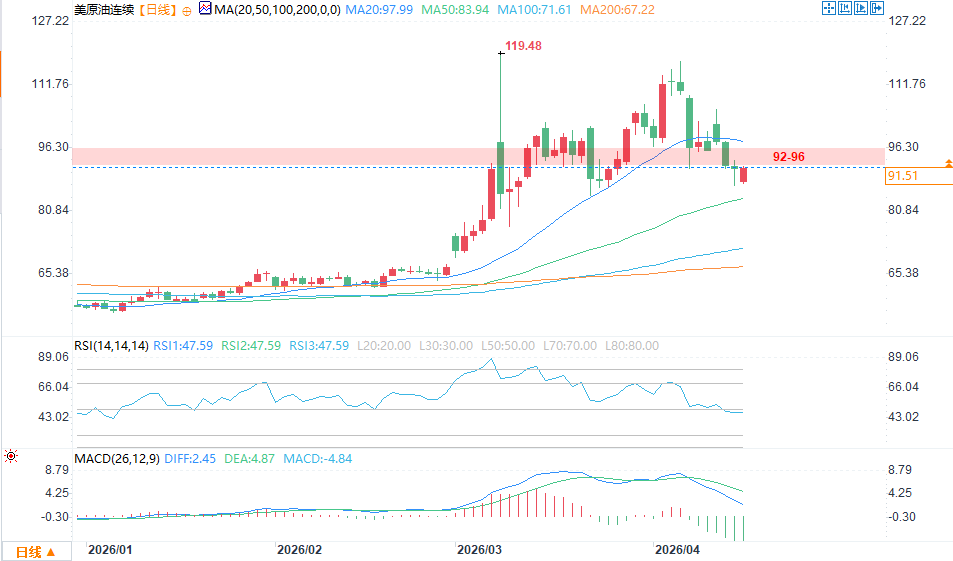
(WTI crude oil daily chart source: FX678)
Conclusion: Oil prices have entered a phase of "long-term frictional pricing".
In summary, the pricing logic of the international crude oil market has shifted from "short-term panic" to "long-term friction pricing," and high oil prices will become the norm. WTI crude oil has shown strong resilience at the $90/barrel mark. If the US-Iran negotiations fail this weekend, $93.51/barrel may become the starting point for a new round of upward movement. UBS predicts that if the Strait of Hormuz blockade continues until the end of April, oil prices could reach $130/barrel, exacerbating the risk of a global economic recession.
The market has realized that a US-Iran peace agreement is not a short-term possibility. Given the global daily loss of 13 million barrels of oil supply, any progress in negotiations, even without an immediate resumption of navigation in the Strait, will be interpreted as a positive signal. Meanwhile, the expiration of sanctions waivers and the implementation of toll systems will increase compliance risks and logistics costs in global energy trade, ultimately driving up inflation and impacting monetary policies in various countries.
For energy traders, geopolitical premiums continue to dominate oil prices. Before the resumption of free navigation in the Straits, any price corrections are likely short-term adjustments and may present buying opportunities. In the long run, this predicament will accelerate the restructuring of the global energy landscape. Countries will promote supply diversification, strengthen strategic reserves, increase investment in non-fossil energy, and reduce dependence on Middle Eastern crude oil and the Straits shipping lanes, profoundly impacting the future direction of the global energy market.
At 02:01 Beijing time, WTI crude oil was trading at $91.28 per ounce, up 3.57%.
Negotiation expectations shrink: from "comprehensive reconciliation" to "temporary avoidance of war"
Iranian sources revealed that, under Pakistan's mediation, the focus of US-Iran negotiations has fundamentally shifted, with ambitions significantly reduced. Previously, the market expected a breakthrough agreement to completely resolve core disputes such as navigation in the Strait of Hormuz, but the latest developments indicate that the two sides have only reached a consensus on a "temporary avoidance of war," with the outcome limited to a provisional memorandum.
The core objective of this memorandum is not to resolve sovereignty disputes, but merely to prevent the conflict from escalating after the two-week ceasefire that began on April 8. It can only "stop the fighting" but not "reconcile" and cannot resolve the core energy issue of navigation in the Taiwan Strait. PVM analyst John Evans pointed out that the market is highly skeptical of an "immediate resolution to the conflict," and the constantly changing diplomatic news has exacerbated uncertainty. In addition, the core demands of the US and Iran are opposed, making it extremely unlikely that a substantial agreement will be reached in the short term. This has become the primary driver of the oil price rebound.
The Strait of Hormuz Dilemma: Iran's "Monetization" of Control Pressures Global Energy
The Strait of Hormuz, a global energy lifeline, determines the flow of approximately 20% of the world's oil and LNG. Iran is currently transforming its military blockade of the strait into long-term administrative control, exacerbating supply concerns. News on April 16th indicated that Iran is pushing for a "monetized" control of navigation through the strait, requiring all vessels to pay a "passage fee," with settlements made through Iranian banks.
The core of this move is strategic maneuvering rather than increased fiscal revenue: on the sovereignty level, it's a disguised assertion of actual jurisdiction over the Strait; on the diplomatic level, it enhances the bargaining power between the US and Iran, and allowing ships to pass through the Omani side is merely a "conditional concession." It is understood that Iran's actual annual revenue from the passage fees is only $1 to $2 billion, far lower than market rumors, and its parliament is pushing forward relevant legislation to solidify its regulatory power over the Strait.
ING analysts estimate that due to the Straits blockade and pipeline rerouting restrictions, an average of 13 million barrels of oil per day globally has been disrupted, equivalent to nearly 15% of the world's daily oil trade. Even if the United States does not extend the sanctions waivers for Iran and Russia, the physical blockade will still prevent the relevant crude oil from entering the global supply chain. The blockade will also exacerbate global inflation and erode the foundation of economic growth through the transmission of the supply chain.
The supply-demand mismatch worsened: An "unexpected" decline in US inventories provided fundamental support.
The inventory data released by the U.S. Energy Information Administration (EIA) on April 15 provided solid fundamental support for the rebound in oil prices. The data showed that U.S. crude oil inventories unexpectedly decreased by 913,000 barrels last week, contrasting with market expectations of an increase of 154,000 barrels, thus contradicting the assessment that "weak demand led to inventory buildup."
The core reason for the decline in inventories is that supply disruptions in the Middle East triggered "alternative purchases" by global buyers. After the Strait of Hormuz was blocked, global buyers turned to the Atlantic Basin to find sources of goods, which drove a surge in US crude oil and refined product exports, resulting in a passive decline in domestic commercial inventories.
TP ICAP analyst Scott Sheldon stated that the lack of substantial improvement in strait navigation and the prolonged blockade are squeezing global inventory buffers. The market is extremely sensitive to supply fluctuations, and the supporting effect of declining inventories will continue to unfold. The current crude oil market has shifted from "panic trading" to fundamental pricing, and continued inventory depletion further strengthens the support for high oil prices.
Trump's diplomatic efforts to "put out the fire" have limited effect, and the deadlock remains unbroken.
Faced with tensions in the Middle East and oil price volatility, Trump launched a series of diplomatic initiatives in an attempt to ease the situation, but with limited effect. On the one hand, he announced a 10-day ceasefire agreement between Lebanon and Israel, which alleviated concerns about a full-scale war in the Middle East, but only marginally improved navigation in the Straits and security in core oil-producing areas. Crude oil prices reacted tepidly, and the market had already decoupled the conflict in the north from the logic of the blockade of the Persian Gulf.
On the other hand, Pakistan is actively mediating, with its Army Chief of Staff arriving in Tehran, indicating that the US and Iran may resume talks this weekend. However, the core differences between the two sides are difficult to bridge: the US refuses to extend sanctions waivers for Iran, while Iran firmly insists on imposing a passage fee on the Strait of Hormuz and does not accept the US's harsh conditions on the nuclear issue, and the window of opportunity for a diplomatic breakthrough continues to narrow.
(WTI crude oil daily chart source: FX678)
Conclusion: Oil prices have entered a phase of "long-term frictional pricing".
In summary, the pricing logic of the international crude oil market has shifted from "short-term panic" to "long-term friction pricing," and high oil prices will become the norm. WTI crude oil has shown strong resilience at the $90/barrel mark. If the US-Iran negotiations fail this weekend, $93.51/barrel may become the starting point for a new round of upward movement. UBS predicts that if the Strait of Hormuz blockade continues until the end of April, oil prices could reach $130/barrel, exacerbating the risk of a global economic recession.
The market has realized that a US-Iran peace agreement is not a short-term possibility. Given the global daily loss of 13 million barrels of oil supply, any progress in negotiations, even without an immediate resumption of navigation in the Strait, will be interpreted as a positive signal. Meanwhile, the expiration of sanctions waivers and the implementation of toll systems will increase compliance risks and logistics costs in global energy trade, ultimately driving up inflation and impacting monetary policies in various countries.
For energy traders, geopolitical premiums continue to dominate oil prices. Before the resumption of free navigation in the Straits, any price corrections are likely short-term adjustments and may present buying opportunities. In the long run, this predicament will accelerate the restructuring of the global energy landscape. Countries will promote supply diversification, strengthen strategic reserves, increase investment in non-fossil energy, and reduce dependence on Middle Eastern crude oil and the Straits shipping lanes, profoundly impacting the future direction of the global energy market.
At 02:01 Beijing time, WTI crude oil was trading at $91.28 per ounce, up 3.57%.
- Risk Warning and Disclaimer
- The market involves risk, and trading may not be suitable for all investors. This article is for reference only and does not constitute personal investment advice, nor does it take into account certain users’ specific investment objectives, financial situation, or other needs. Any investment decisions made based on this information are at your own risk.