A chart: The Baltic Dry Index continues its upward trend due to rising freight rates for large vessels.
2026-04-17 01:36:07
Latest data shows that the Baltic Dry Index (BDI) reached 2523 points on April 16, 2026, a new high since December 9, 2025, up 1.57% month-on-month, marking the 10th consecutive day of increase (including zero growth). Looking at the short-term charts, the recent 11 BDI data points show: 10 positive increases, 1 negative increase, and 0 zero increases. Specifically, the Panamax Freight Index (BPI) was 1970 points, up 1.13% from the previous value; the Capesize Freight Index (BCI) was 4026 points, up 1.56%; and the Supramax Freight Index (BSI) was 1398 points, up 1.97%. For detailed 720-day and 10-year trend charts of the Baltic Dry Index and its three main sub-indices, please refer to the specially designed charts.
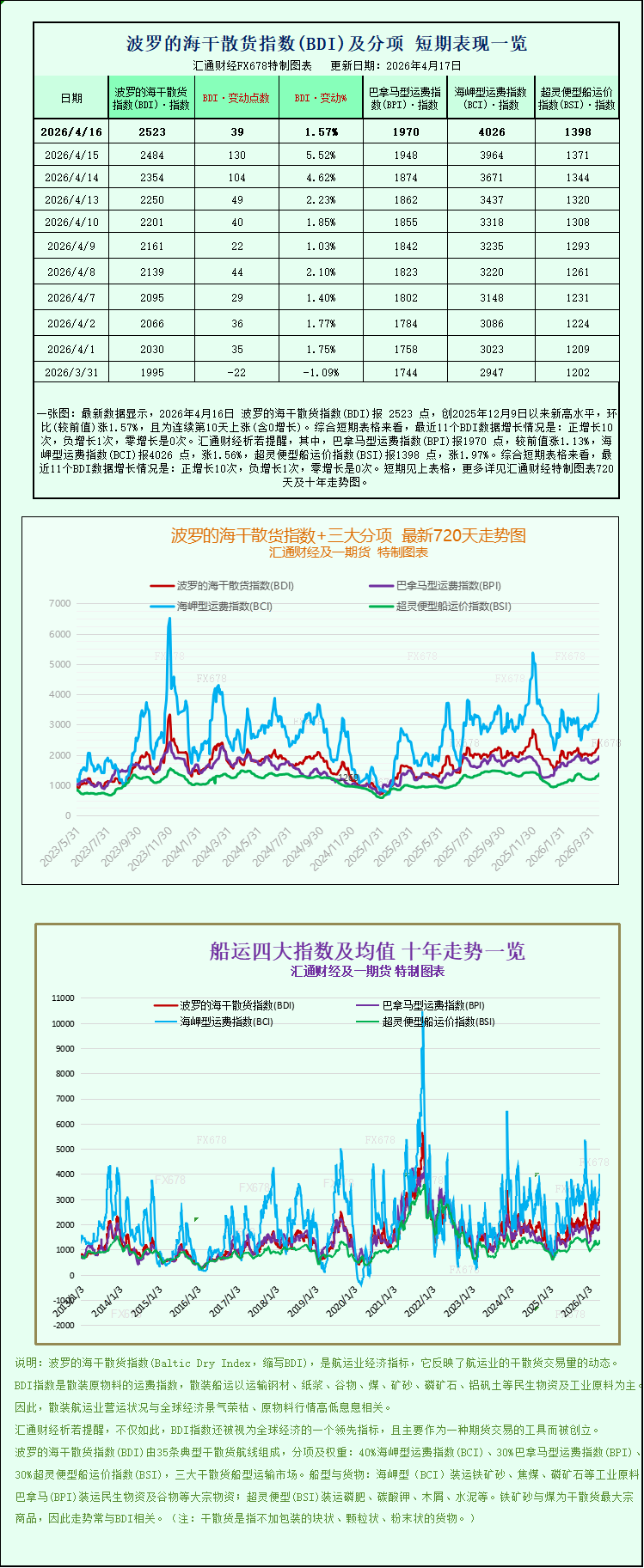
The Baltic Dry Index (BDI) rose to its highest level in more than four months on Thursday, driven primarily by across-the-board increases in freight rates for the three major vessel types: Capesize, Panamax, and Supramax, indicating a strong market recovery. This marks the tenth consecutive trading day of gains, signifying that the global dry bulk shipping market has entered a clear upward cycle.
The Baltic Dry Index, which tracks freight rates for Capesize, Panamax, and Supramax vessels, rose 39 points, or 1.6%, to 2,523, its highest level since early December 2025. This increase broke the consolidation pattern of the previous months, indicating a significant increase in global commodity trade activity and a continued improvement in the supply and demand relationship in the dry bulk shipping market.
The Capesize index rose 62 points, or about 1.6%, to 4,026, its highest level in more than four months. Average daily earnings for Capesize vessels increased by $562 to $33,012. Capesize vessels are the "juggernauts" of dry bulk shipping, typically with a deadweight tonnage between 120,000 and 200,000 tons. They are primarily used for long-distance transport of core industrial materials such as iron ore and coal, and are the core carriers for transporting raw materials upstream in the steel industry chain.
The Panamax index rose 22 points, or about 1.1%, to 1,970, its highest level since early March. Average daily earnings for Panamax vessels increased by $202 to $17,730. Panamax vessels are medium-sized vessels in dry bulk shipping, with a deadweight tonnage between 55,000 and 85,000 tons. They are named for their ability to pass fully loaded through the Panama Canal and primarily handle 60,000 to 70,000 tons of coal, grain, and other goods, playing a vital role in global food and energy transportation.
The Very Large Bulk Carrier (VLCC) index rose 27 points, or 1.97%, to 1,398. Supramax vessels, with a deadweight tonnage between 50,000 and 65,000 tons, are equipped with cranes and loading/unloading equipment and are suitable for transporting goods between ports with less favorable conditions. They mainly transport small bulk commodities such as phosphate fertilizer, potassium carbonate, sawdust, and cement.
Core driving factors for the rise
Iron ore futures prices surged on Thursday, boosted by positive Chinese economic data. China imported 104.743 million tons of iron ore and concentrates in March, an increase of 7.375 million tons from the previous month, representing a month-on-month growth of 7.6%. Cumulative imports of iron ore and concentrates from January to March reached 314.762 million tons, a year-on-year increase of 10.5%. Meanwhile, weak domestic crude steel production also boosted market expectations for rising global steel prices and improved profit margins for Chinese steel mills.
Iron ore market demand recovers
The rebound in iron ore futures prices is mainly supported by two factors: firstly, the continued surge in international oil prices has boosted overall market sentiment for commodities; secondly, the gradual recovery of global industrial production has increased expectations for demand for industrial raw materials such as iron ore.
Global dry bulk shipping demand rebounds
Global demand for some dry bulk cargo categories is steadily recovering, while shipping capacity is experiencing temporary shortages. These two factors combined have driven a broad-based increase in freight rates. In particular, the continued release of demand for resource transportation from West Africa has provided sustained support to the dry bulk market.
Market Outlook
Despite current challenges such as rising fuel costs and geopolitical uncertainties, the recovery trend in the dry bulk market is expected to continue in the short term. Industry analysts point out that the recent index increase is not driven by a single factor, but rather by the combined effects of supply and demand. With the accelerating pace of global economic recovery and continued increases in commodity trading activity, the dry bulk shipping market is poised to maintain strong growth.
Summarize
The continued rise in the Baltic Dry Index is an important signal of recovery in the global dry bulk shipping market. Freight rates for all three major vessel types—Capesize, Panamax, and Supramax—have increased, reflecting a significant boost in global commodity trade activity. Multiple factors, including positive Chinese economic data, a recovery in iron ore market demand, and a rebound in global dry bulk shipping demand, have collectively driven the index's rise. In the short term, the recovery trend in the dry bulk market is expected to continue, with strong growth anticipated.
The Baltic Dry Index (BDI) rose to its highest level in more than four months on Thursday, driven primarily by across-the-board increases in freight rates for the three major vessel types: Capesize, Panamax, and Supramax, indicating a strong market recovery. This marks the tenth consecutive trading day of gains, signifying that the global dry bulk shipping market has entered a clear upward cycle.
The Baltic Dry Index, which tracks freight rates for Capesize, Panamax, and Supramax vessels, rose 39 points, or 1.6%, to 2,523, its highest level since early December 2025. This increase broke the consolidation pattern of the previous months, indicating a significant increase in global commodity trade activity and a continued improvement in the supply and demand relationship in the dry bulk shipping market.
The Capesize index rose 62 points, or about 1.6%, to 4,026, its highest level in more than four months. Average daily earnings for Capesize vessels increased by $562 to $33,012. Capesize vessels are the "juggernauts" of dry bulk shipping, typically with a deadweight tonnage between 120,000 and 200,000 tons. They are primarily used for long-distance transport of core industrial materials such as iron ore and coal, and are the core carriers for transporting raw materials upstream in the steel industry chain.
The Panamax index rose 22 points, or about 1.1%, to 1,970, its highest level since early March. Average daily earnings for Panamax vessels increased by $202 to $17,730. Panamax vessels are medium-sized vessels in dry bulk shipping, with a deadweight tonnage between 55,000 and 85,000 tons. They are named for their ability to pass fully loaded through the Panama Canal and primarily handle 60,000 to 70,000 tons of coal, grain, and other goods, playing a vital role in global food and energy transportation.
The Very Large Bulk Carrier (VLCC) index rose 27 points, or 1.97%, to 1,398. Supramax vessels, with a deadweight tonnage between 50,000 and 65,000 tons, are equipped with cranes and loading/unloading equipment and are suitable for transporting goods between ports with less favorable conditions. They mainly transport small bulk commodities such as phosphate fertilizer, potassium carbonate, sawdust, and cement.
Core driving factors for the rise
Iron ore futures prices surged on Thursday, boosted by positive Chinese economic data. China imported 104.743 million tons of iron ore and concentrates in March, an increase of 7.375 million tons from the previous month, representing a month-on-month growth of 7.6%. Cumulative imports of iron ore and concentrates from January to March reached 314.762 million tons, a year-on-year increase of 10.5%. Meanwhile, weak domestic crude steel production also boosted market expectations for rising global steel prices and improved profit margins for Chinese steel mills.
Iron ore market demand recovers
The rebound in iron ore futures prices is mainly supported by two factors: firstly, the continued surge in international oil prices has boosted overall market sentiment for commodities; secondly, the gradual recovery of global industrial production has increased expectations for demand for industrial raw materials such as iron ore.
Global dry bulk shipping demand rebounds
Global demand for some dry bulk cargo categories is steadily recovering, while shipping capacity is experiencing temporary shortages. These two factors combined have driven a broad-based increase in freight rates. In particular, the continued release of demand for resource transportation from West Africa has provided sustained support to the dry bulk market.
Market Outlook
Despite current challenges such as rising fuel costs and geopolitical uncertainties, the recovery trend in the dry bulk market is expected to continue in the short term. Industry analysts point out that the recent index increase is not driven by a single factor, but rather by the combined effects of supply and demand. With the accelerating pace of global economic recovery and continued increases in commodity trading activity, the dry bulk shipping market is poised to maintain strong growth.
Summarize
The continued rise in the Baltic Dry Index is an important signal of recovery in the global dry bulk shipping market. Freight rates for all three major vessel types—Capesize, Panamax, and Supramax—have increased, reflecting a significant boost in global commodity trade activity. Multiple factors, including positive Chinese economic data, a recovery in iron ore market demand, and a rebound in global dry bulk shipping demand, have collectively driven the index's rise. In the short term, the recovery trend in the dry bulk market is expected to continue, with strong growth anticipated.
- Risk Warning and Disclaimer
- The market involves risk, and trading may not be suitable for all investors. This article is for reference only and does not constitute personal investment advice, nor does it take into account certain users’ specific investment objectives, financial situation, or other needs. Any investment decisions made based on this information are at your own risk.