Gold is facing a stalemate around the $4800 level; where will the upward momentum come from?
2026-04-17 17:57:06
On Friday, April 17th, the spot gold market traded in a narrow range, with prices hovering around $4795 per ounce. Geopolitically, the US-Iran ceasefire agreement entered a crucial window; while optimistic expectations for negotiations remained, significant uncertainties persisted. Meanwhile, the Federal Reserve maintained a neutral policy stance, refraining from signaling a shift towards easing due to high energy prices and resilient economic data. These two factors combined to suppress gold's upward momentum, resulting in a lack of a clear breakout direction. Prices consolidated within a channel, with limited downside and constrained upward movement.
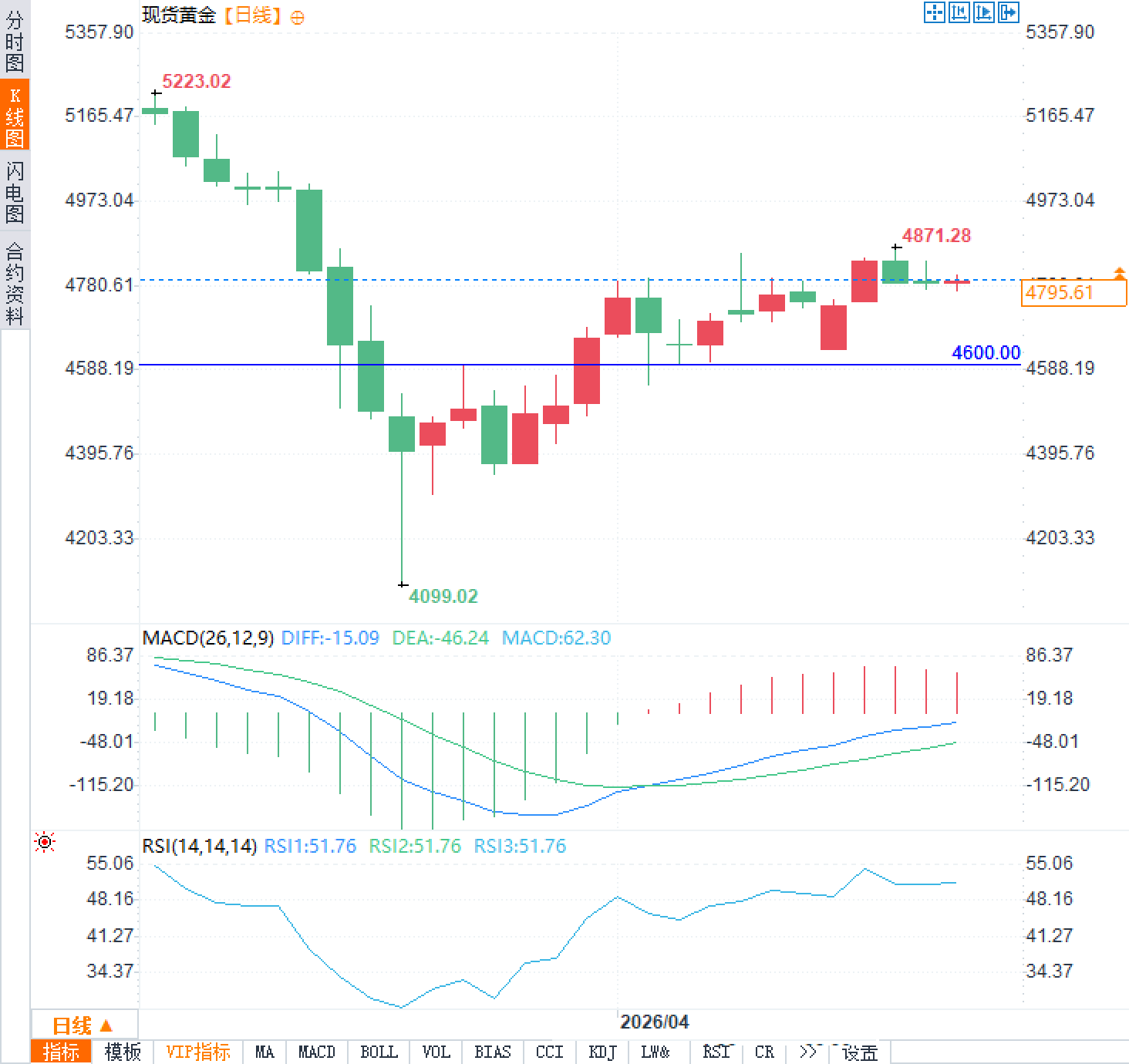
Since its sharp correction at the end of January, spot gold has moved in a significantly different direction, entering a typical range-bound consolidation phase. Currently, the price is fluctuating between $4750 and $4850 per ounce, with short-term highs encountering resistance around $4800-$4820 per ounce and lows finding support at $4750 per ounce. Multiple tests of the lower channel line have seen buying interest, but upward attempts have been met with selling pressure, indicating a balance between bullish and bearish forces.
While gold's safe-haven asset properties continue to play a role, expectations of geopolitical easing and policy pressures are jointly limiting its volatility. If prices remain stable above $4,750 per ounce, they may continue to fluctuate within a channel in the short term; conversely, a break below this level could lead to a test of lower support levels.
The US-Iran negotiations have become the current market focus. The two-week ceasefire agreement is nearing its end, and while diplomatic efforts have spurred a second round of talks, the outcome remains uncertain. Optimistic expectations for peace have directly weakened gold's safe-haven premium, leading to some capital outflows. However, uncertainty surrounding the negotiations and increased regional military deployments have provided downside protection for gold prices. Some analysts suggest that if negotiations break down, escalating geopolitical risks could drive a rapid rebound in gold prices, but given the current optimistic atmosphere, sustained safe-haven buying is unlikely.
This dynamic is clearly linked to oil prices: crude oil prices have remained around $97 per barrel due to concerns about potential supply disruptions, and high oil prices have pushed up inflation expectations, indirectly limiting the upside potential of gold. Traders are primarily focused on the possibility that if the ceasefire is extended or a peace agreement is reached, gold prices may face short-term downward pressure, but will remain supported by global uncertainty in the long term.
The Federal Reserve maintained its target range for the federal funds rate at 3.5%-3.75% at its March meeting, and the dot plot indicates only one rate cut is projected in 2026. This neutral shift stemmed from higher energy prices and resilient economic data, altering the previously dovish signaling path. While a slight decline in real yields is beneficial for gold, policy uncertainty has increased the opportunity cost of holding gold, limiting bullish momentum.
Compared to before the sharp correction in gold prices at the end of January, the Federal Reserve's current stance has become the dominant variable. Traders are tracking subsequent economic data; if inflation continues to exceed expectations due to energy factors, the likelihood of further tightening by the Fed will further suppress gold prices; conversely, if the data slows and policy expectations shift, it could reignite gold's upward trend. In the current environment, gold is unlikely to receive clear policy drivers and relies more on the balance of other variables.
Strong crude oil prices and a slight stabilization of the US dollar index around 98.2 are putting pressure on gold. High oil prices are pushing up inflation expectations, prompting the market to reduce its bets on central bank easing. Data shows that although the correlation between oil prices and gold has been negative recently, geopolitical fluctuations in oil prices have amplified the transmission of policy risks.
Current range characteristics and market structure of spot gold
Since its sharp correction at the end of January, spot gold has moved in a significantly different direction, entering a typical range-bound consolidation phase. Currently, the price is fluctuating between $4750 and $4850 per ounce, with short-term highs encountering resistance around $4800-$4820 per ounce and lows finding support at $4750 per ounce. Multiple tests of the lower channel line have seen buying interest, but upward attempts have been met with selling pressure, indicating a balance between bullish and bearish forces.
While gold's safe-haven asset properties continue to play a role, expectations of geopolitical easing and policy pressures are jointly limiting its volatility. If prices remain stable above $4,750 per ounce, they may continue to fluctuate within a channel in the short term; conversely, a break below this level could lead to a test of lower support levels.
The impact of the prospects of US-Iran negotiations on gold's safe-haven status
The US-Iran negotiations have become the current market focus. The two-week ceasefire agreement is nearing its end, and while diplomatic efforts have spurred a second round of talks, the outcome remains uncertain. Optimistic expectations for peace have directly weakened gold's safe-haven premium, leading to some capital outflows. However, uncertainty surrounding the negotiations and increased regional military deployments have provided downside protection for gold prices. Some analysts suggest that if negotiations break down, escalating geopolitical risks could drive a rapid rebound in gold prices, but given the current optimistic atmosphere, sustained safe-haven buying is unlikely.
This dynamic is clearly linked to oil prices: crude oil prices have remained around $97 per barrel due to concerns about potential supply disruptions, and high oil prices have pushed up inflation expectations, indirectly limiting the upside potential of gold. Traders are primarily focused on the possibility that if the ceasefire is extended or a peace agreement is reached, gold prices may face short-term downward pressure, but will remain supported by global uncertainty in the long term.
The correlation between the Federal Reserve's neutral policy stance and gold prices
The Federal Reserve maintained its target range for the federal funds rate at 3.5%-3.75% at its March meeting, and the dot plot indicates only one rate cut is projected in 2026. This neutral shift stemmed from higher energy prices and resilient economic data, altering the previously dovish signaling path. While a slight decline in real yields is beneficial for gold, policy uncertainty has increased the opportunity cost of holding gold, limiting bullish momentum.
Compared to before the sharp correction in gold prices at the end of January, the Federal Reserve's current stance has become the dominant variable. Traders are tracking subsequent economic data; if inflation continues to exceed expectations due to energy factors, the likelihood of further tightening by the Fed will further suppress gold prices; conversely, if the data slows and policy expectations shift, it could reignite gold's upward trend. In the current environment, gold is unlikely to receive clear policy drivers and relies more on the balance of other variables.
Strong crude oil prices and a slight stabilization of the US dollar index around 98.2 are putting pressure on gold. High oil prices are pushing up inflation expectations, prompting the market to reduce its bets on central bank easing. Data shows that although the correlation between oil prices and gold has been negative recently, geopolitical fluctuations in oil prices have amplified the transmission of policy risks.
Frequently Asked Questions
Question 1: Why is spot gold currently struggling to break through to the upside?
A: This was mainly due to the weakening of safe-haven demand caused by optimistic expectations surrounding US-Iran negotiations, and the suppression of demand by the Federal Reserve's neutral policy stance. High oil prices, pushing up inflation expectations, further limited the room for interest rate cuts, resulting in insufficient bullish momentum. The overall market is awaiting a clearer catalyst, and prices are therefore maintaining a narrow range of fluctuation around $4795 per ounce.
Question 2: How will the Fed's policy path affect the long-term value of gold?
A: The current neutral stance depends on energy prices and economic resilience. If the expectation of only one rate cut in 2026 materializes, the upside potential for gold prices will be limited; however, if inflation falls faster than expected and policy shifts towards easing, a gold bull market could resume. Traders are watching dot plot updates and data changes to determine the direction of evolution in real returns and opportunity costs.
- Risk Warning and Disclaimer
- The market involves risk, and trading may not be suitable for all investors. This article is for reference only and does not constitute personal investment advice, nor does it take into account certain users’ specific investment objectives, financial situation, or other needs. Any investment decisions made based on this information are at your own risk.