Canada's March CPI is projected to rise to 2.5%, reigniting expectations of a Bank of Canada interest rate hike.
2026-04-20 16:09:26
According to APP, Canada's economic data calendar begins on Monday, with a focus on the March Consumer Price Index ( CPI ), which will be closely watched to assess the actual impact of the Iran war on inflation. This data, released by Statistics Canada, is likely to confirm a significant increase in price pressures, primarily driven by rising energy costs.

Market analysts expect the monthly CPI to accelerate to 1.1%, significantly higher than the 0.5% recorded in February before the start of the war. Year-on-year, the CPI is projected to rise to 2.5% from 1.8% in the previous month. The sharp increase in oil and gas prices due to the blockade of the Strait of Hormuz will be the main driver of inflation data. However, core inflation, excluding energy and food prices, is expected to remain relatively stable, rising 0.3% month-on-month in March (0.4% in the previous month) and slightly increasing year-on-year to 2.4% (2.3% in the previous month).
These data are likely to attract the attention of the Bank of Canada's Monetary Policy Committee and bring the possibility of an interest rate hike back to the table. The Bank of Canada has cut interest rates by a total of 2.75% over the past two years. At its March 18 meeting, it kept the benchmark interest rate unchanged at 2.25%, but the monetary policy statement warned of "increased volatility in global energy prices and financial markets, and the increased risks to the global economy from a US-Iran war."
March inflation data will confirm these concerns. As mentioned earlier, overall CPI is expected to rise to 2.5%, and core inflation to 2.4%, both significantly higher than the central bank's 2% inflation target. This data will undoubtedly fuel market speculation about monetary tightening, although the broader macroeconomic picture complicates the central bank's policy stance. The Canadian economy is projected to contract by 0.2% in the fourth quarter of 2025, with January's monthly GDP growth at only 0.1%. The March Ivey Purchasing Managers' Index ( PMI ) showed business activity contracting for the first time since November, suggesting a weak end to the quarter.
Against this backdrop, Bank of Canada policymakers are likely to think twice before raising interest rates, as tightening policy too early could damage already fragile growth and push the economy into recession. Francesco Pesole, an analyst at an international financial institution, points out: "The market is currently pricing in a tightening of about 40 basis points in December, which seems too aggressive, as the Bank of Canada has not yet shown much willingness to raise rates, and its attention may soon turn to the renegotiation of the USMCA—which poses a significant downside risk to Canadian economic activity and employment."
Canada's March Consumer Price Index (CPI) data will be released by Statistics Canada at 12:30 GMT on Monday. Typically, higher inflation driven by strong economic activity and a tight labor market has a positive impact on currencies. However, this time is different: Canadian economic growth remains weak, dragged down by higher tariffs from its major trading partner, the United States. Given this, a surge in inflation will present a challenge for the Bank of Canada, requiring it to balance supporting economic growth with combating inflation, potentially putting pressure on the Canadian dollar.
In summary, strong CPI data is likely to exacerbate stagflation concerns and put pressure on the Canadian dollar. In the current environment, lower-than-expected inflation data would be more favorable for the Canadian dollar, giving the Bank of Canada time to await more data before deciding on its next monetary policy move.
Analyst Guillermo Alcala observed that the USD/CAD pair has been trending downwards since early April, largely due to a weaker US dollar (driven by investor optimism about a resolution to the Middle East conflict) rather than inherent strength in the Canadian dollar. "CAD bulls are watching the 1.3650-1.3670 area, which is the support level for USD/CAD last week and on March 16th and 23rd, following the March 9th low of 1.3525." However, Alcala also cautioned about technical indicators: "The 4-hour Relative Strength Index ( RSI ) is in overbought territory, and the MACD histogram shows a bearish divergence, suggesting a potential correction." On the upside, Alcala sees "the 1.3735 area (the April 14th low) as immediate resistance, followed by the April 15th high, just below 1.3790, and near the April 13th high at 1.3875."
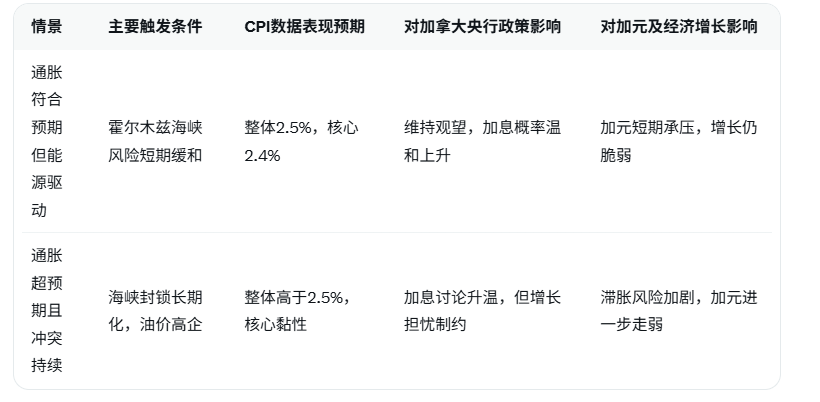
To clearly compare the impact of different scenarios on the Canadian economy and monetary policy, the following table summarizes the two main paths currently in place:
A deeper analysis reveals that this event highlights the amplifying effect of geopolitical risks on import-dependent economies through the energy sector. While the Bank of Canada has repeatedly emphasized its data-dependent principle, the current combination of sluggish economic growth and rising imported inflation is testing its policy balancing ability. Investors should pay close attention to the market reaction following today's data release and the signals from the Bank of Canada's next meeting on April 29th.
Editor's Summary:
March inflation data is expected to exceed expectations due to the energy shock from the Strait of Hormuz, and the Bank of Canada's balancing act between weak growth and inflationary pressures will be a key market focus. Regardless of the final policy path, continued monitoring of geopolitical developments, oil price trends, and domestic demand indicators will be crucial in determining the direction of the Canadian dollar and monetary policy.
Market analysts expect the monthly CPI to accelerate to 1.1%, significantly higher than the 0.5% recorded in February before the start of the war. Year-on-year, the CPI is projected to rise to 2.5% from 1.8% in the previous month. The sharp increase in oil and gas prices due to the blockade of the Strait of Hormuz will be the main driver of inflation data. However, core inflation, excluding energy and food prices, is expected to remain relatively stable, rising 0.3% month-on-month in March (0.4% in the previous month) and slightly increasing year-on-year to 2.4% (2.3% in the previous month).
These data are likely to attract the attention of the Bank of Canada's Monetary Policy Committee and bring the possibility of an interest rate hike back to the table. The Bank of Canada has cut interest rates by a total of 2.75% over the past two years. At its March 18 meeting, it kept the benchmark interest rate unchanged at 2.25%, but the monetary policy statement warned of "increased volatility in global energy prices and financial markets, and the increased risks to the global economy from a US-Iran war."
March inflation data will confirm these concerns. As mentioned earlier, overall CPI is expected to rise to 2.5%, and core inflation to 2.4%, both significantly higher than the central bank's 2% inflation target. This data will undoubtedly fuel market speculation about monetary tightening, although the broader macroeconomic picture complicates the central bank's policy stance. The Canadian economy is projected to contract by 0.2% in the fourth quarter of 2025, with January's monthly GDP growth at only 0.1%. The March Ivey Purchasing Managers' Index ( PMI ) showed business activity contracting for the first time since November, suggesting a weak end to the quarter.
Against this backdrop, Bank of Canada policymakers are likely to think twice before raising interest rates, as tightening policy too early could damage already fragile growth and push the economy into recession. Francesco Pesole, an analyst at an international financial institution, points out: "The market is currently pricing in a tightening of about 40 basis points in December, which seems too aggressive, as the Bank of Canada has not yet shown much willingness to raise rates, and its attention may soon turn to the renegotiation of the USMCA—which poses a significant downside risk to Canadian economic activity and employment."
Canada's March Consumer Price Index (CPI) data will be released by Statistics Canada at 12:30 GMT on Monday. Typically, higher inflation driven by strong economic activity and a tight labor market has a positive impact on currencies. However, this time is different: Canadian economic growth remains weak, dragged down by higher tariffs from its major trading partner, the United States. Given this, a surge in inflation will present a challenge for the Bank of Canada, requiring it to balance supporting economic growth with combating inflation, potentially putting pressure on the Canadian dollar.
In summary, strong CPI data is likely to exacerbate stagflation concerns and put pressure on the Canadian dollar. In the current environment, lower-than-expected inflation data would be more favorable for the Canadian dollar, giving the Bank of Canada time to await more data before deciding on its next monetary policy move.
Analyst Guillermo Alcala observed that the USD/CAD pair has been trending downwards since early April, largely due to a weaker US dollar (driven by investor optimism about a resolution to the Middle East conflict) rather than inherent strength in the Canadian dollar. "CAD bulls are watching the 1.3650-1.3670 area, which is the support level for USD/CAD last week and on March 16th and 23rd, following the March 9th low of 1.3525." However, Alcala also cautioned about technical indicators: "The 4-hour Relative Strength Index ( RSI ) is in overbought territory, and the MACD histogram shows a bearish divergence, suggesting a potential correction." On the upside, Alcala sees "the 1.3735 area (the April 14th low) as immediate resistance, followed by the April 15th high, just below 1.3790, and near the April 13th high at 1.3875."
To clearly compare the impact of different scenarios on the Canadian economy and monetary policy, the following table summarizes the two main paths currently in place:
A deeper analysis reveals that this event highlights the amplifying effect of geopolitical risks on import-dependent economies through the energy sector. While the Bank of Canada has repeatedly emphasized its data-dependent principle, the current combination of sluggish economic growth and rising imported inflation is testing its policy balancing ability. Investors should pay close attention to the market reaction following today's data release and the signals from the Bank of Canada's next meeting on April 29th.
Editor's Summary:
March inflation data is expected to exceed expectations due to the energy shock from the Strait of Hormuz, and the Bank of Canada's balancing act between weak growth and inflationary pressures will be a key market focus. Regardless of the final policy path, continued monitoring of geopolitical developments, oil price trends, and domestic demand indicators will be crucial in determining the direction of the Canadian dollar and monetary policy.
- Risk Warning and Disclaimer
- The market involves risk, and trading may not be suitable for all investors. This article is for reference only and does not constitute personal investment advice, nor does it take into account certain users’ specific investment objectives, financial situation, or other needs. Any investment decisions made based on this information are at your own risk.