The Straits Times: 24-Hour "Opening and Closing Reversal"! Oil Prices Surge and Fall, Equity Markets Rebound – Hidden Clues Lie Behind the Scenes.
2026-04-20 16:10:35
On Monday (April 20), during the Asian and European sessions, international oil prices opened sharply higher but then continued to fall back. Brent crude oil once surged to 6.5% during the session, but the gains have now narrowed to 4.85%, trading at $94.74 per barrel.
The dramatic reversal of control measures in the Strait of Hormuz over the weekend became the key trigger for the surge in international oil prices.
On April 17 local time, Iranian Foreign Minister Araqchi announced that, in order to cooperate with the ceasefire agreement, the Strait of Hormuz would be opened to all merchant ships sailing on designated routes. As soon as the news came out, Brent crude oil prices fell below $90 per barrel.
However, US President Trump immediately stated that "the naval blockade against Iran will continue." Less than 24 hours later, on April 18, the Iranian Armed Forces, the Supreme National Security Council, and the Islamic Revolutionary Guard Corps Navy issued statements one after another, citing the US violation of its ceasefire commitments, announcing the restoration of full control over the Strait of Hormuz, and imposing a blockade from that evening until the blockade is lifted.
This blockade is accompanied by strict control measures: the Iranian Revolutionary Guard Navy has designated the "Laraq Corridor" as the only navigation channel, and no vessel may pass through without permission;
All vessels in the Persian Gulf and the Gulf of Oman are required to remain at their anchorages, and any action that approaches the straits will be considered "cooperation with the enemy," with violating vessels becoming targets.
A CMA CGM merchant ship was fired at with warning shots in the strait on the 18th, further confirming the safety risks in the waterway.
Shipping data shows that the number of ships passing through the strait has remained low recently, with only 19 ships passing through on Saturday, far below the historical average of 138 ships per day. About one-fifth of the world's oil and gas transportation routes are at risk of disruption, directly driving up international oil prices sharply.
The preparations for the second round of US-Iran talks are fraught with conflicting signals, exacerbating market concerns about an escalation of geopolitical conflict.
According to a White House statement on the 19th, US Vice President Vance will lead a delegation to Islamabad, the capital of Pakistan, for a new round of negotiations. President Trump confirmed on social media that the US delegation arrived on the evening of the 20th.
As the host country for the negotiations, Pakistani Interior Minister Muhsin Naqvi visited the U.S. Embassy in Pakistan on the 20th to hold detailed consultations with the U.S. side on matters related to the negotiations and security arrangements. The meeting venue in Islamabad has also been set up.
However, Iran sent a completely opposite signal: later on the 19th, Iran made it clear that it was prepared for the war to reignite and refused to participate in the second round of negotiations.
Iranian Foreign Minister Araqchi accused the United States of repeatedly undermining trust, violating the ceasefire agreement, threatening Iranian ports and ships, and making "excessive demands" and "unrealistic expectations" that lacked diplomatic sincerity.
It is worth noting that the current two-week ceasefire agreement between the US and Iran will expire on the 22nd. The first round of negotiations ended without result in Islamabad earlier this month. If no agreement is reached on extending the ceasefire, the geopolitical conflict is likely to escalate again, directly impacting oil supply expectations. The market needs to pay close attention to this critical time window, and oil price volatility may continue to increase in the short term.
Amidst tense negotiations, progress was made on the US-Iran nuclear issue, becoming an important factor in easing market panic.
Three U.S. and regional diplomatic sources revealed that Iran has agreed to transfer all of its enriched uranium, with potential recipients including Russia, the International Atomic Energy Agency, or the United States.
This development is the core reason why Trump previously expressed optimism. The US had proposed unfreezing $20 billion of Iranian funds in exchange for enriched uranium stockpiles and demanded participation in the uranium enrichment location operation. However, Iran only agreed to allow IAEA personnel to participate and has not yet accepted direct US intervention.
The two sides still have several fundamental differences on the nuclear issue: the US demands that Iran suspend its nuclear program indefinitely and halt uranium enrichment activities for 20 years, while Iran is only willing to accept a 5-year suspension;
Iran's deputy foreign minister made it clear that "we will never hand over enriched uranium to the United States," and the current compromise proposed in the negotiations tends to send some of the highly enriched uranium to a third country rather than the United States.
Furthermore, Iranian President Peshichiyan emphasized that Iran's exercise of its nuclear rights is a legitimate right, and that the United States' attempt to deprive it of this right through bullying tactics is baseless. Iran is making every effort to defend its legitimate rights and also hopes to "end the war in a dignified manner."
The partial thaw in the nuclear issue has preserved room for a diplomatic solution to the dispute, but bridging the core differences still faces enormous challenges.
The differing stances of the Iranian president, foreign minister, and Islamic Revolutionary Guard Corps, along with the profound influence of the internal power structure on the trajectory of the US-Iran rivalry, are evident.
President Pezechyan adhered to a self-defense stance, emphasizing the need to stand firm and remain vigilant in the face of "hostile forces" while actively seeking to "end the war in a dignified manner" through diplomatic means, demonstrating a degree of flexibility on the nuclear issue.
Foreign Minister Araghchi focused on the diplomatic front , coordinating with countries such as Pakistan to advance the negotiation process while harshly criticizing the United States' insincere behavior, becoming a major voice on Iran's diplomatic stance.
The Islamic Revolutionary Guard Corps (IRGC) has adopted a strong and dominant stance, playing a central role in the reversal of control over the Strait of Hormuz. Its blockade announcement on the 18th directly overturned the previously announced opening policy by the Foreign Minister, highlighting its actual influence in national security and foreign policy decisions.
The Revolutionary Guard not only controls the right of navigation in the Strait of Hormuz, demarcates the "Laraq Corridor" and implements strict control, but also forms a direct confrontation with the US military at the military level: recently, the US military fired on Iranian merchant ships in an attempt to force them to turn back. After the Revolutionary Guard's naval forces intervened, the US military quickly withdrew. This incident also reflects the Revolutionary Guard's tough stance in safeguarding Iran's maritime interests.
Some analysts point out that the current civilian government in Iran has relatively weak power, and the attitude of the Revolutionary Guard has become a key variable in determining the course of the situation.
Despite easing expectations of a de-escalation in the US-Iran geopolitical conflict and significant volatility in the oil market, major Asian stock markets opened higher on Monday, exhibiting clear characteristics of cross-market fund reallocation. Japan's Nikkei 225 index rose more than 1% in early trading, South Korea's KOSPI index gained about 1.3%, Hong Kong's Hang Seng Index rose around 0.7%, and the Shanghai Composite Index rose more than 0.7%.
This phenomenon reflects the differentiated selection of funds among different risky assets: on the one hand, the progress in breaking the ice on the nuclear issue has alleviated the market's extreme concerns about a full-scale war;
On the other hand, some funds believe that the current rise in oil prices has fully reflected geopolitical risks, and are instead investing in equity assets with attractive valuations.
However, it is important to be wary that if subsequent negotiations break down or the strait blockade intensifies, the sharp fluctuations in the crude oil market may trigger correlational anomalies in the equity market. Investors need to pay attention to the cross-market risk transmission and adjust their trading strategies in a timely manner.
Judging from various factors, the probability of a full-scale war between the US and Iran in the short term has decreased, but the long-term nature and uncertainty of geopolitical conflicts will continue to support high oil prices.
On the positive side, the progress in breaking the ice on the nuclear issue, Iran's statement on transferring enriched uranium, and the ongoing preparatory work for negotiations between the two sides indicate that a diplomatic solution to the dispute remains the mainstream option.
The Trump administration faces pressure from soaring domestic oil prices and the unpopularity of war, and is also motivated to seek a "get-out-of-jail-free" strategy by exaggerating the progress of negotiations to boost the market and lower oil prices.
However, the risk factors cannot be ignored: the blockade and control of the Strait of Hormuz has not been lifted, the US military plans to board and seize relevant Iranian oil tankers, and the possibility of military friction remains.
With the ceasefire agreement nearing its expiration, the risk of a breakdown in negotiations remains. The hardline stance of the Iranian Revolutionary Guard, the complexity of its internal power structure, and the fundamental differences between the two sides on core issues such as nuclear rights and the lifting of the blockade are unlikely to be fully resolved in the short term.
It is expected that the US and Iran will maintain a situation of "coexistence of negotiations and confrontation" for some time to come. Geopolitical risks will remain an important factor supporting oil prices in the long term, and Brent crude oil may continue to fluctuate at a high level above $90 per barrel in the short term.
As mentioned in previous articles, the areas marked by numerous arrows represent key defensive levels for the bulls and still offer support. Last Friday's rapid drop in oil prices provided an excellent entry opportunity.
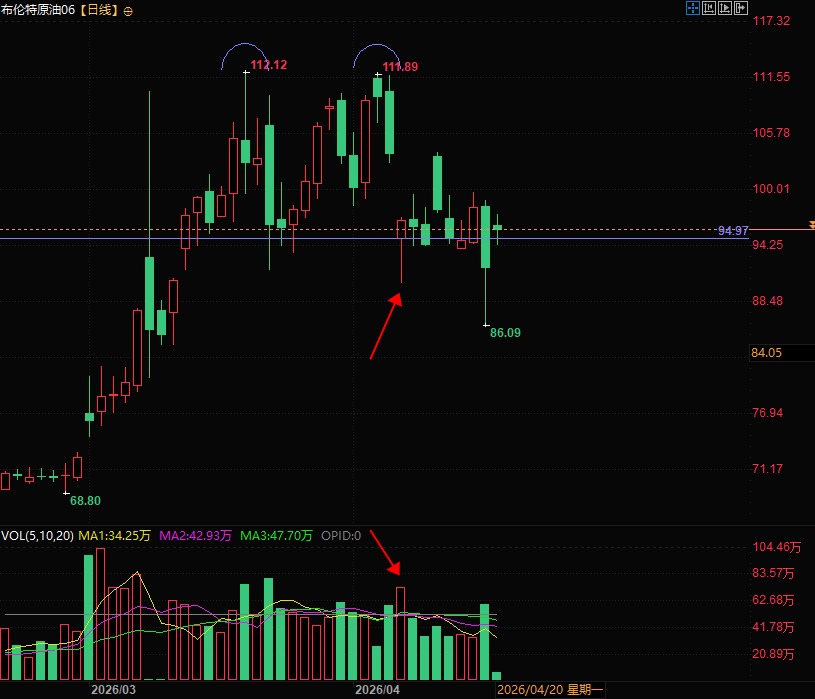
(Brent crude oil June contract daily chart, source: EasyForex)
At 16:07 Beijing time, the Brent crude oil June contract was trading at $95.86 per ounce.
The dramatic reversal of control measures in the Strait of Hormuz over the weekend became the key trigger for the surge in international oil prices.
On April 17 local time, Iranian Foreign Minister Araqchi announced that, in order to cooperate with the ceasefire agreement, the Strait of Hormuz would be opened to all merchant ships sailing on designated routes. As soon as the news came out, Brent crude oil prices fell below $90 per barrel.
However, US President Trump immediately stated that "the naval blockade against Iran will continue." Less than 24 hours later, on April 18, the Iranian Armed Forces, the Supreme National Security Council, and the Islamic Revolutionary Guard Corps Navy issued statements one after another, citing the US violation of its ceasefire commitments, announcing the restoration of full control over the Strait of Hormuz, and imposing a blockade from that evening until the blockade is lifted.
This blockade is accompanied by strict control measures: the Iranian Revolutionary Guard Navy has designated the "Laraq Corridor" as the only navigation channel, and no vessel may pass through without permission;
All vessels in the Persian Gulf and the Gulf of Oman are required to remain at their anchorages, and any action that approaches the straits will be considered "cooperation with the enemy," with violating vessels becoming targets.
A CMA CGM merchant ship was fired at with warning shots in the strait on the 18th, further confirming the safety risks in the waterway.
Shipping data shows that the number of ships passing through the strait has remained low recently, with only 19 ships passing through on Saturday, far below the historical average of 138 ships per day. About one-fifth of the world's oil and gas transportation routes are at risk of disruption, directly driving up international oil prices sharply.
The second round of negotiations between the US and Iran has escalated, and the ceasefire agreement is nearing its expiration.
The preparations for the second round of US-Iran talks are fraught with conflicting signals, exacerbating market concerns about an escalation of geopolitical conflict.
According to a White House statement on the 19th, US Vice President Vance will lead a delegation to Islamabad, the capital of Pakistan, for a new round of negotiations. President Trump confirmed on social media that the US delegation arrived on the evening of the 20th.
As the host country for the negotiations, Pakistani Interior Minister Muhsin Naqvi visited the U.S. Embassy in Pakistan on the 20th to hold detailed consultations with the U.S. side on matters related to the negotiations and security arrangements. The meeting venue in Islamabad has also been set up.
However, Iran sent a completely opposite signal: later on the 19th, Iran made it clear that it was prepared for the war to reignite and refused to participate in the second round of negotiations.
Iranian Foreign Minister Araqchi accused the United States of repeatedly undermining trust, violating the ceasefire agreement, threatening Iranian ports and ships, and making "excessive demands" and "unrealistic expectations" that lacked diplomatic sincerity.
It is worth noting that the current two-week ceasefire agreement between the US and Iran will expire on the 22nd. The first round of negotiations ended without result in Islamabad earlier this month. If no agreement is reached on extending the ceasefire, the geopolitical conflict is likely to escalate again, directly impacting oil supply expectations. The market needs to pay close attention to this critical time window, and oil price volatility may continue to increase in the short term.
Signs of a thaw in the nuclear conflict have emerged, but core differences remain unresolved.
Amidst tense negotiations, progress was made on the US-Iran nuclear issue, becoming an important factor in easing market panic.
Three U.S. and regional diplomatic sources revealed that Iran has agreed to transfer all of its enriched uranium, with potential recipients including Russia, the International Atomic Energy Agency, or the United States.
This development is the core reason why Trump previously expressed optimism. The US had proposed unfreezing $20 billion of Iranian funds in exchange for enriched uranium stockpiles and demanded participation in the uranium enrichment location operation. However, Iran only agreed to allow IAEA personnel to participate and has not yet accepted direct US intervention.
The two sides still have several fundamental differences on the nuclear issue: the US demands that Iran suspend its nuclear program indefinitely and halt uranium enrichment activities for 20 years, while Iran is only willing to accept a 5-year suspension;
Iran's deputy foreign minister made it clear that "we will never hand over enriched uranium to the United States," and the current compromise proposed in the negotiations tends to send some of the highly enriched uranium to a third country rather than the United States.
Furthermore, Iranian President Peshichiyan emphasized that Iran's exercise of its nuclear rights is a legitimate right, and that the United States' attempt to deprive it of this right through bullying tactics is baseless. Iran is making every effort to defend its legitimate rights and also hopes to "end the war in a dignified manner."
The partial thaw in the nuclear issue has preserved room for a diplomatic solution to the dispute, but bridging the core differences still faces enormous challenges.
The three major factions within Iran are divided, with the Revolutionary Guard playing a leading role in the direction of the situation.
The differing stances of the Iranian president, foreign minister, and Islamic Revolutionary Guard Corps, along with the profound influence of the internal power structure on the trajectory of the US-Iran rivalry, are evident.
President Pezechyan adhered to a self-defense stance, emphasizing the need to stand firm and remain vigilant in the face of "hostile forces" while actively seeking to "end the war in a dignified manner" through diplomatic means, demonstrating a degree of flexibility on the nuclear issue.
Foreign Minister Araghchi focused on the diplomatic front , coordinating with countries such as Pakistan to advance the negotiation process while harshly criticizing the United States' insincere behavior, becoming a major voice on Iran's diplomatic stance.
The Islamic Revolutionary Guard Corps (IRGC) has adopted a strong and dominant stance, playing a central role in the reversal of control over the Strait of Hormuz. Its blockade announcement on the 18th directly overturned the previously announced opening policy by the Foreign Minister, highlighting its actual influence in national security and foreign policy decisions.
The Revolutionary Guard not only controls the right of navigation in the Strait of Hormuz, demarcates the "Laraq Corridor" and implements strict control, but also forms a direct confrontation with the US military at the military level: recently, the US military fired on Iranian merchant ships in an attempt to force them to turn back. After the Revolutionary Guard's naval forces intervened, the US military quickly withdrew. This incident also reflects the Revolutionary Guard's tough stance in safeguarding Iran's maritime interests.
Some analysts point out that the current civilian government in Iran has relatively weak power, and the attitude of the Revolutionary Guard has become a key variable in determining the course of the situation.
Cross-market linkage: Equity market bucks the trend and rises, showing clear characteristics of capital reallocation.
Despite easing expectations of a de-escalation in the US-Iran geopolitical conflict and significant volatility in the oil market, major Asian stock markets opened higher on Monday, exhibiting clear characteristics of cross-market fund reallocation. Japan's Nikkei 225 index rose more than 1% in early trading, South Korea's KOSPI index gained about 1.3%, Hong Kong's Hang Seng Index rose around 0.7%, and the Shanghai Composite Index rose more than 0.7%.
This phenomenon reflects the differentiated selection of funds among different risky assets: on the one hand, the progress in breaking the ice on the nuclear issue has alleviated the market's extreme concerns about a full-scale war;
On the other hand, some funds believe that the current rise in oil prices has fully reflected geopolitical risks, and are instead investing in equity assets with attractive valuations.
However, it is important to be wary that if subsequent negotiations break down or the strait blockade intensifies, the sharp fluctuations in the crude oil market may trigger correlational anomalies in the equity market. Investors need to pay attention to the cross-market risk transmission and adjust their trading strategies in a timely manner.
The prospect of a US-Iran war: The probability of avoiding war in the short term is rising, but long-term risks remain.
Judging from various factors, the probability of a full-scale war between the US and Iran in the short term has decreased, but the long-term nature and uncertainty of geopolitical conflicts will continue to support high oil prices.
On the positive side, the progress in breaking the ice on the nuclear issue, Iran's statement on transferring enriched uranium, and the ongoing preparatory work for negotiations between the two sides indicate that a diplomatic solution to the dispute remains the mainstream option.
The Trump administration faces pressure from soaring domestic oil prices and the unpopularity of war, and is also motivated to seek a "get-out-of-jail-free" strategy by exaggerating the progress of negotiations to boost the market and lower oil prices.
However, the risk factors cannot be ignored: the blockade and control of the Strait of Hormuz has not been lifted, the US military plans to board and seize relevant Iranian oil tankers, and the possibility of military friction remains.
With the ceasefire agreement nearing its expiration, the risk of a breakdown in negotiations remains. The hardline stance of the Iranian Revolutionary Guard, the complexity of its internal power structure, and the fundamental differences between the two sides on core issues such as nuclear rights and the lifting of the blockade are unlikely to be fully resolved in the short term.
It is expected that the US and Iran will maintain a situation of "coexistence of negotiations and confrontation" for some time to come. Geopolitical risks will remain an important factor supporting oil prices in the long term, and Brent crude oil may continue to fluctuate at a high level above $90 per barrel in the short term.
As mentioned in previous articles, the areas marked by numerous arrows represent key defensive levels for the bulls and still offer support. Last Friday's rapid drop in oil prices provided an excellent entry opportunity.
(Brent crude oil June contract daily chart, source: EasyForex)
At 16:07 Beijing time, the Brent crude oil June contract was trading at $95.86 per ounce.
- Risk Warning and Disclaimer
- The market involves risk, and trading may not be suitable for all investors. This article is for reference only and does not constitute personal investment advice, nor does it take into account certain users’ specific investment objectives, financial situation, or other needs. Any investment decisions made based on this information are at your own risk.