The game before the US-Iran ceasefire deadline: With oil prices at $200, is Trump willing to gamble?
2026-04-21 14:18:28
This week, the two-week ceasefire agreement between the United States and Iran is set to expire on April 22. This deadline not only marks the end of the temporary ceasefire but has also become a focus of global attention amid the current tensions.
Tehran's repeated opening and closing of the Strait of Hormuz, coupled with Washington's naval blockade of Iranian ports, are, in a broad sense, a continuation of the peace talks that began on April 8. The atmosphere of the negotiations has fluctuated dramatically between the two sides, much like the blockade itself, shifting between optimism and tension.
Even before the latest round of hostilities erupted, Omani Foreign Minister Badr Al-Busaidi, acting as mediator, publicly announced a "historic breakthrough" between the United States and Iran. Iranian Foreign Minister Abbas Araghchi also emphasized the positive progress in the negotiations. US President Trump similarly stated a few days earlier that the two sides were on the verge of reaching an agreement. However, last week a senior EU security source revealed serious differences between the Iranian Foreign Ministry and the Islamic Revolutionary Guard Corps (IRGC), with the latter far less willing to compromise on key issues. Trump subsequently clarified that if an agreement was not signed by Wednesday's April 22 deadline, he "might not extend" the ceasefire, and the US would have to "start dropping bombs again."
Against this backdrop, another important legal deadline has quickly come into the public eye. According to the War Powers Act, May 1st will be the statutory deadline for President Trump to seek congressional approval to continue military operations, 60 days after April 29th. Given this complex situation, what possible future developments might occur? The following analysis will delve into this from multiple perspectives.
A more realistic outcome would be that the two sides fail to reach a final agreement by the middle of this week, but the ceasefire is extended to allow more room for subsequent negotiations. Last week, EU sources and a senior Washington legal source working closely with the US Treasury Department indicated that in this scenario, the US is likely to adopt a wait-and-see "status quo" strategy.
Specifically, the United States will continue its blockade of Iranian ports while further strengthening its military deployment off Iran's southern coast. The USS George H.W. Bush aircraft carrier recently rounded the Cape of Good Hope and is heading towards the area. Combined with other U.S. military assets deployed nearby, Washington will face virtually no operational difficulties if it continues to implement the blockade from a distance. A Washington source noted, "The U.S. Navy and other forces can monitor and execute all necessary actions to blockade Iran from the Arabian Sea, which is enough to make Iran begin to feel the economic pressure of port closures."
Meanwhile, the United States has decided not to extend the 30-day sanctions waiver for Iranian oil exports (which expired on April 19) and further expand financial sanctions against Iran. These measures will not only directly exacerbate Iran's economic difficulties but will also put greater pressure on major Asian powers. These powers have imported large quantities of oil from Iran for many years and had been able to receive it freely before the US blockade of Iranian ports. With the blockade in place but negotiations ongoing, EU sources emphasize that the US is highly likely to facilitate a full reopening of the Strait of Hormuz soon to avoid further drastic fluctuations in energy prices.
In contrast, a more pessimistic scenario is that no agreement is reached by the middle of this week, the ceasefire is not extended, and the conflict between the US and Israel against Iran fully resumes. EU sources analyze that, from Iran's perspective, this scenario could include the continued closure of the Strait of Hormuz and the Bab el-Mandeb Strait, attacks on key energy infrastructure in Saudi Arabia, the UAE, Qatar, and Bahrain, while simultaneously striking key US military and civilian targets in the region, and potentially further strikes on important targets within the US, Israel, and any countries associated with US-Israeli actions.
Sources in Washington indicate that if Iran chooses this path, the United States will consider a larger-scale response, including the infrastructure strikes recently mentioned by the president (covering key bridges and civilian power plants), further targeted special military operations, and more extensive sanctions—all aimed at increasing pressure on the current Iranian regime from both inside and outside. In this scenario, oil prices could very well easily reach the $200 per barrel level that Iran pledged at the beginning of the conflict.
Vikas Dwivedi, global energy strategist at Houston-based Macquarie Group, assessed the potential impact of a war continuing until the end of June. He noted that if the Strait of Hormuz remains closed for an extended period, oil prices would need to rise to a sufficiently high level to destroy the largest global oil demand in history, with some Asian countries already facing actual oil shortages. Given that the current global economy is significantly less oil-intensive than it was 50 years ago, achieving supply and demand balance might require historically high real oil prices, exceeding $200 per barrel, which would cause domestic gasoline prices in the United States to rise to approximately $7 per gallon.
The aforementioned pessimistic scenario would be extremely detrimental to the United States, and a major political disaster for Trump. Historical data shows that a $10 change in oil prices per barrel leads to a corresponding change of approximately 25 to 30 cents in the price of gasoline per gallon; and a 1-cent increase in the average gasoline price per gallon reduces consumer spending by more than $1 billion annually, thus causing significant damage to the overall economy. From a political perspective, since 1896, if the economy does not fall into recession in the two years leading up to the upcoming presidential election, the incumbent US president has won re-election 11 times out of 11; however, if the economy is in recession during the re-election campaign, the president has only won once out of 7 times.
Trump may still seek re-election, but even if he doesn't, he doesn't want his political legacy to be defined by a failed operation against Iran, as Jimmy Carter faced. Sources in Washington indicate that, regardless, the Republican Party wants to maximize the chances of its members entering the White House, which means keeping gasoline prices (and consequently, oil prices) low.
Based on assessments from various sources, all indications point to an agreement being reached sooner rather than later. So, what form will this agreement take? In the early stages of the conflict, Trump clearly outlined four core objectives for the US's actions against Iran and its proxies, in order: first, to completely prevent Iran from developing nuclear weapons; second, to weaken and destroy its missile stockpile and production capabilities; third, to promote regime change; and finally, to cut off funding and arming of its proxies. These objectives not only received the full support of every member of his cabinet but were also fully reflected in Barack Obama's initial draft of the Joint Comprehensive Plan of Action (JCPOA, or the "nuclear agreement"). Since the US unilaterally withdrew from the agreement in May 2018, the Trump team has consistently adhered to these core objectives in subsequent negotiations.
EU sources revealed that significant progress has been made on the key nuclear issue. Iran has agreed in principle to suspend uranium enrichment activities, with the only disagreement being on the duration. Iran proposed a five-year period, while Washington is currently demanding at least 20 years. Iran has also agreed in principle to dispose of its enriched uranium stockpile, with the only disagreement being on the method of disposal: Iran wants to dispose of it itself, while Washington demands the transfer of the material to the US. Furthermore, Iran has agreed in principle to reduce its support for regional proxies; however, in terms of practical capability, Iran's capacity to provide meaningful support to these proxies in the foreseeable future is very limited. Currently, progress on limiting ballistic missile resources is relatively limited, but sufficient progress may soon emerge to give Trump a reason to further extend the negotiation period.
Regardless of which path they ultimately take, both the US and Iran are facing immense pressure at this juncture.
Sources in the EU and Washington agree that an agreement will be reached soon. This agreement will not only directly impact geopolitical stability in the Middle East, but will also profoundly reshape the global energy market landscape.
For ordinary people, the trend of oil prices, gasoline prices, and the resulting economic repercussions will be the focus of close attention in the coming period.
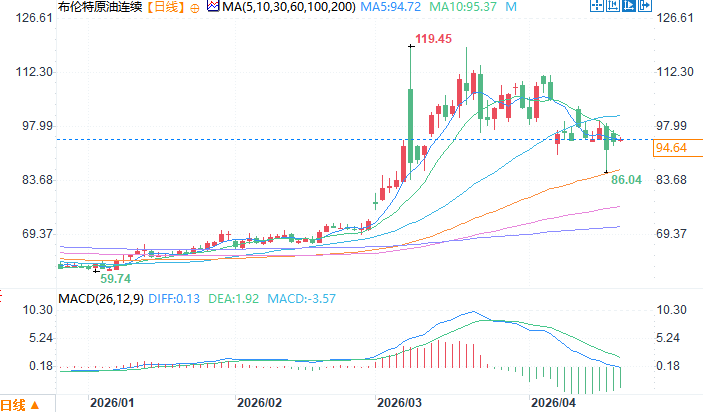
Brent crude oil daily chart source: EasyForex
At 14:04 Beijing time on April 21, Brent crude oil futures were trading at $94.64 per barrel.
Tehran's repeated opening and closing of the Strait of Hormuz, coupled with Washington's naval blockade of Iranian ports, are, in a broad sense, a continuation of the peace talks that began on April 8. The atmosphere of the negotiations has fluctuated dramatically between the two sides, much like the blockade itself, shifting between optimism and tension.
Even before the latest round of hostilities erupted, Omani Foreign Minister Badr Al-Busaidi, acting as mediator, publicly announced a "historic breakthrough" between the United States and Iran. Iranian Foreign Minister Abbas Araghchi also emphasized the positive progress in the negotiations. US President Trump similarly stated a few days earlier that the two sides were on the verge of reaching an agreement. However, last week a senior EU security source revealed serious differences between the Iranian Foreign Ministry and the Islamic Revolutionary Guard Corps (IRGC), with the latter far less willing to compromise on key issues. Trump subsequently clarified that if an agreement was not signed by Wednesday's April 22 deadline, he "might not extend" the ceasefire, and the US would have to "start dropping bombs again."
Against this backdrop, another important legal deadline has quickly come into the public eye. According to the War Powers Act, May 1st will be the statutory deadline for President Trump to seek congressional approval to continue military operations, 60 days after April 29th. Given this complex situation, what possible future developments might occur? The following analysis will delve into this from multiple perspectives.
Ceasefire May Be Extended: US Maintains Blockade, Negotiation Window Remains Open
A more realistic outcome would be that the two sides fail to reach a final agreement by the middle of this week, but the ceasefire is extended to allow more room for subsequent negotiations. Last week, EU sources and a senior Washington legal source working closely with the US Treasury Department indicated that in this scenario, the US is likely to adopt a wait-and-see "status quo" strategy.
Specifically, the United States will continue its blockade of Iranian ports while further strengthening its military deployment off Iran's southern coast. The USS George H.W. Bush aircraft carrier recently rounded the Cape of Good Hope and is heading towards the area. Combined with other U.S. military assets deployed nearby, Washington will face virtually no operational difficulties if it continues to implement the blockade from a distance. A Washington source noted, "The U.S. Navy and other forces can monitor and execute all necessary actions to blockade Iran from the Arabian Sea, which is enough to make Iran begin to feel the economic pressure of port closures."
Meanwhile, the United States has decided not to extend the 30-day sanctions waiver for Iranian oil exports (which expired on April 19) and further expand financial sanctions against Iran. These measures will not only directly exacerbate Iran's economic difficulties but will also put greater pressure on major Asian powers. These powers have imported large quantities of oil from Iran for many years and had been able to receive it freely before the US blockade of Iranian ports. With the blockade in place but negotiations ongoing, EU sources emphasize that the US is highly likely to facilitate a full reopening of the Strait of Hormuz soon to avoid further drastic fluctuations in energy prices.
Risk of a full-scale war restart: Iran launches multi-front counterattacks, oil prices may surge to $200.
In contrast, a more pessimistic scenario is that no agreement is reached by the middle of this week, the ceasefire is not extended, and the conflict between the US and Israel against Iran fully resumes. EU sources analyze that, from Iran's perspective, this scenario could include the continued closure of the Strait of Hormuz and the Bab el-Mandeb Strait, attacks on key energy infrastructure in Saudi Arabia, the UAE, Qatar, and Bahrain, while simultaneously striking key US military and civilian targets in the region, and potentially further strikes on important targets within the US, Israel, and any countries associated with US-Israeli actions.
Sources in Washington indicate that if Iran chooses this path, the United States will consider a larger-scale response, including the infrastructure strikes recently mentioned by the president (covering key bridges and civilian power plants), further targeted special military operations, and more extensive sanctions—all aimed at increasing pressure on the current Iranian regime from both inside and outside. In this scenario, oil prices could very well easily reach the $200 per barrel level that Iran pledged at the beginning of the conflict.
Vikas Dwivedi, global energy strategist at Houston-based Macquarie Group, assessed the potential impact of a war continuing until the end of June. He noted that if the Strait of Hormuz remains closed for an extended period, oil prices would need to rise to a sufficiently high level to destroy the largest global oil demand in history, with some Asian countries already facing actual oil shortages. Given that the current global economy is significantly less oil-intensive than it was 50 years ago, achieving supply and demand balance might require historically high real oil prices, exceeding $200 per barrel, which would cause domestic gasoline prices in the United States to rise to approximately $7 per gallon.
Dual political and economic pressures: Trump is unwilling to repeat Carter's mistakes.
The aforementioned pessimistic scenario would be extremely detrimental to the United States, and a major political disaster for Trump. Historical data shows that a $10 change in oil prices per barrel leads to a corresponding change of approximately 25 to 30 cents in the price of gasoline per gallon; and a 1-cent increase in the average gasoline price per gallon reduces consumer spending by more than $1 billion annually, thus causing significant damage to the overall economy. From a political perspective, since 1896, if the economy does not fall into recession in the two years leading up to the upcoming presidential election, the incumbent US president has won re-election 11 times out of 11; however, if the economy is in recession during the re-election campaign, the president has only won once out of 7 times.
Trump may still seek re-election, but even if he doesn't, he doesn't want his political legacy to be defined by a failed operation against Iran, as Jimmy Carter faced. Sources in Washington indicate that, regardless, the Republican Party wants to maximize the chances of its members entering the White House, which means keeping gasoline prices (and consequently, oil prices) low.
Outlook for the Agreement: Substantial Progress Has Been Made on Trump's Four Core Objectives
Based on assessments from various sources, all indications point to an agreement being reached sooner rather than later. So, what form will this agreement take? In the early stages of the conflict, Trump clearly outlined four core objectives for the US's actions against Iran and its proxies, in order: first, to completely prevent Iran from developing nuclear weapons; second, to weaken and destroy its missile stockpile and production capabilities; third, to promote regime change; and finally, to cut off funding and arming of its proxies. These objectives not only received the full support of every member of his cabinet but were also fully reflected in Barack Obama's initial draft of the Joint Comprehensive Plan of Action (JCPOA, or the "nuclear agreement"). Since the US unilaterally withdrew from the agreement in May 2018, the Trump team has consistently adhered to these core objectives in subsequent negotiations.
EU sources revealed that significant progress has been made on the key nuclear issue. Iran has agreed in principle to suspend uranium enrichment activities, with the only disagreement being on the duration. Iran proposed a five-year period, while Washington is currently demanding at least 20 years. Iran has also agreed in principle to dispose of its enriched uranium stockpile, with the only disagreement being on the method of disposal: Iran wants to dispose of it itself, while Washington demands the transfer of the material to the US. Furthermore, Iran has agreed in principle to reduce its support for regional proxies; however, in terms of practical capability, Iran's capacity to provide meaningful support to these proxies in the foreseeable future is very limited. Currently, progress on limiting ballistic missile resources is relatively limited, but sufficient progress may soon emerge to give Trump a reason to further extend the negotiation period.
Summary: A historic agreement is on the verge of a major shift in the global energy landscape.
Regardless of which path they ultimately take, both the US and Iran are facing immense pressure at this juncture.
Sources in the EU and Washington agree that an agreement will be reached soon. This agreement will not only directly impact geopolitical stability in the Middle East, but will also profoundly reshape the global energy market landscape.
For ordinary people, the trend of oil prices, gasoline prices, and the resulting economic repercussions will be the focus of close attention in the coming period.
Brent crude oil daily chart source: EasyForex
At 14:04 Beijing time on April 21, Brent crude oil futures were trading at $94.64 per barrel.
- Risk Warning and Disclaimer
- The market involves risk, and trading may not be suitable for all investors. This article is for reference only and does not constitute personal investment advice, nor does it take into account certain users’ specific investment objectives, financial situation, or other needs. Any investment decisions made based on this information are at your own risk.