Is the Fed's new head taking action? When will gold break through?
2026-04-21 20:12:57
On Tuesday, April 21, spot gold prices were slightly pressured in pre-market trading. Latest market data showed spot gold fell 0.5% to around $4795 per ounce, while US gold futures for June delivery fell 0.3% to around $4815 per ounce. This movement was mainly due to a stronger US dollar index, coupled with significant uncertainty surrounding the prospects for US-Iran peace negotiations, leading investors to adopt a cautious stance. The continued blockade of the Strait of Hormuz, coupled with Iran's strong dissatisfaction with the US actions against its merchant ships over the weekend, has kept market inflation expectations high, directly suppressing gold, a non-yielding asset.

Spot gold retreated from recent highs at the beginning of the week, briefly testing support near the $4,800/oz level, but failed to hold onto its gains. Looking at the daily chart, gold prices are currently consolidating within a range of $4,600 to $4,890/oz. Other precious metals also saw corrections, with spot silver falling 1.2% to $78.94/oz, platinum down 1% to $2,068.32/oz, and palladium rising slightly by 0.3% to $1,555.41/oz.
Crude oil prices fell slightly due to expectations of peace talks, but the potential risk of energy supply disruptions continued to support inflation concerns, indirectly affecting gold pricing logic. Meanwhile, US stock index futures rebounded slightly, indicating a recovery in market risk appetite, but gold's appeal as a safe-haven asset temporarily weakened.
While the US-Iran peace talks show signs of continued progress in Pakistan, the ongoing blockade of the Strait of Hormuz and the approaching two-week ceasefire deadline have made the situation highly uncertain. The Iranian Foreign Ministry's explicit condemnation of the merchant ship incident and demand for its immediate release has further exacerbated market concerns about supply disruptions. Gold, traditionally used as an inflation hedge, faces significantly higher holding costs in a high-interest-rate environment, and its non-yielding nature makes it more vulnerable to a stronger dollar. In the current environment, the rebound in the dollar index directly raises the holding threshold for dollar-denominated commodities, becoming a major headwind for gold.
Federal Reserve Chair nominee Kevin Warsh will testify before the Senate on Thursday, and his prepared remarks emphasize his commitment to ensuring that monetary policy remains strictly independent. This statement is particularly crucial in the current high-interest-rate environment, suggesting that future policy will focus on controlling inflation rather than being overly influenced by external factors. Market interpretations suggest that Warsh's stance may continue the current tightening trend, maintaining high real interest rates, which will exert long-term downward pressure on gold. Traders are closely monitoring potential signals from the hearing; if he further clarifies his hawkish stance on inflation, the dollar may continue to strengthen, further diminishing gold's appeal. Considering recent macroeconomic data, while inflation concerns have fluctuated due to energy price volatility, the Fed's commitment to independence helps stabilize market expectations regarding the interest rate path and prevents excessive easing from triggering a gold price rebound.
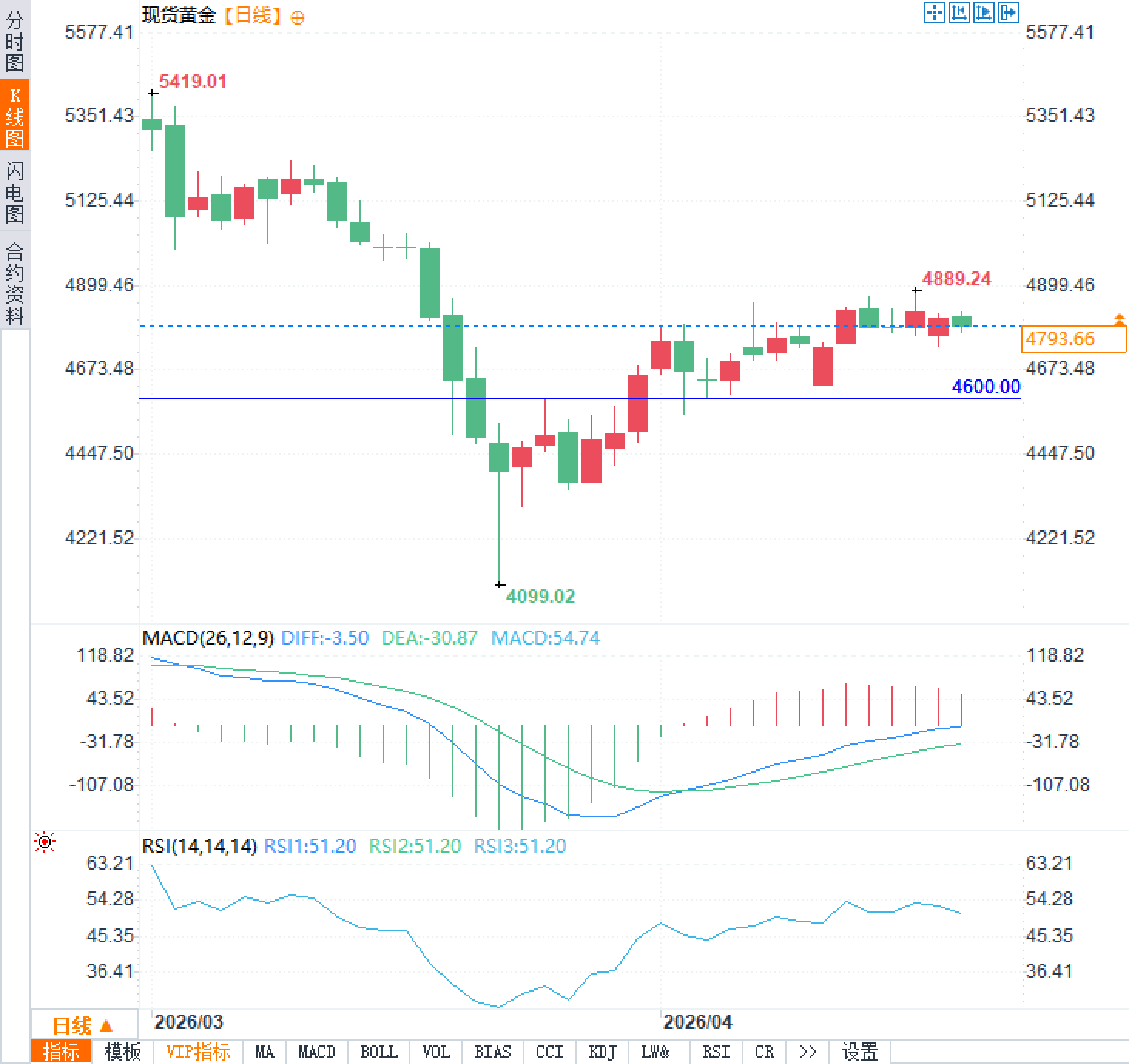
From the daily chart, spot gold has fallen sharply from its high of $5419.01/oz, finding strong support around $4600/oz recently, while facing resistance at $4890/oz. The MACD indicator shows a DIFF of -3.50, a DEA of -30.87, and the MACD histogram at 54.74, indicating it remains in a weak zone, although downward momentum has slowed. The RSI indicator remains around 51.20, in a neutral zone, neither oversold nor showing a clear overbought signal, suggesting a high probability of short-term consolidation. The $4600/oz level is a key support level; a break below this level could open up further downside potential; conversely, a hold above this level accompanied by increased volume could test the $4840-$4890/oz range.
Current Market Overview
Spot gold retreated from recent highs at the beginning of the week, briefly testing support near the $4,800/oz level, but failed to hold onto its gains. Looking at the daily chart, gold prices are currently consolidating within a range of $4,600 to $4,890/oz. Other precious metals also saw corrections, with spot silver falling 1.2% to $78.94/oz, platinum down 1% to $2,068.32/oz, and palladium rising slightly by 0.3% to $1,555.41/oz.
Crude oil prices fell slightly due to expectations of peace talks, but the potential risk of energy supply disruptions continued to support inflation concerns, indirectly affecting gold pricing logic. Meanwhile, US stock index futures rebounded slightly, indicating a recovery in market risk appetite, but gold's appeal as a safe-haven asset temporarily weakened.
Geopolitical uncertainty is putting downward pressure on gold prices.
While the US-Iran peace talks show signs of continued progress in Pakistan, the ongoing blockade of the Strait of Hormuz and the approaching two-week ceasefire deadline have made the situation highly uncertain. The Iranian Foreign Ministry's explicit condemnation of the merchant ship incident and demand for its immediate release has further exacerbated market concerns about supply disruptions. Gold, traditionally used as an inflation hedge, faces significantly higher holding costs in a high-interest-rate environment, and its non-yielding nature makes it more vulnerable to a stronger dollar. In the current environment, the rebound in the dollar index directly raises the holding threshold for dollar-denominated commodities, becoming a major headwind for gold.
Federal Reserve personnel changes and monetary policy outlook
Federal Reserve Chair nominee Kevin Warsh will testify before the Senate on Thursday, and his prepared remarks emphasize his commitment to ensuring that monetary policy remains strictly independent. This statement is particularly crucial in the current high-interest-rate environment, suggesting that future policy will focus on controlling inflation rather than being overly influenced by external factors. Market interpretations suggest that Warsh's stance may continue the current tightening trend, maintaining high real interest rates, which will exert long-term downward pressure on gold. Traders are closely monitoring potential signals from the hearing; if he further clarifies his hawkish stance on inflation, the dollar may continue to strengthen, further diminishing gold's appeal. Considering recent macroeconomic data, while inflation concerns have fluctuated due to energy price volatility, the Fed's commitment to independence helps stabilize market expectations regarding the interest rate path and prevents excessive easing from triggering a gold price rebound.
Technical Indicator Interpretation
From the daily chart, spot gold has fallen sharply from its high of $5419.01/oz, finding strong support around $4600/oz recently, while facing resistance at $4890/oz. The MACD indicator shows a DIFF of -3.50, a DEA of -30.87, and the MACD histogram at 54.74, indicating it remains in a weak zone, although downward momentum has slowed. The RSI indicator remains around 51.20, in a neutral zone, neither oversold nor showing a clear overbought signal, suggesting a high probability of short-term consolidation. The $4600/oz level is a key support level; a break below this level could open up further downside potential; conversely, a hold above this level accompanied by increased volume could test the $4840-$4890/oz range.
Frequently Asked Questions
Question 1: How exactly does the uncertainty surrounding the US-Iran peace talks affect spot gold pricing?
A: The prospects for negotiations directly influence crude oil supply expectations and the path of inflation. A continued blockade of the Straits pushes up energy costs, supports the US dollar, and increases the opportunity cost of gold, putting downward pressure on gold prices. If the ceasefire is extended or an agreement is reached, the fading risk premium will further suppress safe-haven demand.
Question 2: What potential spillover effects will the Kevin Warsh hearing have on the gold market?
A: The emphasis on policy independence may strengthen market expectations that the Federal Reserve will maintain high interest rates, pushing up the dollar and real yields, and weakening the attractiveness of gold. If the hearing releases dovish signals, gold prices may get a brief respite; conversely, hawkish statements will exacerbate the current downward pressure. This personnel change has become a secondary but important driver, compounded by geopolitical factors.
- Risk Warning and Disclaimer
- The market involves risk, and trading may not be suitable for all investors. This article is for reference only and does not constitute personal investment advice, nor does it take into account certain users’ specific investment objectives, financial situation, or other needs. Any investment decisions made based on this information are at your own risk.