Gold Trading Alert: Gold Prices Plunge 2% to Over a Week Low! The US Dollar, US Treasury Bonds, Iran, and the Warsh Movement – Four Forces Simultaneously Suppress Gold Prices
2026-04-22 07:35:40
Gold prices plunged on Tuesday, falling more than 2% and briefly breaching the key psychological level of $4,700 per ounce, hitting a new low in nearly ten days. This move is undoubtedly perplexing for investors accustomed to gold's role as a safe haven during turbulent times. After all, the powder keg in the Middle East has not truly been extinguished, and the rivalry between the US and Iran, as well as the shadow of the Strait of Hormuz, still loom over the global energy market. However, the logic of financial markets is often more complex than it appears on the surface. This sharp drop in gold prices was not due to the disappearance of risk; on the contrary, it was because several core forces driving gold prices—the US dollar, US Treasury yields, geopolitical expectations, and the future path of the Federal Reserve—collided and reset dramatically on the same trading day. On Wednesday (April 22) in early Asian trading, spot gold fluctuated slightly higher, currently trading around $4,730 per ounce.
To understand why gold prices fell despite persistent safe-haven demand, we must first examine the most direct and ruthless market logic. Gold is a global asset priced in US dollars. When the dollar strengthens, gold becomes relatively expensive for investors holding other currencies, directly suppressing demand and driving down prices. Simultaneously, gold is a non-interest-bearing asset. When holding safe-haven assets like government bonds offers substantial returns, the opportunity cost of holding gold increases significantly, naturally leading investors to sell gold and embrace interest-bearing assets.
Tuesday's market perfectly illustrated this double whammy. The US dollar index climbed to a one-week high, rising 0.33%. The forces supporting the dollar's strength were multi-layered. On one hand, the latest US retail sales data far exceeded expectations, with March retail sales jumping 1.7% month-on-month. While soaring gasoline prices due to the war were a major driver, other consumer sectors, supported by tax rebates, also showed resilience. This sent a clear signal to the market: despite the impact of the Middle East conflict, the underlying momentum of the US economy remains robust. Strong economic data directly weakened market expectations for a Federal Reserve rate cut this year. Futures market pricing showed that traders believed the probability of a 25-basis-point rate cut by the Fed this year plummeted from 46% the previous day to 20%. The cooling of rate cut expectations naturally pushed up the dollar exchange rate.
On the other hand, US Treasury yields rose in tandem, with the 10-year yield climbing to 4.288% and the 2-year yield increasing by 6.3 basis points to 3.779%. This means that the returns on risk-free assets are becoming more attractive. When investors can easily obtain an annualized yield of nearly 4.3% from US government bonds, the opportunity cost of holding and storing gold bars that do not generate interest becomes exceptionally high. It can be said that in the face of strong economic data, the market has repriced the Federal Reserve's monetary policy path, and gold has become one of the most direct victims of this repricing process.
If the US dollar and US Treasury yields constituted the macroeconomic backdrop that weighed on gold prices, then the dramatic developments surrounding the US-Iran negotiations were the direct trigger for the day's market movements. Throughout Tuesday, the market was plagued by a series of contradictory and rapidly shifting signals. This information chaos did not simply lead to safe-haven demand or risk appetite, but rather to extreme uncertainty and sharp adjustments at the trading level.
Initially, the market was gripped by deep concerns about an escalation of the conflict. US President Trump had earlier issued a strong warning, indicating his unwillingness to extend the expiring ceasefire agreement and stating that the US military was poised to intervene if negotiations broke down. Simultaneously, US forces boarded a large Iranian oil tanker at sea, to which Iran responded that it had not yet decided whether to participate in peace talks and made it clear that it would not reopen the Strait of Hormuz as long as the naval blockade continued. These developments undoubtedly exacerbated geopolitical tensions, briefly pushing oil prices up by more than 3%. Rising energy prices typically exacerbate inflation concerns, thus having a complex impact on gold.
However, just as the market was bracing for the worst, the plot took a dramatic turn. On Tuesday evening, Trump decided to extend the ceasefire agreement, leaving room for a diplomatic solution. But at the same time, Vice President Vance's scheduled trip to Pakistan for talks was canceled indefinitely, and Iran explicitly rejected a second round of talks in Pakistan, believing the US was obstructing any meaningful agreement. This situation—extending the ceasefire while canceling high-level trips, and one side directly refusing to negotiate—created unprecedented information noise.
For gold traders, the immediate consequence of this confusing signal is the rapid collapse of the previously positively priced-in expectations of peace. In recent weeks, as optimism surrounding a potential ceasefire between the US and Iran grew, gold's safe-haven premium was gradually squeezed out, and the dollar also declined. However, when Tuesday's reality showed that peace was far from being achieved, and even negotiations themselves were deadlocked, the market did not simply revert to a full-blown risk-averse mode. Instead, investors began to calmly assess a more persistent and complex stalemate: the US blockading Iranian ports, Iran blocking the Strait of Hormuz, both sides suffering economic losses, but without escalating to a full-blown war. In this scenario, the dollar benefits from its relatively safe-haven status, while gold loses some of the support previously provided by the "reversal of ceasefire expectations."
While the US-Iran situation gripped nerves, a crucial event unfolded on another stage in Washington, potentially having a profound impact on global financial markets. Former Federal Reserve Governor Kevin Warsh testified before the Senate, facing questioning regarding his nomination as the next Federal Reserve Chairman. Warsh's statements at the hearing provided the market with important clues about the future direction of monetary policy and indirectly influenced the price movement of gold.
Warsh explicitly called for a "systemic reform" at the Federal Reserve. His proposed reforms included adopting new methods for controlling inflation and a complete overhaul of the Fed's communication mechanisms. The latter is particularly noteworthy; Warsh seemed inclined to limit Fed officials' public discussions of the specific path of monetary policy. This emphasis on communication discipline was intended to reduce market volatility caused by frequent pronouncements from Fed officials. More importantly, however, Warsh attempted to assure senators at his hearings that he had not promised the president any interest rate cuts and that he would act independently of the White House.
This statement had an immediate impact on interest rate expectations. A Federal Reserve chairman who advocates for institutional reform, emphasizes independence, and did not commit to loose monetary policy means that the Fed is more likely to maintain its current tightening stance rather than quickly shift to rate cuts in the near future. As market strategists have pointed out, traders are closely watching Warsh's every word, and market volatility is expected to intensify significantly during the hearing. Warsh's hawkish tone, coupled with the strong retail sales data of the day, jointly contributed to cooling expectations of rate cuts, strengthening the dollar, and rising US Treasury yields—all of which put pressure on gold.
In this market trend driven by geopolitics, monetary policy, and macroeconomic data, crude oil prices played a rather subtle role. On Tuesday, crude oil prices rose by more than 3%, which, on the surface, should have exacerbated inflation concerns, thereby increasing the attractiveness of gold as an inflation hedge. However, in reality, gold and oil prices did not move in the same direction that day.
The key lies in how the market interprets the impact of rising oil prices on different assets. While rising oil prices have certainly increased inflation expectations, in the current market environment, their more direct effect is to reinforce the necessity for the Federal Reserve to maintain its tight monetary policy. When gasoline prices drive up retail sales data, and when energy costs permeate every corner of the economy, the Fed finds it harder to find reasons to cut interest rates. In fact, market expectations for rate cuts have cooled sharply due to the combined effect of rising oil prices and better-than-expected economic data. Therefore, the positive logic of rising oil prices for gold is outweighed by the negative logic that the Fed may therefore maintain high interest rates for a longer period.
Meanwhile, the reaction in the US Treasury market confirmed this. Treasury prices fell for the second consecutive trading day, while yields climbed, exhibiting a "bear market flattening" pattern—short-term yields rising faster than long-term yields. This typically indicates that the market does not expect the Federal Reserve to cut interest rates in the near term. A senior macro strategist at State Street Group astutely pointed out that the day's bond market volatility was highly correlated with the war and oil price movements. As soon as oil prices turned lower, yields began to rise. This price linkage mechanism clearly demonstrates that geopolitical risks are reshaping market expectations for inflation and monetary policy through the energy channel, and gold is temporarily at a disadvantage in this complex transmission chain.
In summary, gold's more than 2% drop on Tuesday was the result of a confluence of factors. Strong US economic data led the market to recalibrate its expectations for interest rate cuts, and a strong dollar coupled with high US Treasury yields put direct pressure on gold. The chaotic signals from the US and Iran did not simply trigger safe-haven buying; instead, the market began a sober assessment of the potential for a prolonged stalemate and standoff. Warsh's statements at his confirmation hearing for the Fed Chair reinforced expectations that monetary policy is unlikely to shift towards easing in the short term. When these factors combined, gold experienced a significant correction.
However, this does not mean the bull market for gold is over. On the contrary, the current pullback is more like a brief respite in the eye of the storm. The fundamental differences between the US and Iran remain unresolved, the risk of shipping disruptions in the Strait of Hormuz is real, and if diplomatic efforts completely fail and war reignites, gold's safe-haven appeal will quickly return. Furthermore, how Warsh's proposed "systemic reforms" at the Federal Reserve will actually be implemented, and whether the US economy can maintain its resilience under sustained high interest rate pressures, are all significant unresolved variables.
For investors, the current decline in gold prices offers an opportunity to examine the deeper structure of the market. Amid a complex landscape interwoven with a strong dollar, hawkish central bank expectations, and persistent geopolitical risks, gold is no longer merely a simple safe-haven asset; its price fluctuations are becoming a mirror reflecting the interplay of global macroeconomic forces. Looking ahead, every detail of the US-Iran negotiations, every release of US economic data, and every statement from Federal Reserve official could trigger significant market volatility.
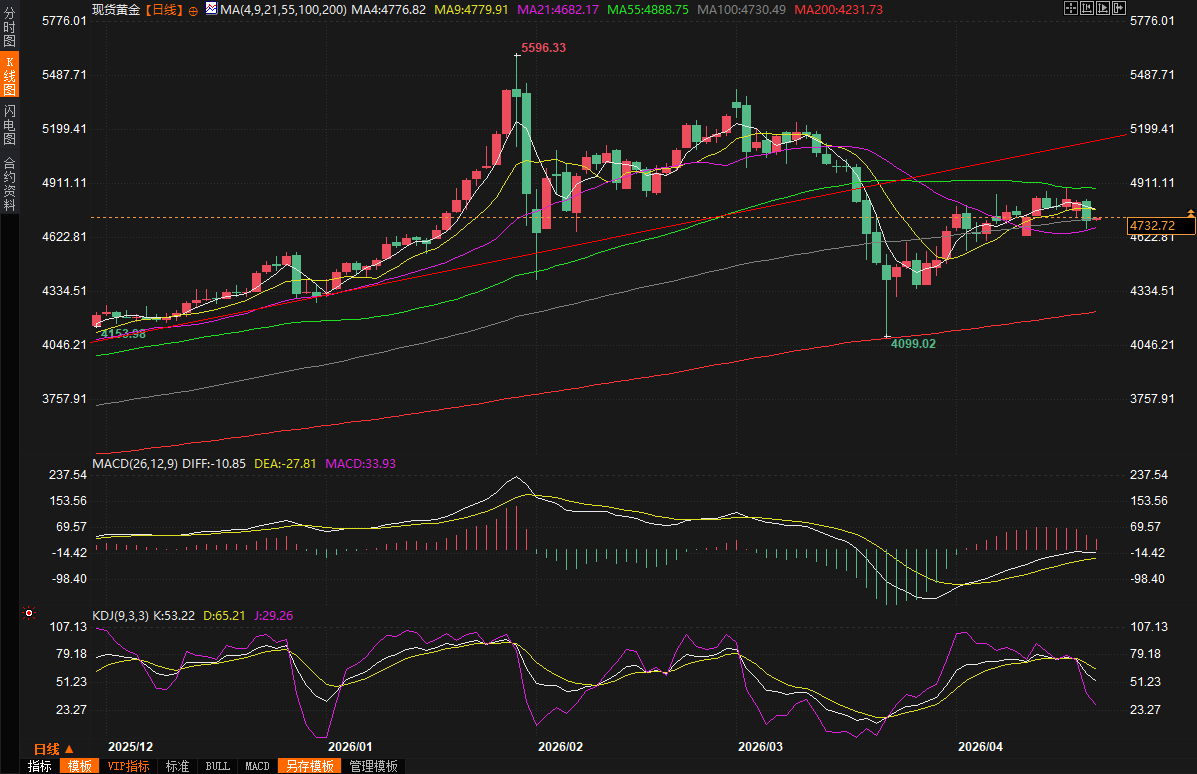
(Spot gold daily chart, source: FX678)
At 07:33 Beijing time, spot gold was trading at $4232.89 per ounce.
The double whammy of a strong dollar and high yields
To understand why gold prices fell despite persistent safe-haven demand, we must first examine the most direct and ruthless market logic. Gold is a global asset priced in US dollars. When the dollar strengthens, gold becomes relatively expensive for investors holding other currencies, directly suppressing demand and driving down prices. Simultaneously, gold is a non-interest-bearing asset. When holding safe-haven assets like government bonds offers substantial returns, the opportunity cost of holding gold increases significantly, naturally leading investors to sell gold and embrace interest-bearing assets.
Tuesday's market perfectly illustrated this double whammy. The US dollar index climbed to a one-week high, rising 0.33%. The forces supporting the dollar's strength were multi-layered. On one hand, the latest US retail sales data far exceeded expectations, with March retail sales jumping 1.7% month-on-month. While soaring gasoline prices due to the war were a major driver, other consumer sectors, supported by tax rebates, also showed resilience. This sent a clear signal to the market: despite the impact of the Middle East conflict, the underlying momentum of the US economy remains robust. Strong economic data directly weakened market expectations for a Federal Reserve rate cut this year. Futures market pricing showed that traders believed the probability of a 25-basis-point rate cut by the Fed this year plummeted from 46% the previous day to 20%. The cooling of rate cut expectations naturally pushed up the dollar exchange rate.
On the other hand, US Treasury yields rose in tandem, with the 10-year yield climbing to 4.288% and the 2-year yield increasing by 6.3 basis points to 3.779%. This means that the returns on risk-free assets are becoming more attractive. When investors can easily obtain an annualized yield of nearly 4.3% from US government bonds, the opportunity cost of holding and storing gold bars that do not generate interest becomes exceptionally high. It can be said that in the face of strong economic data, the market has repriced the Federal Reserve's monetary policy path, and gold has become one of the most direct victims of this repricing process.
Ceasefire or war? The market oscillates wildly amid conflicting signals.
If the US dollar and US Treasury yields constituted the macroeconomic backdrop that weighed on gold prices, then the dramatic developments surrounding the US-Iran negotiations were the direct trigger for the day's market movements. Throughout Tuesday, the market was plagued by a series of contradictory and rapidly shifting signals. This information chaos did not simply lead to safe-haven demand or risk appetite, but rather to extreme uncertainty and sharp adjustments at the trading level.
Initially, the market was gripped by deep concerns about an escalation of the conflict. US President Trump had earlier issued a strong warning, indicating his unwillingness to extend the expiring ceasefire agreement and stating that the US military was poised to intervene if negotiations broke down. Simultaneously, US forces boarded a large Iranian oil tanker at sea, to which Iran responded that it had not yet decided whether to participate in peace talks and made it clear that it would not reopen the Strait of Hormuz as long as the naval blockade continued. These developments undoubtedly exacerbated geopolitical tensions, briefly pushing oil prices up by more than 3%. Rising energy prices typically exacerbate inflation concerns, thus having a complex impact on gold.
However, just as the market was bracing for the worst, the plot took a dramatic turn. On Tuesday evening, Trump decided to extend the ceasefire agreement, leaving room for a diplomatic solution. But at the same time, Vice President Vance's scheduled trip to Pakistan for talks was canceled indefinitely, and Iran explicitly rejected a second round of talks in Pakistan, believing the US was obstructing any meaningful agreement. This situation—extending the ceasefire while canceling high-level trips, and one side directly refusing to negotiate—created unprecedented information noise.
For gold traders, the immediate consequence of this confusing signal is the rapid collapse of the previously positively priced-in expectations of peace. In recent weeks, as optimism surrounding a potential ceasefire between the US and Iran grew, gold's safe-haven premium was gradually squeezed out, and the dollar also declined. However, when Tuesday's reality showed that peace was far from being achieved, and even negotiations themselves were deadlocked, the market did not simply revert to a full-blown risk-averse mode. Instead, investors began to calmly assess a more persistent and complex stalemate: the US blockading Iranian ports, Iran blocking the Strait of Hormuz, both sides suffering economic losses, but without escalating to a full-blown war. In this scenario, the dollar benefits from its relatively safe-haven status, while gold loses some of the support previously provided by the "reversal of ceasefire expectations."
The Warsh hearing: The future of the Federal Reserve remains uncertain.
While the US-Iran situation gripped nerves, a crucial event unfolded on another stage in Washington, potentially having a profound impact on global financial markets. Former Federal Reserve Governor Kevin Warsh testified before the Senate, facing questioning regarding his nomination as the next Federal Reserve Chairman. Warsh's statements at the hearing provided the market with important clues about the future direction of monetary policy and indirectly influenced the price movement of gold.
Warsh explicitly called for a "systemic reform" at the Federal Reserve. His proposed reforms included adopting new methods for controlling inflation and a complete overhaul of the Fed's communication mechanisms. The latter is particularly noteworthy; Warsh seemed inclined to limit Fed officials' public discussions of the specific path of monetary policy. This emphasis on communication discipline was intended to reduce market volatility caused by frequent pronouncements from Fed officials. More importantly, however, Warsh attempted to assure senators at his hearings that he had not promised the president any interest rate cuts and that he would act independently of the White House.
This statement had an immediate impact on interest rate expectations. A Federal Reserve chairman who advocates for institutional reform, emphasizes independence, and did not commit to loose monetary policy means that the Fed is more likely to maintain its current tightening stance rather than quickly shift to rate cuts in the near future. As market strategists have pointed out, traders are closely watching Warsh's every word, and market volatility is expected to intensify significantly during the hearing. Warsh's hawkish tone, coupled with the strong retail sales data of the day, jointly contributed to cooling expectations of rate cuts, strengthening the dollar, and rising US Treasury yields—all of which put pressure on gold.
The seesaw effect of oil prices and the myth of inflation.
In this market trend driven by geopolitics, monetary policy, and macroeconomic data, crude oil prices played a rather subtle role. On Tuesday, crude oil prices rose by more than 3%, which, on the surface, should have exacerbated inflation concerns, thereby increasing the attractiveness of gold as an inflation hedge. However, in reality, gold and oil prices did not move in the same direction that day.
The key lies in how the market interprets the impact of rising oil prices on different assets. While rising oil prices have certainly increased inflation expectations, in the current market environment, their more direct effect is to reinforce the necessity for the Federal Reserve to maintain its tight monetary policy. When gasoline prices drive up retail sales data, and when energy costs permeate every corner of the economy, the Fed finds it harder to find reasons to cut interest rates. In fact, market expectations for rate cuts have cooled sharply due to the combined effect of rising oil prices and better-than-expected economic data. Therefore, the positive logic of rising oil prices for gold is outweighed by the negative logic that the Fed may therefore maintain high interest rates for a longer period.
Meanwhile, the reaction in the US Treasury market confirmed this. Treasury prices fell for the second consecutive trading day, while yields climbed, exhibiting a "bear market flattening" pattern—short-term yields rising faster than long-term yields. This typically indicates that the market does not expect the Federal Reserve to cut interest rates in the near term. A senior macro strategist at State Street Group astutely pointed out that the day's bond market volatility was highly correlated with the war and oil price movements. As soon as oil prices turned lower, yields began to rise. This price linkage mechanism clearly demonstrates that geopolitical risks are reshaping market expectations for inflation and monetary policy through the energy channel, and gold is temporarily at a disadvantage in this complex transmission chain.
Choices in the Eye of the Storm
In summary, gold's more than 2% drop on Tuesday was the result of a confluence of factors. Strong US economic data led the market to recalibrate its expectations for interest rate cuts, and a strong dollar coupled with high US Treasury yields put direct pressure on gold. The chaotic signals from the US and Iran did not simply trigger safe-haven buying; instead, the market began a sober assessment of the potential for a prolonged stalemate and standoff. Warsh's statements at his confirmation hearing for the Fed Chair reinforced expectations that monetary policy is unlikely to shift towards easing in the short term. When these factors combined, gold experienced a significant correction.
However, this does not mean the bull market for gold is over. On the contrary, the current pullback is more like a brief respite in the eye of the storm. The fundamental differences between the US and Iran remain unresolved, the risk of shipping disruptions in the Strait of Hormuz is real, and if diplomatic efforts completely fail and war reignites, gold's safe-haven appeal will quickly return. Furthermore, how Warsh's proposed "systemic reforms" at the Federal Reserve will actually be implemented, and whether the US economy can maintain its resilience under sustained high interest rate pressures, are all significant unresolved variables.
For investors, the current decline in gold prices offers an opportunity to examine the deeper structure of the market. Amid a complex landscape interwoven with a strong dollar, hawkish central bank expectations, and persistent geopolitical risks, gold is no longer merely a simple safe-haven asset; its price fluctuations are becoming a mirror reflecting the interplay of global macroeconomic forces. Looking ahead, every detail of the US-Iran negotiations, every release of US economic data, and every statement from Federal Reserve official could trigger significant market volatility.
(Spot gold daily chart, source: FX678)
At 07:33 Beijing time, spot gold was trading at $4232.89 per ounce.
- Risk Warning and Disclaimer
- The market involves risk, and trading may not be suitable for all investors. This article is for reference only and does not constitute personal investment advice, nor does it take into account certain users’ specific investment objectives, financial situation, or other needs. Any investment decisions made based on this information are at your own risk.