A chart shows that the Baltic Dry Index rose, boosted by freight rates for Capesize and Supramax vessels.
2026-04-23 00:22:06
Latest data shows that the Baltic Dry Index (BDI) reached 2675 points on April 22, 2026, a new high since December 8, 2025, up 1.33% month-on-month, the largest increase since April 20, 2026, and marking the 14th consecutive day of increase (including zero growth). Looking at the short-term charts, the recent 11 BDI data points show: 11 positive increases, 0 negative increases, and 0 zero increases. Specifically, the Panamax Freight Index (BPI) was 1971 points, down 0.10% from the previous value; the Capesize Freight Index (BCI) was 4356 points, up 1.30%; and the Supramax Freight Index (BSI) was 1484 points, up 2.84%. For detailed 720-day and 10-year trend charts of the Baltic Dry Index and its three main sub-indices, please refer to the specially designed charts.
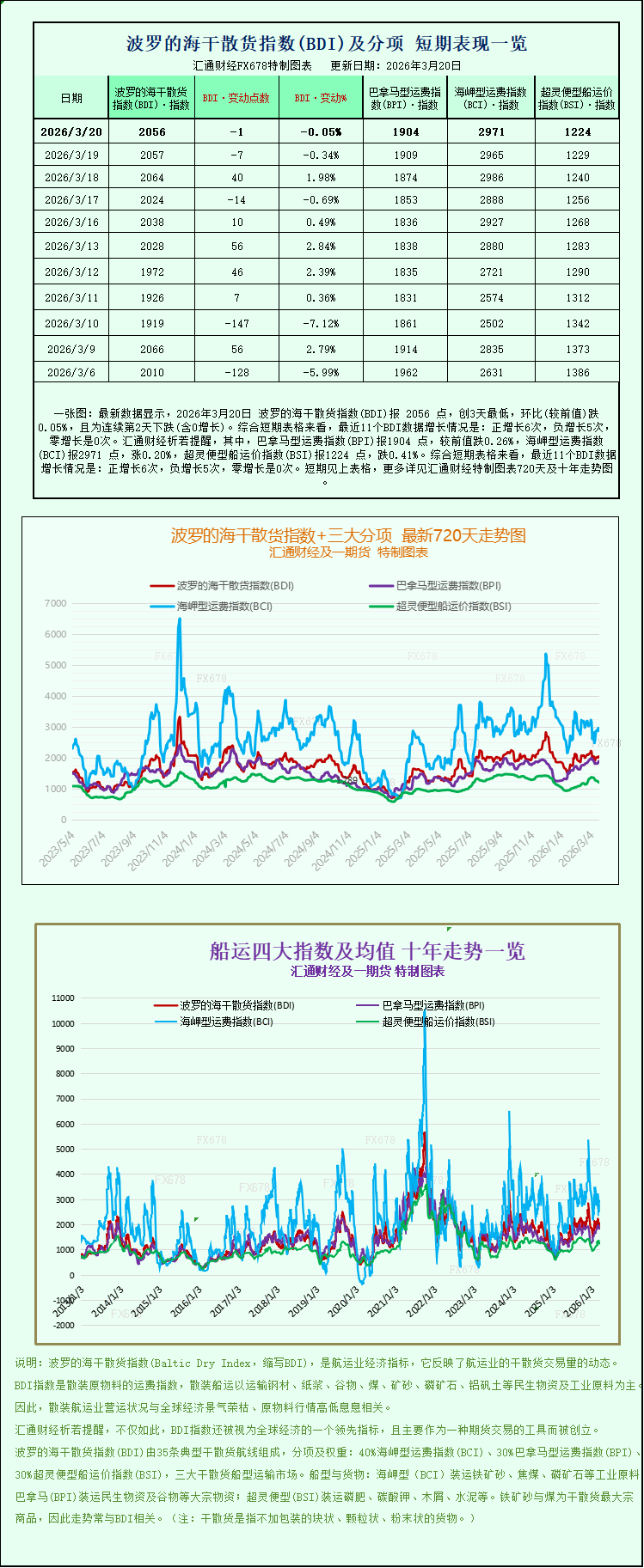
The Baltic Dry Index (BDI), published by the Baltic Exchange, saw a significant increase on the day of the index's rise. Its core function is to monitor real-time shipping costs for dry bulk commodities worldwide, covering ocean freight rates for key commodities such as iron ore, coal, and grain; it is a key indicator of the global dry bulk shipping market's health. This upward trend was mainly driven by the continued rise in freight rates for major vessel types such as Capesize and Supramax. Although freight rates for Panamax vessels saw a slight decline, its drag on the overall index was completely offset by the strong gains in other vessel types, ultimately propelling the index to a steady increase.
The Baltic Dry Index, which tracks freight rates for the three core vessel types—Capesize, Panamax, and Supramax—continued its recent upward trend, marking its 14th consecutive trading day of slight gains. Specifically, the index rose 35 points, or 1.3%, to close at 2675 points, its highest level since early December 2025. This signifies a further consolidation of the global dry bulk shipping market's recovery since the end of last year, with continued increases in market activity.
As one of the main vessel types in the dry bulk shipping market, Capesize vessels have shown particularly strong freight rates. On the same day, the Capesize index rose 56 points, a 1.3% increase, closing at 4356 points, a record high in over four months, highlighting the robust market demand for this vessel type. It is understood that Capesize vessels are mainly used to transport bulk cargoes of 150,000 tons or more, with iron ore and coal as the core commodities, serving as key transport carriers in the global steel and energy industry supply chains.
In line with the rise in the index, the actual operating earnings of Capesize vessels also increased. Data shows that Capesize vessels carrying 150,000 tons of cargo (mainly iron ore and coal) saw their average daily earnings increase by $505 compared to the previous trading day, ultimately reaching $36,002. This revenue growth was mainly due to a slight increase in iron ore prices and the release of pre-holiday restocking demand from Chinese steel companies. With the domestic holidays approaching, Chinese steel companies increased their iron ore purchases to ensure production supply during the holidays. This demand effectively offset market concerns about increased iron ore supply following the resolution of the months-long contract dispute between BHP Billiton and China, providing strong support for Capesize freight rates. It is understood that BHP Billiton released its operating report on April 22, confirming the completion of iron ore sales contract negotiations with China Mineral Resources Group. Previously, import restrictions starting in September 2025 were gradually eased, alleviating the pressure of previous inventory backlogs. However, the concentrated restocking demand from Chinese steel companies still dominated short-term market trends.
In contrast to the strong performance of Capesize vessels, Panamax vessels were slightly weaker on the day. The Panamax index fell slightly by 2 points, a drop of approximately 0.1%, closing at 1971 points. The decline was relatively mild and did not have a significant impact on the overall market. Panamax vessels mainly handle bulk cargo transportation in the 60,000 to 70,000 tonne class, with coal and grain as their core commodities. Their freight rate fluctuations are mainly affected by changes in global food trade and coal demand.
Affected by the decline in the index, the average daily revenue of Panamax vessels also saw a slight decrease. Data shows that the average daily revenue of Panamax vessels decreased by $14 from the previous trading day, ultimately falling to $17,744. Industry analysts believe that the slight decline in Panamax freight rates is mainly related to the recent slowdown in global grain trade and the temporary adjustment in coal transportation demand. It is also influenced by the potential impact of the projected increase in Panamax fleet capacity in 2026. Currently, the market remains cautious about the short-term trend of this vessel type.
Besides Capesize vessels, Supramax vessels also played a significant role in driving the Baltic Dry Index's rise. On that day, the Very Large Bulk Carrier (VLCC) index performed exceptionally well, rising 41 points, a substantial increase of 2.8%, closing at 1484 points, becoming the core vessel type index with the largest increase that day. It is understood that Supramax vessels, with their flexible route adaptability, hold an advantage in small-volume bulk cargo transportation. Recently, global demand for small-volume bulk cargo has remained stable, coupled with tight supply in the secondhand ship market, driving up freight rates for this vessel type and further contributing to the overall index's rise.
It is noteworthy that the global shipping market was also indirectly affected by geopolitical developments that day. US President Donald Trump publicly stated on Tuesday (April 22) that he would extend the ceasefire agreement with Iran indefinitely to promote further peace negotiations. However, he explicitly added that the US blockade of Tehran's maritime trade would remain strictly enforced without any easing. It is understood that Trump had previously stated he did not want to extend the ceasefire agreement and that the US military was prepared for combat, but at Pakistan's request, he ultimately decided to extend the ceasefire until Iran submits a unified negotiating proposal.
Meanwhile, Iran retaliated by seizing two vessels in the Strait of Hormuz. According to reports, the Iranian Islamic Revolutionary Guard Corps Navy carried out the seizure, accusing the vessels of navigating without proper permits and tampering with navigation systems, endangering maritime safety. The Strait of Hormuz is a vital global shipping chokepoint; the Middle East Gulf accounts for approximately 19% of global seaborne fertilizer trade and about 4% of mineral trade, including limestone, pellets, and gypsum. While this vessel seizure has not directly impacted the dry bulk shipping market, it has raised concerns about shipping safety and route stability. Industry insiders worry that continued escalation of geopolitical tensions could have medium- to long-term effects on global dry bulk trade.
The Baltic Dry Index (BDI), published by the Baltic Exchange, saw a significant increase on the day of the index's rise. Its core function is to monitor real-time shipping costs for dry bulk commodities worldwide, covering ocean freight rates for key commodities such as iron ore, coal, and grain; it is a key indicator of the global dry bulk shipping market's health. This upward trend was mainly driven by the continued rise in freight rates for major vessel types such as Capesize and Supramax. Although freight rates for Panamax vessels saw a slight decline, its drag on the overall index was completely offset by the strong gains in other vessel types, ultimately propelling the index to a steady increase.
The Baltic Dry Index, which tracks freight rates for the three core vessel types—Capesize, Panamax, and Supramax—continued its recent upward trend, marking its 14th consecutive trading day of slight gains. Specifically, the index rose 35 points, or 1.3%, to close at 2675 points, its highest level since early December 2025. This signifies a further consolidation of the global dry bulk shipping market's recovery since the end of last year, with continued increases in market activity.
As one of the main vessel types in the dry bulk shipping market, Capesize vessels have shown particularly strong freight rates. On the same day, the Capesize index rose 56 points, a 1.3% increase, closing at 4356 points, a record high in over four months, highlighting the robust market demand for this vessel type. It is understood that Capesize vessels are mainly used to transport bulk cargoes of 150,000 tons or more, with iron ore and coal as the core commodities, serving as key transport carriers in the global steel and energy industry supply chains.
In line with the rise in the index, the actual operating earnings of Capesize vessels also increased. Data shows that Capesize vessels carrying 150,000 tons of cargo (mainly iron ore and coal) saw their average daily earnings increase by $505 compared to the previous trading day, ultimately reaching $36,002. This revenue growth was mainly due to a slight increase in iron ore prices and the release of pre-holiday restocking demand from Chinese steel companies. With the domestic holidays approaching, Chinese steel companies increased their iron ore purchases to ensure production supply during the holidays. This demand effectively offset market concerns about increased iron ore supply following the resolution of the months-long contract dispute between BHP Billiton and China, providing strong support for Capesize freight rates. It is understood that BHP Billiton released its operating report on April 22, confirming the completion of iron ore sales contract negotiations with China Mineral Resources Group. Previously, import restrictions starting in September 2025 were gradually eased, alleviating the pressure of previous inventory backlogs. However, the concentrated restocking demand from Chinese steel companies still dominated short-term market trends.
In contrast to the strong performance of Capesize vessels, Panamax vessels were slightly weaker on the day. The Panamax index fell slightly by 2 points, a drop of approximately 0.1%, closing at 1971 points. The decline was relatively mild and did not have a significant impact on the overall market. Panamax vessels mainly handle bulk cargo transportation in the 60,000 to 70,000 tonne class, with coal and grain as their core commodities. Their freight rate fluctuations are mainly affected by changes in global food trade and coal demand.
Affected by the decline in the index, the average daily revenue of Panamax vessels also saw a slight decrease. Data shows that the average daily revenue of Panamax vessels decreased by $14 from the previous trading day, ultimately falling to $17,744. Industry analysts believe that the slight decline in Panamax freight rates is mainly related to the recent slowdown in global grain trade and the temporary adjustment in coal transportation demand. It is also influenced by the potential impact of the projected increase in Panamax fleet capacity in 2026. Currently, the market remains cautious about the short-term trend of this vessel type.
Besides Capesize vessels, Supramax vessels also played a significant role in driving the Baltic Dry Index's rise. On that day, the Very Large Bulk Carrier (VLCC) index performed exceptionally well, rising 41 points, a substantial increase of 2.8%, closing at 1484 points, becoming the core vessel type index with the largest increase that day. It is understood that Supramax vessels, with their flexible route adaptability, hold an advantage in small-volume bulk cargo transportation. Recently, global demand for small-volume bulk cargo has remained stable, coupled with tight supply in the secondhand ship market, driving up freight rates for this vessel type and further contributing to the overall index's rise.
It is noteworthy that the global shipping market was also indirectly affected by geopolitical developments that day. US President Donald Trump publicly stated on Tuesday (April 22) that he would extend the ceasefire agreement with Iran indefinitely to promote further peace negotiations. However, he explicitly added that the US blockade of Tehran's maritime trade would remain strictly enforced without any easing. It is understood that Trump had previously stated he did not want to extend the ceasefire agreement and that the US military was prepared for combat, but at Pakistan's request, he ultimately decided to extend the ceasefire until Iran submits a unified negotiating proposal.
Meanwhile, Iran retaliated by seizing two vessels in the Strait of Hormuz. According to reports, the Iranian Islamic Revolutionary Guard Corps Navy carried out the seizure, accusing the vessels of navigating without proper permits and tampering with navigation systems, endangering maritime safety. The Strait of Hormuz is a vital global shipping chokepoint; the Middle East Gulf accounts for approximately 19% of global seaborne fertilizer trade and about 4% of mineral trade, including limestone, pellets, and gypsum. While this vessel seizure has not directly impacted the dry bulk shipping market, it has raised concerns about shipping safety and route stability. Industry insiders worry that continued escalation of geopolitical tensions could have medium- to long-term effects on global dry bulk trade.
- Risk Warning and Disclaimer
- The market involves risk, and trading may not be suitable for all investors. This article is for reference only and does not constitute personal investment advice, nor does it take into account certain users’ specific investment objectives, financial situation, or other needs. Any investment decisions made based on this information are at your own risk.