Geopolitical risks coupled with a sharp decline in refined oil inventories led to a significant rise in international oil prices.
2026-04-23 01:04:34
On Wednesday (April 22), during the US trading session, the international crude oil market saw a significant rise, with both major benchmark oil prices increasing by more than $3 in a single day. This round of price increases stemmed from both fundamental support from a larger-than-expected decline in US gasoline and distillate fuel inventories, and geopolitical risks fueled by the ongoing shipping safety incident in the Strait of Hormuz and the stalled progress of US-Iran negotiations. With continued supply disruptions, the global energy market is once again gripped by concerns about both oil supply shortages and economic stagflation.

At 00:58 Beijing time, international oil prices had risen significantly. Brent crude futures rose $2.94, or 2.97%, to $102.13 per barrel; West Texas Intermediate (WTI) crude oil rose $3.95, or 4.41%, to $93.62 per barrel. This marks the second consecutive trading day of sharp increases in both crude oil futures, reflecting rising market risk aversion and expectations of tightening supply.
Structural divergence in EIA inventories and a sharp drop in refined product prices solidify the base for oil prices.
On the fundamental front, the weekly inventory data released by the U.S. Energy Information Administration (EIA) showed a clear structural divergence, becoming a significant driver of oil price strength. Data showed that U.S. crude oil inventories increased by 1.9 million barrels this period, reaching a total of 465.7 million barrels, continuing a slight accumulation trend; however, refined product inventories declined sharply, significantly exceeding market expectations. Specifically, gasoline inventories decreased by 4.6 million barrels, far exceeding the 1.5 million barrel decrease estimated in a Reuters survey; distillate fuel inventories decreased by 3.4 million barrels, also exceeding the expected 2.5 million barrel decrease.
Latest data shows that U.S. gasoline inventories have fallen to 228.4 million barrels, and distillate fuel inventories have dropped to 108.1 million barrels, both near one-month lows. The unexpectedly tighter-than-expected refined product inventories reflect strong end-consumer demand and directly reinforce market expectations of tight oil supply, providing solid fundamental support for rising oil prices.
Turbulence reignites in the Strait of Hormuz, shipping crisis drives up risk premiums.
Geopolitically, tensions in the Strait of Hormuz have further increased oil price risk premiums. Reports surfaced that at least three container ships were shot at in the waters off Hormuz, drastically deteriorating the maritime security situation. The Iranian Revolutionary Guard subsequently seized two vessels suspected of violating maritime regulations and brought them to the Iranian coast. The Revolutionary Guard stated it remains on high alert and is prepared to respond to any threats.
As a vital global energy transport chokepoint, the Strait of Hormuz handles approximately 20% of the world's oil and liquefied natural gas seaborne traffic. Any disruption to shipping can trigger global supply concerns. Currently, the strait is in a state of "semi-accessibility with high control," with shipping insurance premiums soaring, shipowners hesitant, and passage efficiency declining, resulting in actual traffic volume of only 10% of normal levels.
Meanwhile, peace talks between the US and Iran in Pakistan failed to make substantial progress, with Iran formally refusing to attend the latest round of talks and accusing the US of obstructing a substantive agreement. Although the US unilaterally announced an indefinite extension of the ceasefire agreement, neither Iran nor Israel gave a clear response, further escalating regional uncertainty. Trump's remarks on the 22nd regarding a possible new round of talks between the US and Iran on the 24th were also denied by Iran, which stated that it had "not yet decided to participate in the negotiations."
Restructuring of the global energy supply chain
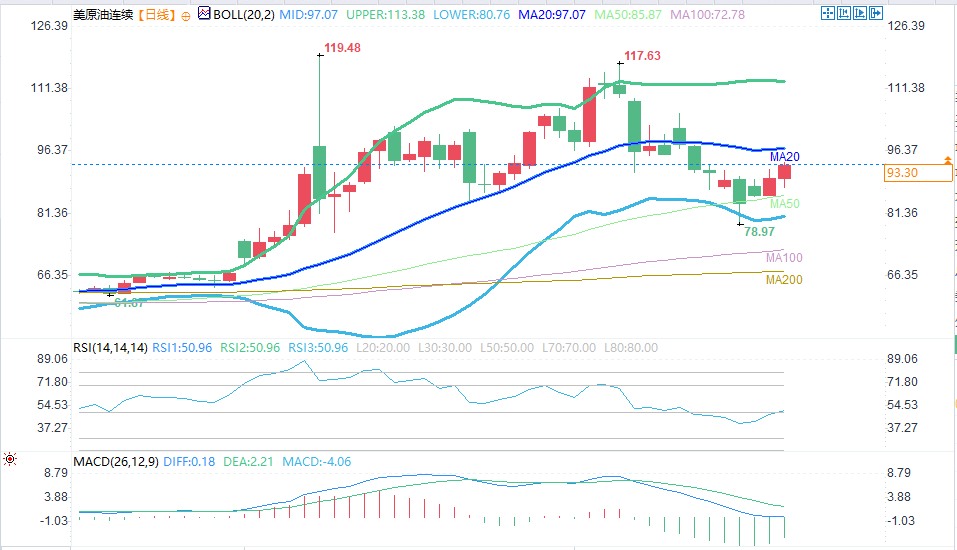
(WTI crude oil daily chart source: FX678)
Recent developments have also emerged regarding adjustments to the global energy supply chain. Russian Deputy Prime Minister Novak announced that, starting May 1st, Kazakhstani oil transported to Germany via the "Friendship" pipeline will be diverted to other routes, an adjustment agreed upon with Kazakhstan. This move will further alter the land-based supply pattern of European crude oil.
Meanwhile, the United States announced a 30-day extension of sanctions waivers for seaborne oil from Russia and Iran to alleviate supply shortages faced by some countries. The European Union is also urgently studying countermeasures, considering requiring member states to establish aviation fuel reserves and to conduct cross-regional allocation based on regional supply and demand to prevent potential fuel shortages.
The continued rise in oil prices has triggered concerns among institutions about the macroeconomy. Strategists at OCBC Bank pointed out that Brent crude oil prices are approaching the $100 mark. If the disruption to shipping in the Strait of Hormuz continues for a month, global oil inventories may fall to critical operating levels. At that point, demand contraction will become the main balancing mechanism in the market, thereby exacerbating inflationary pressures and dragging down economic growth.
Currently, the market is showing signs of weakening demand, including an increase in flight cancellations and a decline in refinery operating rates. The coexistence of supply shocks and weak demand has significantly increased the risk of stagflation. Goldman Sachs analysts point out that if the Straits blockade continues for a month, the average price of Brent crude oil in 2026 may exceed $100; if it continues for three months, the average price in the third quarter may rise to $120.
At 00:58 Beijing time, international oil prices had risen significantly. Brent crude futures rose $2.94, or 2.97%, to $102.13 per barrel; West Texas Intermediate (WTI) crude oil rose $3.95, or 4.41%, to $93.62 per barrel. This marks the second consecutive trading day of sharp increases in both crude oil futures, reflecting rising market risk aversion and expectations of tightening supply.
Structural divergence in EIA inventories and a sharp drop in refined product prices solidify the base for oil prices.
On the fundamental front, the weekly inventory data released by the U.S. Energy Information Administration (EIA) showed a clear structural divergence, becoming a significant driver of oil price strength. Data showed that U.S. crude oil inventories increased by 1.9 million barrels this period, reaching a total of 465.7 million barrels, continuing a slight accumulation trend; however, refined product inventories declined sharply, significantly exceeding market expectations. Specifically, gasoline inventories decreased by 4.6 million barrels, far exceeding the 1.5 million barrel decrease estimated in a Reuters survey; distillate fuel inventories decreased by 3.4 million barrels, also exceeding the expected 2.5 million barrel decrease.
Latest data shows that U.S. gasoline inventories have fallen to 228.4 million barrels, and distillate fuel inventories have dropped to 108.1 million barrels, both near one-month lows. The unexpectedly tighter-than-expected refined product inventories reflect strong end-consumer demand and directly reinforce market expectations of tight oil supply, providing solid fundamental support for rising oil prices.
Turbulence reignites in the Strait of Hormuz, shipping crisis drives up risk premiums.
Geopolitically, tensions in the Strait of Hormuz have further increased oil price risk premiums. Reports surfaced that at least three container ships were shot at in the waters off Hormuz, drastically deteriorating the maritime security situation. The Iranian Revolutionary Guard subsequently seized two vessels suspected of violating maritime regulations and brought them to the Iranian coast. The Revolutionary Guard stated it remains on high alert and is prepared to respond to any threats.
As a vital global energy transport chokepoint, the Strait of Hormuz handles approximately 20% of the world's oil and liquefied natural gas seaborne traffic. Any disruption to shipping can trigger global supply concerns. Currently, the strait is in a state of "semi-accessibility with high control," with shipping insurance premiums soaring, shipowners hesitant, and passage efficiency declining, resulting in actual traffic volume of only 10% of normal levels.
Meanwhile, peace talks between the US and Iran in Pakistan failed to make substantial progress, with Iran formally refusing to attend the latest round of talks and accusing the US of obstructing a substantive agreement. Although the US unilaterally announced an indefinite extension of the ceasefire agreement, neither Iran nor Israel gave a clear response, further escalating regional uncertainty. Trump's remarks on the 22nd regarding a possible new round of talks between the US and Iran on the 24th were also denied by Iran, which stated that it had "not yet decided to participate in the negotiations."
Restructuring of the global energy supply chain
(WTI crude oil daily chart source: FX678)
Recent developments have also emerged regarding adjustments to the global energy supply chain. Russian Deputy Prime Minister Novak announced that, starting May 1st, Kazakhstani oil transported to Germany via the "Friendship" pipeline will be diverted to other routes, an adjustment agreed upon with Kazakhstan. This move will further alter the land-based supply pattern of European crude oil.
Meanwhile, the United States announced a 30-day extension of sanctions waivers for seaborne oil from Russia and Iran to alleviate supply shortages faced by some countries. The European Union is also urgently studying countermeasures, considering requiring member states to establish aviation fuel reserves and to conduct cross-regional allocation based on regional supply and demand to prevent potential fuel shortages.
The continued rise in oil prices has triggered concerns among institutions about the macroeconomy. Strategists at OCBC Bank pointed out that Brent crude oil prices are approaching the $100 mark. If the disruption to shipping in the Strait of Hormuz continues for a month, global oil inventories may fall to critical operating levels. At that point, demand contraction will become the main balancing mechanism in the market, thereby exacerbating inflationary pressures and dragging down economic growth.
Currently, the market is showing signs of weakening demand, including an increase in flight cancellations and a decline in refinery operating rates. The coexistence of supply shocks and weak demand has significantly increased the risk of stagflation. Goldman Sachs analysts point out that if the Straits blockade continues for a month, the average price of Brent crude oil in 2026 may exceed $100; if it continues for three months, the average price in the third quarter may rise to $120.
- Risk Warning and Disclaimer
- The market involves risk, and trading may not be suitable for all investors. This article is for reference only and does not constitute personal investment advice, nor does it take into account certain users’ specific investment objectives, financial situation, or other needs. Any investment decisions made based on this information are at your own risk.