Gold Trading Alert: Iran flexes its muscles in the Strait of Hormuz, gold prices fall to a two-week low; Lebanon-Israel ceasefire becomes a lifeline for bulls?
2026-04-24 07:49:01
The ongoing geopolitical turmoil in the Middle East and the continued rise in international oil prices have dampened expectations of a Federal Reserve rate cut, leading to a stronger US dollar. On Thursday (April 23), spot gold briefly touched $4664.28 per ounce, a near two-week low. Although it recovered some losses during the session due to news of a possible extension of the ceasefire between Lebanon and Israel, it ultimately succumbed to the strong dollar, closing at $4694.07, a drop of approximately 1% for the day. On Friday (April 24) in early Asian trading, spot gold traded in a narrow range, currently hovering around $4697 per ounce. The market will continue to focus on news related to the Middle East situation and is beginning to anticipate next week's central bank spending spree.
On the surface, the direct driver of the gold price decline is the continuous strengthening of the US dollar index. The dollar index has risen for three consecutive trading days, reaching 98.94 at one point, a new high since April 13th. The strong performance of the dollar has put significant selling pressure on dollar-denominated gold. The dollar's ability to strengthen against the trend is largely due to safe-haven demand triggered by the turmoil in the Middle East. When investors are uneasy about geopolitical situations, the dollar often becomes the preferred safe haven, while gold has somewhat paled in comparison to this round of safe-haven sentiment.
A deeper reason lies in the rapid cooling of market expectations for a Federal Reserve rate cut. With continued tensions in the Middle East, international oil prices have surged, with Brent crude breaking the $100 per barrel mark on Thursday. The soaring oil prices have exacerbated market concerns about a resurgence of inflation, further reducing the Fed's room for further rate cuts.
According to estimates from the London Stock Exchange Group, the US interest rate futures market currently anticipates only about 7 basis points of interest rate cuts this year, compared to over 50 basis points before the Iran war. In other words, the market has almost ruled out the possibility of a significant interest rate cut this year. The fading expectation of rate cuts directly weakens the attractiveness of gold, because gold itself does not generate interest income, and with interest rates remaining high, the opportunity cost of holding gold becomes particularly prominent.
Thursday's U.S. initial jobless claims data appeared to signal a weakening economy. The data showed that seasonally adjusted initial jobless claims rose by 6,000 to 214,000 in the week ending April 18, slightly higher than the market expectation of 210,000. This should have been a bullish factor supporting gold, as a loosening in the job market could prompt the Federal Reserve to reconsider its interest rate cut timetable.
However, the market's interpretation of this data was quite sober. Economists generally believe that although initial jobless claims slightly exceeded expectations, the overall US labor market remains stable. The level of 214,000 is still within a relatively healthy range historically, far from worrying levels. More noteworthy is that the S&P Global US Composite Purchasing Managers' Index rose to 52.0 in April, while the March reading was only 50.3, the lowest level since September 2023. This data indicates that despite the dual pressures of war and inflation, US business activity has shown surprising resilience. With no clear signs of economic slowdown, the Federal Reserve has even less reason to rush into cutting interest rates.
If the US dollar and interest rates are the surface-level factors influencing gold prices, then the struggle for control of the Strait of Hormuz is a deeper variable affecting the overall situation. On Thursday, Iran released a visually striking video showing special forces raiding a giant cargo ship in speedboats. Armed personnel climbed rope ladders to board the ship and swiftly launched their operation on the deck, rifles in hand. This video, accompanied by action-movie-style music, sends a clear signal to the world: despite the strength of the US military, Iran still possesses a considerable counterbalancing force in the narrow Strait of Hormuz.
The statements from the US and Iran regarding control of the Strait of Hormuz present a stark contrast. Trump claimed that the US has "complete control" of the Strait of Hormuz and ordered the Navy to "shoot and destroy" Iranian vessels laid mines in the strait. Iran, on the other hand, has demonstrated its presence through concrete actions, with its speedboats and naval drones hidden in sea caves off the islands, posing a constant threat to passing ships. The deputy speaker of the Iranian parliament even stated that Iran has begun collecting tolls from ships passing through the Strait of Hormuz, with the first revenue already transferred to the central bank.
This standoff, with each side sticking to its own narrative, is precisely what the market least wants to see. As Standard Chartered's head of foreign exchange strategy pointed out, the market is neither certain that the ceasefire will last nor that it will completely break down. In this state of ambiguity, investors find it difficult to make decisive asset allocation decisions, which explains why, despite high geopolitical risks, funds have not flowed into gold as a safe haven.
Israeli Defense Minister Katz's latest remarks have further complicated the situation. He explicitly stated that Israel is awaiting the United States' "green light" to resume military action against Iran, and issued extremely tough statements: once strikes resume, the first target will be Iran's Supreme Leader Mojtaba Khamenei, sending "Iran back to the Dark Ages." This statement, directly targeting the other side's supreme leader, undoubtedly elevates the nature of the conflict to a new level.
It's worth noting that since the US and Israel launched their war against Iran on February 28th, gold prices have fallen by more than 11%. This seems counterintuitive—war should typically push up gold prices. However, this anomaly precisely illustrates that the impact of this round of Middle East conflict on gold is far more complex than it appears. The outbreak of war pushed up oil prices, exacerbated inflation expectations, and reinforced the Federal Reserve's rationale for maintaining high interest rates, ultimately putting downward pressure on gold prices. In other words, the Middle East conflict indirectly suppressed gold by pushing up oil prices, forming a transmission chain of "war → rising oil prices → rising inflation expectations → decreased probability of interest rate cuts → falling gold prices."
Brent crude oil prices have broken through $100 per barrel, marking another milestone since the outbreak of this round of conflict. Behind the soaring oil prices lies the real predicament of blocked passage through the Strait of Hormuz. If this most important global oil transportation route is blocked, approximately 20 million barrels of crude oil passing through daily will be unable to be transported smoothly to the global market, and the resulting supply-demand imbalance will inevitably push up oil prices.
High oil prices have a two-fold impact on gold. On the one hand, rising oil prices exacerbate inflationary pressures, from which gold, as a traditional hedge against inflation, should benefit. On the other hand, high inflation forces the Federal Reserve to maintain or even tighten monetary policy, and a high-interest-rate environment is precisely gold's biggest enemy. Judging from the current market reaction, the latter force clearly prevails. The federal funds futures market currently prices only a 24% probability of an interest rate cut before the end of the year, meaning that the vast majority of investors have accepted the reality that interest rates will remain high for a longer period.
The most striking characteristic of the current market is the wait-and-see attitude of investors. Nuveen's chief investment officer succinctly summarized the market's predicament: "Given market concerns that the war may last longer, investors are adopting a wait-and-see approach. From a bond investment perspective, because we cannot predict how things will develop, investors lack confidence in more aggressively positioning themselves." This statement accurately describes the current market sentiment.
The performance of the US Treasury market is telling. Despite heightened geopolitical risks, Treasury prices have fallen, while yields have risen slightly. Typically, increased risk aversion would drive funds into US Treasuries, pushing yields down. However, the reality is that the 10-year Treasury yield rose 2.6 basis points to 4.319%, indicating that investors did not flock to safe-haven assets on a large scale. This anomaly is because investors are concerned about both escalating war and rebounding inflation; these two concerns offset each other, ultimately leading to market stagnation.
The stock market's performance also reflected this contradictory sentiment. U.S. stocks closed lower on Thursday in volatile trading, but the declines were relatively limited, with the Dow Jones Industrial Average down 0.36%, the S&P 500 down 0.41%, and the Nasdaq Composite down 0.89%. The CEO of Infrastructure Capital Advisors aptly described the current market as "a game of musical chairs between earnings season and war headlines that are unlikely to bring good news." Some investors chose to reduce their positions, with the war merely serving as an excuse.
In this gloomy market landscape, the news that Lebanon and Israel might extend their ceasefire agreement is the only glimmer of hope for gold bulls. If the ceasefire is successfully extended, it could at least prevent the situation from escalating further, providing some support for gold. Gold prices recovered all their losses during Thursday's trading session, a positive market response to this news.
However, this support is limited. The extension of the ceasefire agreement only prevented the worst-case scenario from occurring; it did not fundamentally resolve the passage issue in the Strait of Hormuz, nor did it change the core contradiction in the US-Iran standoff. As long as the strait remains unopened, oil prices will struggle to fall, expectations of a Federal Reserve rate cut will remain high, and the pressure on gold prices will persist.
In summary, the gold market is currently caught in a tug-of-war between multiple forces. The downward pull comes from a strong US dollar, inflation concerns stemming from high oil prices, and a cooling of expectations for interest rate cuts; the upward support comes from uncertainties in the Middle East geopolitical situation, the potential extension of the Lebanon-Israel ceasefire agreement, and the safe-haven demand that could arise should the situation escalate unexpectedly.
From a broader perspective, gold investors need to be aware that the impact mechanism of this round of Middle East conflict on gold differs from past experience. The traditional logic of "war pushing up gold prices" is being replaced by a new transmission chain: "war pushing up oil prices → oil prices pushing up inflation → inflation delaying interest rate cuts → delayed interest rate cuts suppressing gold prices." As long as the stalemate in the Strait of Hormuz continues, and as long as oil prices remain above $100, gold will continue to face pressure from interest rate expectations.
Of course, the market is always full of variables. If Israel does receive the US's "green light" and resumes large-scale military operations against Iran, and if the conflict escalates from a proxy war into a full-blown war, then risk aversion could overwhelm all other factors, driving a genuine surge in gold prices. But until then, gold is more likely to continue its consolidation pattern, searching for direction amidst the dollar's performance, oil price fluctuations, and geopolitical news.
For ordinary investors, patience and clear-headedness are most needed right now. Don't panic and sell because of a single day's sharp decline, nor blindly chase high prices because of escalating geopolitical risks. Closely monitoring developments in the Strait of Hormuz, paying attention to statements from Federal Reserve officials regarding inflation and interest rate paths, and keeping an eye on weekly employment and inflation data are the rational ways to navigate the current complex situation.
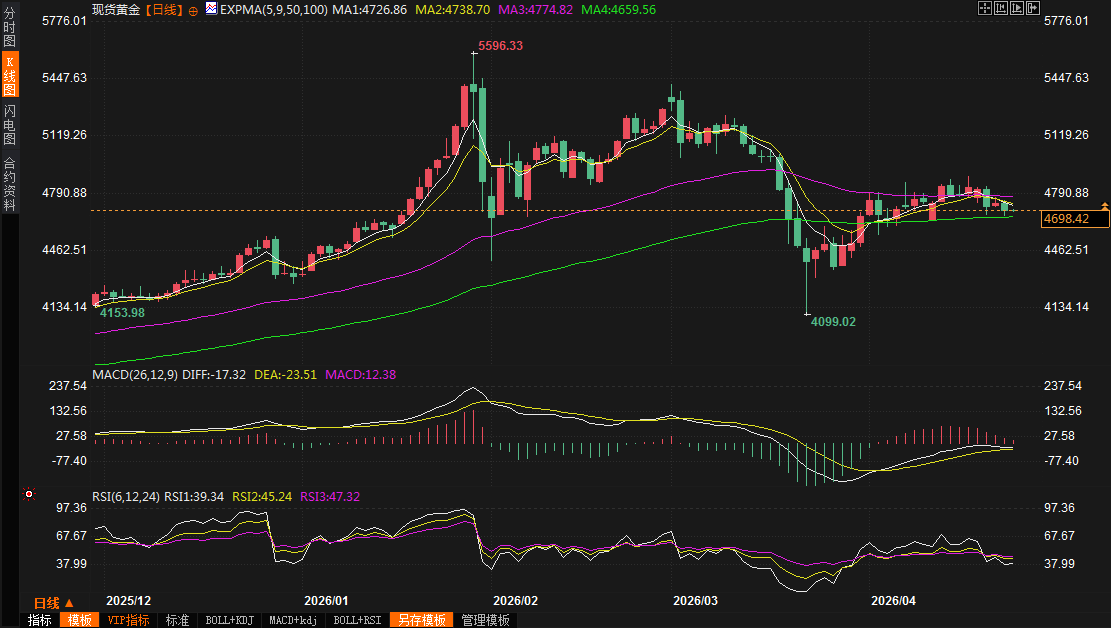
(Spot gold daily chart, source: FX678)
At 07:46 Beijing time, spot gold was trading at $4698.28 per ounce.
A double blow from a stronger dollar and waning expectations of interest rate cuts
On the surface, the direct driver of the gold price decline is the continuous strengthening of the US dollar index. The dollar index has risen for three consecutive trading days, reaching 98.94 at one point, a new high since April 13th. The strong performance of the dollar has put significant selling pressure on dollar-denominated gold. The dollar's ability to strengthen against the trend is largely due to safe-haven demand triggered by the turmoil in the Middle East. When investors are uneasy about geopolitical situations, the dollar often becomes the preferred safe haven, while gold has somewhat paled in comparison to this round of safe-haven sentiment.
A deeper reason lies in the rapid cooling of market expectations for a Federal Reserve rate cut. With continued tensions in the Middle East, international oil prices have surged, with Brent crude breaking the $100 per barrel mark on Thursday. The soaring oil prices have exacerbated market concerns about a resurgence of inflation, further reducing the Fed's room for further rate cuts.
According to estimates from the London Stock Exchange Group, the US interest rate futures market currently anticipates only about 7 basis points of interest rate cuts this year, compared to over 50 basis points before the Iran war. In other words, the market has almost ruled out the possibility of a significant interest rate cut this year. The fading expectation of rate cuts directly weakens the attractiveness of gold, because gold itself does not generate interest income, and with interest rates remaining high, the opportunity cost of holding gold becomes particularly prominent.
The Hidden Story Behind Initial Jobless Claims Data: The Labor Market Remains Robust
Thursday's U.S. initial jobless claims data appeared to signal a weakening economy. The data showed that seasonally adjusted initial jobless claims rose by 6,000 to 214,000 in the week ending April 18, slightly higher than the market expectation of 210,000. This should have been a bullish factor supporting gold, as a loosening in the job market could prompt the Federal Reserve to reconsider its interest rate cut timetable.
However, the market's interpretation of this data was quite sober. Economists generally believe that although initial jobless claims slightly exceeded expectations, the overall US labor market remains stable. The level of 214,000 is still within a relatively healthy range historically, far from worrying levels. More noteworthy is that the S&P Global US Composite Purchasing Managers' Index rose to 52.0 in April, while the March reading was only 50.3, the lowest level since September 2023. This data indicates that despite the dual pressures of war and inflation, US business activity has shown surprising resilience. With no clear signs of economic slowdown, the Federal Reserve has even less reason to rush into cutting interest rates.
The struggle for the Strait of Hormuz: A war without gunfire is reshaping global risk appetite.
If the US dollar and interest rates are the surface-level factors influencing gold prices, then the struggle for control of the Strait of Hormuz is a deeper variable affecting the overall situation. On Thursday, Iran released a visually striking video showing special forces raiding a giant cargo ship in speedboats. Armed personnel climbed rope ladders to board the ship and swiftly launched their operation on the deck, rifles in hand. This video, accompanied by action-movie-style music, sends a clear signal to the world: despite the strength of the US military, Iran still possesses a considerable counterbalancing force in the narrow Strait of Hormuz.
The statements from the US and Iran regarding control of the Strait of Hormuz present a stark contrast. Trump claimed that the US has "complete control" of the Strait of Hormuz and ordered the Navy to "shoot and destroy" Iranian vessels laid mines in the strait. Iran, on the other hand, has demonstrated its presence through concrete actions, with its speedboats and naval drones hidden in sea caves off the islands, posing a constant threat to passing ships. The deputy speaker of the Iranian parliament even stated that Iran has begun collecting tolls from ships passing through the Strait of Hormuz, with the first revenue already transferred to the central bank.
This standoff, with each side sticking to its own narrative, is precisely what the market least wants to see. As Standard Chartered's head of foreign exchange strategy pointed out, the market is neither certain that the ceasefire will last nor that it will completely break down. In this state of ambiguity, investors find it difficult to make decisive asset allocation decisions, which explains why, despite high geopolitical risks, funds have not flowed into gold as a safe haven.
Israel's threat of war: A Damocles' sword awaiting the US's "green light"
Israeli Defense Minister Katz's latest remarks have further complicated the situation. He explicitly stated that Israel is awaiting the United States' "green light" to resume military action against Iran, and issued extremely tough statements: once strikes resume, the first target will be Iran's Supreme Leader Mojtaba Khamenei, sending "Iran back to the Dark Ages." This statement, directly targeting the other side's supreme leader, undoubtedly elevates the nature of the conflict to a new level.
It's worth noting that since the US and Israel launched their war against Iran on February 28th, gold prices have fallen by more than 11%. This seems counterintuitive—war should typically push up gold prices. However, this anomaly precisely illustrates that the impact of this round of Middle East conflict on gold is far more complex than it appears. The outbreak of war pushed up oil prices, exacerbated inflation expectations, and reinforced the Federal Reserve's rationale for maintaining high interest rates, ultimately putting downward pressure on gold prices. In other words, the Middle East conflict indirectly suppressed gold by pushing up oil prices, forming a transmission chain of "war → rising oil prices → rising inflation expectations → decreased probability of interest rate cuts → falling gold prices."
The chain reaction of oil prices breaking $100: the specter of inflation reappears.
Brent crude oil prices have broken through $100 per barrel, marking another milestone since the outbreak of this round of conflict. Behind the soaring oil prices lies the real predicament of blocked passage through the Strait of Hormuz. If this most important global oil transportation route is blocked, approximately 20 million barrels of crude oil passing through daily will be unable to be transported smoothly to the global market, and the resulting supply-demand imbalance will inevitably push up oil prices.
High oil prices have a two-fold impact on gold. On the one hand, rising oil prices exacerbate inflationary pressures, from which gold, as a traditional hedge against inflation, should benefit. On the other hand, high inflation forces the Federal Reserve to maintain or even tighten monetary policy, and a high-interest-rate environment is precisely gold's biggest enemy. Judging from the current market reaction, the latter force clearly prevails. The federal funds futures market currently prices only a 24% probability of an interest rate cut before the end of the year, meaning that the vast majority of investors have accepted the reality that interest rates will remain high for a longer period.
The market's contradictory mentality: Why are investors hesitant to make large bets?
The most striking characteristic of the current market is the wait-and-see attitude of investors. Nuveen's chief investment officer succinctly summarized the market's predicament: "Given market concerns that the war may last longer, investors are adopting a wait-and-see approach. From a bond investment perspective, because we cannot predict how things will develop, investors lack confidence in more aggressively positioning themselves." This statement accurately describes the current market sentiment.
The performance of the US Treasury market is telling. Despite heightened geopolitical risks, Treasury prices have fallen, while yields have risen slightly. Typically, increased risk aversion would drive funds into US Treasuries, pushing yields down. However, the reality is that the 10-year Treasury yield rose 2.6 basis points to 4.319%, indicating that investors did not flock to safe-haven assets on a large scale. This anomaly is because investors are concerned about both escalating war and rebounding inflation; these two concerns offset each other, ultimately leading to market stagnation.
The stock market's performance also reflected this contradictory sentiment. U.S. stocks closed lower on Thursday in volatile trading, but the declines were relatively limited, with the Dow Jones Industrial Average down 0.36%, the S&P 500 down 0.41%, and the Nasdaq Composite down 0.89%. The CEO of Infrastructure Capital Advisors aptly described the current market as "a game of musical chairs between earnings season and war headlines that are unlikely to bring good news." Some investors chose to reduce their positions, with the war merely serving as an excuse.
The delicate balance of the Lebanon-Israel ceasefire agreement: the last straw
In this gloomy market landscape, the news that Lebanon and Israel might extend their ceasefire agreement is the only glimmer of hope for gold bulls. If the ceasefire is successfully extended, it could at least prevent the situation from escalating further, providing some support for gold. Gold prices recovered all their losses during Thursday's trading session, a positive market response to this news.
However, this support is limited. The extension of the ceasefire agreement only prevented the worst-case scenario from occurring; it did not fundamentally resolve the passage issue in the Strait of Hormuz, nor did it change the core contradiction in the US-Iran standoff. As long as the strait remains unopened, oil prices will struggle to fall, expectations of a Federal Reserve rate cut will remain high, and the pressure on gold prices will persist.
In conclusion: Gold is at a crossroads.
In summary, the gold market is currently caught in a tug-of-war between multiple forces. The downward pull comes from a strong US dollar, inflation concerns stemming from high oil prices, and a cooling of expectations for interest rate cuts; the upward support comes from uncertainties in the Middle East geopolitical situation, the potential extension of the Lebanon-Israel ceasefire agreement, and the safe-haven demand that could arise should the situation escalate unexpectedly.
From a broader perspective, gold investors need to be aware that the impact mechanism of this round of Middle East conflict on gold differs from past experience. The traditional logic of "war pushing up gold prices" is being replaced by a new transmission chain: "war pushing up oil prices → oil prices pushing up inflation → inflation delaying interest rate cuts → delayed interest rate cuts suppressing gold prices." As long as the stalemate in the Strait of Hormuz continues, and as long as oil prices remain above $100, gold will continue to face pressure from interest rate expectations.
Of course, the market is always full of variables. If Israel does receive the US's "green light" and resumes large-scale military operations against Iran, and if the conflict escalates from a proxy war into a full-blown war, then risk aversion could overwhelm all other factors, driving a genuine surge in gold prices. But until then, gold is more likely to continue its consolidation pattern, searching for direction amidst the dollar's performance, oil price fluctuations, and geopolitical news.
For ordinary investors, patience and clear-headedness are most needed right now. Don't panic and sell because of a single day's sharp decline, nor blindly chase high prices because of escalating geopolitical risks. Closely monitoring developments in the Strait of Hormuz, paying attention to statements from Federal Reserve officials regarding inflation and interest rate paths, and keeping an eye on weekly employment and inflation data are the rational ways to navigate the current complex situation.
(Spot gold daily chart, source: FX678)
At 07:46 Beijing time, spot gold was trading at $4698.28 per ounce.
- Risk Warning and Disclaimer
- The market involves risk, and trading may not be suitable for all investors. This article is for reference only and does not constitute personal investment advice, nor does it take into account certain users’ specific investment objectives, financial situation, or other needs. Any investment decisions made based on this information are at your own risk.