USD/JPY Analysis: Inflation Data and Intervention Warnings Intertwine, Yen Remains Neutral.
2026-04-24 18:25:19
On Friday (April 24), during the European session, with the week's trading nearing its end, the USD/JPY pair continued to trade within a narrow range. Over the past two trading days, the pair's average volatility was only 0.2%, making it difficult to establish a clear trend. The market is currently caught in a complex interplay of inflation data, warnings of currency intervention, and central bank policies, resulting in a neutral market sentiment.

With both the Bank of Japan and the Federal Reserve about to announce their interest rate decisions, coupled with factors such as Japan's March inflation data exceeding expectations and the yen approaching the 160 intervention level, market trading is becoming increasingly cautious. On the one hand, funds are tending to wait and see ahead of a series of risk events; on the other hand, the recent stabilization and strengthening of the US dollar, combined with the depreciation pressure on the yen and the expectation of intervention, suggests that the USD/JPY exchange rate is likely to maintain a neutral and volatile pattern in the short term.
The US dollar has regained its upward momentum as geopolitical and currency competition intensifies.
Uncertainty surrounding the situation in the Middle East remains high. Iran has stated that the Strait of Hormuz cannot reopen as long as US blockade measures continue; meanwhile, the US has issued orders to take direct military action against potential threats in the region. Geopolitical tensions have slowed negotiations and, in the short term, increased market risk aversion and led to more conservative trading.
Supported by geopolitical uncertainty and a rebound in the dollar index, the dollar's weakness eased last week. The dollar index (DXY), which measures the dollar's performance against a basket of major currencies, steadily recovered, regaining the 98 level and turning upward in the short term. Meanwhile, the yen remained under pressure below the key 160 level, prompting the Japanese government to issue another strong warning of intervention, stating its readiness to coordinate with the United States to take "decisive action" to curb excessive yen depreciation.
The rebound in the US dollar offset expectations of yen intervention, directly limiting the volatility of the currency pair and further intensifying the battle between bulls and bears in the market. Barring any major new geopolitical conflicts or sudden intervention, the USD/JPY pair is likely to continue its neutral-to-volatile trend in the short term.
Central bank policies and inflation data from various countries may become key factors in market movements.
Next week's market movements in the USD/JPY exchange rate may be dominated by the latest interest rate decisions from both Japan and the United States, while the better-than-expected performance of Japan's inflation data has already attracted market attention.
Regarding the Federal Reserve, the market widely expects no significant policy adjustments. According to data from the Chicago Mercantile Exchange, there is a 99.5% probability that the Fed will maintain its interest rate at 3.75% at its April 29th policy meeting. This expectation has already been fully priced in by the market and is unlikely to trigger significant market fluctuations in the short term.
The Bank of Japan is scheduled to announce its interest rate decision on April 27, with the market expecting the benchmark interest rate to remain unchanged at 0.75%. The key focus will be on Japan's March inflation data: the CPI rose 3.1% year-on-year (previous value 2.9%, expected 2.8%), and the core inflation rate, excluding fresh food, rose to 3.2% (previous value 3.0%, expected 3.0%), marking the 43rd consecutive month of year-on-year increases. Although the Bank of Japan has previously reiterated that inflationary pressures may force a tightening of monetary policy, the market is still awaiting a clear signal from the decision.
One of the core drivers of the fundamentals remains the interest rate differential between the US and Japan. Currently, the US benchmark interest rate is 3.75%, while Japan's is 0.75%. This significant interest rate differential supports the attractiveness of dollar assets and is conducive to a stronger dollar. However, the imported inflationary pressures and intervention risks caused by the yen's depreciation also constrain the dollar's upward momentum.
Therefore, if the Bank of Japan signals a tightening of monetary policy in its decision, the interest rate differential between the US and Japan may reverse, and the narrowing of the interest rate differential is expected to boost demand for the yen, thereby putting significant downward pressure on the USD/JPY exchange rate in the medium term. Conversely, if the policy remains unchanged and no intervention statements are strengthened, the USD/JPY exchange rate may break through the 160 level.
Technical Analysis
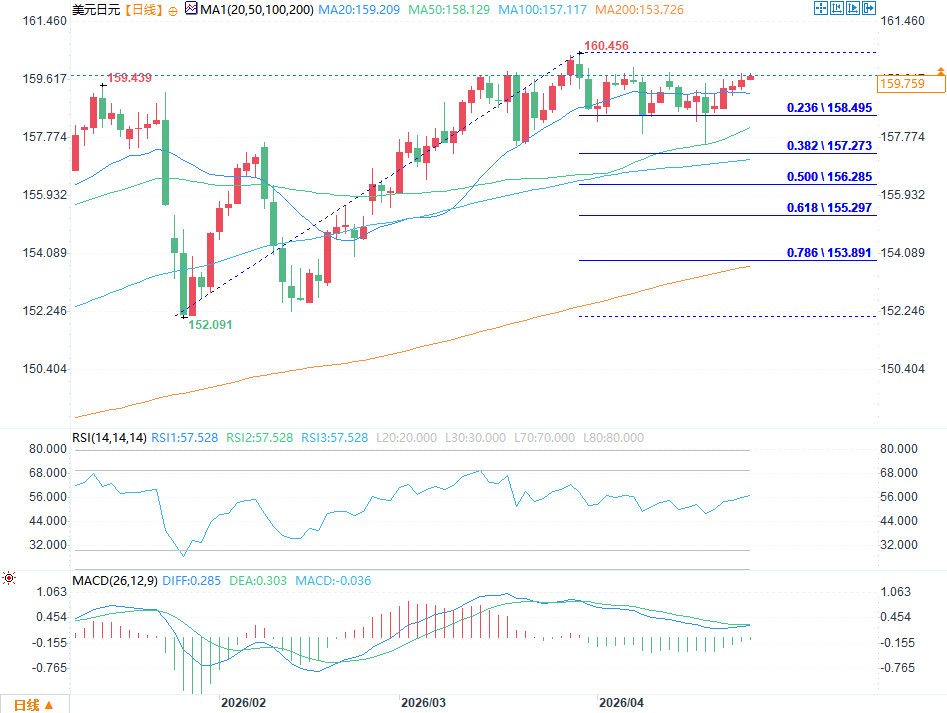
(USD/JPY daily chart source: FX678)
Long-term trend: The long-term upward trend remains the core technical logic. Although the market is experiencing neutral fluctuations in the short term, the long-term upward trend line that has been in place for several months remains intact. Furthermore, since April, the USD/JPY pair has attempted to break below the 158.49 support level (the 23.6% Fibonacci retracement level of the 2026 uptrend from 152.10 to 160.47) four times without success, indicating that the dominant medium- to long-term upward trend remains unbroken.
Relative Strength Index (RSI): The indicator remains around the 50 mark, indicating that the forces of bulls and bears are evenly matched, suggesting that the short-term volatile and oscillating market may continue.
Moving Average Convergence Divergence (MACD): The histogram is close to the zero axis, and the short-term moving averages are trending steadily, further confirming the overall neutral oscillation pattern of the market.
Key price level
The key resistance zone is 159.826-160.00: 159.826 is the recent high, and 160.00 is a key level for Japanese intervention, forming a double resistance. A successful breakout of this zone will restart the bullish trend and push the price towards the 162-165 range.
158.49 is a short-term pivot point: it coincides with the 23.6% Fibonacci retracement level and previous support, forming a neutral oscillation range close to the 50-period moving average. A pullback to this level would strengthen short-term bearish signals; a break below this level could lead to a test of 158.028.
158.028 is a secondary support level: a technical support level that aligns with the moving average. If this level is breached, it will further test the key support level of 155.53.
The key support level is 155.53: a recent low and also connecting to the bottom of the long-term uptrend. If the price tests this support level, it will shake the existing upward structure, and a deep trend reversal may occur in the coming weeks.
At 18:14 Beijing time, the USD/JPY exchange rate was 159.595/838, up 0.07%.
With both the Bank of Japan and the Federal Reserve about to announce their interest rate decisions, coupled with factors such as Japan's March inflation data exceeding expectations and the yen approaching the 160 intervention level, market trading is becoming increasingly cautious. On the one hand, funds are tending to wait and see ahead of a series of risk events; on the other hand, the recent stabilization and strengthening of the US dollar, combined with the depreciation pressure on the yen and the expectation of intervention, suggests that the USD/JPY exchange rate is likely to maintain a neutral and volatile pattern in the short term.
The US dollar has regained its upward momentum as geopolitical and currency competition intensifies.
Uncertainty surrounding the situation in the Middle East remains high. Iran has stated that the Strait of Hormuz cannot reopen as long as US blockade measures continue; meanwhile, the US has issued orders to take direct military action against potential threats in the region. Geopolitical tensions have slowed negotiations and, in the short term, increased market risk aversion and led to more conservative trading.
Supported by geopolitical uncertainty and a rebound in the dollar index, the dollar's weakness eased last week. The dollar index (DXY), which measures the dollar's performance against a basket of major currencies, steadily recovered, regaining the 98 level and turning upward in the short term. Meanwhile, the yen remained under pressure below the key 160 level, prompting the Japanese government to issue another strong warning of intervention, stating its readiness to coordinate with the United States to take "decisive action" to curb excessive yen depreciation.
The rebound in the US dollar offset expectations of yen intervention, directly limiting the volatility of the currency pair and further intensifying the battle between bulls and bears in the market. Barring any major new geopolitical conflicts or sudden intervention, the USD/JPY pair is likely to continue its neutral-to-volatile trend in the short term.
Central bank policies and inflation data from various countries may become key factors in market movements.
Next week's market movements in the USD/JPY exchange rate may be dominated by the latest interest rate decisions from both Japan and the United States, while the better-than-expected performance of Japan's inflation data has already attracted market attention.
Regarding the Federal Reserve, the market widely expects no significant policy adjustments. According to data from the Chicago Mercantile Exchange, there is a 99.5% probability that the Fed will maintain its interest rate at 3.75% at its April 29th policy meeting. This expectation has already been fully priced in by the market and is unlikely to trigger significant market fluctuations in the short term.
The Bank of Japan is scheduled to announce its interest rate decision on April 27, with the market expecting the benchmark interest rate to remain unchanged at 0.75%. The key focus will be on Japan's March inflation data: the CPI rose 3.1% year-on-year (previous value 2.9%, expected 2.8%), and the core inflation rate, excluding fresh food, rose to 3.2% (previous value 3.0%, expected 3.0%), marking the 43rd consecutive month of year-on-year increases. Although the Bank of Japan has previously reiterated that inflationary pressures may force a tightening of monetary policy, the market is still awaiting a clear signal from the decision.
One of the core drivers of the fundamentals remains the interest rate differential between the US and Japan. Currently, the US benchmark interest rate is 3.75%, while Japan's is 0.75%. This significant interest rate differential supports the attractiveness of dollar assets and is conducive to a stronger dollar. However, the imported inflationary pressures and intervention risks caused by the yen's depreciation also constrain the dollar's upward momentum.
Therefore, if the Bank of Japan signals a tightening of monetary policy in its decision, the interest rate differential between the US and Japan may reverse, and the narrowing of the interest rate differential is expected to boost demand for the yen, thereby putting significant downward pressure on the USD/JPY exchange rate in the medium term. Conversely, if the policy remains unchanged and no intervention statements are strengthened, the USD/JPY exchange rate may break through the 160 level.
Technical Analysis
(USD/JPY daily chart source: FX678)
Long-term trend: The long-term upward trend remains the core technical logic. Although the market is experiencing neutral fluctuations in the short term, the long-term upward trend line that has been in place for several months remains intact. Furthermore, since April, the USD/JPY pair has attempted to break below the 158.49 support level (the 23.6% Fibonacci retracement level of the 2026 uptrend from 152.10 to 160.47) four times without success, indicating that the dominant medium- to long-term upward trend remains unbroken.
Relative Strength Index (RSI): The indicator remains around the 50 mark, indicating that the forces of bulls and bears are evenly matched, suggesting that the short-term volatile and oscillating market may continue.
Moving Average Convergence Divergence (MACD): The histogram is close to the zero axis, and the short-term moving averages are trending steadily, further confirming the overall neutral oscillation pattern of the market.
Key price level
The key resistance zone is 159.826-160.00: 159.826 is the recent high, and 160.00 is a key level for Japanese intervention, forming a double resistance. A successful breakout of this zone will restart the bullish trend and push the price towards the 162-165 range.
158.49 is a short-term pivot point: it coincides with the 23.6% Fibonacci retracement level and previous support, forming a neutral oscillation range close to the 50-period moving average. A pullback to this level would strengthen short-term bearish signals; a break below this level could lead to a test of 158.028.
158.028 is a secondary support level: a technical support level that aligns with the moving average. If this level is breached, it will further test the key support level of 155.53.
The key support level is 155.53: a recent low and also connecting to the bottom of the long-term uptrend. If the price tests this support level, it will shake the existing upward structure, and a deep trend reversal may occur in the coming weeks.
At 18:14 Beijing time, the USD/JPY exchange rate was 159.595/838, up 0.07%.
- Risk Warning and Disclaimer
- The market involves risk, and trading may not be suitable for all investors. This article is for reference only and does not constitute personal investment advice, nor does it take into account certain users’ specific investment objectives, financial situation, or other needs. Any investment decisions made based on this information are at your own risk.