Gold Trading Alert: Gold Prices Volatile Amid Geopolitical Stalemate, Market Awaits Powell's "Farewell Performance"
2026-04-28 08:04:19
Spot gold fell slightly by 0.6% on Monday (April 27), closing near $4,681.67 per ounce, while U.S. June gold futures also fell 1% to around $4,693.70. The diplomatic stalemate in the Middle East conflict between the U.S. and Iran, shipping disruptions in the Strait of Hormuz, persistently high oil prices fueling inflation concerns, and the possibility of a hawkish signal from the upcoming Federal Reserve policy meeting all weighed on gold prices. However, market sentiment remained cautious ahead of Fed Chairman Powell's final press conference and a clearer picture of the situation in Iran.
Gold prices have retreated from previous highs, but market sentiment is sensitive; any progress in peace or escalation of tensions could trigger significant volatility. With supply concerns driving up oil prices and reinforcing inflation expectations, should gold, as a traditional safe-haven asset, continue to face pressure, or is it poised for a new rebound?
Entering late April 2026, the gold market generally exhibited a downward trend with fluctuations. Recently, gold prices have gradually retreated from the higher levels of early April, even touching near one-week lows on some trading days. This performance seems to contradict the traditional safe-haven logic—Middle East tensions should have boosted gold demand, but the opposite has occurred. Bart Melek, Global Head of Commodity Strategy at TD Securities, bluntly stated that the market remains skeptical about reaching a strong agreement to reopen the Strait of Hormuz in the short term, which puts direct pressure on gold and silver.
Specifically, spot gold fell on Monday, pressured by persistently high oil prices and continued inflation concerns. Brent crude hit a three-week high, and U.S. crude futures also rose accordingly, clearly signaling a tight global energy supply. The Strait of Hormuz, a key passage for approximately one-fifth of the world's maritime oil and gas transport, is currently largely closed or severely restricted. In the past 24 hours, the number of ships passing through the strait was extremely low, only a fraction of the pre-conflict daily average, with several tankers carrying Iranian crude forced to turn back due to the blockade. This directly resulted in a reduction of 10 million to 13 million barrels per day in oil supply, exacerbating the already strained supply-demand balance.
Meanwhile, U.S. stocks showed cautious optimism, with the S&P 500 and Nasdaq closing slightly higher, but the Dow Jones Industrial Average dipped slightly, with overall trading light. Investors are preparing for this week's busy earnings season and central bank meetings, with tech giants such as Amazon and Alphabet set to release their results, while the Federal Reserve's policy statement is undoubtedly the focus. The bond market saw yields rise, with the 10-year Treasury yield climbing to 4.338%, reflecting market concerns about increased supply and the inflation outlook. The dollar index fluctuated slightly, weakening slightly amid the stalemate in U.S.-Iran negotiations, but remained relatively strong overall.
These signals collectively outline the short-term predicament of the gold market: geopolitical tensions should have benefited gold's safe-haven appeal, but inflationary pressures triggered by rising oil prices have suppressed gold prices by reinforcing the Federal Reserve's expectations of "higher and longer" interest rates. As a non-interest-bearing asset, the opportunity cost of holding gold increases significantly in an environment of high real yields, which is one of the core reasons why gold prices are currently struggling to sustain an upward trend.
To understand the future trend of gold, it's crucial to focus on a key variable—oil prices. More precisely, the navigation status of the Strait of Hormuz. The biggest difference between this conflict between the US, Israel, and Iran and other geopolitical events is that it directly controls the global energy supply chain. Iran has clearly stated its preconditions for negotiations: lift the blockade first, then discuss other matters. The US and Israel are clearly unlikely to give in easily, especially regarding the issues of control of the Strait of Hormuz and Iran's nuclear program, where their differences are so significant as to be almost irreconcilable.
According to Pakistani mediators, Iran's latest proposal is to completely shelve the nuclear issue until after the war and the Gulf shipping dispute are resolved. This condition is unacceptable to the United States. Secretary of State Rubio, in an interview with Fox News, made it clear that he believes Iran is stalling for time and stated explicitly, "We cannot let them succeed." Rubio emphasized that the nuclear issue must be resolved from the outset, and any agreement must effectively prevent Iran from accelerating its progress towards nuclear weapons at any time.
This creates a deadlock. Iran wants a ceasefire and the lifting of the blockade first, before discussing the nuclear issue. The US wants nuclear talks first, for Iran to stop enriching uranium and promise not to develop nuclear weapons, before considering lifting the blockade. This fundamental difference means the blockade of the Strait of Hormuz shows no hope of being lifted in the short term. And as long as this vital energy artery remains blocked, oil prices will not fall.
Looking at the actual data, only about seven ships passed through the Strait of Hormuz in the past 24 hours, and these were mainly dry bulk carriers. Before the conflict, normally about 140 ships would pass through the strait daily. This means the current traffic volume is less than a fraction of the normal level. This level of supply disruption is a major earthquake in the global oil market. Tamás Varga, an analyst at PVM Oil Associates, made a very straightforward assessment: "This diplomatic stalemate means that 10 to 13 million barrels of crude oil cannot enter the international market every day, exacerbating the already tight oil supply and demand balance. Therefore, oil prices can only go one way: upward."
Goldman Sachs has already raised its oil price forecasts accordingly, raising its Q4 target for Brent crude to $90 and for U.S. crude to $83. Note that this forecast is made against the backdrop of continued declines in Middle Eastern production. If the stalemate worsens further, and oil prices break through $110 or even higher, market expectations for interest rate hikes will only intensify, putting even greater pressure on gold.
The last week of April will be a super central bank week for global financial markets, with the Federal Reserve's policy meeting being the most anticipated. This is likely to be Powell's last scheduled meeting as Fed Chairman. While the market widely expects no interest rate adjustments, everyone is waiting for changes in the meeting statement and Powell's press conference. Specifically, the market wants to know how the Fed views the impact of the war on inflation, and whether soaring energy prices will alter its assessment of the interest rate path.
Anthony Salimbenyi, chief market strategist at Ameriprise, offers a very insightful analysis. He points out that the market is likely to be highly sensitive to whether the Federal Reserve explicitly mentions rising oil prices, and most importantly, it depends on whether the Fed views these energy price pressures as persistent or temporary. If they are persistent, it means the probability of an interest rate hike will increase significantly. If they are considered temporary, then gold bulls might be able to breathe a sigh of relief.
However, judging from current indications, optimism is unlikely. A research report from JPMorgan Chase has clearly stated that the Federal Reserve is expected to maintain interest rates unchanged until the end of the first half of 2027, and specifically emphasized that there is still a certain risk of interest rate hikes in the second half of 2027. In the context of financial markets, this statement is essentially a warning—the interest rate hike cycle is not only not over, but may even be making a comeback.
More notably, the bond market has already begun to react in advance. The yield on the two-year U.S. Treasury note rose 2.6 basis points to 3.802% on April 27th, while the auction results for five-year bonds were significantly weaker, with investor demand indicators below average. This indicates that market participants are genuinely preparing for higher interest rates. Jan Nevruzzi, U.S. interest rate strategist at TD Securities, commented on the bond auction, noting that the end-investor acceptance rate for five-year bonds was slightly below average. Behind this technical detail lies the cautious attitude of institutional investors towards medium- to long-term interest rate trends.
Another issue worth considering is that escalating geopolitical conflicts typically boost the US dollar, as it is the world's leading safe-haven currency. However, the situation this time is more complex. On April 27th, the dollar actually weakened slightly against the euro. Marc Chandler, chief market strategist at Bannockburn Global Forex, offered an interesting explanation. He believes the market was relatively optimistic over the weekend because of expectations of face-to-face talks between the US and Iran. However, no talks took place, and the market should have shifted towards risk aversion. But on Monday morning, Iran suddenly made a new proposal, bringing renewed hope to the market, thus putting some pressure on the dollar.
This passage contains a crucial piece of information—the market's current pricing logic for the Middle East situation has shifted to "peace expectations are good for the dollar and gold, while a stalemate is bad." Why this inversion? Because the current stalemate directly leads to persistently high oil prices, and high oil prices, through inflation, are forcing the Federal Reserve to maintain or even tighten monetary policy. For the dollar, if the Fed didn't cut or even raise interest rates, it should have strengthened. However, the problem is that the US itself is highly dependent on the global energy market, and soaring oil prices are also a heavy blow to the US economy. When assessing the dollar's trajectory, the market is actually weighing two forces—the support for the dollar from Fed tightening expectations, and the erosion of the US economic fundamentals by high oil prices.
Gold is in an even more awkward position. It lacks both the interest rate advantage of the US dollar and the real demand support of oil. When the market anticipates that the Federal Reserve will maintain high interest rates for an extended period or even raise them further, gold becomes the first asset to be abandoned. You can think of gold as a kind of "zero-coupon bond," which is very attractive when real interest rates are negative or very low. But when real interest rates turn positive and continue to rise, holding gold means incurring opportunity costs every day.
To predict the future trend of gold, it is essential to closely monitor every detail of the US-Iran negotiations. This is no longer a traditional geopolitical risk event, but a core variable determining global energy supply, inflation trends, and central bank interest rate paths. Currently, although Trump abruptly canceled his special envoy and son-in-law Kushner's visit to Pakistan last weekend, diplomatic contacts have not been completely severed. Pakistani mediators are still working remotely to push both sides to narrow their differences.
After shuttling between Islamabad and Oman, Iranian Foreign Minister Araghchi went to Moscow and received verbal support from Putin. During their meeting, Putin clearly stated that Moscow would do everything possible to assist Tehran. This is certainly not a positive sign for the United States, implying that Iran has Russia as a bargaining chip in addition to negotiations.
Trump himself met with his national security team on Monday morning to discuss Iran's new proposals. White House Press Secretary Levitt cautiously declined to reveal details of the meeting but expressed confidence that the president would provide further details soon. This ambiguous statement suggests that the White House has not yet reached a consensus on how to handle the impasse. Intriguingly, while Trump has expressed doubts about Iran's sincerity, he has previously threatened to resume bombing if he deems negotiations futile. However, a growing sentiment within the US government now suggests that Trump's true objective is to avoid resuming hostilities. This stance of "threatening while restraining" speaks volumes—the US understands the devastating impact of a full-scale war on oil prices, a cost that neither the global economy nor the US itself can afford.
From Iran's perspective, Araghchi's statement to reporters in Moscow is representative. He believes Trump's demand for negotiations stems from the fact that the US has not yet achieved any of its objectives. This statement conveys the message that Iran believes it currently holds the upper hand, particularly regarding control of the Strait of Hormuz. Iran's negotiating strategy is very clear—the first step must be ending the war, with the US guaranteeing no further conflict. Then, discussions will focus on lifting the blockade and the fate of the Strait of Hormuz. Only lastly will the nuclear program be addressed. This sequence is not arbitrary but rather a strategic move to maximize Iran's greatest leverage—the ability to blockade the strait.
Current market pricing actually reflects a very pessimistic expectation: the likelihood of a substantial agreement in the short term is very low. The streets of Islamabad, the Pakistani capital, which had been closed for a week in anticipation of talks, have now reopened. This small detail speaks volumes more than any lengthy analysis—face-to-face negotiations are unlikely in the near future, and a diplomatic breakthrough is a long way off.
In the current situation, what conditions need to be met for gold to truly turn things around? The answer is two scenarios.
The first scenario is a sudden and complete easing of tensions in the Middle East, with the Strait of Hormuz quickly reopening to navigation and oil prices falling sharply. In this situation, with easing inflationary pressures and cooling expectations of a Fed rate hike, would gold actually be sold off due to a decline in "safe-haven demand"? Not at all. Note the logical chain we outlined earlier—gold is not rising because of easing tensions; rather, it's precisely because tensions have eased, oil prices have fallen, and expectations of a rate hike have weakened that gold is rising. This sounds counterintuitive, but it is indeed the core logic of current market pricing. Recall the key judgment quoted at the beginning of the article: "If tensions in the Middle East escalate, gold prices tend to fall because it increases supply concerns and boosts oil prices, strengthening expectations of a Fed rate hike; while if tensions in the Middle East ease, gold prices tend to rise." This statement is worth reading three times over for every gold investor.
The second scenario is a sudden and significant deterioration in US economic data, or a systemic risk in the financial markets, forcing the Federal Reserve to reconsider its stance on interest rate hikes. If the risk of recession outweighs concerns about inflation, gold will regain favor even if oil prices remain high. This is because the main theme of market speculation will shift from "raising interest rates to combat inflation" to "recession forcing interest rate cuts." However, currently, while US economic data is not particularly strong, it has not yet reached the point of recession. The S&P 500 and Nasdaq indices continue to reach new historical highs, and the first-quarter earnings season has been strong so far, with over 80% of companies exceeding expectations, and overall profit growth forecasts have been revised upwards to over 16%. This economic environment clearly does not make the Federal Reserve feel the need to shift towards easing.
The gold market is currently in a cautious wait-and-see mode. Investors are assessing whether the previous rally was fundamentally supported, while also digesting geopolitical and policy uncertainties. Technology company earnings reports will be a key indicator of risk appetite; if AI investments yield strong returns, the resilience of the stock market may divert some demand from gold.
From a technical perspective, gold prices are currently fluctuating between $4,600 and $4,800, and key support and resistance levels need to be monitored. In the short term, oil price movements and the Fed's rhetoric will be the main catalysts. In the long term, global debt levels, persistent geopolitical risks, and the dollar cycle continue to provide structural support for gold.
Based on current information, gold faces downward pressure in the short term, but opportunities lie hidden within the medium- to long-term uncertainties. If tensions escalate in the Middle East and oil prices remain high, persistent inflation will reinforce expectations of high interest rates, potentially pushing gold prices to even lower levels. Conversely, if diplomatic breakthroughs are achieved, the Taiwan Strait reopens, oil prices fall, and expectations of interest rate cuts rise, favoring an upward trend in gold prices. The Federal Reserve meeting will be a key juncture in the near term, and its assessment of the impact on oil prices will influence market pricing.
More broadly, gold's performance in 2026 will depend on the persistence of supply shocks and the speed of monetary policy response. Investors should closely monitor the developments of the Holmos event, oil price crack spreads, and central bank communications. Diversification, focusing on physical gold or related ETFs, may be a rational choice to cope with uncertainty.
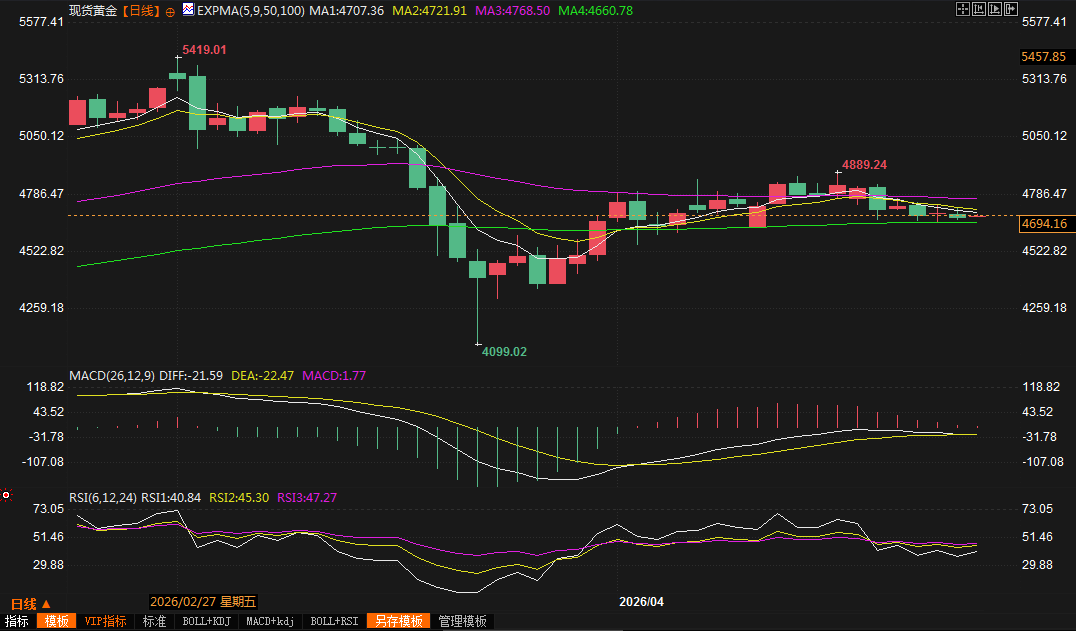
(Spot gold daily chart, source: FX678)
At 08:03 Beijing time, spot gold was trading at $4695.29 per ounce.
Gold prices have retreated from previous highs, but market sentiment is sensitive; any progress in peace or escalation of tensions could trigger significant volatility. With supply concerns driving up oil prices and reinforcing inflation expectations, should gold, as a traditional safe-haven asset, continue to face pressure, or is it poised for a new rebound?
Current Market Overview: Multiple Signals Behind the Pressure on Gold Prices
Entering late April 2026, the gold market generally exhibited a downward trend with fluctuations. Recently, gold prices have gradually retreated from the higher levels of early April, even touching near one-week lows on some trading days. This performance seems to contradict the traditional safe-haven logic—Middle East tensions should have boosted gold demand, but the opposite has occurred. Bart Melek, Global Head of Commodity Strategy at TD Securities, bluntly stated that the market remains skeptical about reaching a strong agreement to reopen the Strait of Hormuz in the short term, which puts direct pressure on gold and silver.
Specifically, spot gold fell on Monday, pressured by persistently high oil prices and continued inflation concerns. Brent crude hit a three-week high, and U.S. crude futures also rose accordingly, clearly signaling a tight global energy supply. The Strait of Hormuz, a key passage for approximately one-fifth of the world's maritime oil and gas transport, is currently largely closed or severely restricted. In the past 24 hours, the number of ships passing through the strait was extremely low, only a fraction of the pre-conflict daily average, with several tankers carrying Iranian crude forced to turn back due to the blockade. This directly resulted in a reduction of 10 million to 13 million barrels per day in oil supply, exacerbating the already strained supply-demand balance.
Meanwhile, U.S. stocks showed cautious optimism, with the S&P 500 and Nasdaq closing slightly higher, but the Dow Jones Industrial Average dipped slightly, with overall trading light. Investors are preparing for this week's busy earnings season and central bank meetings, with tech giants such as Amazon and Alphabet set to release their results, while the Federal Reserve's policy statement is undoubtedly the focus. The bond market saw yields rise, with the 10-year Treasury yield climbing to 4.338%, reflecting market concerns about increased supply and the inflation outlook. The dollar index fluctuated slightly, weakening slightly amid the stalemate in U.S.-Iran negotiations, but remained relatively strong overall.
These signals collectively outline the short-term predicament of the gold market: geopolitical tensions should have benefited gold's safe-haven appeal, but inflationary pressures triggered by rising oil prices have suppressed gold prices by reinforcing the Federal Reserve's expectations of "higher and longer" interest rates. As a non-interest-bearing asset, the opportunity cost of holding gold increases significantly in an environment of high real yields, which is one of the core reasons why gold prices are currently struggling to sustain an upward trend.
The butterfly effect of the Strait of Hormuz
To understand the future trend of gold, it's crucial to focus on a key variable—oil prices. More precisely, the navigation status of the Strait of Hormuz. The biggest difference between this conflict between the US, Israel, and Iran and other geopolitical events is that it directly controls the global energy supply chain. Iran has clearly stated its preconditions for negotiations: lift the blockade first, then discuss other matters. The US and Israel are clearly unlikely to give in easily, especially regarding the issues of control of the Strait of Hormuz and Iran's nuclear program, where their differences are so significant as to be almost irreconcilable.
According to Pakistani mediators, Iran's latest proposal is to completely shelve the nuclear issue until after the war and the Gulf shipping dispute are resolved. This condition is unacceptable to the United States. Secretary of State Rubio, in an interview with Fox News, made it clear that he believes Iran is stalling for time and stated explicitly, "We cannot let them succeed." Rubio emphasized that the nuclear issue must be resolved from the outset, and any agreement must effectively prevent Iran from accelerating its progress towards nuclear weapons at any time.
This creates a deadlock. Iran wants a ceasefire and the lifting of the blockade first, before discussing the nuclear issue. The US wants nuclear talks first, for Iran to stop enriching uranium and promise not to develop nuclear weapons, before considering lifting the blockade. This fundamental difference means the blockade of the Strait of Hormuz shows no hope of being lifted in the short term. And as long as this vital energy artery remains blocked, oil prices will not fall.
Looking at the actual data, only about seven ships passed through the Strait of Hormuz in the past 24 hours, and these were mainly dry bulk carriers. Before the conflict, normally about 140 ships would pass through the strait daily. This means the current traffic volume is less than a fraction of the normal level. This level of supply disruption is a major earthquake in the global oil market. Tamás Varga, an analyst at PVM Oil Associates, made a very straightforward assessment: "This diplomatic stalemate means that 10 to 13 million barrels of crude oil cannot enter the international market every day, exacerbating the already tight oil supply and demand balance. Therefore, oil prices can only go one way: upward."
Goldman Sachs has already raised its oil price forecasts accordingly, raising its Q4 target for Brent crude to $90 and for U.S. crude to $83. Note that this forecast is made against the backdrop of continued declines in Middle Eastern production. If the stalemate worsens further, and oil prices break through $110 or even higher, market expectations for interest rate hikes will only intensify, putting even greater pressure on gold.
The Federal Reserve meeting is in focus: Powell's final "test".
The last week of April will be a super central bank week for global financial markets, with the Federal Reserve's policy meeting being the most anticipated. This is likely to be Powell's last scheduled meeting as Fed Chairman. While the market widely expects no interest rate adjustments, everyone is waiting for changes in the meeting statement and Powell's press conference. Specifically, the market wants to know how the Fed views the impact of the war on inflation, and whether soaring energy prices will alter its assessment of the interest rate path.
Anthony Salimbenyi, chief market strategist at Ameriprise, offers a very insightful analysis. He points out that the market is likely to be highly sensitive to whether the Federal Reserve explicitly mentions rising oil prices, and most importantly, it depends on whether the Fed views these energy price pressures as persistent or temporary. If they are persistent, it means the probability of an interest rate hike will increase significantly. If they are considered temporary, then gold bulls might be able to breathe a sigh of relief.
However, judging from current indications, optimism is unlikely. A research report from JPMorgan Chase has clearly stated that the Federal Reserve is expected to maintain interest rates unchanged until the end of the first half of 2027, and specifically emphasized that there is still a certain risk of interest rate hikes in the second half of 2027. In the context of financial markets, this statement is essentially a warning—the interest rate hike cycle is not only not over, but may even be making a comeback.
More notably, the bond market has already begun to react in advance. The yield on the two-year U.S. Treasury note rose 2.6 basis points to 3.802% on April 27th, while the auction results for five-year bonds were significantly weaker, with investor demand indicators below average. This indicates that market participants are genuinely preparing for higher interest rates. Jan Nevruzzi, U.S. interest rate strategist at TD Securities, commented on the bond auction, noting that the end-investor acceptance rate for five-year bonds was slightly below average. Behind this technical detail lies the cautious attitude of institutional investors towards medium- to long-term interest rate trends.
The delicate game between the US dollar and gold
Another issue worth considering is that escalating geopolitical conflicts typically boost the US dollar, as it is the world's leading safe-haven currency. However, the situation this time is more complex. On April 27th, the dollar actually weakened slightly against the euro. Marc Chandler, chief market strategist at Bannockburn Global Forex, offered an interesting explanation. He believes the market was relatively optimistic over the weekend because of expectations of face-to-face talks between the US and Iran. However, no talks took place, and the market should have shifted towards risk aversion. But on Monday morning, Iran suddenly made a new proposal, bringing renewed hope to the market, thus putting some pressure on the dollar.
This passage contains a crucial piece of information—the market's current pricing logic for the Middle East situation has shifted to "peace expectations are good for the dollar and gold, while a stalemate is bad." Why this inversion? Because the current stalemate directly leads to persistently high oil prices, and high oil prices, through inflation, are forcing the Federal Reserve to maintain or even tighten monetary policy. For the dollar, if the Fed didn't cut or even raise interest rates, it should have strengthened. However, the problem is that the US itself is highly dependent on the global energy market, and soaring oil prices are also a heavy blow to the US economy. When assessing the dollar's trajectory, the market is actually weighing two forces—the support for the dollar from Fed tightening expectations, and the erosion of the US economic fundamentals by high oil prices.
Gold is in an even more awkward position. It lacks both the interest rate advantage of the US dollar and the real demand support of oil. When the market anticipates that the Federal Reserve will maintain high interest rates for an extended period or even raise them further, gold becomes the first asset to be abandoned. You can think of gold as a kind of "zero-coupon bond," which is very attractive when real interest rates are negative or very low. But when real interest rates turn positive and continue to rise, holding gold means incurring opportunity costs every day.
Undercurrents at the Negotiation Table: How Does the Diplomatic Stalemate Affect Gold Prices?
To predict the future trend of gold, it is essential to closely monitor every detail of the US-Iran negotiations. This is no longer a traditional geopolitical risk event, but a core variable determining global energy supply, inflation trends, and central bank interest rate paths. Currently, although Trump abruptly canceled his special envoy and son-in-law Kushner's visit to Pakistan last weekend, diplomatic contacts have not been completely severed. Pakistani mediators are still working remotely to push both sides to narrow their differences.
After shuttling between Islamabad and Oman, Iranian Foreign Minister Araghchi went to Moscow and received verbal support from Putin. During their meeting, Putin clearly stated that Moscow would do everything possible to assist Tehran. This is certainly not a positive sign for the United States, implying that Iran has Russia as a bargaining chip in addition to negotiations.
Trump himself met with his national security team on Monday morning to discuss Iran's new proposals. White House Press Secretary Levitt cautiously declined to reveal details of the meeting but expressed confidence that the president would provide further details soon. This ambiguous statement suggests that the White House has not yet reached a consensus on how to handle the impasse. Intriguingly, while Trump has expressed doubts about Iran's sincerity, he has previously threatened to resume bombing if he deems negotiations futile. However, a growing sentiment within the US government now suggests that Trump's true objective is to avoid resuming hostilities. This stance of "threatening while restraining" speaks volumes—the US understands the devastating impact of a full-scale war on oil prices, a cost that neither the global economy nor the US itself can afford.
From Iran's perspective, Araghchi's statement to reporters in Moscow is representative. He believes Trump's demand for negotiations stems from the fact that the US has not yet achieved any of its objectives. This statement conveys the message that Iran believes it currently holds the upper hand, particularly regarding control of the Strait of Hormuz. Iran's negotiating strategy is very clear—the first step must be ending the war, with the US guaranteeing no further conflict. Then, discussions will focus on lifting the blockade and the fate of the Strait of Hormuz. Only lastly will the nuclear program be addressed. This sequence is not arbitrary but rather a strategic move to maximize Iran's greatest leverage—the ability to blockade the strait.
Current market pricing actually reflects a very pessimistic expectation: the likelihood of a substantial agreement in the short term is very low. The streets of Islamabad, the Pakistani capital, which had been closed for a week in anticipation of talks, have now reopened. This small detail speaks volumes more than any lengthy analysis—face-to-face negotiations are unlikely in the near future, and a diplomatic breakthrough is a long way off.
Where is the real turning point for gold?
In the current situation, what conditions need to be met for gold to truly turn things around? The answer is two scenarios.
The first scenario is a sudden and complete easing of tensions in the Middle East, with the Strait of Hormuz quickly reopening to navigation and oil prices falling sharply. In this situation, with easing inflationary pressures and cooling expectations of a Fed rate hike, would gold actually be sold off due to a decline in "safe-haven demand"? Not at all. Note the logical chain we outlined earlier—gold is not rising because of easing tensions; rather, it's precisely because tensions have eased, oil prices have fallen, and expectations of a rate hike have weakened that gold is rising. This sounds counterintuitive, but it is indeed the core logic of current market pricing. Recall the key judgment quoted at the beginning of the article: "If tensions in the Middle East escalate, gold prices tend to fall because it increases supply concerns and boosts oil prices, strengthening expectations of a Fed rate hike; while if tensions in the Middle East ease, gold prices tend to rise." This statement is worth reading three times over for every gold investor.
The second scenario is a sudden and significant deterioration in US economic data, or a systemic risk in the financial markets, forcing the Federal Reserve to reconsider its stance on interest rate hikes. If the risk of recession outweighs concerns about inflation, gold will regain favor even if oil prices remain high. This is because the main theme of market speculation will shift from "raising interest rates to combat inflation" to "recession forcing interest rate cuts." However, currently, while US economic data is not particularly strong, it has not yet reached the point of recession. The S&P 500 and Nasdaq indices continue to reach new historical highs, and the first-quarter earnings season has been strong so far, with over 80% of companies exceeding expectations, and overall profit growth forecasts have been revised upwards to over 16%. This economic environment clearly does not make the Federal Reserve feel the need to shift towards easing.
Market psychology and technical factors: the delicate balance of investor sentiment
The gold market is currently in a cautious wait-and-see mode. Investors are assessing whether the previous rally was fundamentally supported, while also digesting geopolitical and policy uncertainties. Technology company earnings reports will be a key indicator of risk appetite; if AI investments yield strong returns, the resilience of the stock market may divert some demand from gold.
From a technical perspective, gold prices are currently fluctuating between $4,600 and $4,800, and key support and resistance levels need to be monitored. In the short term, oil price movements and the Fed's rhetoric will be the main catalysts. In the long term, global debt levels, persistent geopolitical risks, and the dollar cycle continue to provide structural support for gold.
Looking ahead: Multiple scenarios and investment implications for gold
Based on current information, gold faces downward pressure in the short term, but opportunities lie hidden within the medium- to long-term uncertainties. If tensions escalate in the Middle East and oil prices remain high, persistent inflation will reinforce expectations of high interest rates, potentially pushing gold prices to even lower levels. Conversely, if diplomatic breakthroughs are achieved, the Taiwan Strait reopens, oil prices fall, and expectations of interest rate cuts rise, favoring an upward trend in gold prices. The Federal Reserve meeting will be a key juncture in the near term, and its assessment of the impact on oil prices will influence market pricing.
More broadly, gold's performance in 2026 will depend on the persistence of supply shocks and the speed of monetary policy response. Investors should closely monitor the developments of the Holmos event, oil price crack spreads, and central bank communications. Diversification, focusing on physical gold or related ETFs, may be a rational choice to cope with uncertainty.
(Spot gold daily chart, source: FX678)
At 08:03 Beijing time, spot gold was trading at $4695.29 per ounce.
- Risk Warning and Disclaimer
- The market involves risk, and trading may not be suitable for all investors. This article is for reference only and does not constitute personal investment advice, nor does it take into account certain users’ specific investment objectives, financial situation, or other needs. Any investment decisions made based on this information are at your own risk.