Crude oil trading alert: Uncertainty surrounding US-Iran negotiations coupled with rising supply disruption risks keeps oil prices fluctuating at high levels.
2026-04-28 09:16:51
On Tuesday during Asian trading hours, US crude oil traded around $97, continuing its high-level fluctuations. Fundamentally, the power struggle between the US and Iran has once again become the core variable in the global energy market. Latest news indicates that US President Trump and his national security team have discussed a proposal from Iran that includes ensuring unimpeded navigation in the Strait of Hormuz and temporarily suspending contentious issues related to Iran's nuclear program. However, the US is clearly cautious, particularly expressing doubt about Iran's willingness to fulfill its commitments. Trump's side emphasized that any agreement is contingent on Iran halting its nuclear enrichment activities and promising not to develop nuclear weapons. This core disagreement means that negotiations will face significant uncertainty in the short term.

Meanwhile, the energy market has already reacted to potential risks. As the Strait of Hormuz is one of the world's most important energy transport routes, its stability directly impacts the global supply chain, and the market is paying close attention to changes in the situation in the region. Current data shows that approximately 15% of global crude oil supply has been disrupted to varying degrees, amounting to about 13.7 million barrels per day , a level significantly higher than historical averages. More importantly, the majority of idle capacity is concentrated in the Persian Gulf region ; with transport disruptions, the actual available supply capacity is severely limited.
From a market perspective, despite rising supply-side risks, oil prices have not seen a corresponding increase. Market surveys indicate that many institutions believe current prices do not fully reflect the degree of supply tightness, exhibiting a significant "pricing discrepancy." This phenomenon may stem from investors' lingering expectations of an easing situation, while uncertainty surrounding the macroeconomic demand outlook is exerting some downward pressure on oil prices.
In terms of institutional perspectives, mainstream investment banks have clearly shifted to more optimistic price forecasts. Goldman Sachs recently raised its fourth-quarter Brent crude oil price forecast to $90 per barrel and WTI crude oil forecast to $83 per barrel , provided that regional supply can gradually recover by the end of June. Their analysis points out that the current market faces not only a supply-demand imbalance in crude oil itself, but also soaring refined product prices and potential shortage risks; these factors combined will put greater pressure on the global economy.
Meanwhile, Citibank's forecast is even more aggressive, suggesting that if supply disruptions continue beyond June, Brent crude prices could rise to $150 per barrel , with the average price expected to remain around $100 per barrel in the fourth quarter. This extreme scenario reflects the market's high sensitivity to the scale of supply shocks and indicates that current oil prices still face significant upside tail risks.
From a global market perspective, persistently high oil prices will not only increase inflationary pressures but may also exert a crowding-out effect on consumption and manufacturing. Especially given the still fragile growth momentum in major economies, rising energy costs could further exacerbate expectations of an economic slowdown. Simultaneously, from a financial perspective, the simultaneous increase in demand for safe-haven assets and commodity allocation has led to a rise in the weighting of crude oil in asset portfolios.
From a market sentiment perspective, investors are currently in a state of "cautious optimism." On the one hand, the continued expansion of supply disruptions reinforces the bullish logic; on the other hand, diplomatic negotiations still offer potential avenues for easing tensions, making the market reluctant to chase prices excessively. In the short term, oil price movements will be highly dependent on marginal changes in the geopolitical situation and the actual navigability of key shipping lanes.
From a technical perspective, current oil prices are exhibiting a typical high-level consolidation pattern. On the daily chart, the overall trend remains upward, but momentum has slowed. Prices have repeatedly tested the $100 level without a decisive breakthrough, indicating strong resistance above. Support is forming around $92 ; a break below this level could trigger a technical pullback. Momentum indicators show that while bullish forces are dominant, they are showing signs of weakening. On the 4-hour chart, prices are trading within a range, exhibiting a short-term slightly bullish bias. Technical indicators such as the RSI remain in the mid-to-high range, indicating intensified competition between bulls and bears. A break above $100 could open up further upside potential; conversely, a break below $92 should raise concerns about a potential pullback to lower support levels.
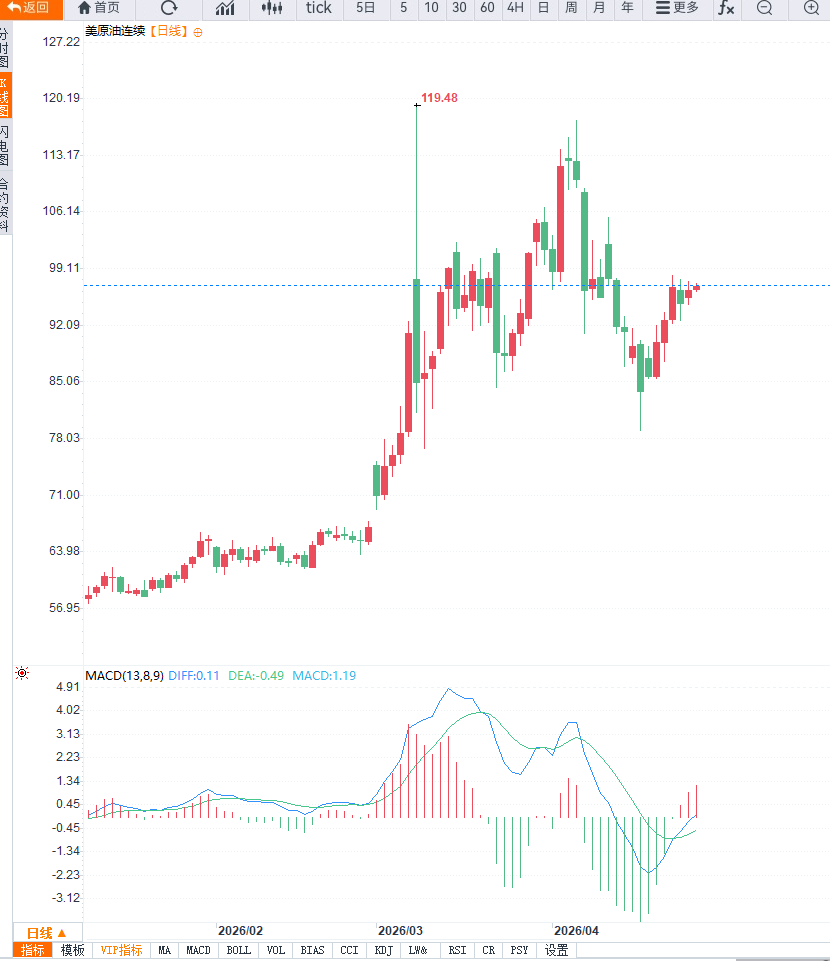
Editor's Summary : Overall, oil prices are currently at a critical juncture driven by both fundamentals and geopolitical risks. Expanding supply disruptions provide solid support for prices, while the uncertainty surrounding US-Iran negotiations is the biggest short-term variable. From a trend perspective, oil prices still have upward potential, but the pace will depend on whether geopolitical tensions ease. In the coming period, the market needs to focus on the Strait of Hormuz's traffic conditions, the progress of supply recovery, and changes in major institutions' expectations. In a highly volatile environment, the crude oil market presents both trend opportunities and significant risks.
Meanwhile, the energy market has already reacted to potential risks. As the Strait of Hormuz is one of the world's most important energy transport routes, its stability directly impacts the global supply chain, and the market is paying close attention to changes in the situation in the region. Current data shows that approximately 15% of global crude oil supply has been disrupted to varying degrees, amounting to about 13.7 million barrels per day , a level significantly higher than historical averages. More importantly, the majority of idle capacity is concentrated in the Persian Gulf region ; with transport disruptions, the actual available supply capacity is severely limited.
From a market perspective, despite rising supply-side risks, oil prices have not seen a corresponding increase. Market surveys indicate that many institutions believe current prices do not fully reflect the degree of supply tightness, exhibiting a significant "pricing discrepancy." This phenomenon may stem from investors' lingering expectations of an easing situation, while uncertainty surrounding the macroeconomic demand outlook is exerting some downward pressure on oil prices.
In terms of institutional perspectives, mainstream investment banks have clearly shifted to more optimistic price forecasts. Goldman Sachs recently raised its fourth-quarter Brent crude oil price forecast to $90 per barrel and WTI crude oil forecast to $83 per barrel , provided that regional supply can gradually recover by the end of June. Their analysis points out that the current market faces not only a supply-demand imbalance in crude oil itself, but also soaring refined product prices and potential shortage risks; these factors combined will put greater pressure on the global economy.
Meanwhile, Citibank's forecast is even more aggressive, suggesting that if supply disruptions continue beyond June, Brent crude prices could rise to $150 per barrel , with the average price expected to remain around $100 per barrel in the fourth quarter. This extreme scenario reflects the market's high sensitivity to the scale of supply shocks and indicates that current oil prices still face significant upside tail risks.
From a global market perspective, persistently high oil prices will not only increase inflationary pressures but may also exert a crowding-out effect on consumption and manufacturing. Especially given the still fragile growth momentum in major economies, rising energy costs could further exacerbate expectations of an economic slowdown. Simultaneously, from a financial perspective, the simultaneous increase in demand for safe-haven assets and commodity allocation has led to a rise in the weighting of crude oil in asset portfolios.
From a market sentiment perspective, investors are currently in a state of "cautious optimism." On the one hand, the continued expansion of supply disruptions reinforces the bullish logic; on the other hand, diplomatic negotiations still offer potential avenues for easing tensions, making the market reluctant to chase prices excessively. In the short term, oil price movements will be highly dependent on marginal changes in the geopolitical situation and the actual navigability of key shipping lanes.
From a technical perspective, current oil prices are exhibiting a typical high-level consolidation pattern. On the daily chart, the overall trend remains upward, but momentum has slowed. Prices have repeatedly tested the $100 level without a decisive breakthrough, indicating strong resistance above. Support is forming around $92 ; a break below this level could trigger a technical pullback. Momentum indicators show that while bullish forces are dominant, they are showing signs of weakening. On the 4-hour chart, prices are trading within a range, exhibiting a short-term slightly bullish bias. Technical indicators such as the RSI remain in the mid-to-high range, indicating intensified competition between bulls and bears. A break above $100 could open up further upside potential; conversely, a break below $92 should raise concerns about a potential pullback to lower support levels.
Editor's Summary : Overall, oil prices are currently at a critical juncture driven by both fundamentals and geopolitical risks. Expanding supply disruptions provide solid support for prices, while the uncertainty surrounding US-Iran negotiations is the biggest short-term variable. From a trend perspective, oil prices still have upward potential, but the pace will depend on whether geopolitical tensions ease. In the coming period, the market needs to focus on the Strait of Hormuz's traffic conditions, the progress of supply recovery, and changes in major institutions' expectations. In a highly volatile environment, the crude oil market presents both trend opportunities and significant risks.
- Risk Warning and Disclaimer
- The market involves risk, and trading may not be suitable for all investors. This article is for reference only and does not constitute personal investment advice, nor does it take into account certain users’ specific investment objectives, financial situation, or other needs. Any investment decisions made based on this information are at your own risk.