Uncertainty surrounding the Middle East situation and a rebounding US dollar put downward pressure on gold, causing it to fall below $4,650 and hit a two-week low.
2026-04-28 15:19:04
Gold prices continued to decline during Tuesday's Asian trading session, falling to around $4,630 , a near two-week low. This pullback was mainly driven by the temporary strengthening of the US dollar, which in turn stemmed from renewed uncertainty in the Middle East. As the market reprices geopolitical risks, safe-haven funds tend to flow into dollar assets, directly suppressing gold prices, which are denominated in dollars.

The market's current focus on the Middle East situation is on the progress of related negotiations. US President Donald Trump recently canceled a planned diplomatic visit, cooling market expectations for short-term easing. Meanwhile, Iran proposed a new plan to postpone sensitive issues, but this failed to meet the core demands of the US. This state of power struggle has led to uncertainty about the future, further intensifying market risk aversion. Against this backdrop, the US dollar, as the world's main reserve currency, has become more attractive , becoming one of the preferred safe-haven assets, thus weakening the appeal of gold.
However, from a macroeconomic perspective, the downside potential for gold remains somewhat limited. The market widely expects the Federal Reserve to keep interest rates unchanged at this week's meeting, but expectations for the future policy path have subtly shifted. Market estimates suggest a 35% probability of a rate cut this year , an expectation that provides potential support for gold, a non-interest-bearing asset. Since gold itself does not generate interest, its holding cost decreases relatively when interest rates are expected to fall, thus increasing its attractiveness.
Furthermore, market focus is gradually shifting to the upcoming Federal Open Market Committee (FOMC) meeting. Investors are paying close attention not only to the interest rate decision itself, but also to the post-meeting statement and Chairman Jerome Powell's remarks. If the policy wording reveals a more pronounced dovish bias, it could limit the dollar's gains and provide an opportunity for gold to rebound. Conversely, if the policy stance is cautious or even maintains high interest rates for an extended period, it could further depress gold prices.
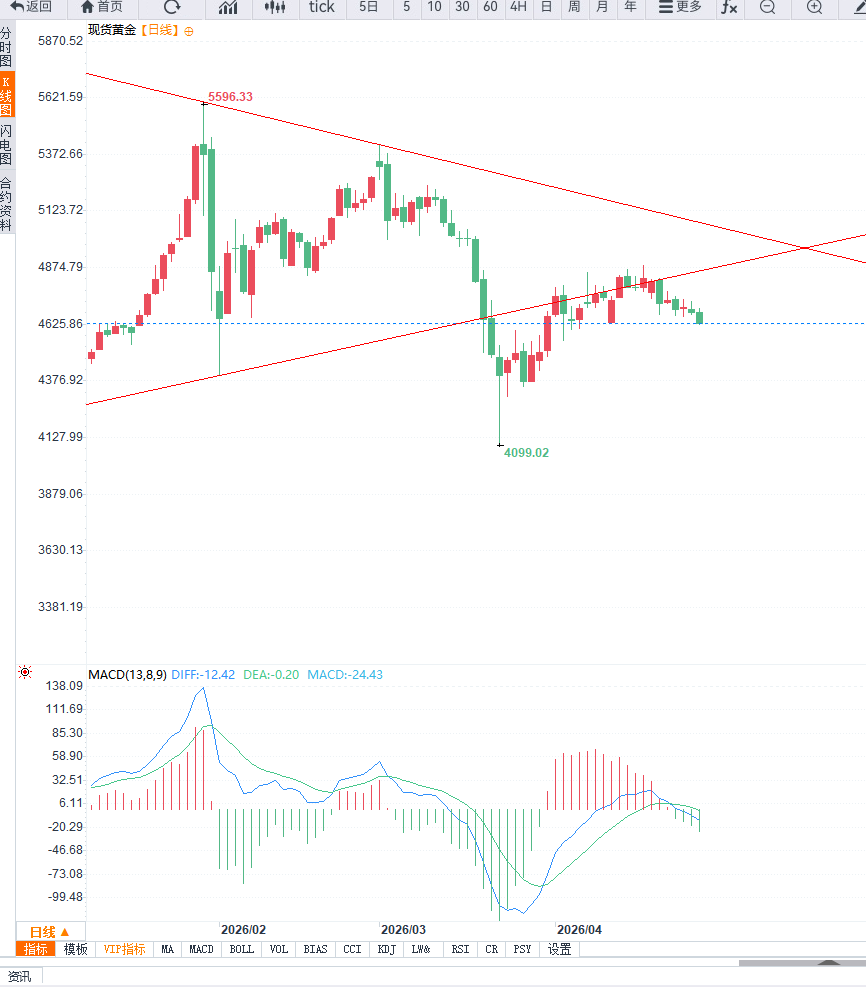
From an overall market structure perspective, gold is currently still within a trading range, but its short-term trend is clearly weak. The daily chart shows that gold prices have repeatedly encountered resistance during recent rebounds, with the overall center of gravity gradually shifting downwards, indicating that bearish forces are gradually strengthening. If the fundamentals continue to favor a strong US dollar, gold may face further downward pressure.
From a technical perspective, the daily chart shows gold trading below short-term moving averages, indicating a bearish trend, and the price is gradually approaching the lower edge of the trading range, suggesting the market is testing a key support area. The current major support level is around $4600 ; a decisive break below this level could trigger further technical selling and open up downside potential. Resistance is concentrated in the $4720–$4725 range , which also coincides with key moving average resistance and is a crucial level that bulls must break through.
From the 4-hour chart, gold's price action clearly shows a weak structure. The price has repeatedly failed to hold above the 200-period moving average, indicating insufficient upward momentum. In terms of momentum indicators, the Relative Strength Index (RSI) is around 41 , slightly below neutral levels, suggesting the market remains in bearish territory. Meanwhile, the MACD indicator remains below the zero line, and the histogram is negative, indicating that bearish momentum continues. If gold cannot recover the key moving average resistance in the short term, it may continue its downward trend.
Editor's Summary:
In summary, gold is currently in a phase of mixed bullish and bearish factors. In the short term, uncertainty in the Middle East is driving a stronger US dollar, putting downward pressure on gold prices; however, in the medium to long term, the expectation of a potential interest rate cut by the Federal Reserve continues to provide support for gold. The key to future price movements lies in two major variables: whether geopolitical tensions ease and whether the Federal Reserve's policy signals shift towards easing. If the US dollar continues to strengthen, gold may further test support levels; if policy shifts or risk sentiment cools, gold prices are expected to see a phase of rebound. Overall, the short-term outlook is bearish, while the medium-term outlook remains uncertain.
The market's current focus on the Middle East situation is on the progress of related negotiations. US President Donald Trump recently canceled a planned diplomatic visit, cooling market expectations for short-term easing. Meanwhile, Iran proposed a new plan to postpone sensitive issues, but this failed to meet the core demands of the US. This state of power struggle has led to uncertainty about the future, further intensifying market risk aversion. Against this backdrop, the US dollar, as the world's main reserve currency, has become more attractive , becoming one of the preferred safe-haven assets, thus weakening the appeal of gold.
However, from a macroeconomic perspective, the downside potential for gold remains somewhat limited. The market widely expects the Federal Reserve to keep interest rates unchanged at this week's meeting, but expectations for the future policy path have subtly shifted. Market estimates suggest a 35% probability of a rate cut this year , an expectation that provides potential support for gold, a non-interest-bearing asset. Since gold itself does not generate interest, its holding cost decreases relatively when interest rates are expected to fall, thus increasing its attractiveness.
Furthermore, market focus is gradually shifting to the upcoming Federal Open Market Committee (FOMC) meeting. Investors are paying close attention not only to the interest rate decision itself, but also to the post-meeting statement and Chairman Jerome Powell's remarks. If the policy wording reveals a more pronounced dovish bias, it could limit the dollar's gains and provide an opportunity for gold to rebound. Conversely, if the policy stance is cautious or even maintains high interest rates for an extended period, it could further depress gold prices.
From an overall market structure perspective, gold is currently still within a trading range, but its short-term trend is clearly weak. The daily chart shows that gold prices have repeatedly encountered resistance during recent rebounds, with the overall center of gravity gradually shifting downwards, indicating that bearish forces are gradually strengthening. If the fundamentals continue to favor a strong US dollar, gold may face further downward pressure.
From a technical perspective, the daily chart shows gold trading below short-term moving averages, indicating a bearish trend, and the price is gradually approaching the lower edge of the trading range, suggesting the market is testing a key support area. The current major support level is around $4600 ; a decisive break below this level could trigger further technical selling and open up downside potential. Resistance is concentrated in the $4720–$4725 range , which also coincides with key moving average resistance and is a crucial level that bulls must break through.
From the 4-hour chart, gold's price action clearly shows a weak structure. The price has repeatedly failed to hold above the 200-period moving average, indicating insufficient upward momentum. In terms of momentum indicators, the Relative Strength Index (RSI) is around 41 , slightly below neutral levels, suggesting the market remains in bearish territory. Meanwhile, the MACD indicator remains below the zero line, and the histogram is negative, indicating that bearish momentum continues. If gold cannot recover the key moving average resistance in the short term, it may continue its downward trend.
Editor's Summary:
In summary, gold is currently in a phase of mixed bullish and bearish factors. In the short term, uncertainty in the Middle East is driving a stronger US dollar, putting downward pressure on gold prices; however, in the medium to long term, the expectation of a potential interest rate cut by the Federal Reserve continues to provide support for gold. The key to future price movements lies in two major variables: whether geopolitical tensions ease and whether the Federal Reserve's policy signals shift towards easing. If the US dollar continues to strengthen, gold may further test support levels; if policy shifts or risk sentiment cools, gold prices are expected to see a phase of rebound. Overall, the short-term outlook is bearish, while the medium-term outlook remains uncertain.
- Risk Warning and Disclaimer
- The market involves risk, and trading may not be suitable for all investors. This article is for reference only and does not constitute personal investment advice, nor does it take into account certain users’ specific investment objectives, financial situation, or other needs. Any investment decisions made based on this information are at your own risk.