Geopolitical uncertainty puts pressure on the euro, leading to continuous adjustments.
2026-04-28 16:45:34
According to APP, the European Central Bank's quarterly bank credit survey released on Tuesday showed that eurozone banks significantly tightened credit access standards in the three months to March, and this trend is expected to continue this quarter, mainly due to the conflict in Iran pushing up energy prices and overall financing costs. The survey, covering 21 eurozone countries, shows that financing conditions have begun to deteriorate significantly since the conflict began in late February.

Data shows that banks have tightened loan approval standards more than the market expected, particularly for businesses, with the tightening reaching its most significant level since the third quarter of 2023. The European Central Bank explicitly stated that increased perceptions of risks to the economic outlook and declining risk tolerance among banks themselves are the main driving factors. Several banks reported in open-ended questions that geopolitical tensions and sharp rises in energy prices have exerted direct pressure on credit policy. Furthermore, some banks also reported that exposure to energy-intensive companies and the Middle East has led to additional credit tightening.
Latest market data shows that Brent crude oil prices remain high, hovering between $105 and $112 per barrel, despite the impact of the conflict, significantly increasing energy and logistics costs for Eurozone companies. The supply chain fluctuations of major Asian countries, as important global trading partners, have also indirectly exacerbated the financing pressures and uncertainties faced by European companies.
The European Central Bank further stated that banks expect a "general and more significant" tightening of credit standards in the three months ending in June. This expectation reflects financial institutions' cautious stance on geopolitical risks and concerns about a potential broader economic slowdown triggered by energy shocks. Tighter credit conditions will directly impact business investment expansion and household consumer lending, putting additional downward pressure on eurozone economic growth.
The table below compares recent changes and future expectations in Eurozone bank credit standards (based on the latest survey data):
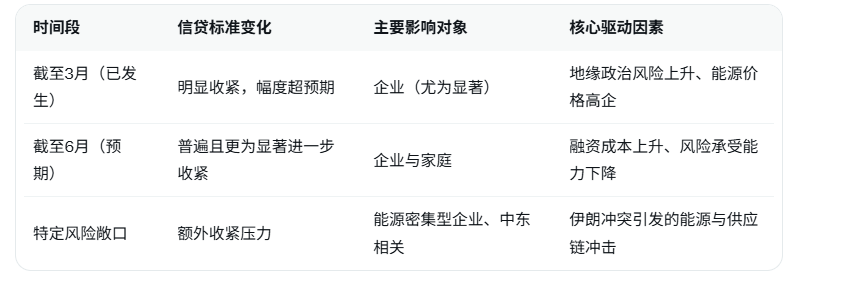
The findings of this credit survey are highly consistent with the current environment of high energy prices. The conflict in Iran has not only driven up prices of commodities such as crude oil, but also increased uncertainty in global supply chains, leading banks to be more stringent in their loan approval processes for high-risk sectors. Businesses, especially in manufacturing and energy-related sectors, are facing higher borrowing thresholds, which could slow capital expenditures and job growth.
From a broader perspective, tightening credit conditions coupled with rising energy costs are creating a double squeeze on the Eurozone economy. The European Central Bank needs to find a balance between curbing inflationary pressures and supporting economic growth, and the cautious behavior of the banking system will amplify this policy challenge.
Editor's Summary:
The accelerated tightening of credit standards in the Eurozone reflects the energy shock triggered by the Iranian conflict, which has spread from the real economy to the financial sector. Tighter financing conditions in the coming months will test corporate resilience and economic growth potential, and policymakers need to closely monitor risk developments to avoid a escalating negative cycle.
Data shows that banks have tightened loan approval standards more than the market expected, particularly for businesses, with the tightening reaching its most significant level since the third quarter of 2023. The European Central Bank explicitly stated that increased perceptions of risks to the economic outlook and declining risk tolerance among banks themselves are the main driving factors. Several banks reported in open-ended questions that geopolitical tensions and sharp rises in energy prices have exerted direct pressure on credit policy. Furthermore, some banks also reported that exposure to energy-intensive companies and the Middle East has led to additional credit tightening.
Latest market data shows that Brent crude oil prices remain high, hovering between $105 and $112 per barrel, despite the impact of the conflict, significantly increasing energy and logistics costs for Eurozone companies. The supply chain fluctuations of major Asian countries, as important global trading partners, have also indirectly exacerbated the financing pressures and uncertainties faced by European companies.
The European Central Bank further stated that banks expect a "general and more significant" tightening of credit standards in the three months ending in June. This expectation reflects financial institutions' cautious stance on geopolitical risks and concerns about a potential broader economic slowdown triggered by energy shocks. Tighter credit conditions will directly impact business investment expansion and household consumer lending, putting additional downward pressure on eurozone economic growth.
The table below compares recent changes and future expectations in Eurozone bank credit standards (based on the latest survey data):
The findings of this credit survey are highly consistent with the current environment of high energy prices. The conflict in Iran has not only driven up prices of commodities such as crude oil, but also increased uncertainty in global supply chains, leading banks to be more stringent in their loan approval processes for high-risk sectors. Businesses, especially in manufacturing and energy-related sectors, are facing higher borrowing thresholds, which could slow capital expenditures and job growth.
From a broader perspective, tightening credit conditions coupled with rising energy costs are creating a double squeeze on the Eurozone economy. The European Central Bank needs to find a balance between curbing inflationary pressures and supporting economic growth, and the cautious behavior of the banking system will amplify this policy challenge.
Editor's Summary:
The accelerated tightening of credit standards in the Eurozone reflects the energy shock triggered by the Iranian conflict, which has spread from the real economy to the financial sector. Tighter financing conditions in the coming months will test corporate resilience and economic growth potential, and policymakers need to closely monitor risk developments to avoid a escalating negative cycle.
- Risk Warning and Disclaimer
- The market involves risk, and trading may not be suitable for all investors. This article is for reference only and does not constitute personal investment advice, nor does it take into account certain users’ specific investment objectives, financial situation, or other needs. Any investment decisions made based on this information are at your own risk.