The Bank of Japan's signal of an interest rate hike, coupled with uncertainty in the Middle East, pushed the USD/JPY pair back up to above 159.
2026-04-28 15:40:58
On Tuesday morning in Europe, the USD/JPY exchange rate stabilized and rebounded after a brief pullback, generally fluctuating around 159.30 . Earlier, the Bank of Japan announced its latest interest rate decision, maintaining the rate unchanged as expected, but the policy details released a tightening signal, pushing the yen higher in the short term, with the exchange rate briefly falling below the 159 level to a one-week low.

At this meeting, the Bank of Japan decided to maintain its interest rate at 0.75% by a 6-3 vote , with three members supporting a rate hike, indicating widening internal policy disagreements. Simultaneously, the Bank of Japan raised its inflation forecast, reinforcing market expectations of future rate hikes. The market generally believes that a rate hike is possible in June or July , providing short- to medium-term support for the yen.
In his post-meeting remarks, Bank of Japan Governor Kazuo Ueda pointed out that current real interest rates remain significantly low, while inflation faces the risk of upward deviation and could negatively impact the economy. This statement was interpreted by the market as a hawkish stance, further enhancing the yen's attractiveness. Furthermore, Finance Minister Satsuki Katayama also warned of intervention in the foreign exchange market, emphasizing that the authorities are prepared to deal with speculative activities, which to some extent curbed expectations of excessive yen depreciation.
However, despite policy support, the yen's appreciation is still limited by external factors. The ongoing uncertainty in the Middle East continues to affect market sentiment, particularly the potential risks posed by the Strait of Hormuz, raising concerns about energy supplies. This strait handles approximately 20% of global oil shipments ; any disruption would have profound consequences for the global economy and financial markets. Against this backdrop, the US dollar's safe-haven status as the global reserve currency has become more prominent, attracting capital inflows and thus limiting the yen's appreciation potential.
Meanwhile, US policies and geopolitical tensions also significantly impacted exchange rates. US President Donald Trump's recent cancellation of a diplomatic visit lowered market expectations for a de-escalation of tensions. Furthermore, stalled negotiations exacerbated market uncertainty. Driven by safe-haven demand, the US dollar found support, propelling the USD/JPY pair to rebound from below 159.00.
From an overall market structure perspective, the USD/JPY pair is currently exhibiting a clear tug-of-war between bulls and bears. On one hand, the Bank of Japan's policy is gradually shifting towards normalization, providing support for the yen; on the other hand, global risk sentiment and demand for the US dollar are supporting the exchange rate, making it difficult for it to continue its downward trend.
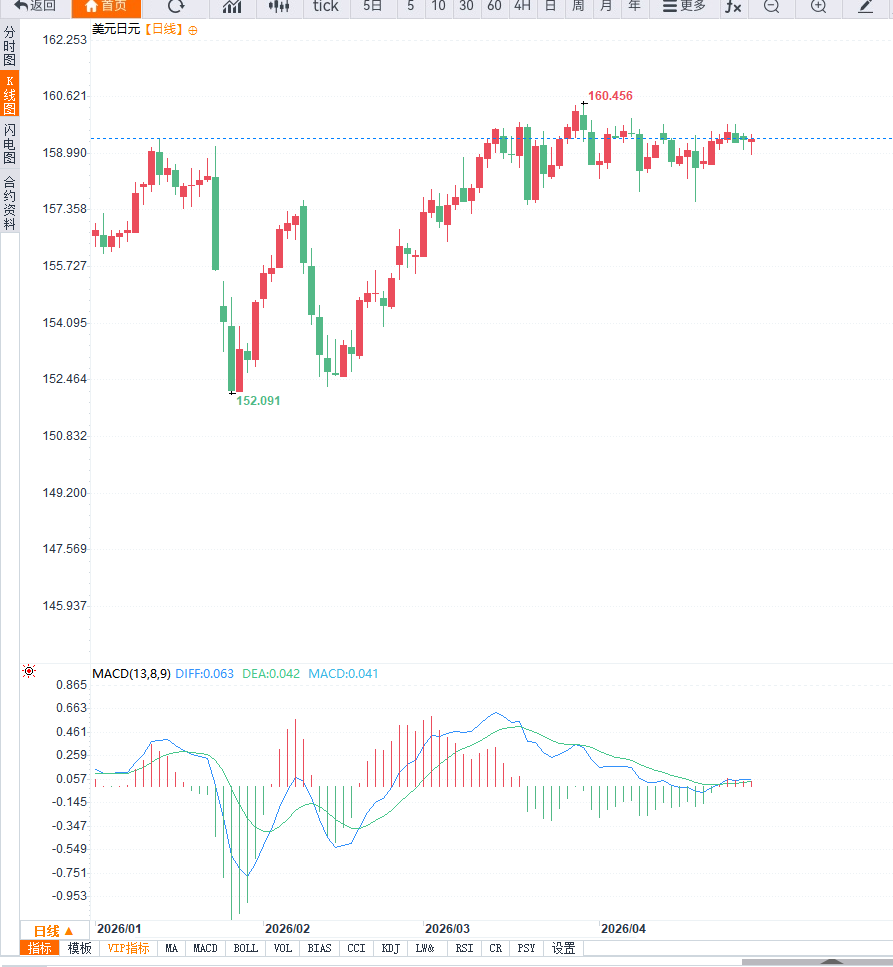
From a technical perspective, the daily chart shows that USD/JPY remains in a high-level consolidation pattern, with no clear reversal in the overall trend. The exchange rate stabilized quickly after a short-term pullback, indicating some buying support below. The key support level is currently at the psychological level of 159.00 ; a break below this level could trigger further retracement towards lower levels. On the upside, the key resistance level to watch is 160.00 , a significant psychological level and also a recent high; a break above this level could open up further upside potential.
From the 4-hour chart, the exchange rate is showing signs of consolidation in the short term, with the moving average system trending flat, indicating that the market direction is still unclear. In terms of momentum indicators, the Relative Strength Index (RSI) is fluctuating near the neutral zone, showing no clear trend signal; the MACD indicator is close to the zero line, indicating a relatively balanced balance between bullish and bearish forces. If there is a lack of new fundamental drivers in the short term, the exchange rate may maintain its range-bound trading pattern.
Editor's Summary:
The current USD/JPY exchange rate is influenced by both the Bank of Japan's policy shift and global risk sentiment. In the short term, the yen is supported by expectations of an interest rate hike, but strong demand for the US dollar as a safe haven keeps the exchange rate fluctuating at high levels. The future trend hinges on two factors: whether the Bank of Japan will raise interest rates this summer, and whether global geopolitical tensions will ease. If expectations of a rate hike strengthen further and risk sentiment declines, USD/JPY may experience a pullback; conversely, if the US dollar continues to strengthen, the exchange rate still has room to rise.
At this meeting, the Bank of Japan decided to maintain its interest rate at 0.75% by a 6-3 vote , with three members supporting a rate hike, indicating widening internal policy disagreements. Simultaneously, the Bank of Japan raised its inflation forecast, reinforcing market expectations of future rate hikes. The market generally believes that a rate hike is possible in June or July , providing short- to medium-term support for the yen.
In his post-meeting remarks, Bank of Japan Governor Kazuo Ueda pointed out that current real interest rates remain significantly low, while inflation faces the risk of upward deviation and could negatively impact the economy. This statement was interpreted by the market as a hawkish stance, further enhancing the yen's attractiveness. Furthermore, Finance Minister Satsuki Katayama also warned of intervention in the foreign exchange market, emphasizing that the authorities are prepared to deal with speculative activities, which to some extent curbed expectations of excessive yen depreciation.
However, despite policy support, the yen's appreciation is still limited by external factors. The ongoing uncertainty in the Middle East continues to affect market sentiment, particularly the potential risks posed by the Strait of Hormuz, raising concerns about energy supplies. This strait handles approximately 20% of global oil shipments ; any disruption would have profound consequences for the global economy and financial markets. Against this backdrop, the US dollar's safe-haven status as the global reserve currency has become more prominent, attracting capital inflows and thus limiting the yen's appreciation potential.
Meanwhile, US policies and geopolitical tensions also significantly impacted exchange rates. US President Donald Trump's recent cancellation of a diplomatic visit lowered market expectations for a de-escalation of tensions. Furthermore, stalled negotiations exacerbated market uncertainty. Driven by safe-haven demand, the US dollar found support, propelling the USD/JPY pair to rebound from below 159.00.
From an overall market structure perspective, the USD/JPY pair is currently exhibiting a clear tug-of-war between bulls and bears. On one hand, the Bank of Japan's policy is gradually shifting towards normalization, providing support for the yen; on the other hand, global risk sentiment and demand for the US dollar are supporting the exchange rate, making it difficult for it to continue its downward trend.
From a technical perspective, the daily chart shows that USD/JPY remains in a high-level consolidation pattern, with no clear reversal in the overall trend. The exchange rate stabilized quickly after a short-term pullback, indicating some buying support below. The key support level is currently at the psychological level of 159.00 ; a break below this level could trigger further retracement towards lower levels. On the upside, the key resistance level to watch is 160.00 , a significant psychological level and also a recent high; a break above this level could open up further upside potential.
From the 4-hour chart, the exchange rate is showing signs of consolidation in the short term, with the moving average system trending flat, indicating that the market direction is still unclear. In terms of momentum indicators, the Relative Strength Index (RSI) is fluctuating near the neutral zone, showing no clear trend signal; the MACD indicator is close to the zero line, indicating a relatively balanced balance between bullish and bearish forces. If there is a lack of new fundamental drivers in the short term, the exchange rate may maintain its range-bound trading pattern.
Editor's Summary:
The current USD/JPY exchange rate is influenced by both the Bank of Japan's policy shift and global risk sentiment. In the short term, the yen is supported by expectations of an interest rate hike, but strong demand for the US dollar as a safe haven keeps the exchange rate fluctuating at high levels. The future trend hinges on two factors: whether the Bank of Japan will raise interest rates this summer, and whether global geopolitical tensions will ease. If expectations of a rate hike strengthen further and risk sentiment declines, USD/JPY may experience a pullback; conversely, if the US dollar continues to strengthen, the exchange rate still has room to rise.
- Risk Warning and Disclaimer
- The market involves risk, and trading may not be suitable for all investors. This article is for reference only and does not constitute personal investment advice, nor does it take into account certain users’ specific investment objectives, financial situation, or other needs. Any investment decisions made based on this information are at your own risk.