Global gold demand surges to a record high of $193 billion.
2026-04-29 14:33:33
The latest Global Gold Demand Trends report shows that the global gold market in the first quarter of 2026 exhibited a significant characteristic of "stable volume and rising prices." Data shows that total global gold demand (including over-the-counter transactions) reached 1,231 tons in the first quarter, a year-on-year increase of approximately 2%, with a relatively moderate overall growth rate. However, driven by price factors, the total value of gold demand surged to US$193 billion , a year-on-year increase of 74%, breaking historical records and highlighting the amplifying effect of rising gold prices on market value.

Structurally, the core driver of this round of gold demand growth mainly comes from the investment side. Investment demand for gold bars and coins increased significantly by 42% year-on-year, reaching 474 tons , becoming a key factor driving overall demand growth. This change reflects a significant increase in investors' willingness to allocate to physical gold against the backdrop of rising global uncertainty, with gold's safe-haven attributes once again becoming a focus of market attention.
In terms of regional distribution, the Asian market performed particularly well. Demand for gold bars and coins in major Asian countries surged 67% year-on-year to 207 tons , a record quarterly high, demonstrating a strong recovery in investment demand. Meanwhile, gold investment demand also rose in markets such as India, South Korea, and Japan, indicating the continued increasing importance of the entire Asian region in the global gold demand landscape.
The European and American markets also showed clear signs of recovery. Demand for gold bars and coins in the United States increased by 14% year-on-year, while the European market saw a significant increase of approximately 50%. This phenomenon indicates that, against the backdrop of inflationary pressures, geopolitical risks, and monetary policy uncertainty, investors in developed economies are increasing their allocation to gold to hedge against potential risks.
From a macroeconomic perspective, the current changes in the structure of gold demand are mainly driven by three factors. First, the continued uncertainty in the global geopolitical situation has increased market demand for safe-haven assets. Second, fluctuations in energy prices have pushed up inflation expectations, further highlighting gold's anti-inflationary properties. Finally, the divergence in monetary policy paths among major economies has increased market volatility, prompting funds to flow into the gold market.
From a price perspective, the continued rise in gold prices has not only enhanced expectations of investment returns but also strengthened the positive feedback mechanism of "price increases—capital inflows—demand growth." In this process, gold has gradually transformed from a simple safe-haven asset into an important commodity with both investment and asset allocation functions.
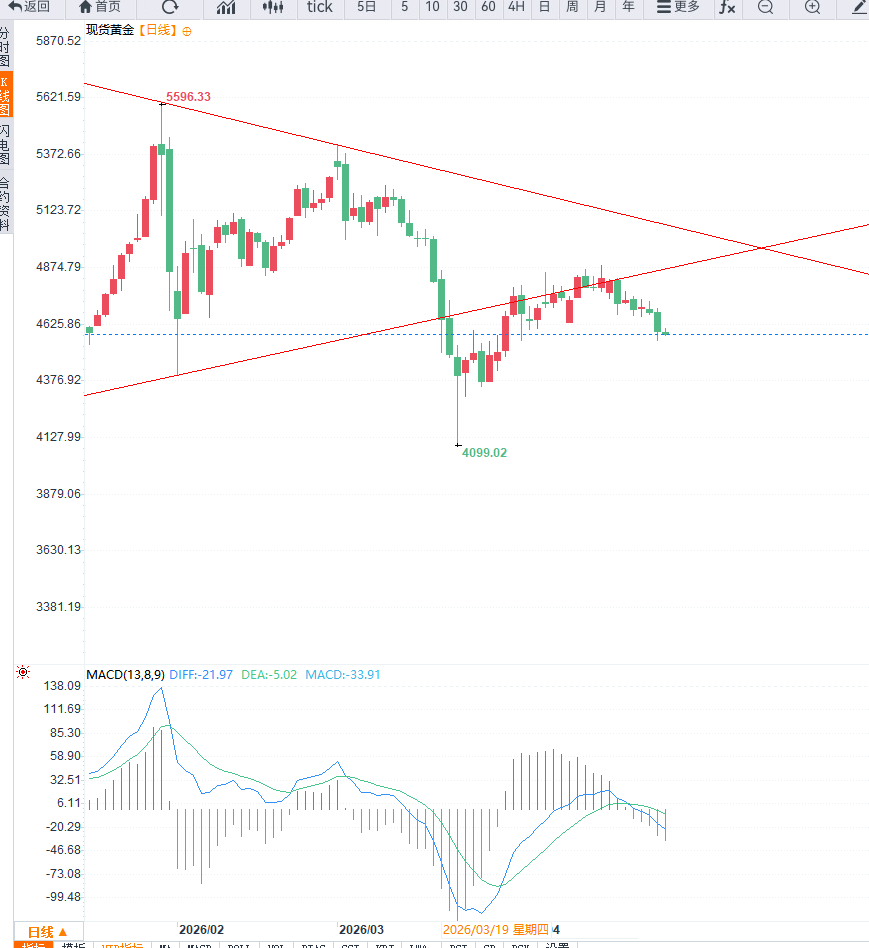
From a technical perspective, gold maintains an upward trend on the daily chart, with prices trading above major moving averages, indicating a solid medium-term bullish structure. The $4550 level forms a key support zone, while $4700 is a significant resistance level. A break above this level could open up further upside potential. Momentum indicators show that bullish forces still dominate, but momentum at higher levels has slowed, suggesting a more rational pace of the upward movement.
From a 4-hour chart perspective, the short-term trend shows a consolidation pattern at high levels, with prices oscillating within the $4550-$4650 range. The RSI is near the neutral zone, indicating a balance between bulls and bears. A break above the upper limit of the range may lead to a continuation of the upward trend; conversely, a break below the support level could indicate a risk of a short-term pullback.
Editor's Summary : Overall, the global gold market is undergoing a shift from price-driven to structural demand-driven growth. Although the increase in total demand is limited, rapid growth in investment demand and rising gold prices have jointly propelled the market to new highs. In the short term, safe-haven demand and inflation expectations will continue to support gold prices, but the risk of increased volatility at high levels should be noted. In the medium to long term, as global uncertainties persist, gold's position in asset allocation is expected to further increase.
Structurally, the core driver of this round of gold demand growth mainly comes from the investment side. Investment demand for gold bars and coins increased significantly by 42% year-on-year, reaching 474 tons , becoming a key factor driving overall demand growth. This change reflects a significant increase in investors' willingness to allocate to physical gold against the backdrop of rising global uncertainty, with gold's safe-haven attributes once again becoming a focus of market attention.
In terms of regional distribution, the Asian market performed particularly well. Demand for gold bars and coins in major Asian countries surged 67% year-on-year to 207 tons , a record quarterly high, demonstrating a strong recovery in investment demand. Meanwhile, gold investment demand also rose in markets such as India, South Korea, and Japan, indicating the continued increasing importance of the entire Asian region in the global gold demand landscape.
The European and American markets also showed clear signs of recovery. Demand for gold bars and coins in the United States increased by 14% year-on-year, while the European market saw a significant increase of approximately 50%. This phenomenon indicates that, against the backdrop of inflationary pressures, geopolitical risks, and monetary policy uncertainty, investors in developed economies are increasing their allocation to gold to hedge against potential risks.
From a macroeconomic perspective, the current changes in the structure of gold demand are mainly driven by three factors. First, the continued uncertainty in the global geopolitical situation has increased market demand for safe-haven assets. Second, fluctuations in energy prices have pushed up inflation expectations, further highlighting gold's anti-inflationary properties. Finally, the divergence in monetary policy paths among major economies has increased market volatility, prompting funds to flow into the gold market.
From a price perspective, the continued rise in gold prices has not only enhanced expectations of investment returns but also strengthened the positive feedback mechanism of "price increases—capital inflows—demand growth." In this process, gold has gradually transformed from a simple safe-haven asset into an important commodity with both investment and asset allocation functions.
From a technical perspective, gold maintains an upward trend on the daily chart, with prices trading above major moving averages, indicating a solid medium-term bullish structure. The $4550 level forms a key support zone, while $4700 is a significant resistance level. A break above this level could open up further upside potential. Momentum indicators show that bullish forces still dominate, but momentum at higher levels has slowed, suggesting a more rational pace of the upward movement.
From a 4-hour chart perspective, the short-term trend shows a consolidation pattern at high levels, with prices oscillating within the $4550-$4650 range. The RSI is near the neutral zone, indicating a balance between bulls and bears. A break above the upper limit of the range may lead to a continuation of the upward trend; conversely, a break below the support level could indicate a risk of a short-term pullback.
Editor's Summary : Overall, the global gold market is undergoing a shift from price-driven to structural demand-driven growth. Although the increase in total demand is limited, rapid growth in investment demand and rising gold prices have jointly propelled the market to new highs. In the short term, safe-haven demand and inflation expectations will continue to support gold prices, but the risk of increased volatility at high levels should be noted. In the medium to long term, as global uncertainties persist, gold's position in asset allocation is expected to further increase.
- Risk Warning and Disclaimer
- The market involves risk, and trading may not be suitable for all investors. This article is for reference only and does not constitute personal investment advice, nor does it take into account certain users’ specific investment objectives, financial situation, or other needs. Any investment decisions made based on this information are at your own risk.