Oil prices surged over 5% in two days! This article explains the underlying logic.
2026-04-29 18:19:22
Traders may now be more familiar with maps of the Persian Gulf region than with their favorite tourist cities.
On Wednesday (April 29), international oil prices continued to rise during the Asian and European sessions, gaining another 3% on top of a more than 2% increase the previous day. The catalyst was Iran's renewed focus on the Bab el-Mandeb Strait, indicating an escalation of its countermeasures. On April 29, local time, Borrujerdi, Vice Chairman of the Iranian Parliament's National Security Committee, stated that Iran has reserved unused "trump cards," and that the strategic importance of the Bab el-Mandeb Strait is no less than that of the Strait of Hormuz. Yemen may take action to block the strait, potentially reducing global daily oil supply to 25 million barrels, which would be a fatal blow to international oil prices.
Iran also emphasized that its military capabilities, including missiles, tanks, and drones, are sufficient to sustain a protracted conflict and that it will never relinquish control of the Strait of Hormuz.
Meanwhile, there are many other influencing factors recently, which traders can grasp and apply to their understanding of crude oil trading.
In response to Iran's tough stance, US President Trump posted a message of pressure in the early hours of April 29, accompanied by a picture of himself holding a gun and the caption "No more nice guys," stating bluntly that "Iran doesn't know how to sign a nuclear-free agreement and had better be smart."
Behind the tough talk are concrete actions: According to US officials, Trump has ordered his staff to develop a long-term blockade plan against Iran . The core strategy was finalized in consultations in the White House Situation Room—to continuously suppress Iran's economy and crude oil exports by blocking Iranian ports and disrupting shipping. He believes this plan is less risky than restarting bombing or unilaterally withdrawing troops, although it would significantly prolong the conflict.
The US-Iran negotiations are currently at a stalemate: Iran's negotiations, under the guidance of Supreme Leader Khamenei and personally chaired by the Speaker of Parliament, have expressed a desire for "positive results," but are clearly not in a hurry to make concessions.
Trump expressed clear dissatisfaction with Iran's three-stage proposal of "first a ceasefire, then resumption of flights, and finally nuclear talks," believing it lacked sincerity and did not commit to halting uranium enrichment activities.
The stalemate between the two sides means that the uncertainty surrounding Middle Eastern oil transportation routes will persist for a long time, supporting the "geopolitical premium" of oil prices.
Just as the market was focused on the blockade of the Strait of Hormuz, the United Arab Emirates, OPEC's third-largest oil producer, suddenly dropped a bombshell by announcing its withdrawal from OPEC on April 29. It officially announced its withdrawal from OPEC, completely freeing itself from production quota constraints, and plans to increase its daily production from 3.4 million barrels to 5 million barrels by 2027.
To bypass the shipping bottleneck in the Strait of Hormuz, Abu Dhabi National Oil Company has notified its long-term customers that starting in May, they can extract Upper Zakum crude oil via ship-to-ship transfer at the port of Fujairah outside the Persian Gulf, achieving a "circuitous export" through the land-based oil pipeline connecting the Persian Gulf and the Gulf of Oman.
However, the boosting effect of this breakthrough is limited: the oil inventory at Fujairah Port has now fallen to a historic low of 6 million barrels, and 53% of the UAE’s previous daily exports of 1.5 million barrels relied on the Strait of Hormuz. Even if pipeline capacity is fully utilized, it will be difficult to fill the gap in the short term.
The longer the Straits are disrupted, the more foreign exchange the UAE can earn. Previously, the UAE's tourism and energy sectors were hit hard, and the rapid loss of US dollars also forced it to face multiple threats such as the withdrawal of foreign capital.
It is worth noting that behind the United States' tough stance on Iran lies a deep connection with its domestic economic interests.
The total U.S. national debt has now exceeded $39 trillion, and net interest payments will reach $1 trillion in fiscal year 2026, accounting for 3.3% of GDP. Under such a heavy debt burden, controllable inflation has become an implicit tool to reduce the government's repayment pressure—inflation driven by rising oil prices can both dilute the real value of the debt and fill part of the fiscal gap through the revenue of the energy sector.
What's even more intriguing is Trump's frequent interactions with oil executives.
Amid the ongoing standoff in Iran, Trump has once again convened a meeting with oil company executives, a similar meeting that took place before the war and was then questioned for potential bribery.
Considering the US's previous actions in pushing oil companies to invest in Venezuela and control crude oil production and exports, its attitude toward high oil prices is not merely "unwilling" on the surface, but may instead be using geopolitical conflict to maintain a "price range that is comfortable for the government."
After all, high oil prices can both benefit energy giants and indirectly alleviate debt pressure. This dual benefit makes the United States lack sufficient motivation to "cool down" the situation in the Middle East.
The current crude oil market has entered a complex stage of "geopolitical dominance + interest entanglement". The trading logic needs to shift from simple supply and demand to multi-dimensional game: first, the actual pace of production increase and inventory replenishment capacity after the UAE leaves OPEC;
Secondly, there are risks associated with passage through the Bab el-Mandeb Strait and the Strait of Hormuz. Although they are not major oil transport routes, they still carry a volume of nearly 500 tons. In particular, there is concern about whether Iran will actually use its "blockade trump card."
Third, the progress of US debt negotiations and the capital movements of oil companies.
The unpredictability of geopolitical conflicts will remain the main theme of the market, while the underlying economic interests may be the core driver of persistent high oil prices.
As repeatedly emphasized in previous articles, the long-term valuation center of oil prices will continue to rise, and readers who have followed along carefully should have gained something from this article.
From a technical perspective, after breaking through the descending wedge pattern, oil prices embarked on a major upward trend, supported by the five-day moving average. As long as the five-day moving average holds, oil prices are expected to continue rising.
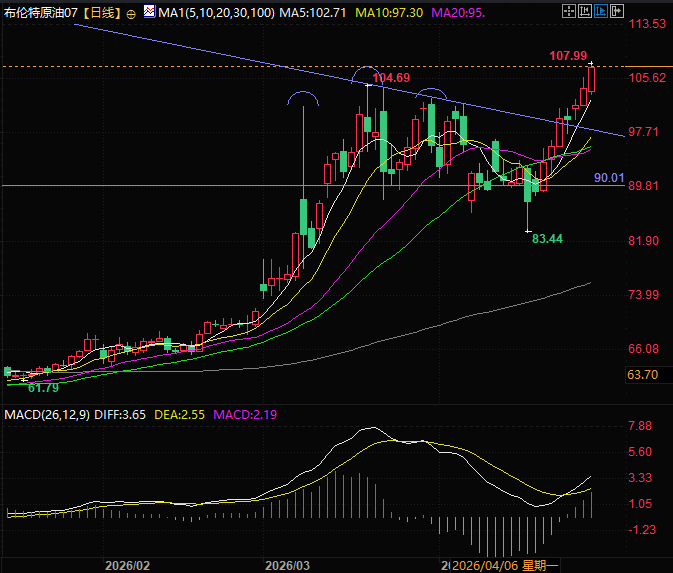
(Brent crude oil July contract daily chart, source: EasyForex)
At 18:17 Beijing time, the Brent crude oil July contract was trading at $107.72 per barrel.
On Wednesday (April 29), international oil prices continued to rise during the Asian and European sessions, gaining another 3% on top of a more than 2% increase the previous day. The catalyst was Iran's renewed focus on the Bab el-Mandeb Strait, indicating an escalation of its countermeasures. On April 29, local time, Borrujerdi, Vice Chairman of the Iranian Parliament's National Security Committee, stated that Iran has reserved unused "trump cards," and that the strategic importance of the Bab el-Mandeb Strait is no less than that of the Strait of Hormuz. Yemen may take action to block the strait, potentially reducing global daily oil supply to 25 million barrels, which would be a fatal blow to international oil prices.
Iran also emphasized that its military capabilities, including missiles, tanks, and drones, are sufficient to sustain a protracted conflict and that it will never relinquish control of the Strait of Hormuz.
Meanwhile, there are many other influencing factors recently, which traders can grasp and apply to their understanding of crude oil trading.
The US-Iran standoff intensifies: Trump's "showdown" and contingency plans for a long-term lockdown.
In response to Iran's tough stance, US President Trump posted a message of pressure in the early hours of April 29, accompanied by a picture of himself holding a gun and the caption "No more nice guys," stating bluntly that "Iran doesn't know how to sign a nuclear-free agreement and had better be smart."
Behind the tough talk are concrete actions: According to US officials, Trump has ordered his staff to develop a long-term blockade plan against Iran . The core strategy was finalized in consultations in the White House Situation Room—to continuously suppress Iran's economy and crude oil exports by blocking Iranian ports and disrupting shipping. He believes this plan is less risky than restarting bombing or unilaterally withdrawing troops, although it would significantly prolong the conflict.
The US-Iran negotiations are currently at a stalemate: Iran's negotiations, under the guidance of Supreme Leader Khamenei and personally chaired by the Speaker of Parliament, have expressed a desire for "positive results," but are clearly not in a hurry to make concessions.
Trump expressed clear dissatisfaction with Iran's three-stage proposal of "first a ceasefire, then resumption of flights, and finally nuclear talks," believing it lacked sincerity and did not commit to halting uranium enrichment activities.
The stalemate between the two sides means that the uncertainty surrounding Middle Eastern oil transportation routes will persist for a long time, supporting the "geopolitical premium" of oil prices.
Withdrawal from the group may benefit crude oil supply, but short-term support is limited.
Just as the market was focused on the blockade of the Strait of Hormuz, the United Arab Emirates, OPEC's third-largest oil producer, suddenly dropped a bombshell by announcing its withdrawal from OPEC on April 29. It officially announced its withdrawal from OPEC, completely freeing itself from production quota constraints, and plans to increase its daily production from 3.4 million barrels to 5 million barrels by 2027.
To bypass the shipping bottleneck in the Strait of Hormuz, Abu Dhabi National Oil Company has notified its long-term customers that starting in May, they can extract Upper Zakum crude oil via ship-to-ship transfer at the port of Fujairah outside the Persian Gulf, achieving a "circuitous export" through the land-based oil pipeline connecting the Persian Gulf and the Gulf of Oman.
However, the boosting effect of this breakthrough is limited: the oil inventory at Fujairah Port has now fallen to a historic low of 6 million barrels, and 53% of the UAE’s previous daily exports of 1.5 million barrels relied on the Strait of Hormuz. Even if pipeline capacity is fully utilized, it will be difficult to fill the gap in the short term.
The longer the Straits are disrupted, the more foreign exchange the UAE can earn. Previously, the UAE's tourism and energy sectors were hit hard, and the rapid loss of US dollars also forced it to face multiple threats such as the withdrawal of foreign capital.
The underlying logic: the tacit understanding of high oil prices under the pressure of US debt.
It is worth noting that behind the United States' tough stance on Iran lies a deep connection with its domestic economic interests.
The total U.S. national debt has now exceeded $39 trillion, and net interest payments will reach $1 trillion in fiscal year 2026, accounting for 3.3% of GDP. Under such a heavy debt burden, controllable inflation has become an implicit tool to reduce the government's repayment pressure—inflation driven by rising oil prices can both dilute the real value of the debt and fill part of the fiscal gap through the revenue of the energy sector.
What's even more intriguing is Trump's frequent interactions with oil executives.
Amid the ongoing standoff in Iran, Trump has once again convened a meeting with oil company executives, a similar meeting that took place before the war and was then questioned for potential bribery.
Considering the US's previous actions in pushing oil companies to invest in Venezuela and control crude oil production and exports, its attitude toward high oil prices is not merely "unwilling" on the surface, but may instead be using geopolitical conflict to maintain a "price range that is comfortable for the government."
After all, high oil prices can both benefit energy giants and indirectly alleviate debt pressure. This dual benefit makes the United States lack sufficient motivation to "cool down" the situation in the Middle East.
Conclusion: Crude oil trading requires close monitoring of three key signals.
The current crude oil market has entered a complex stage of "geopolitical dominance + interest entanglement". The trading logic needs to shift from simple supply and demand to multi-dimensional game: first, the actual pace of production increase and inventory replenishment capacity after the UAE leaves OPEC;
Secondly, there are risks associated with passage through the Bab el-Mandeb Strait and the Strait of Hormuz. Although they are not major oil transport routes, they still carry a volume of nearly 500 tons. In particular, there is concern about whether Iran will actually use its "blockade trump card."
Third, the progress of US debt negotiations and the capital movements of oil companies.
The unpredictability of geopolitical conflicts will remain the main theme of the market, while the underlying economic interests may be the core driver of persistent high oil prices.
As repeatedly emphasized in previous articles, the long-term valuation center of oil prices will continue to rise, and readers who have followed along carefully should have gained something from this article.
From a technical perspective, after breaking through the descending wedge pattern, oil prices embarked on a major upward trend, supported by the five-day moving average. As long as the five-day moving average holds, oil prices are expected to continue rising.
(Brent crude oil July contract daily chart, source: EasyForex)
At 18:17 Beijing time, the Brent crude oil July contract was trading at $107.72 per barrel.
- Risk Warning and Disclaimer
- The market involves risk, and trading may not be suitable for all investors. This article is for reference only and does not constitute personal investment advice, nor does it take into account certain users’ specific investment objectives, financial situation, or other needs. Any investment decisions made based on this information are at your own risk.