The memory of Japan's window guidance to the market remains, leading to a significant appreciation of the yen.
2026-04-30 18:54:41
On Thursday (April 30), the US dollar fell sharply against the Japanese yen during the Asian and European sessions, currently down 1.23% and trading around 158.42. The yen appreciated briefly and rapidly as the Japanese government's window guidance became more pronounced.
The continued weakening of the yen is constantly impacting the foundations of the Japanese economy. A report released by the Bank of Japan explicitly stated that the impact of the weak yen on domestic inflation has far exceeded the impact of oil prices.
A weak yen has pushed up prices for goods and services across the board, further increasing core consumer inflation excluding fresh food and energy, and continuing to put upward pressure on Japan's price system.
The Bank of Japan further assessed the risks, predicting that under extreme risk scenarios, Japan's inflation rate could climb to 3% and likely remain at that level for two years.

The bank also emphasized that the geopolitical conflict in the Middle East has added a high degree of uncertainty to Japan's overall economic development.
The Bank of Japan's full quarterly economic outlook report released on Thursday indicated that if international oil prices remain high for an extended period, coupled with a significant weakening of the yen and the domestic stock market, Japan's core CPI, excluding fresh food, may rise by 3.1% this fiscal year, and inflation is expected to reach 3% in the next fiscal year.
Brent crude oil surged to a four-year high on Thursday amid news of a potential escalation in the Middle East, while the yen simultaneously fell below the key 160 level. This not only amplified the risk of imported inflation in Japan but also raised widespread concerns among traders that the Japanese Ministry of Finance would intervene in the foreign exchange market.
Prior to this, supported by the Federal Reserve's favorable policies, the US dollar remained strong overall, directly driving the USD/JPY exchange rate to rise all the way up, once reaching 160.73, a multi-month high since July 2024.
The Federal Reserve kept interest rates unchanged at this meeting, but released a hawkish policy tone. Coupled with internal policy disagreements, the market subsequently lowered its expectations for interest rate cuts significantly, driving up US Treasury yields and providing solid support for the US dollar exchange rate.
Despite solid fundamental support, the USD/JPY pair's breakthrough of the key 160 level reignited market intervention and risk aversion, a level historically considered a red line for Japanese government intervention.
Faced with the grim situation of the continued depreciation of the yen, Japanese Finance Minister Satsuki Katayama made a public response on Thursday to the yen's renewed weakness, stating that the time for Japan to take decisive action to regulate the foreign exchange market is approaching.
When pressed by the media about specific possible intervention measures and whether Japan would join forces with the United States to curb the yen's decline, Satsuki Katayama declined to comment.
Directly affected by these strong verbal intervention remarks, the yen strengthened rapidly in the short term, and the USD/JPY pair fell by more than 200 points, breaking through the 160 level and several support levels.
Analysts point out that the increasingly assertive verbal intervention by the Japanese government can boost the yen in the short term, and the 160 level has become an insurmountable bottom line for Japanese policy.
Historical data on the Japanese yen shows that in July 2024, the yen was subject to window guidance, and the USD/JPY exchange rate fell from 161.9 to 139, causing short-term panic in the market . However, it should be noted that the macroeconomic fundamentals are quite different from those in 2024. In an environment of rising oil prices and a significant slowdown in economic growth, the medium- to long-term stabilization effect of such verbal interventions and subsequent actual market operations is relatively limited.
Currently, the USD/JPY exchange rate is caught in a clear battle between bulls and bears. The dollar is backed by the Federal Reserve and has solid fundamental support, while Japan is suffering from the inflationary impact of the yen's depreciation and is constantly issuing warnings of intervention. In the short term, this has firmly suppressed the upside potential of the USD/JPY exchange rate, and the yen's future trend will continue to fluctuate between economic inflationary pressures and expectations of official intervention.
From a technical perspective, the USD/JPY pair has broken below the lower channel line. Although there is panic here, considering the fundamentals, a significant rebound is highly likely. The current support levels are around 156.9 and 158.
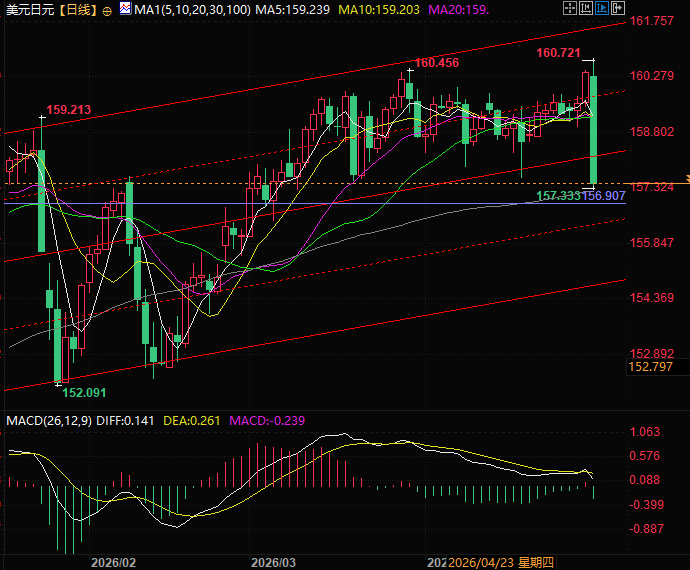
(USD/JPY daily chart, source: EasyForex)
At 18:52 Beijing time, the USD/JPY exchange rate is currently at 157.17/18.
The continued weakening of the yen is constantly impacting the foundations of the Japanese economy. A report released by the Bank of Japan explicitly stated that the impact of the weak yen on domestic inflation has far exceeded the impact of oil prices.
A weak yen has pushed up prices for goods and services across the board, further increasing core consumer inflation excluding fresh food and energy, and continuing to put upward pressure on Japan's price system.
The Bank of Japan further assessed the risks, predicting that under extreme risk scenarios, Japan's inflation rate could climb to 3% and likely remain at that level for two years.
The bank also emphasized that the geopolitical conflict in the Middle East has added a high degree of uncertainty to Japan's overall economic development.
The Bank of Japan's full quarterly economic outlook report released on Thursday indicated that if international oil prices remain high for an extended period, coupled with a significant weakening of the yen and the domestic stock market, Japan's core CPI, excluding fresh food, may rise by 3.1% this fiscal year, and inflation is expected to reach 3% in the next fiscal year.
Brent crude oil surged to a four-year high on Thursday amid news of a potential escalation in the Middle East, while the yen simultaneously fell below the key 160 level. This not only amplified the risk of imported inflation in Japan but also raised widespread concerns among traders that the Japanese Ministry of Finance would intervene in the foreign exchange market.
The Fed's hawkish stance spurred the USD/JPY exchange rate to a new high for the period.
Prior to this, supported by the Federal Reserve's favorable policies, the US dollar remained strong overall, directly driving the USD/JPY exchange rate to rise all the way up, once reaching 160.73, a multi-month high since July 2024.
The Federal Reserve kept interest rates unchanged at this meeting, but released a hawkish policy tone. Coupled with internal policy disagreements, the market subsequently lowered its expectations for interest rate cuts significantly, driving up US Treasury yields and providing solid support for the US dollar exchange rate.
Despite solid fundamental support, the USD/JPY pair's breakthrough of the key 160 level reignited market intervention and risk aversion, a level historically considered a red line for Japanese government intervention.
The finance minister signaled intervention, verbally reversing market trends.
Faced with the grim situation of the continued depreciation of the yen, Japanese Finance Minister Satsuki Katayama made a public response on Thursday to the yen's renewed weakness, stating that the time for Japan to take decisive action to regulate the foreign exchange market is approaching.
When pressed by the media about specific possible intervention measures and whether Japan would join forces with the United States to curb the yen's decline, Satsuki Katayama declined to comment.
Directly affected by these strong verbal intervention remarks, the yen strengthened rapidly in the short term, and the USD/JPY pair fell by more than 200 points, breaking through the 160 level and several support levels.
Summary and Technical Analysis:
Analysts point out that the increasingly assertive verbal intervention by the Japanese government can boost the yen in the short term, and the 160 level has become an insurmountable bottom line for Japanese policy.
Historical data on the Japanese yen shows that in July 2024, the yen was subject to window guidance, and the USD/JPY exchange rate fell from 161.9 to 139, causing short-term panic in the market . However, it should be noted that the macroeconomic fundamentals are quite different from those in 2024. In an environment of rising oil prices and a significant slowdown in economic growth, the medium- to long-term stabilization effect of such verbal interventions and subsequent actual market operations is relatively limited.
Currently, the USD/JPY exchange rate is caught in a clear battle between bulls and bears. The dollar is backed by the Federal Reserve and has solid fundamental support, while Japan is suffering from the inflationary impact of the yen's depreciation and is constantly issuing warnings of intervention. In the short term, this has firmly suppressed the upside potential of the USD/JPY exchange rate, and the yen's future trend will continue to fluctuate between economic inflationary pressures and expectations of official intervention.
From a technical perspective, the USD/JPY pair has broken below the lower channel line. Although there is panic here, considering the fundamentals, a significant rebound is highly likely. The current support levels are around 156.9 and 158.
(USD/JPY daily chart, source: EasyForex)
At 18:52 Beijing time, the USD/JPY exchange rate is currently at 157.17/18.
- Risk Warning and Disclaimer
- The market involves risk, and trading may not be suitable for all investors. This article is for reference only and does not constitute personal investment advice, nor does it take into account certain users’ specific investment objectives, financial situation, or other needs. Any investment decisions made based on this information are at your own risk.