Is the increased production just a smokescreen? Unveiling the truth behind oil price resilience.
2026-05-04 17:58:27
On Monday, May 4th, Brent crude oil futures prices stabilized around $109.30 per barrel, with market sentiment calming after last week's sharp fluctuations. Traders are digesting US President Trump's Strait of Hormuz shipping guidance plan, while also watching the implementation of OPEC+'s June supply adjustments and signals of continued tightening in European jet fuel inventories. The interplay of geopolitical logistical bottlenecks and changes in product inventories creates a complex fundamental landscape in the short term.

Trump's "Project Freedom" aims to guide commercial vessels out of the Persian Gulf and through the Strait of Hormuz. Oil prices briefly sold off after the announcement, but quickly recovered some losses. The market remains highly cautious because the plan does not involve US naval escorts and primarily affects outbound shipping, with limited expected inbound vessel traffic. This only allows for a temporary release of floating storage tankers and cannot fundamentally reverse the obstruction of Persian Gulf exports. Iran has received a response from the US to the latest peace proposal, but Trump has stated that the proposal is unacceptable, and the two sides remain deadlocked, further amplifying uncertainty. In the short term, the implementation of the plan may slightly increase outbound crude oil flow, but the overall recovery of Persian Gulf supply will take much longer, and the market has already priced this in as a limited negative factor.
OPEC+ announced a production increase of 188,000 barrels per day in June, the first collective decision since the UAE's withdrawal. However, approximately 55% of this increase comes from Persian Gulf oil-producing countries, making its actual implementation extremely difficult given the current disruptions to shipping through the Straits of Hormuz. The market widely expects the actual supply increase to be significantly lower than the official figures, with some oil-producing countries struggling to meet their quotas due to export restrictions. This has significantly weakened the downward pressure on oil prices from OPEC+'s decision, instead reinforcing expectations of a supply shortage. Traders are closely monitoring subsequent actual export data and OPEC+ monthly reports to assess the actual rate of implementation of the production increase plan.
Latest positioning data shows that speculators increased their net long positions in ICE Brent crude by 13,862 contracts last week, to 383,205 contracts, with the increase mainly coming from new long positions entering the market. This indicates that market participants still maintain a bullish bias at current price levels, but the increase is limited, reflecting a cautiously optimistic sentiment. On the European inventory front, jet fuel inventories in the ARA region decreased by 27,000 tons to 552,000 tons last week, a cumulative decrease of 34% since February 26, reaching a new low since 2020. Europe is highly dependent on Persian Gulf jet fuel imports, and the continued tightening of inventories directly pushes up crack spreads, thereby supporting upstream crude oil demand. The tight supply on the product side and the supply disruptions on the crude oil side resonate, providing structural support for Brent prices, especially given the resilient global jet fuel demand.
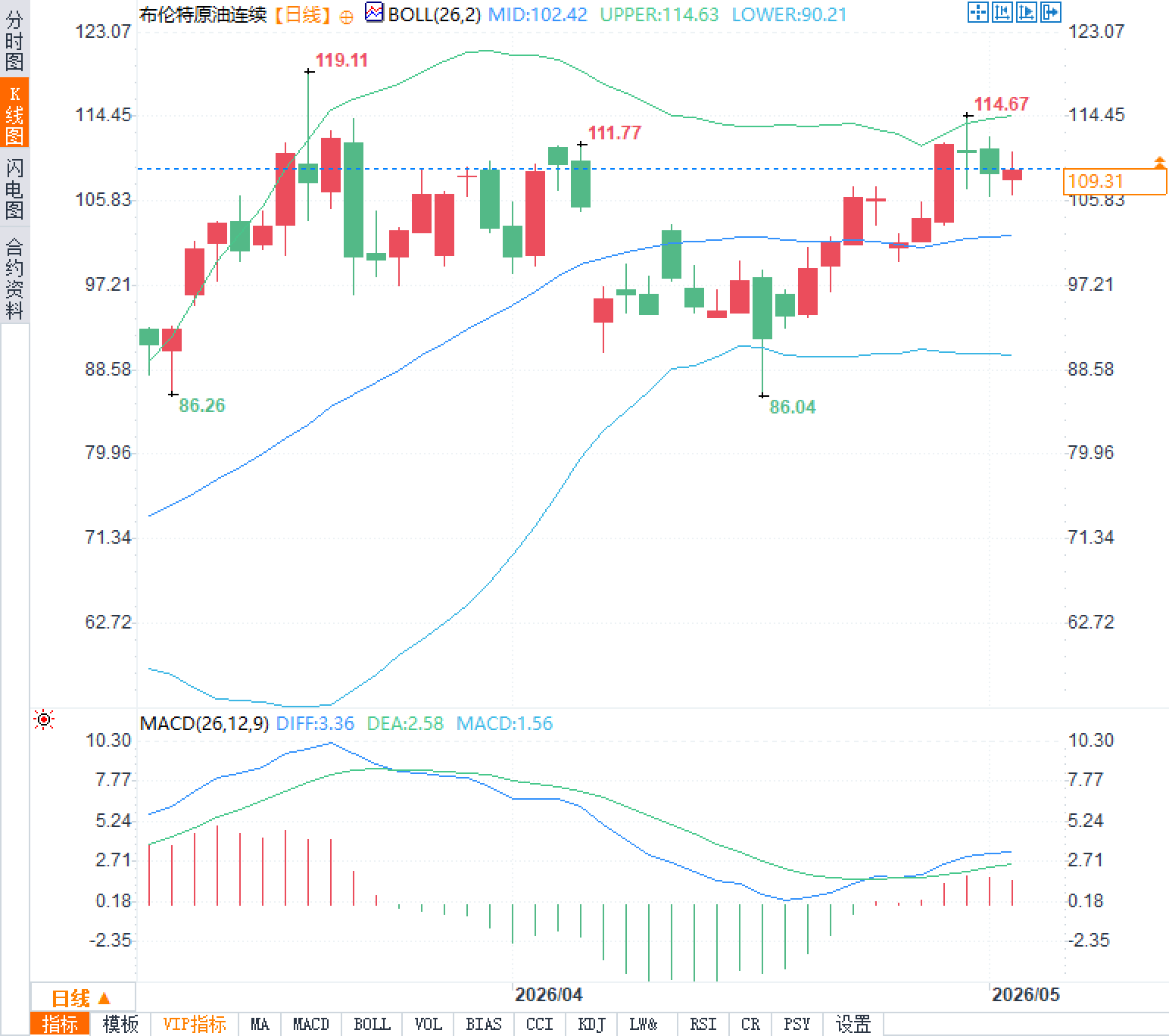
The daily chart shows Brent crude oil prices trading above the Bollinger Band middle line at 102.42, with the upper band at 114 and the lower band at 90.21, currently fluctuating around the 109.30 area. The MACD indicator readings are DIFF 3.36, DEA 2.58, and MACD 1.56, with the histogram showing a converging trend, indicating weakening short-term momentum. Prices are currently in the upper Bollinger Band range, facing resistance near the upper band. If geopolitical risks ease further, prices may retrace to the middle band at 102.42 for support; conversely, they may retest the area above 114.
Market Analysis of the Strait of Hormuz Shipping Plan
Trump's "Project Freedom" aims to guide commercial vessels out of the Persian Gulf and through the Strait of Hormuz. Oil prices briefly sold off after the announcement, but quickly recovered some losses. The market remains highly cautious because the plan does not involve US naval escorts and primarily affects outbound shipping, with limited expected inbound vessel traffic. This only allows for a temporary release of floating storage tankers and cannot fundamentally reverse the obstruction of Persian Gulf exports. Iran has received a response from the US to the latest peace proposal, but Trump has stated that the proposal is unacceptable, and the two sides remain deadlocked, further amplifying uncertainty. In the short term, the implementation of the plan may slightly increase outbound crude oil flow, but the overall recovery of Persian Gulf supply will take much longer, and the market has already priced this in as a limited negative factor.
Challenges in implementing OPEC+'s June production increase plan
OPEC+ announced a production increase of 188,000 barrels per day in June, the first collective decision since the UAE's withdrawal. However, approximately 55% of this increase comes from Persian Gulf oil-producing countries, making its actual implementation extremely difficult given the current disruptions to shipping through the Straits of Hormuz. The market widely expects the actual supply increase to be significantly lower than the official figures, with some oil-producing countries struggling to meet their quotas due to export restrictions. This has significantly weakened the downward pressure on oil prices from OPEC+'s decision, instead reinforcing expectations of a supply shortage. Traders are closely monitoring subsequent actual export data and OPEC+ monthly reports to assess the actual rate of implementation of the production increase plan.
Analysis of Speculative Positions and Changes in European Jet Fuel Inventories
Latest positioning data shows that speculators increased their net long positions in ICE Brent crude by 13,862 contracts last week, to 383,205 contracts, with the increase mainly coming from new long positions entering the market. This indicates that market participants still maintain a bullish bias at current price levels, but the increase is limited, reflecting a cautiously optimistic sentiment. On the European inventory front, jet fuel inventories in the ARA region decreased by 27,000 tons to 552,000 tons last week, a cumulative decrease of 34% since February 26, reaching a new low since 2020. Europe is highly dependent on Persian Gulf jet fuel imports, and the continued tightening of inventories directly pushes up crack spreads, thereby supporting upstream crude oil demand. The tight supply on the product side and the supply disruptions on the crude oil side resonate, providing structural support for Brent prices, especially given the resilient global jet fuel demand.
Technical Patterns Under Bollinger Bands and MACD Indicator
The daily chart shows Brent crude oil prices trading above the Bollinger Band middle line at 102.42, with the upper band at 114 and the lower band at 90.21, currently fluctuating around the 109.30 area. The MACD indicator readings are DIFF 3.36, DEA 2.58, and MACD 1.56, with the histogram showing a converging trend, indicating weakening short-term momentum. Prices are currently in the upper Bollinger Band range, facing resistance near the upper band. If geopolitical risks ease further, prices may retrace to the middle band at 102.42 for support; conversely, they may retest the area above 114.
Frequently Asked Questions
Question 1: Will Trump's Strait of Hormuz plan significantly alleviate oil supply pressure?
A: The plan primarily guides outbound vessels. Currently, lacking naval escort support and with limited inbound traffic, it can only achieve temporary release of floating storage tankers and cannot solve the core problem of blocked export channels for Persian Gulf oil-producing countries. The market experienced brief selling pressure after the plan's announcement but quickly recovered, indicating that traders viewed it as a short-term, localized negative factor, and the long-term supply gap expectation remains unchanged.
Question 2: Why is the market viewing the OPEC+ production increase of 188,000 barrels per day as difficult to implement?
A: Approximately 55% of the planned production increase comes from oil-producing countries in the Persian Gulf region, and the disruption to shipping through the Strait of Hormuz directly limits these countries' export capacity. Although this is the first decision since the UAE's withdrawal, logistical bottlenecks have resulted in the actual increase being far lower than the official figures. The market has already factored this into pricing, weakening the suppressive effect of the production increase on oil prices.
Question 3: What is the transmission mechanism of the decline in European jet fuel inventories to Brent crude oil prices?
A: ARA jet fuel inventories fell to 552,000 tons, the lowest level since 2020, reflecting hampered exports of refined products from the Middle East. Europe, reliant on Persian Gulf jet fuel supplies, saw its inventory tightening push up crack spreads, increasing implicit demand for crude oil. Meanwhile, resilient global jet fuel demand supports the oil product chain, indirectly benefiting Brent benchmark prices, especially given the continued geopolitical uncertainty, which provides structural support.
- Risk Warning and Disclaimer
- The market involves risk, and trading may not be suitable for all investors. This article is for reference only and does not constitute personal investment advice, nor does it take into account certain users’ specific investment objectives, financial situation, or other needs. Any investment decisions made based on this information are at your own risk.