Inflation backfires! Has gold lost its value under high interest rates?
2026-05-04 20:56:08
On Monday, May 4th, spot gold saw a significant decline in thin trading, falling by more than 1%. Escalating tensions between the US and Iran were the core driver, pushing up inflation expectations and weakening the prospect of interest rate cuts, while a slight strengthening of the US dollar index further pressured gold prices. Spot gold is currently trading around $4570 per ounce, down 1.2%; US June gold futures fell 1.7% to $4578.60 per ounce. With some markets closed for holidays, overall trading was thin, and insufficient liquidity amplified price sensitivity.
The latest developments in the Middle East conflict, including Iranian reports of US warships being attacked by missiles and their subsequent withdrawal from the Strait of Hormuz, coupled with the US denial of these claims, have directly fueled market concerns about disruptions to the energy supply chain. Brent crude oil prices have consequently risen above $113 per barrel, nearly doubling since the beginning of the year. Rising energy costs are rapidly being passed on to the manufacturing sector, with producers passing on the extra costs to consumers, thus increasing overall inflationary pressures. Central banks, constrained by a higher price environment, may extend the period of high interest rates to curb cost-push inflation.
As a non-interest-bearing asset, gold's opportunity cost increases significantly in a high-interest-rate environment. Since the outbreak of the conflict, gold prices have fallen by more than 13%. The Federal Reserve kept its policy rate unchanged last Wednesday, and some officials explicitly stated in the statement that the oil price shock has altered the policy path, and they are no longer inclined to cut rates, increasing the risk of rising borrowing costs in the future. This statement reinforced the market's repricing of the policy path, directly weakening gold's attractiveness. Some analysts believe that gold is being impacted by renewed concerns about the Middle East conflict, while the US dollar is once again demonstrating its safe-haven asset status. Gold's sensitivity to the geopolitical landscape will continue, which in turn frames the global inflation outlook.
The US dollar index rose slightly, directly increasing the cost of dollar-denominated gold for holders of non-dollar currencies. In an environment of multiple overlapping risks, safe-haven funds are preferentially flowing into dollar assets rather than gold, even though geopolitical tensions are traditionally considered to boost gold prices. This round of adjustments highlights the safe-haven status of the US dollar under the dual pressures of inflation and geopolitics. Traders are focusing on the real effective exchange rate of the US dollar; if it remains strong, gold prices will find it difficult to find support in the short term. In a low-liquidity environment, this linkage effect is further amplified, with price discovery reflecting more macroeconomic variables than local supply and demand.
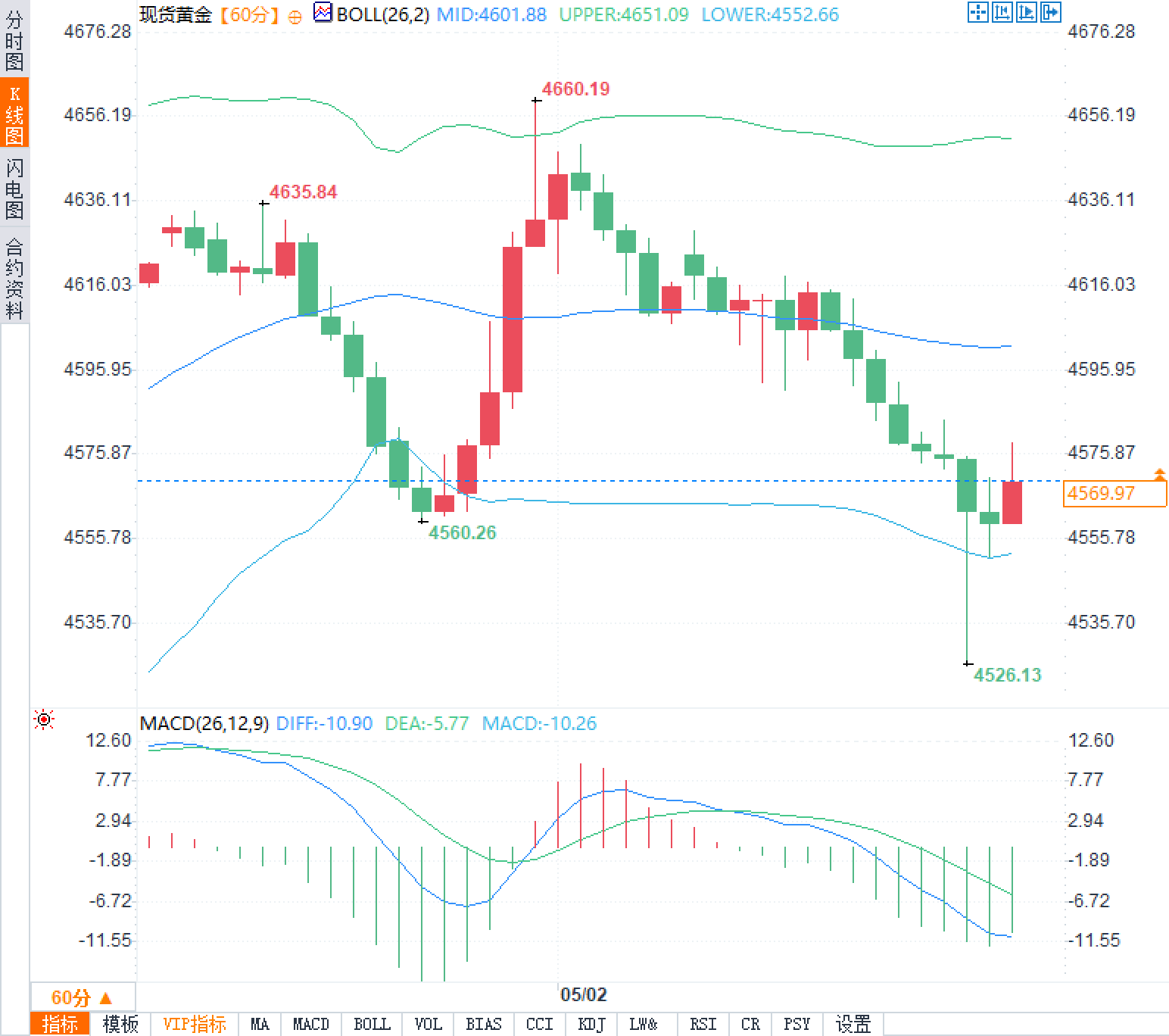
Referring to the 60-minute candlestick chart, the Bollinger Band middle line is at $4601.88/oz, the upper line at $4651.09/oz, and the lower line at $4552.66/oz. The price has fallen back below the middle line. The MACD indicator shows the DIFF line at -10.90 below the DEA line at -5.77, and the histogram is negative, indicating weak short-term momentum. Recent highs reached $4660.19/oz, and lows dipped to $4526.13/oz. The current price is fluctuating between $4560 and $4580/oz. Traders can observe the narrowing of the Bollinger Bands and changes in the MACD histogram; if the negative histogram continues to expand, short-term downward pressure may persist.
Apart from gold, other precious metals also declined, reflecting the common downward pressure on the sector from the macroeconomic environment. Spot silver fell 3.1% to $73.04 per ounce, platinum fell 2.5% to $1938.65 per ounce, and palladium fell 3.5% to $1470.75 per ounce. Silver, with its stronger industrial attributes, was more significantly affected by economic growth expectations; platinum and palladium faced additional pressure due to slowing demand from the automotive and industrial sectors. In a phase dominated by inflation and interest rate expectations, the relative disadvantage of precious metals as non-interest-bearing assets becomes apparent.
Escalating geopolitical conflicts in the Middle East are driving up oil prices and inflation expectations.
The latest developments in the Middle East conflict, including Iranian reports of US warships being attacked by missiles and their subsequent withdrawal from the Strait of Hormuz, coupled with the US denial of these claims, have directly fueled market concerns about disruptions to the energy supply chain. Brent crude oil prices have consequently risen above $113 per barrel, nearly doubling since the beginning of the year. Rising energy costs are rapidly being passed on to the manufacturing sector, with producers passing on the extra costs to consumers, thus increasing overall inflationary pressures. Central banks, constrained by a higher price environment, may extend the period of high interest rates to curb cost-push inflation.
As a non-interest-bearing asset, gold's opportunity cost increases significantly in a high-interest-rate environment. Since the outbreak of the conflict, gold prices have fallen by more than 13%. The Federal Reserve kept its policy rate unchanged last Wednesday, and some officials explicitly stated in the statement that the oil price shock has altered the policy path, and they are no longer inclined to cut rates, increasing the risk of rising borrowing costs in the future. This statement reinforced the market's repricing of the policy path, directly weakening gold's attractiveness. Some analysts believe that gold is being impacted by renewed concerns about the Middle East conflict, while the US dollar is once again demonstrating its safe-haven asset status. Gold's sensitivity to the geopolitical landscape will continue, which in turn frames the global inflation outlook.
The negative correlation between the rebound of the US dollar and gold prices
The US dollar index rose slightly, directly increasing the cost of dollar-denominated gold for holders of non-dollar currencies. In an environment of multiple overlapping risks, safe-haven funds are preferentially flowing into dollar assets rather than gold, even though geopolitical tensions are traditionally considered to boost gold prices. This round of adjustments highlights the safe-haven status of the US dollar under the dual pressures of inflation and geopolitics. Traders are focusing on the real effective exchange rate of the US dollar; if it remains strong, gold prices will find it difficult to find support in the short term. In a low-liquidity environment, this linkage effect is further amplified, with price discovery reflecting more macroeconomic variables than local supply and demand.
Technical Dynamics and Price Behavior Under Low Liquidity
Referring to the 60-minute candlestick chart, the Bollinger Band middle line is at $4601.88/oz, the upper line at $4651.09/oz, and the lower line at $4552.66/oz. The price has fallen back below the middle line. The MACD indicator shows the DIFF line at -10.90 below the DEA line at -5.77, and the histogram is negative, indicating weak short-term momentum. Recent highs reached $4660.19/oz, and lows dipped to $4526.13/oz. The current price is fluctuating between $4560 and $4580/oz. Traders can observe the narrowing of the Bollinger Bands and changes in the MACD histogram; if the negative histogram continues to expand, short-term downward pressure may persist.
The precious metals sector was under overall pressure.
Apart from gold, other precious metals also declined, reflecting the common downward pressure on the sector from the macroeconomic environment. Spot silver fell 3.1% to $73.04 per ounce, platinum fell 2.5% to $1938.65 per ounce, and palladium fell 3.5% to $1470.75 per ounce. Silver, with its stronger industrial attributes, was more significantly affected by economic growth expectations; platinum and palladium faced additional pressure due to slowing demand from the automotive and industrial sectors. In a phase dominated by inflation and interest rate expectations, the relative disadvantage of precious metals as non-interest-bearing assets becomes apparent.
| variety | Latest price (USD/ounce) | Daily decline (%) |
|---|---|---|
| spot gold | 4570 | -1.2 |
| spot silver | 73.04 | -3.1 |
| Platinum | 1938.65 | -2.5 |
| palladium | 1470.75 | -3.5 |
Frequently Asked Questions
Question 1: Why did the escalating conflict in the Middle East fail to boost gold prices and instead cause them to fall?
A: Traditionally, geopolitical risks boost demand for gold as a safe haven, but the current surge in oil prices and the resulting rise in inflation expectations are more crucial. Rising energy costs may force central banks to extend high-interest-rate cycles, increasing the opportunity cost of holding gold as real yields rise, leading to a shift of funds towards interest-bearing assets such as the US dollar, thus putting downward pressure on gold prices.
Question 2: How will the Fed's policy statements change the macroeconomic drivers of gold?
A: After the Federal Reserve kept interest rates unchanged, some officials pointed out that the oil price shock had ruled out any further easing, and that borrowing costs might rise in the future. This signal boosted expectations of a strong dollar, weakened gold's appeal as an inflation hedge, and the market's repricing of policy path directly suppressed gold prices.
Question 3: What specific impact does the low liquidity environment have on current price trends?
A: Market closures for holidays have led to thin trading volumes, which amplifies the price discovery process. Current price movements reflect macroeconomic variables such as the US dollar and inflation expectations. Short-term fluctuations may exceed the reasonable range of fundamentals, but in the medium to long term, interest rates and geopolitical dynamics will still dominate.
- Risk Warning and Disclaimer
- The market involves risk, and trading may not be suitable for all investors. This article is for reference only and does not constitute personal investment advice, nor does it take into account certain users’ specific investment objectives, financial situation, or other needs. Any investment decisions made based on this information are at your own risk.