Breaking News! US Warship Attacked? Oil Prices Surge
2026-05-04 18:34:50
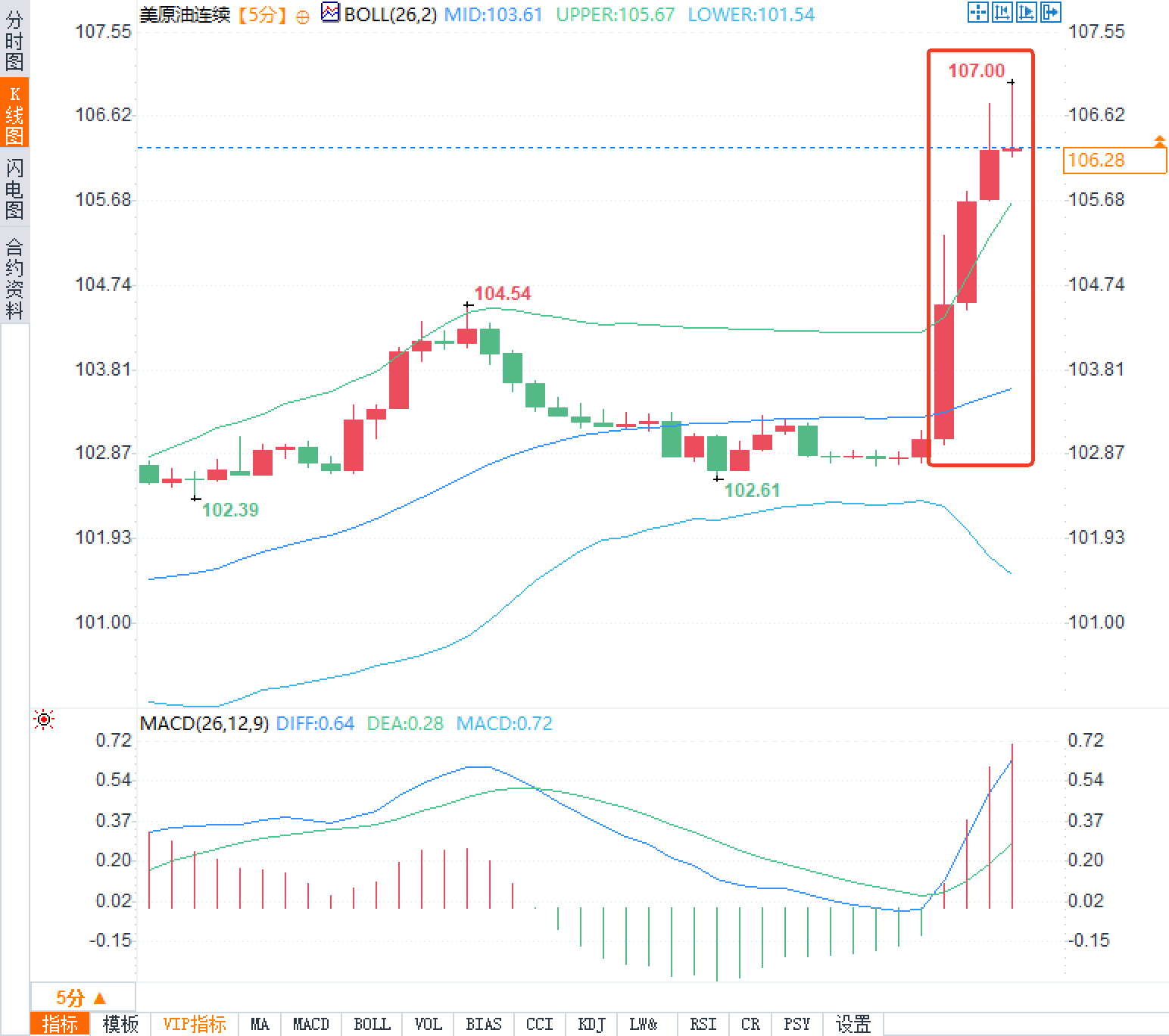
On Monday, May 4th, during the European session, the global crude oil market experienced significant volatility due to a sudden geopolitical event. Iranian media reported that two missiles struck a US warship that attempted to enter the Strait of Hormuz near Jask Island despite warnings. This event directly boosted risk premiums, with US crude oil futures rising rapidly from a low of $102.61 on the 5-minute chart, reaching a high of $107.00 during the session, and currently trading at $106.28, a single-day range exceeding $4. The Bollinger Bands widened significantly, the MACD histogram continued to expand, and market risk aversion rapidly increased, putting pressure on US stock futures as well.
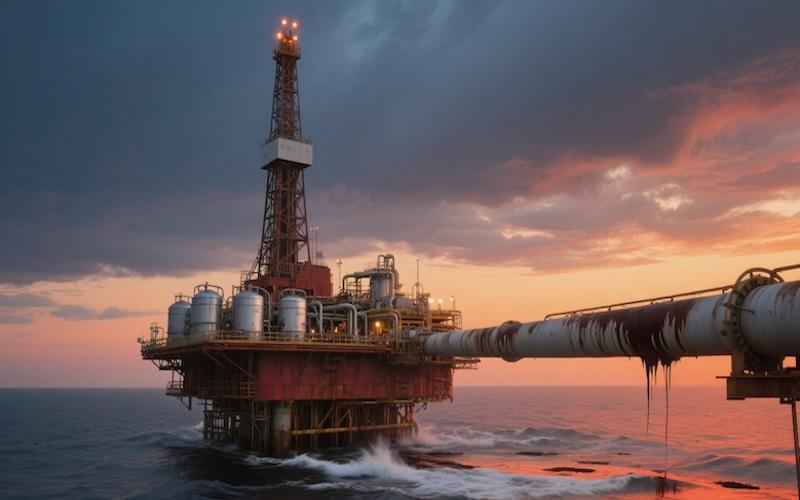
The Strait of Hormuz handles approximately 21% of global liquid oil transport daily, serving as a crucial choke point for Middle Eastern crude oil exports to the world. Iran's announcement of a new controlled area extending to Fujairah, further tightening shipping security standards, could lead to delays in ship inspections or increased detour costs. Historical data shows that such single events often inject a 5% to 12% geopolitical risk premium into oil prices. This event coincided with the breakdown of a fragile ceasefire agreement, and market concerns about potential shipping disruptions were immediately reflected in a steepening of the futures curve. Increased open interest in the WTI main contract, with short covering and long buying simultaneously, propelled prices rapidly from near the lower bound to a breakout above the upper bound. The global energy supply chain is highly dependent on the Strait of Hormuz; any sustained tension will be transmitted to downstream refining and end-consumer sectors through a price premium.
Comparison of key price data before and after the event
The above data indicates that the price has effectively broken through the upper Bollinger Band at $105.67, and the volatility indicator has increased accordingly, indicating a significant strengthening of the short-term trend.
On the 5-minute chart, the Bollinger Bands (26,2) have a middle band at $103.61, an upper band at $105.67, and a lower band at $101.54. The price breaking above the upper band, accompanied by a significant expansion of the channel, indicates a rapid release of market volatility from its lows, with a clear upward trend. The MACD (26,12,9) readings are DIFF 0.64, DEA 0.28, and MACD 0.72, with the histogram turning from green to red and continuing to expand, showing a typical bullish momentum pattern. In terms of candlestick patterns, consecutive red bodies accompanied by long upper shadows indicate that buying pressure remains strong at higher levels, but profit-taking pressure is also present. The increased trading volume confirms the event-driven nature of the price action. If the price can firmly hold above the $106 level, the technical indicators will continue to provide upward momentum; conversely, a pullback to the middle band around $103.61 will test the bulls' defensive capabilities.
Iran's increased naval patrols and the establishment of a new controlled zone in the Strait of Hormuz have directly heightened shipping uncertainty in the region. While global crude oil inventories remain relatively high, the release of spare capacity under the OPEC+ framework will take time, making it difficult to fully offset potential shortfalls in the short term. Following the events, risk assets generally came under pressure, and the US dollar index strengthened, reflecting the market's repricing of geopolitical premiums. The future energy landscape may accelerate towards diversification, with traditional reliance on the Strait potentially decreasing, but in the short term, the price center will still be dominated by the development of events.
In the baseline scenario, the event remains limited in scale, with oil prices fluctuating at high levels between $105 and $108, and the risk premium gradually being digested. In the optimistic scenario, if diplomatic efforts progress rapidly, prices may retrace to the mid-range area of $103 to $104. In the pessimistic scenario, if tensions escalate further, prices may test above $110. Regardless of the path taken, volatility indicators are expected to remain high, and traders should pay close attention to warning signals such as shrinking trading volume or MACD histogram divergence. Overall, current prices have fully reflected short-term geopolitical shocks; long-term pricing still depends on the pace of global demand recovery and OPEC+ policy coordination.
Market transmission mechanism of geopolitical events
The Strait of Hormuz handles approximately 21% of global liquid oil transport daily, serving as a crucial choke point for Middle Eastern crude oil exports to the world. Iran's announcement of a new controlled area extending to Fujairah, further tightening shipping security standards, could lead to delays in ship inspections or increased detour costs. Historical data shows that such single events often inject a 5% to 12% geopolitical risk premium into oil prices. This event coincided with the breakdown of a fragile ceasefire agreement, and market concerns about potential shipping disruptions were immediately reflected in a steepening of the futures curve. Increased open interest in the WTI main contract, with short covering and long buying simultaneously, propelled prices rapidly from near the lower bound to a breakout above the upper bound. The global energy supply chain is highly dependent on the Strait of Hormuz; any sustained tension will be transmitted to downstream refining and end-consumer sectors through a price premium.
Comparison of key price data before and after the event
| Time period | Price (USD) | Variation range |
|---|---|---|
| Pre-event low | 102.61 | — |
| Intraday high | 107.00 | +4.28% |
| Latest transaction price | 106.28 | +3.57% |
| Bollinger Band Middle Rail | 103.61 | Benchmark Reference |
Technical Analysis of Bullish and Bearish Forces and Indicator Signals
On the 5-minute chart, the Bollinger Bands (26,2) have a middle band at $103.61, an upper band at $105.67, and a lower band at $101.54. The price breaking above the upper band, accompanied by a significant expansion of the channel, indicates a rapid release of market volatility from its lows, with a clear upward trend. The MACD (26,12,9) readings are DIFF 0.64, DEA 0.28, and MACD 0.72, with the histogram turning from green to red and continuing to expand, showing a typical bullish momentum pattern. In terms of candlestick patterns, consecutive red bodies accompanied by long upper shadows indicate that buying pressure remains strong at higher levels, but profit-taking pressure is also present. The increased trading volume confirms the event-driven nature of the price action. If the price can firmly hold above the $106 level, the technical indicators will continue to provide upward momentum; conversely, a pullback to the middle band around $103.61 will test the bulls' defensive capabilities.
Supply risks and the reshaping of the global energy landscape
Iran's increased naval patrols and the establishment of a new controlled zone in the Strait of Hormuz have directly heightened shipping uncertainty in the region. While global crude oil inventories remain relatively high, the release of spare capacity under the OPEC+ framework will take time, making it difficult to fully offset potential shortfalls in the short term. Following the events, risk assets generally came under pressure, and the US dollar index strengthened, reflecting the market's repricing of geopolitical premiums. The future energy landscape may accelerate towards diversification, with traditional reliance on the Strait potentially decreasing, but in the short term, the price center will still be dominated by the development of events.
Potential scenarios for future market trends
In the baseline scenario, the event remains limited in scale, with oil prices fluctuating at high levels between $105 and $108, and the risk premium gradually being digested. In the optimistic scenario, if diplomatic efforts progress rapidly, prices may retrace to the mid-range area of $103 to $104. In the pessimistic scenario, if tensions escalate further, prices may test above $110. Regardless of the path taken, volatility indicators are expected to remain high, and traders should pay close attention to warning signals such as shrinking trading volume or MACD histogram divergence. Overall, current prices have fully reflected short-term geopolitical shocks; long-term pricing still depends on the pace of global demand recovery and OPEC+ policy coordination.
- Risk Warning and Disclaimer
- The market involves risk, and trading may not be suitable for all investors. This article is for reference only and does not constitute personal investment advice, nor does it take into account certain users’ specific investment objectives, financial situation, or other needs. Any investment decisions made based on this information are at your own risk.