Gold rebounded 0.7% but struggled to break through resistance; will the 4500 support level fail?
2026-05-05 17:33:54
On Tuesday, May 5th, spot gold rebounded slightly after a sharp drop of over 2% on Monday, hitting a five-week low, but overall gains were limited. The core market driver was the tension in the Middle East pushing up oil prices, which in turn exacerbated inflation concerns. Meanwhile, a stronger dollar and rising US Treasury yields jointly suppressed the performance of non-interest-bearing assets. Traders are closely watching this week's release of US employment data, which will further clarify expectations for the interest rate path. Some analysts believe that prices appear to be digesting Monday's pullback due to the return of the "war deal," but inflation expectations stimulated by the oil price rebound and the strong dollar still pose significant headwinds.
Spot gold rose 0.73% to $4,550 an ounce in early European trading on Tuesday, while U.S. June gold futures rose 0.5% to $4,562 an ounce. Gold prices had plunged on Monday due to fluctuations in market risk appetite, resulting in a clear short-term correction. Analysts emphasize that this digestion process reflects investors' cautious attitude amid a confluence of factors. Crude oil prices remaining above $113 per barrel have directly pushed up global inflation expectations. High oil prices not only increase production costs but may also be transmitted through the supply chain to a broader price level, thereby altering market pricing in the Federal Reserve's policy path.
A stronger dollar has further exacerbated the pressure on gold, as dollar-denominated gold has become more expensive for holders of other currencies. Simultaneously, rising US Treasury yields have increased the attractiveness of holding interest-bearing assets, weakening gold's relative advantage as a traditional safe-haven asset. Traders have now largely ruled out the possibility of a Federal Reserve rate cut this year, with the market's implied probability of a rate hike before March 2027 rising to 37%, a significant reversal from the 27% probability expected a week ago. This shift in expectations has directly limited the upside potential for gold.
The following is a comparison of the latest precious metal prices:
As can be seen from the table, other precious metals rebounded in tandem, with platinum and palladium, which have stronger industrial attributes, showing more significant gains. This is somewhat related to the transmission of energy costs under high oil prices, but gold, as a purely financial asset, showed relatively restrained performance.
The current market focus is on tensions in the Strait of Hormuz. Military interactions between the US and Iran in the region continue, with both sides seeking a ceasefire while maintaining limited confrontation. The US military claimed on Monday to have destroyed six small Iranian vessels and intercepted cruise missiles and drones, escalating geopolitical friction and increasing short-term supply uncertainty. Brent crude oil has thus remained high, directly fueling inflation expectations.
Geopolitical risks typically provide support for gold, but this time the situation is markedly divergent. Inflationary pressures from high oil prices have outweighed traditional safe-haven demand, as the market believes this could force major central banks to maintain high interest rates or even raise them slightly. Analysts point out that the simultaneous rise in yields and the US dollar is directly pressuring gold. The logic is clear: oil supply risks increase energy prices, energy prices push up overall price levels, and higher price levels reinforce expectations of monetary tightening, ultimately weakening the willingness to hold gold.
This week, the US will release several important employment data points, including job openings, the ADP employment report, and the April non-farm payrolls report. These data will be crucial in determining the inflation path. Strong employment data will further solidify market expectations that interest rates will remain high, thus continuing to put downward pressure on gold.
From a technical perspective, the daily chart shows that spot gold is currently trading near the lower Bollinger Band (approximately $4504.63/oz), with the middle band at $4693.12/oz, indicating that the price is clearly under pressure below the middle band. The MACD indicator shows a DIFF of -55.46, a DEA of -40.68, and a MACD histogram of -29.57, all in negative territory without a clear golden cross signal, suggesting that short-term momentum remains weak. The price is fluctuating within the $4500-$4600/oz range, indicating a balance between bullish and bearish forces, with the bears holding a slight advantage.
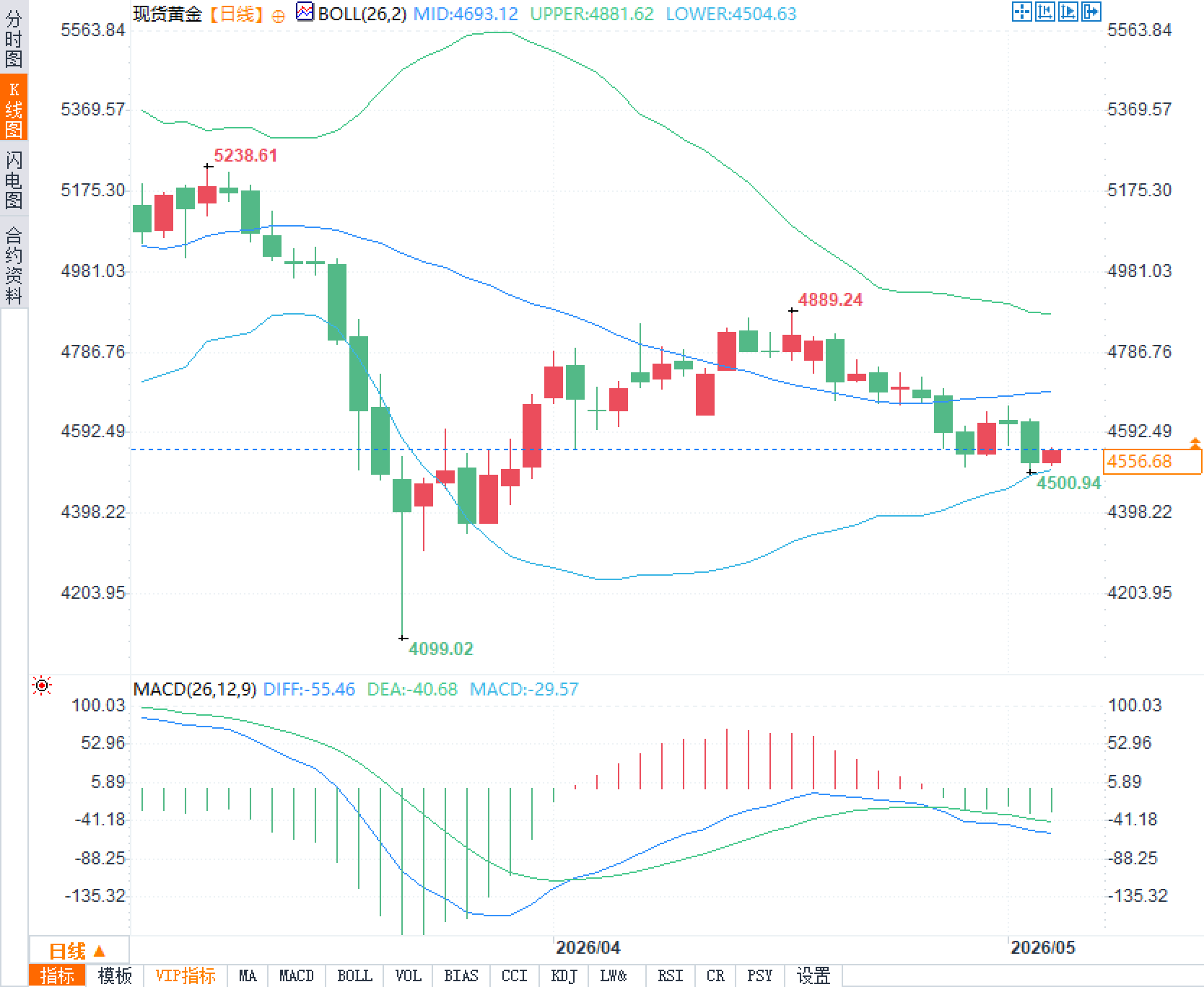
This convergence of technology and fundamentals makes a trend-driven breakout in gold unlikely in the short term, with it more likely to exhibit range-bound trading. Investors are focused on the fact that any unexpectedly strong employment data or signs of geopolitical easing could quickly alter the current balance.
Spot gold price movements and fundamental drivers
Spot gold rose 0.73% to $4,550 an ounce in early European trading on Tuesday, while U.S. June gold futures rose 0.5% to $4,562 an ounce. Gold prices had plunged on Monday due to fluctuations in market risk appetite, resulting in a clear short-term correction. Analysts emphasize that this digestion process reflects investors' cautious attitude amid a confluence of factors. Crude oil prices remaining above $113 per barrel have directly pushed up global inflation expectations. High oil prices not only increase production costs but may also be transmitted through the supply chain to a broader price level, thereby altering market pricing in the Federal Reserve's policy path.
A stronger dollar has further exacerbated the pressure on gold, as dollar-denominated gold has become more expensive for holders of other currencies. Simultaneously, rising US Treasury yields have increased the attractiveness of holding interest-bearing assets, weakening gold's relative advantage as a traditional safe-haven asset. Traders have now largely ruled out the possibility of a Federal Reserve rate cut this year, with the market's implied probability of a rate hike before March 2027 rising to 37%, a significant reversal from the 27% probability expected a week ago. This shift in expectations has directly limited the upside potential for gold.
The following is a comparison of the latest precious metal prices:
| variety | Latest price (USD/ounce) | Change |
|---|---|---|
| spot gold | 4550 | +0.73% |
| spot silver | 73.29 | +0.8% |
| Platinum | 1978.77 | +1.7% |
| palladium | 1496.25 | +1.1% |
Geopolitical factors and crude oil prices indirectly suppress gold prices.
The current market focus is on tensions in the Strait of Hormuz. Military interactions between the US and Iran in the region continue, with both sides seeking a ceasefire while maintaining limited confrontation. The US military claimed on Monday to have destroyed six small Iranian vessels and intercepted cruise missiles and drones, escalating geopolitical friction and increasing short-term supply uncertainty. Brent crude oil has thus remained high, directly fueling inflation expectations.
Geopolitical risks typically provide support for gold, but this time the situation is markedly divergent. Inflationary pressures from high oil prices have outweighed traditional safe-haven demand, as the market believes this could force major central banks to maintain high interest rates or even raise them slightly. Analysts point out that the simultaneous rise in yields and the US dollar is directly pressuring gold. The logic is clear: oil supply risks increase energy prices, energy prices push up overall price levels, and higher price levels reinforce expectations of monetary tightening, ultimately weakening the willingness to hold gold.
Federal Reserve Interest Rate Expectations Adjustment and Technical Signals
This week, the US will release several important employment data points, including job openings, the ADP employment report, and the April non-farm payrolls report. These data will be crucial in determining the inflation path. Strong employment data will further solidify market expectations that interest rates will remain high, thus continuing to put downward pressure on gold.
From a technical perspective, the daily chart shows that spot gold is currently trading near the lower Bollinger Band (approximately $4504.63/oz), with the middle band at $4693.12/oz, indicating that the price is clearly under pressure below the middle band. The MACD indicator shows a DIFF of -55.46, a DEA of -40.68, and a MACD histogram of -29.57, all in negative territory without a clear golden cross signal, suggesting that short-term momentum remains weak. The price is fluctuating within the $4500-$4600/oz range, indicating a balance between bullish and bearish forces, with the bears holding a slight advantage.
This convergence of technology and fundamentals makes a trend-driven breakout in gold unlikely in the short term, with it more likely to exhibit range-bound trading. Investors are focused on the fact that any unexpectedly strong employment data or signs of geopolitical easing could quickly alter the current balance.
Frequently Asked Questions
Question 1: What were the main reasons for the slight rebound in spot gold on Tuesday, but the limited gains?
A: The core issue is the dual pressure from inflation concerns stemming from crude oil prices remaining above $113/barrel, coupled with a stronger dollar. The market is digesting Monday's pullback due to the "war trade," but the inflation expectations driven by high oil prices have altered interest rate pricing. Traders have largely ruled out a rate cut this year, instead pricing in a 37% probability of a rate hike before March 2027. The rising dollar index has further increased the cost of holding gold, significantly limiting the rebound's strength.
Question 2: What impact might this week's US employment data have on gold prices?
A: Job vacancies, the ADP employment report, and the April non-farm payroll data will directly test the strength of the labor market. Stronger-than-expected data will reinforce persistent inflationary pressures, further pushing up interest rate expectations and suppressing gold prices; conversely, weaker-than-expected data may alleviate tightening concerns, providing room for a gold rebound. However, the market has already significantly adjusted its expectations, and any data results must be interpreted in conjunction with crude oil prices to accurately assess their actual impact on gold.
- Risk Warning and Disclaimer
- The market involves risk, and trading may not be suitable for all investors. This article is for reference only and does not constitute personal investment advice, nor does it take into account certain users’ specific investment objectives, financial situation, or other needs. Any investment decisions made based on this information are at your own risk.