157 Life-or-Death Situation: Can Yen Intervention Stop the Dollar's Counterattack?
2026-05-05 18:09:18
On Tuesday, May 5th, the USD/JPY exchange rate hovered around 157.50, fluctuating between 157 and 157.80 throughout the day. At the end of April, the exchange rate briefly touched a high of around 160.50 before Japanese intervention caused it to fall sharply back to around 156. While the exchange rate has rebounded slightly, traders remain highly cautious. Meanwhile, the yield on the 30-year US Treasury bond has returned above 5.0%, further strengthening the dollar's support, while the escalating conflict between the US and Iran, fueled by safe-haven demand and oil price volatility, continues to put downward pressure on the yen.
The USD/JPY daily chart shows that in late April, the exchange rate encountered strong resistance near the upper Bollinger Band at 160.732, reaching a high of 160.467. Subsequent Japanese intervention triggered a single-day drop of over 3%, reaching a low of 155.486. Currently, the exchange rate has rebounded above the 157.00 level, but remains below the middle Bollinger Band at 158.915, with the lower Bollinger Band at 157.099 providing initial support.
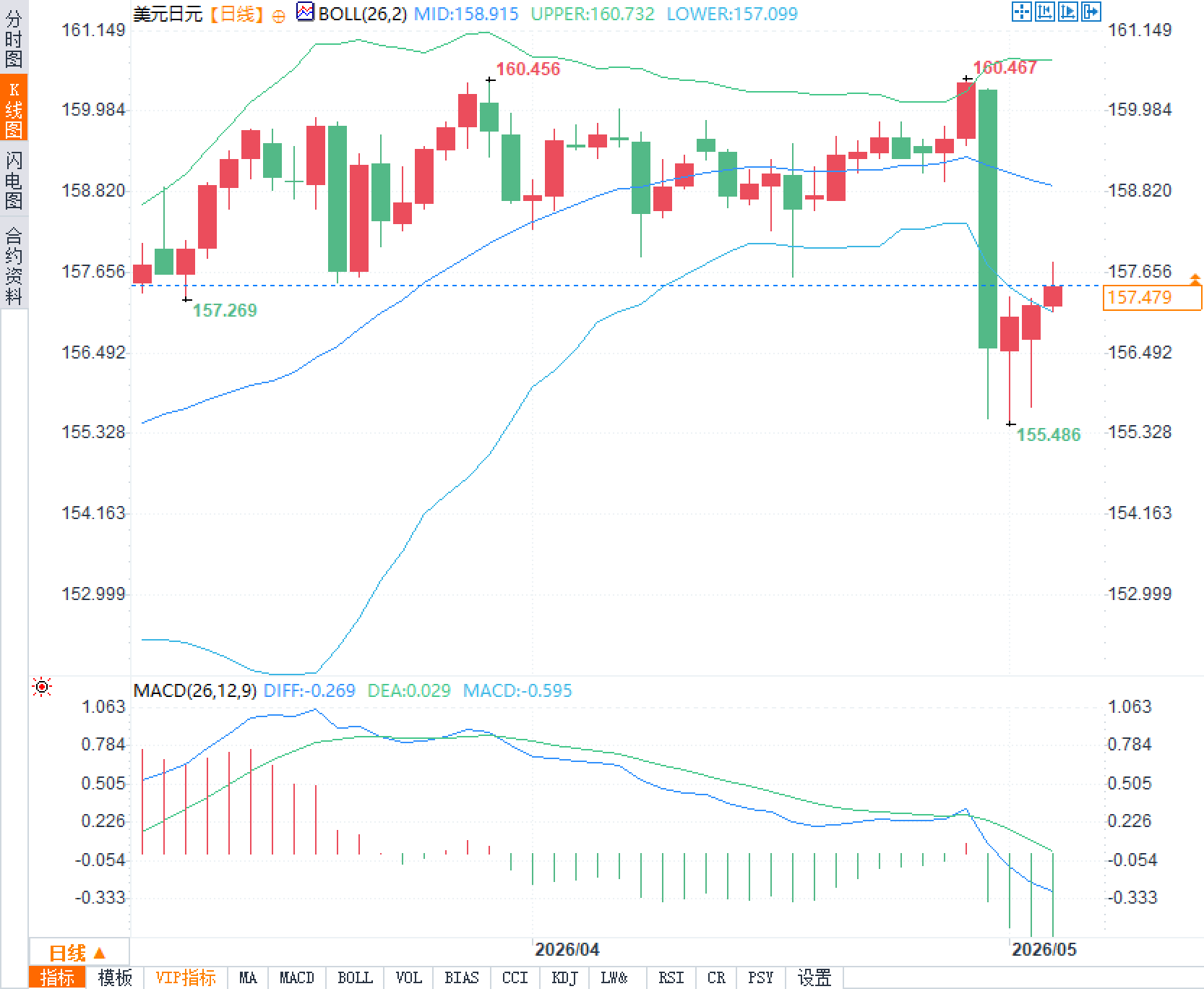
The MACD indicator (26,12,9) shows a DIFF of -0.269, a DEA of 0.029, and a MACD histogram of -0.595, with the green bars remaining below the zero line, indicating that short-term bearish momentum still dominates. Traders are watching whether the 157.50-158.00 range can be effectively broken. Once the middle band is firmly established, the next target may be around 159.00; conversely, if the 157.00 level is breached, 155.00 will become an important psychological level.
On April 30, 2026, Japanese authorities implemented their first large-scale foreign exchange intervention in nearly two years. Market estimates indicate that approximately 5.48 trillion yen, or about 35 billion US dollars, was actually injected that day, directly pushing the USD/JPY exchange rate down from around 160.50 to the 156 area.
Finance Minister Katayama repeatedly sent strong signals before and after the intervention, clearly stating that "speculative positions remain excessive, and decisive action will be taken if necessary," and requesting relevant departments to keep their mobile phones accessible during the Golden Week holiday. This statement was interpreted by the market as a "final warning," directly leading to short-term sharp rises despite thin trading volume during the holiday.
However, the intervention's effects were phased: although the exchange rate fell rapidly, signs of a rebound emerged, indicating that the market's assessment of the USD/JPY interest rate differential as the dominant trend has not fundamentally changed. Traders generally believe that single intervention is unlikely to suppress the exchange rate in the long term, and unless the Bank of Japan adjusts its policy path accordingly, the 155-160 range-bound trading pattern may continue.
The core drivers of the current USD/JPY exchange rate movement remain the dual factors of interest rate differentials and geopolitics. The ongoing conflict between the US and Iran continues to push up international oil prices. As a net energy exporter, the US benefits relatively, strengthening the dollar's safe-haven appeal. For Japan, a major energy importer, rising oil prices directly exacerbate its trade deficit pressure, further weakening the yen's fundamentals.
The yield on 30-year US Treasury bonds has held steady above 5.0%, and the US-Japan interest rate differential remains high, becoming the dominant force suppressing the long-term trend of the yen. Despite intervention by Japanese authorities, the fundamental background has not undergone a substantial reversal. Traders continue to monitor US economic data, oil price fluctuations, and the minutes of the Bank of Japan's next policy meeting; any signal of narrowing interest rate differentials could trigger a new round of directional market movements.
Recent Market Trends and Technical Indicator Analysis
The USD/JPY daily chart shows that in late April, the exchange rate encountered strong resistance near the upper Bollinger Band at 160.732, reaching a high of 160.467. Subsequent Japanese intervention triggered a single-day drop of over 3%, reaching a low of 155.486. Currently, the exchange rate has rebounded above the 157.00 level, but remains below the middle Bollinger Band at 158.915, with the lower Bollinger Band at 157.099 providing initial support.
The MACD indicator (26,12,9) shows a DIFF of -0.269, a DEA of 0.029, and a MACD histogram of -0.595, with the green bars remaining below the zero line, indicating that short-term bearish momentum still dominates. Traders are watching whether the 157.50-158.00 range can be effectively broken. Once the middle band is firmly established, the next target may be around 159.00; conversely, if the 157.00 level is breached, 155.00 will become an important psychological level.
Japanese authorities' intervention dynamics and policy signals
On April 30, 2026, Japanese authorities implemented their first large-scale foreign exchange intervention in nearly two years. Market estimates indicate that approximately 5.48 trillion yen, or about 35 billion US dollars, was actually injected that day, directly pushing the USD/JPY exchange rate down from around 160.50 to the 156 area.
Finance Minister Katayama repeatedly sent strong signals before and after the intervention, clearly stating that "speculative positions remain excessive, and decisive action will be taken if necessary," and requesting relevant departments to keep their mobile phones accessible during the Golden Week holiday. This statement was interpreted by the market as a "final warning," directly leading to short-term sharp rises despite thin trading volume during the holiday.
However, the intervention's effects were phased: although the exchange rate fell rapidly, signs of a rebound emerged, indicating that the market's assessment of the USD/JPY interest rate differential as the dominant trend has not fundamentally changed. Traders generally believe that single intervention is unlikely to suppress the exchange rate in the long term, and unless the Bank of Japan adjusts its policy path accordingly, the 155-160 range-bound trading pattern may continue.
In-depth analysis of fundamental drivers
The core drivers of the current USD/JPY exchange rate movement remain the dual factors of interest rate differentials and geopolitics. The ongoing conflict between the US and Iran continues to push up international oil prices. As a net energy exporter, the US benefits relatively, strengthening the dollar's safe-haven appeal. For Japan, a major energy importer, rising oil prices directly exacerbate its trade deficit pressure, further weakening the yen's fundamentals.
The yield on 30-year US Treasury bonds has held steady above 5.0%, and the US-Japan interest rate differential remains high, becoming the dominant force suppressing the long-term trend of the yen. Despite intervention by Japanese authorities, the fundamental background has not undergone a substantial reversal. Traders continue to monitor US economic data, oil price fluctuations, and the minutes of the Bank of Japan's next policy meeting; any signal of narrowing interest rate differentials could trigger a new round of directional market movements.
Frequently Asked Questions
Question 1: Can Japan's recent intervention completely change the long-term trend of the USD/JPY exchange rate?
A: It's difficult to fundamentally change the situation. While intervention can create short-term volatility, historical data shows that single interventions typically only maintain their effectiveness for a few weeks. Currently, the USD/JPY interest rate differential and geopolitical factors still dominate. Traders observed a rapid rebound in the exchange rate above 157 after intervention, indicating that the market's assessment of the fundamentals has not fundamentally changed. Unless the Bank of Japan substantially tightens its policy, a range-bound movement between 155 and 160 is more likely.
Question 2: What is the specific transmission path of the US-Iran conflict to the USD/JPY exchange rate?
A: The conflict primarily impacts Japan through two pathways. First, rising oil prices increase Japan's energy import costs, worsening its trade balance. Second, increased demand for the US dollar as a safe haven pushes up the dollar index. Data shows that after the conflict escalated, the USD/JPY exchange rate accelerated its rise to around 160.50. Although intervention temporarily suppressed the rise, risk aversion has not completely subsided, and traders are wary of the chain reaction caused by a second shock to oil prices.
- Risk Warning and Disclaimer
- The market involves risk, and trading may not be suitable for all investors. This article is for reference only and does not constitute personal investment advice, nor does it take into account certain users’ specific investment objectives, financial situation, or other needs. Any investment decisions made based on this information are at your own risk.