Gold Trading Alert: Middle East Ceasefire "In Name Only," Gold Prices Hold Above $4,500; Watch These Two Key Signals for Future Price Movement
2026-05-06 06:54:33
Spot gold closed at $4,557.27 per ounce on Tuesday, a 0.74% increase for the day. This rebound occurred after gold prices hit a low of $4,501, their lowest level since March 31, on Monday. Jim Wikoff, a market analyst at American Gold Exchange, pointed out that bargain hunting following the recent sell-off, coupled with a pullback in oil prices, provided support for gold prices. Wikoff's explanation reveals an important signal—there is no shortage of buyers willing to enter the market near the psychological level of $4,500. These buyers clearly believe that the current geopolitical environment and macroeconomic background are still sufficient to support gold prices at relatively high levels.
However, Vikoff also issued a cautious warning. He stated that gold bulls currently need a significant fundamental boost to truly regain confidence. The implication is that the current rebound is more technical and emotional than a trend reversal. A stronger catalyst is needed for gold prices to challenge previous highs.
To understand why gold rebounded quickly after hitting its lows, it's essential to grasp the true temperature of the situation in the Middle East. On the surface, US officials are attempting to maintain the faltering ceasefire agreement with Iran, but what's happening on the ground makes it hard to believe that peace has truly arrived.
The United Arab Emirates (UAE) suffered its second consecutive day of missile and drone attacks from Iran on Tuesday, with the country's Ministry of Defense stating that its air defense systems were responding to a new wave of attacks. The UAE Ministry of Foreign Affairs went further, characterizing the situation as a "serious escalation" and emphasizing its "right to a full and lawful retaliation." The Gulf Arab state's statement is very close to a declaration of war.
Meanwhile, the Strait of Hormuz, a narrow waterway carrying a large volume of global oil, fertilizer, and other commodity supplies, has been largely closed since the attacks began on February 28. While US Defense Secretary Peter Hegses declared that the ceasefire agreement was not over and that the US military had successfully secured passage with hundreds of merchant ships queuing to pass, the Iranian Revolutionary Guard warned ships to adhere to its designated routes or face a "decisive response." The conflicting signals from both sides in the same waters suggest that this dangerous standoff could easily escalate into a full-blown conflict.
US Secretary of State Marco Rubio characterized the US military action as "defensive," emphasizing that they would not fire unless fired upon first. US President Trump, however, used a rather dismissive analogy, claiming that the Iranian military had been reduced to firing only "toy guns." Regardless of the rhetoric, the undeniable fact is that US forces did engage in firefights with Iranian forces while escorting merchant ships through the Strait of Hormuz, and Iranian speedboats, cruise missiles, and drones were intercepted and struck.
For gold investors, this situation of "intermittent fighting, but no end in sight" is precisely the most troublesome. A completely out-of-control war would cause gold prices to skyrocket, while genuine peace would bring selling pressure. But the current ambiguous state of affairs, where the ceasefire agreement is effective on paper while the actual conflict continues, keeps the market on edge.
The relationship between oil and gold prices has never been a simple matter of moving in the same or opposite directions. This time was no exception. On Tuesday, the international crude oil market saw a drop of about 4%, with Brent crude futures closing at $109.87 per barrel and U.S. crude futures closing at $102.27 per barrel. Just the previous trading day, Brent crude prices had surged by about 6%.
Analysts at energy consultancy Ritterbusch and Associates attributed the recent drop in oil prices to optimistic comments from the Trump administration regarding a ceasefire. However, they also noted that Tuesday's weakness was more of a technical correction, as Brent crude had experienced a significant rise over the past week.
The decline in oil prices has had a dual impact on the gold market. On the one hand, the drop in oil prices has helped alleviate inflation concerns, which has somewhat diminished gold's appeal as an inflation hedge. On the other hand, as City Index market analyst Fawad Razakzada points out, the demand for inflation hedging, coupled with continued central bank buying, has so far helped limit a deeper decline in gold prices.
More concerning is that energy prices remain stubbornly high. Even with a slight pullback on Tuesday, Brent crude oil is still firmly holding above $110. If this level of oil price continues, it will inevitably transmit to the consumer end, pushing up overall inflation and thus delaying the easing cycle of central banks worldwide. Meanwhile, prolonged high interest rates are undoubtedly a negative factor for gold, which does not generate interest. This creates a delicate paradox: geopolitical risks drive up oil prices, oil prices drive up inflation, high inflation limits central banks' room for interest rate cuts, and high interest rates suppress gold prices. Gold is struggling to find a balance within this contradictory chain.
In the pricing logic of gold, the US dollar exchange rate and US Treasury yields are two key variables that cannot be ignored. On Tuesday, the US dollar index fluctuated, closing near 98.50, almost unchanged. Shaun Osborne, chief foreign exchange strategist at Scotiabank, described the current market state as "stagnant," believing that the market has not ignored the fact that Trump did not use this opportunity to launch a new round of attacks. This wait-and-see sentiment is also reflected in the gold market.
The US Treasury market sent a more complex signal. The 10-year Treasury yield fell 3 basis points to 4.416% on Tuesday, after hitting 4.464% the previous day, its highest level since March 27. The 30-year Treasury yield fell 4 basis points to 4.985% on Tuesday after breaking the 5% mark on Monday. More notably, the breakeven yield on the five-year Treasury Inflation-Protected Securities (TIPS) closed at 2.828% on Monday, the highest closing level since August 2022, implying that the market expects an average inflation rate of close to 2.8% over the next five years, significantly higher than the Federal Reserve's target.
JoAnne Bianco of BondBloxx Investment Management succinctly summarizes this: current interest rates have reached levels unforeseen before the outbreak of the US-Iran conflict at the beginning of the year. In other words, the Middle East conflict has significantly altered market expectations regarding the interest rate path. At the beginning of the year, the market had priced in a cumulative interest rate cut of approximately 50 basis points by 2026, but this expectation has now been significantly reduced.
If the situation in the Middle East is the "accelerator" affecting short-term fluctuations in gold prices, then US economic data, especially labor market data, is the "steering wheel" determining the medium-term trend of gold prices. The US jobs report to be released later this week is widely regarded by the market as a litmus test for economic resilience.
Economists expect nonfarm payrolls to increase by 62,000 in April. This number itself isn't particularly striking, but the key question is whether the market will interpret it as "strong enough to allow the Federal Reserve to keep interest rates unchanged" or "weak enough to reignite calls for rate cuts." March's job openings data already provided a vague answer—6.866 million openings, slightly higher than expected, indicating that the labor market, while cooling, remains resilient.
The U.S. Institute for Supply Management's (ISM) non-manufacturing purchasing managers' index (PMI) for April came in at 53.6, slightly below the expected 53.7, but still within expansion territory. This marks the second consecutive month that the expansionary momentum has slowed. For gold, a gradually cooling but not yet stalled economic environment may be the most perplexing—it's neither enough to prompt the Federal Reserve to rush into cutting interest rates, nor enough to make the market completely abandon its expectations for rate cuts.
It's worth noting that while gold struggled to hold the $4,500 mark, the US stock market was jubilant. The S&P 500 and Nasdaq both hit record closing highs on Tuesday, Intel surged 13% on rumors of securing an Apple order, and the Philadelphia Semiconductor Index soared 4.2% to a record high, bringing its year-to-date gain to 55%.
This stark contrast reveals an important signal regarding capital flows: in a market environment of heightened risk appetite, funds are more willing to chase growth stories in artificial intelligence and technology stocks rather than flowing into safe-haven assets like gold. Tom Hainlin, an investment strategist at Bank of America Wealth Management, stated bluntly that the market is following fundamentals, with strong earnings performance and robust corporate spending on both artificial intelligence and other productivity tools.
However, it's noteworthy that even amidst a booming stock market and heightened risk appetite, gold prices managed to hold above $4,500 and rebound back above $4,550. This in itself demonstrates the resilience of current support for gold. As Razakzada stated, although the influence of safe-haven demand has weakened, this demand still exists. Furthermore, continued buying by central banks provides a stable underlying demand for the market.
In summary, the current gold market is in a typical "balanced market" state. Looking down, the $4,500 level has proven to be strong support, with bargain hunters, central bank gold purchases, and persistent geopolitical risks all providing a floor. Looking up, the area above $4,600 faces dual resistance from high interest rate expectations and heightened risk appetite; bulls need a truly significant positive catalyst to open up new upward potential.
In the coming period, gold investors need to closely monitor two key variables. The first is the actual situation in the Strait of Hormuz. While the current ceasefire agreement is nominally effective, the ongoing attacks on the UAE and the clashes between the US and Iran mean that any miscalculation or unexpected event could lead to a sharp escalation of the conflict. If the strait is substantially blocked again, oil prices will surge once more, and gold's safe-haven appeal will be reactivated. The second variable is US employment data and the resulting expectations for Federal Reserve policy. If the job market shows unexpected weakness, expectations for interest rate cuts will rise again, giving gold a real respite; conversely, if employment data remains resilient, the high-interest-rate environment will continue to suppress gold prices.
In this market rife with uncertainty, gold is neither poised for a meteoric rise as optimists anticipate, nor has the bull market ended as pessimists fear. It's more like a cautious boxer, testing the waters between $4,500 and $4,600, awaiting the next decisive signal.
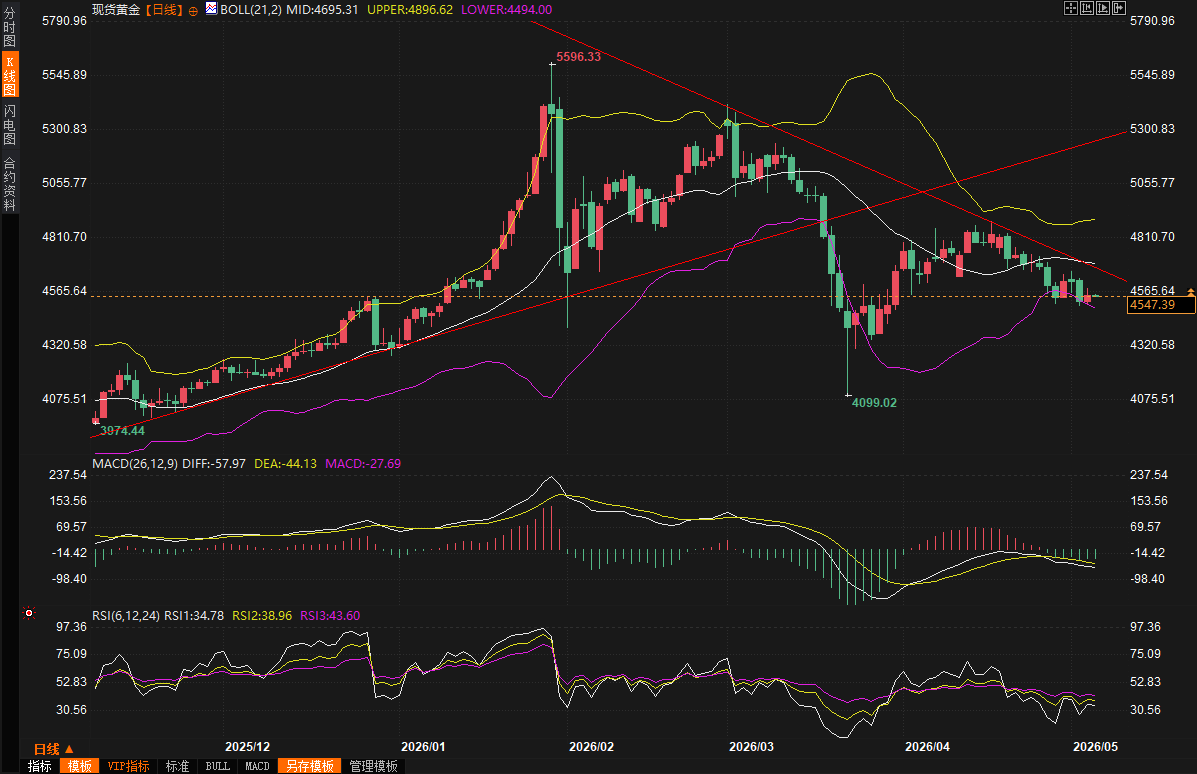
(Spot gold daily chart, source: FX678)
At 06:51 Beijing time, spot gold was trading at $4,547.51 per ounce.
However, Vikoff also issued a cautious warning. He stated that gold bulls currently need a significant fundamental boost to truly regain confidence. The implication is that the current rebound is more technical and emotional than a trend reversal. A stronger catalyst is needed for gold prices to challenge previous highs.
Gunfire in the Strait of Hormuz: Is the ceasefire agreement a mere formality?
To understand why gold rebounded quickly after hitting its lows, it's essential to grasp the true temperature of the situation in the Middle East. On the surface, US officials are attempting to maintain the faltering ceasefire agreement with Iran, but what's happening on the ground makes it hard to believe that peace has truly arrived.
The United Arab Emirates (UAE) suffered its second consecutive day of missile and drone attacks from Iran on Tuesday, with the country's Ministry of Defense stating that its air defense systems were responding to a new wave of attacks. The UAE Ministry of Foreign Affairs went further, characterizing the situation as a "serious escalation" and emphasizing its "right to a full and lawful retaliation." The Gulf Arab state's statement is very close to a declaration of war.
Meanwhile, the Strait of Hormuz, a narrow waterway carrying a large volume of global oil, fertilizer, and other commodity supplies, has been largely closed since the attacks began on February 28. While US Defense Secretary Peter Hegses declared that the ceasefire agreement was not over and that the US military had successfully secured passage with hundreds of merchant ships queuing to pass, the Iranian Revolutionary Guard warned ships to adhere to its designated routes or face a "decisive response." The conflicting signals from both sides in the same waters suggest that this dangerous standoff could easily escalate into a full-blown conflict.
US Secretary of State Marco Rubio characterized the US military action as "defensive," emphasizing that they would not fire unless fired upon first. US President Trump, however, used a rather dismissive analogy, claiming that the Iranian military had been reduced to firing only "toy guns." Regardless of the rhetoric, the undeniable fact is that US forces did engage in firefights with Iranian forces while escorting merchant ships through the Strait of Hormuz, and Iranian speedboats, cruise missiles, and drones were intercepted and struck.
For gold investors, this situation of "intermittent fighting, but no end in sight" is precisely the most troublesome. A completely out-of-control war would cause gold prices to skyrocket, while genuine peace would bring selling pressure. But the current ambiguous state of affairs, where the ceasefire agreement is effective on paper while the actual conflict continues, keeps the market on edge.
The bizarre trajectory of oil prices: from a surge to a plunge, inflation expectations are fluctuating.
The relationship between oil and gold prices has never been a simple matter of moving in the same or opposite directions. This time was no exception. On Tuesday, the international crude oil market saw a drop of about 4%, with Brent crude futures closing at $109.87 per barrel and U.S. crude futures closing at $102.27 per barrel. Just the previous trading day, Brent crude prices had surged by about 6%.
Analysts at energy consultancy Ritterbusch and Associates attributed the recent drop in oil prices to optimistic comments from the Trump administration regarding a ceasefire. However, they also noted that Tuesday's weakness was more of a technical correction, as Brent crude had experienced a significant rise over the past week.
The decline in oil prices has had a dual impact on the gold market. On the one hand, the drop in oil prices has helped alleviate inflation concerns, which has somewhat diminished gold's appeal as an inflation hedge. On the other hand, as City Index market analyst Fawad Razakzada points out, the demand for inflation hedging, coupled with continued central bank buying, has so far helped limit a deeper decline in gold prices.
More concerning is that energy prices remain stubbornly high. Even with a slight pullback on Tuesday, Brent crude oil is still firmly holding above $110. If this level of oil price continues, it will inevitably transmit to the consumer end, pushing up overall inflation and thus delaying the easing cycle of central banks worldwide. Meanwhile, prolonged high interest rates are undoubtedly a negative factor for gold, which does not generate interest. This creates a delicate paradox: geopolitical risks drive up oil prices, oil prices drive up inflation, high inflation limits central banks' room for interest rate cuts, and high interest rates suppress gold prices. Gold is struggling to find a balance within this contradictory chain.
Subtle Signals from the US Dollar and US Treasuries: Interest Rate Cut Expectations Are Being Repriced
In the pricing logic of gold, the US dollar exchange rate and US Treasury yields are two key variables that cannot be ignored. On Tuesday, the US dollar index fluctuated, closing near 98.50, almost unchanged. Shaun Osborne, chief foreign exchange strategist at Scotiabank, described the current market state as "stagnant," believing that the market has not ignored the fact that Trump did not use this opportunity to launch a new round of attacks. This wait-and-see sentiment is also reflected in the gold market.
The US Treasury market sent a more complex signal. The 10-year Treasury yield fell 3 basis points to 4.416% on Tuesday, after hitting 4.464% the previous day, its highest level since March 27. The 30-year Treasury yield fell 4 basis points to 4.985% on Tuesday after breaking the 5% mark on Monday. More notably, the breakeven yield on the five-year Treasury Inflation-Protected Securities (TIPS) closed at 2.828% on Monday, the highest closing level since August 2022, implying that the market expects an average inflation rate of close to 2.8% over the next five years, significantly higher than the Federal Reserve's target.
JoAnne Bianco of BondBloxx Investment Management succinctly summarizes this: current interest rates have reached levels unforeseen before the outbreak of the US-Iran conflict at the beginning of the year. In other words, the Middle East conflict has significantly altered market expectations regarding the interest rate path. At the beginning of the year, the market had priced in a cumulative interest rate cut of approximately 50 basis points by 2026, but this expectation has now been significantly reduced.
US jobs report coming soon: the next key catalyst for gold.
If the situation in the Middle East is the "accelerator" affecting short-term fluctuations in gold prices, then US economic data, especially labor market data, is the "steering wheel" determining the medium-term trend of gold prices. The US jobs report to be released later this week is widely regarded by the market as a litmus test for economic resilience.
Economists expect nonfarm payrolls to increase by 62,000 in April. This number itself isn't particularly striking, but the key question is whether the market will interpret it as "strong enough to allow the Federal Reserve to keep interest rates unchanged" or "weak enough to reignite calls for rate cuts." March's job openings data already provided a vague answer—6.866 million openings, slightly higher than expected, indicating that the labor market, while cooling, remains resilient.
The U.S. Institute for Supply Management's (ISM) non-manufacturing purchasing managers' index (PMI) for April came in at 53.6, slightly below the expected 53.7, but still within expansion territory. This marks the second consecutive month that the expansionary momentum has slowed. For gold, a gradually cooling but not yet stalled economic environment may be the most perplexing—it's neither enough to prompt the Federal Reserve to rush into cutting interest rates, nor enough to make the market completely abandon its expectations for rate cuts.
The Stock Market Frenzy and the Gold Market Decline: The Hidden Battlefield of Capital Flows
It's worth noting that while gold struggled to hold the $4,500 mark, the US stock market was jubilant. The S&P 500 and Nasdaq both hit record closing highs on Tuesday, Intel surged 13% on rumors of securing an Apple order, and the Philadelphia Semiconductor Index soared 4.2% to a record high, bringing its year-to-date gain to 55%.
This stark contrast reveals an important signal regarding capital flows: in a market environment of heightened risk appetite, funds are more willing to chase growth stories in artificial intelligence and technology stocks rather than flowing into safe-haven assets like gold. Tom Hainlin, an investment strategist at Bank of America Wealth Management, stated bluntly that the market is following fundamentals, with strong earnings performance and robust corporate spending on both artificial intelligence and other productivity tools.
However, it's noteworthy that even amidst a booming stock market and heightened risk appetite, gold prices managed to hold above $4,500 and rebound back above $4,550. This in itself demonstrates the resilience of current support for gold. As Razakzada stated, although the influence of safe-haven demand has weakened, this demand still exists. Furthermore, continued buying by central banks provides a stable underlying demand for the market.
Conclusion: Two major variables will determine the future direction of the market.
In summary, the current gold market is in a typical "balanced market" state. Looking down, the $4,500 level has proven to be strong support, with bargain hunters, central bank gold purchases, and persistent geopolitical risks all providing a floor. Looking up, the area above $4,600 faces dual resistance from high interest rate expectations and heightened risk appetite; bulls need a truly significant positive catalyst to open up new upward potential.
In the coming period, gold investors need to closely monitor two key variables. The first is the actual situation in the Strait of Hormuz. While the current ceasefire agreement is nominally effective, the ongoing attacks on the UAE and the clashes between the US and Iran mean that any miscalculation or unexpected event could lead to a sharp escalation of the conflict. If the strait is substantially blocked again, oil prices will surge once more, and gold's safe-haven appeal will be reactivated. The second variable is US employment data and the resulting expectations for Federal Reserve policy. If the job market shows unexpected weakness, expectations for interest rate cuts will rise again, giving gold a real respite; conversely, if employment data remains resilient, the high-interest-rate environment will continue to suppress gold prices.
In this market rife with uncertainty, gold is neither poised for a meteoric rise as optimists anticipate, nor has the bull market ended as pessimists fear. It's more like a cautious boxer, testing the waters between $4,500 and $4,600, awaiting the next decisive signal.
(Spot gold daily chart, source: FX678)
At 06:51 Beijing time, spot gold was trading at $4,547.51 per ounce.
- Risk Warning and Disclaimer
- The market involves risk, and trading may not be suitable for all investors. This article is for reference only and does not constitute personal investment advice, nor does it take into account certain users’ specific investment objectives, financial situation, or other needs. Any investment decisions made based on this information are at your own risk.