Crude oil trading alert: Easing geopolitical tensions coupled with a significant drop in inventories caused WTI crude oil prices to rise and then fall, continuing their correction.
2026-05-06 09:53:41
On Wednesday during Asian trading hours, US WTI crude oil prices fell back to around $100.50, ending the previous rally driven by geopolitical conflicts. Market risk sentiment saw a significant correction, primarily due to signs of easing tensions in the Middle East. The US announced a temporary suspension of military operations related to the restoration of key shipping lanes to monitor progress in negotiations, a statement that significantly reduced market concerns about disruptions to oil supply.

The U.S. Department of Defense stated that the ceasefire remains largely stable. The U.S. Department of Foreign Affairs indicated that the objectives of the relevant military operations have been achieved and the offensive phase of the conflict has ended.
As tensions eased, the geopolitical risk premium previously priced into oil prices was reversed, prompting short-term profit-taking and pushing oil prices down. However, at a deeper level, the supply-side fundamentals have not improved significantly; in fact, they have continued to tighten.
According to the latest data, U.S. crude oil inventories have declined for the third consecutive week. In the week ending early May, inventories fell by approximately 8.1 million barrels, far exceeding the previous week's decrease of about 1.79 million barrels and significantly surpassing market expectations of a decline of about 2.8 million barrels. This much larger-than-expected inventory drop reflects the continued resilience of current demand, while the pace of supply replenishment remains relatively slow.
The continuous decline in inventories indicates that the market's buffer is shrinking. Oil prices will be more vulnerable to shocks should new supply disruptions occur in the future. Furthermore, market surveys show that global crude oil inventory levels are near their lowest levels in the past eight years, a trend that further reinforces expectations of tight supply.
Globally, the energy market is facing a confluence of multiple variables. On the one hand, the easing of geopolitical risks is putting short-term downward pressure on oil prices; on the other hand, declining inventories, limited production capacity release, and transportation bottlenecks are still supporting prices in the medium to long term. In particular, the stability of key energy corridors remains uncertain, and market sentiment has not fully turned optimistic.
From a market sentiment perspective, the current trading logic has shifted from "pricing extreme risks" to "fundamental repricing." Investors are beginning to reassess the supply and demand structure, rather than solely relying on geopolitical events. Short-term volatility has intensified, but the medium- to long-term trend still depends on inventory changes and the pace of supply recovery.
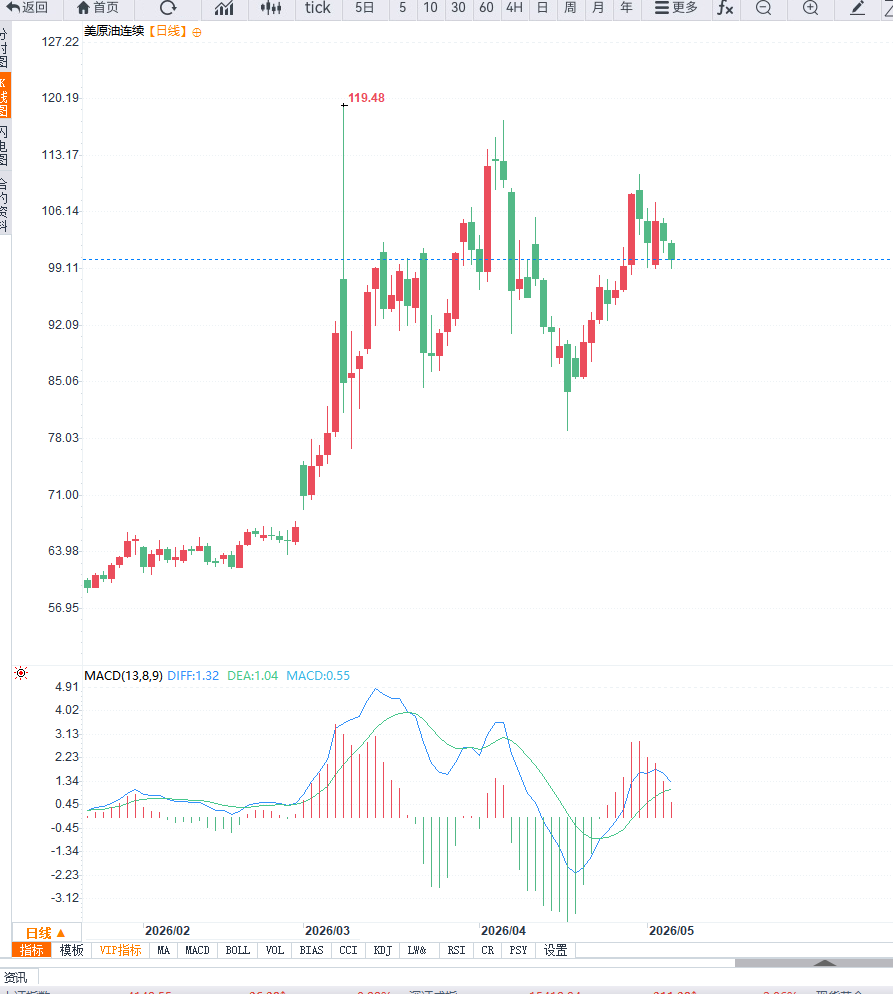
From a technical perspective, WTI crude oil remains within a medium-term upward channel on the daily chart, but momentum has weakened. The current price is fluctuating around $100, with short-term resistance levels at $102 and $105, and support levels concentrated between $95 and $92. A break below $95 could trigger a further technical correction, but the overall structure has not yet turned bearish. Momentum indicators suggest that upward momentum has slowed, but no clear trend reversal signals have yet appeared.
On the 4-hour chart, oil prices are showing a high-level consolidation and pullback pattern, with short-term moving averages beginning to flatten, indicating a near balance between bullish and bearish forces. The MACD indicator has formed a slight death cross, suggesting short-term downward pressure, but if prices can stabilize above $100, there is still a possibility of retesting the $105 level. Overall, the short-term outlook is biased towards consolidation, while the medium-term bias remains bullish.
Editor's Summary:
In summary, the current decline in oil prices is more of a correction in sentiment due to easing geopolitical risks than a weakening of fundamentals. Continued inventory declines and tight global supply remain key supporting factors for oil prices. Future market trends will depend on two core variables: whether the situation in the Middle East truly stabilizes, and whether the inventory decline trend continues. If inventories continue to decline rapidly, oil prices still have room to rise; conversely, if supply gradually recovers, oil prices may enter a period of high-level fluctuation. Overall, the market is in a complex pattern of "short-term pressure and medium-term strength," and volatility is expected to remain high.
The U.S. Department of Defense stated that the ceasefire remains largely stable. The U.S. Department of Foreign Affairs indicated that the objectives of the relevant military operations have been achieved and the offensive phase of the conflict has ended.
As tensions eased, the geopolitical risk premium previously priced into oil prices was reversed, prompting short-term profit-taking and pushing oil prices down. However, at a deeper level, the supply-side fundamentals have not improved significantly; in fact, they have continued to tighten.
According to the latest data, U.S. crude oil inventories have declined for the third consecutive week. In the week ending early May, inventories fell by approximately 8.1 million barrels, far exceeding the previous week's decrease of about 1.79 million barrels and significantly surpassing market expectations of a decline of about 2.8 million barrels. This much larger-than-expected inventory drop reflects the continued resilience of current demand, while the pace of supply replenishment remains relatively slow.
The continuous decline in inventories indicates that the market's buffer is shrinking. Oil prices will be more vulnerable to shocks should new supply disruptions occur in the future. Furthermore, market surveys show that global crude oil inventory levels are near their lowest levels in the past eight years, a trend that further reinforces expectations of tight supply.
Globally, the energy market is facing a confluence of multiple variables. On the one hand, the easing of geopolitical risks is putting short-term downward pressure on oil prices; on the other hand, declining inventories, limited production capacity release, and transportation bottlenecks are still supporting prices in the medium to long term. In particular, the stability of key energy corridors remains uncertain, and market sentiment has not fully turned optimistic.
From a market sentiment perspective, the current trading logic has shifted from "pricing extreme risks" to "fundamental repricing." Investors are beginning to reassess the supply and demand structure, rather than solely relying on geopolitical events. Short-term volatility has intensified, but the medium- to long-term trend still depends on inventory changes and the pace of supply recovery.
From a technical perspective, WTI crude oil remains within a medium-term upward channel on the daily chart, but momentum has weakened. The current price is fluctuating around $100, with short-term resistance levels at $102 and $105, and support levels concentrated between $95 and $92. A break below $95 could trigger a further technical correction, but the overall structure has not yet turned bearish. Momentum indicators suggest that upward momentum has slowed, but no clear trend reversal signals have yet appeared.
On the 4-hour chart, oil prices are showing a high-level consolidation and pullback pattern, with short-term moving averages beginning to flatten, indicating a near balance between bullish and bearish forces. The MACD indicator has formed a slight death cross, suggesting short-term downward pressure, but if prices can stabilize above $100, there is still a possibility of retesting the $105 level. Overall, the short-term outlook is biased towards consolidation, while the medium-term bias remains bullish.
Editor's Summary:
In summary, the current decline in oil prices is more of a correction in sentiment due to easing geopolitical risks than a weakening of fundamentals. Continued inventory declines and tight global supply remain key supporting factors for oil prices. Future market trends will depend on two core variables: whether the situation in the Middle East truly stabilizes, and whether the inventory decline trend continues. If inventories continue to decline rapidly, oil prices still have room to rise; conversely, if supply gradually recovers, oil prices may enter a period of high-level fluctuation. Overall, the market is in a complex pattern of "short-term pressure and medium-term strength," and volatility is expected to remain high.
- Risk Warning and Disclaimer
- The market involves risk, and trading may not be suitable for all investors. This article is for reference only and does not constitute personal investment advice, nor does it take into account certain users’ specific investment objectives, financial situation, or other needs. Any investment decisions made based on this information are at your own risk.