The Australian dollar rose, driven by hawkish expectations from the Reserve Bank of Australia and a weaker US dollar, with AUD/USD reaching near a three-year high.
2026-05-07 15:34:11
The Australian dollar (AUD/USD) attracted bargain hunters in early Asian trading on Thursday, stabilizing after falling from around 0.7275 in the previous session and currently trading around 0.7250, marking its third consecutive day of gains. The recent strength of the Australian dollar is mainly driven by expectations of a hawkish policy stance from the Reserve Bank of Australia (RBA) and the continued weakening of the US dollar index.

Despite mixed results in Australian trade data for March, the market still believes that the Reserve Bank of Australia is likely to maintain a hawkish stance in the short term, which continues to support the Australian dollar.
Meanwhile, market optimism regarding a potential agreement between the US and Iran has weakened demand for the US dollar as a safe haven. Furthermore, market bets on further rate hikes by the Federal Reserve in 2026 have cooled significantly, limiting the dollar's upside potential. Overall pressure on the US dollar and hawkish expectations from the Reserve Bank of Australia have been the core drivers of the recent rise in the Australian dollar.
Risk sentiment in international markets has improved significantly recently. With markets believing that the situation in the Middle East may ease, global risk appetite has rebounded, which typically benefits risk-sensitive currencies such as the Australian dollar. The United States and Iran are discussing an agreement that could end the conflict, including the gradual restoration of shipping through the Strait of Hormuz and the easing of some sanctions.
The market believes that once the situation in the Middle East eases, global energy supply risks may decrease, thereby alleviating market concerns about renewed inflation and further weakening safe-haven buying of the US dollar. However, the market remains cautious about whether a final agreement can be reached. Due to the significant differences that still exist on the Iranian nuclear issue, investor sentiment remains largely cautious.
On the other hand, the Australian domestic economy remains relatively robust overall. Despite fluctuations in some trade data, the Australian job market and inflation data have remained resilient, strengthening market expectations that the Reserve Bank of Australia (RBA) will continue to maintain high interest rates. The market currently widely expects the RBA to maintain a relatively tight policy stance in the short term.
The market focus has gradually shifted to US non-farm payroll data. Strong US employment data could drive a short-term rebound in the US dollar and limit further gains in the Australian dollar. However, weak US economic data could further strengthen market bets on future interest rate cuts by the Federal Reserve, thus pushing the Australian dollar higher against the US dollar.
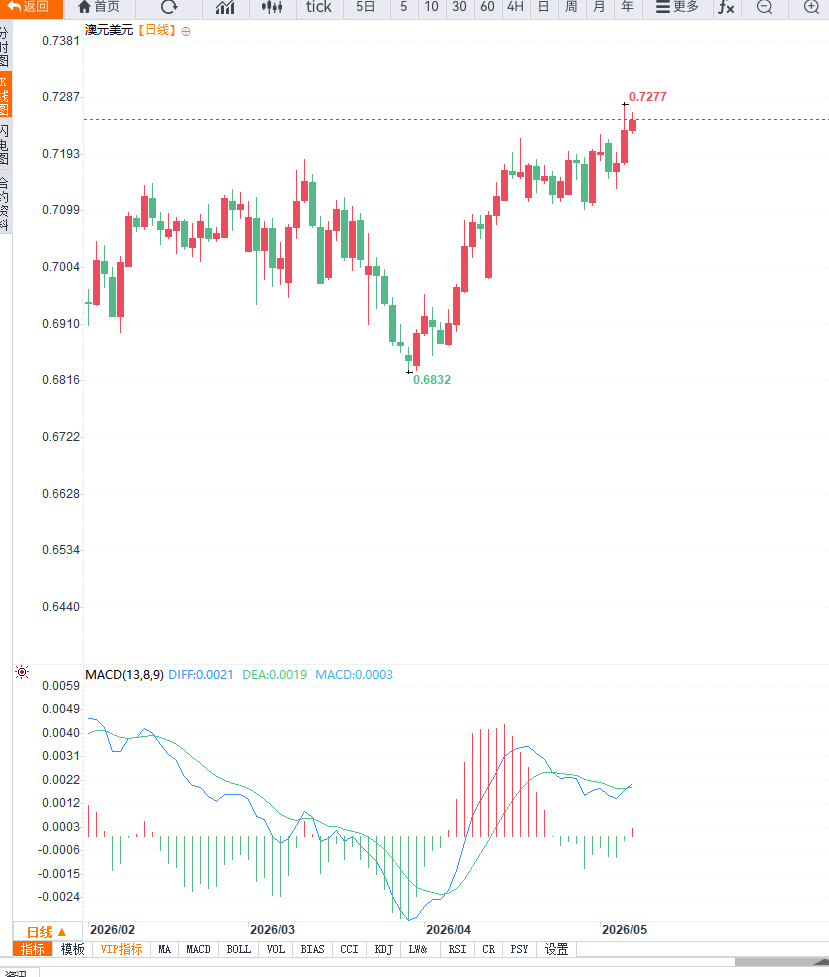
From a technical perspective, the daily chart for the Australian dollar against the US dollar shows that the exchange rate has recently broken through the key psychological level of 0.7200 and reached its highest level since June 2022, significantly strengthening its overall medium- to long-term upward structure. Currently, the exchange rate continues to trade above its medium- to long-term moving averages, indicating that the overall bullish trend remains intact. The 0.7275 to 0.7300 area has formed a significant resistance zone on the current daily chart. A successful break above the 0.7300 level could open up further upside potential for the Australian dollar against the US dollar, potentially testing the 0.7350 and even 0.7400 areas.
Looking at the downside, 0.7200 has formed the first important support area. A break below this level could lead to a further pullback to the support around 0.7158, which also coincides with the 4-hour 100-period exponential moving average (EMA). The daily MACD indicator is currently holding above the zero line, with the red histogram continuing to expand, indicating that the medium-term uptrend remains dominant. The RSI indicator remains around 64, suggesting strong bullish momentum, but it has not yet entered a clearly overbought zone. Overall, from a technical perspective, the medium-to-long-term trend for the AUD/USD pair has clearly shifted to a bullish structure. The daily chart shows a continued strengthening of the uptrend, while the 4-hour chart reflects that the bulls still hold the initiative in the short term.
Editor's Summary : The current Australian dollar's movement against the US dollar is primarily driven by both "hawkish expectations from the Reserve Bank of Australia" and "overall weakening of the US dollar." In the short term, improved market risk appetite due to easing tensions in the Middle East, coupled with a cooling of expectations for further interest rate hikes by the Federal Reserve, continues to support the Australian dollar. From a technical perspective, the medium- to long-term upward trend of the Australian dollar against the US dollar has clearly strengthened, but market volatility may intensify as it approaches a key resistance area in the short term. Going forward, investors should pay close attention to US non-farm payroll data, changes in the US dollar index, and subsequent policy signals from the Reserve Bank of Australia.
Despite mixed results in Australian trade data for March, the market still believes that the Reserve Bank of Australia is likely to maintain a hawkish stance in the short term, which continues to support the Australian dollar.
Meanwhile, market optimism regarding a potential agreement between the US and Iran has weakened demand for the US dollar as a safe haven. Furthermore, market bets on further rate hikes by the Federal Reserve in 2026 have cooled significantly, limiting the dollar's upside potential. Overall pressure on the US dollar and hawkish expectations from the Reserve Bank of Australia have been the core drivers of the recent rise in the Australian dollar.
Risk sentiment in international markets has improved significantly recently. With markets believing that the situation in the Middle East may ease, global risk appetite has rebounded, which typically benefits risk-sensitive currencies such as the Australian dollar. The United States and Iran are discussing an agreement that could end the conflict, including the gradual restoration of shipping through the Strait of Hormuz and the easing of some sanctions.
The market believes that once the situation in the Middle East eases, global energy supply risks may decrease, thereby alleviating market concerns about renewed inflation and further weakening safe-haven buying of the US dollar. However, the market remains cautious about whether a final agreement can be reached. Due to the significant differences that still exist on the Iranian nuclear issue, investor sentiment remains largely cautious.
On the other hand, the Australian domestic economy remains relatively robust overall. Despite fluctuations in some trade data, the Australian job market and inflation data have remained resilient, strengthening market expectations that the Reserve Bank of Australia (RBA) will continue to maintain high interest rates. The market currently widely expects the RBA to maintain a relatively tight policy stance in the short term.
The market focus has gradually shifted to US non-farm payroll data. Strong US employment data could drive a short-term rebound in the US dollar and limit further gains in the Australian dollar. However, weak US economic data could further strengthen market bets on future interest rate cuts by the Federal Reserve, thus pushing the Australian dollar higher against the US dollar.
From a technical perspective, the daily chart for the Australian dollar against the US dollar shows that the exchange rate has recently broken through the key psychological level of 0.7200 and reached its highest level since June 2022, significantly strengthening its overall medium- to long-term upward structure. Currently, the exchange rate continues to trade above its medium- to long-term moving averages, indicating that the overall bullish trend remains intact. The 0.7275 to 0.7300 area has formed a significant resistance zone on the current daily chart. A successful break above the 0.7300 level could open up further upside potential for the Australian dollar against the US dollar, potentially testing the 0.7350 and even 0.7400 areas.
Looking at the downside, 0.7200 has formed the first important support area. A break below this level could lead to a further pullback to the support around 0.7158, which also coincides with the 4-hour 100-period exponential moving average (EMA). The daily MACD indicator is currently holding above the zero line, with the red histogram continuing to expand, indicating that the medium-term uptrend remains dominant. The RSI indicator remains around 64, suggesting strong bullish momentum, but it has not yet entered a clearly overbought zone. Overall, from a technical perspective, the medium-to-long-term trend for the AUD/USD pair has clearly shifted to a bullish structure. The daily chart shows a continued strengthening of the uptrend, while the 4-hour chart reflects that the bulls still hold the initiative in the short term.
Editor's Summary : The current Australian dollar's movement against the US dollar is primarily driven by both "hawkish expectations from the Reserve Bank of Australia" and "overall weakening of the US dollar." In the short term, improved market risk appetite due to easing tensions in the Middle East, coupled with a cooling of expectations for further interest rate hikes by the Federal Reserve, continues to support the Australian dollar. From a technical perspective, the medium- to long-term upward trend of the Australian dollar against the US dollar has clearly strengthened, but market volatility may intensify as it approaches a key resistance area in the short term. Going forward, investors should pay close attention to US non-farm payroll data, changes in the US dollar index, and subsequent policy signals from the Reserve Bank of Australia.
- Risk Warning and Disclaimer
- The market involves risk, and trading may not be suitable for all investors. This article is for reference only and does not constitute personal investment advice, nor does it take into account certain users’ specific investment objectives, financial situation, or other needs. Any investment decisions made based on this information are at your own risk.